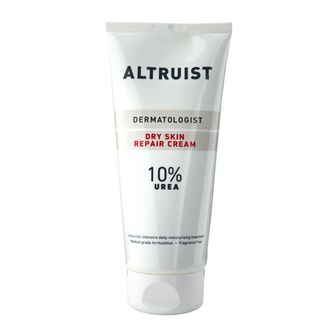
Altruist Dry Skin Repair Cream
Works for
1 of 1 advertised claim delivered
MoisturizingUrea, Cetyl dimethicone + 8 moreStrong evidence
“A carefully balanced, protective cream that helps strengthen the skin, restore the body’s natural barrier function and prevent moisture loss.”
This product can help improve hydration of the skin with the two types of ingredients.
The first type is called “humectants”:
these ingredients help attract water.
When humectants are on the surface of the skin, they “pull in” the moisture from the outside environment, or from
within deeper layers of the skin. The following ingredients in this product do the job:
glycerin, propylene glycol.
This product also contains ingredients called “occlusives”. They help reduce the speed with which our skin loses moisture to the outside environment. These ingredients also help soften the upper layer of the skin, so it feels less tight and nicer to the touch. The following ingredients in this product do the job: dimethicone, cetyl dimethicone.
The following ingredients in this product are especially good for supporting the skin barrier and helping with the hydration level: urea
Can it cause trouble?
Irritancy5 flagged ingredientsLow risk
Comedogenic1 ingredient rated 2 or more on the 0–5 pore-clogging scale1 flagged
User reviews
Be the first — your take helps the next person decide.
Ingredients
Filter by role to see what each ingredient is doing.
Water~40–60%
Urea~8.4–12.6%
- Irritation risk
- Low
Naturally present in skin (urea makes up about 7% of natural moisturizing factors in skin). Attracts water to the upper layer of the skin. Also has a positive effect on the skin barrier beyond the humectant action. Can enhance penetration of other ingredients. Is an exfoliating ingredient when used in high concentrations
More about UreaGlycerin~3.8–5.7%
- Irritation risk
- Low
One of the best moisturizing ingredients. Naturally present in skin. It attracts water to the upper layer of the skin working as a humectant
More about GlycerinGlyceryl stearate~2.6–4%
- Irritation risk
- Low
An emollient that softens the skin and forms a protective layer on its surface. Helps water and oil mix together
More about Glyceryl stearateCetearyl alcohol~2.1–3.2%
- Irritation risk
- Low
- Comedogenicity
- 2/5
A non-drying alcohol. Works as an emollient. Helps water and oil mix together and creates a nice product texture
More about Cetearyl alcoholDicaprylyl ether~1.8–2.7%
- Irritation risk
- Low
Helps soften the upper layer of the skin while creating a non-greasy feel on the skin. Helps to dissolve other ingredients
More about Dicaprylyl etherEthylhexyl stearate~1.5–2.2%
- Irritation risk
- Low
Helps soften the upper layer of the skin
More about Ethylhexyl stearateDimethicone~1.3–2%
- Irritation risk
- Low
A silicone that helps to reduce water loss from the surface of the skin. Can temporarily "fill in" lines and wrinkles, absorb oil, and create a nice product finish
More about DimethiconeSodium stearoyl glutamate~1.1–1.7%
- Irritation risk
- Medium
Helps oil and water mix together
More about Sodium stearoyl glutamatePotassium lactate~0.85–1.3%
- Irritation risk
- Low
Titanium dioxide~0.85–1.25%
- Irritation risk
- Low
Works as a UV filter when used in high concentrations. It is photostable and is effective mostly against the UVB light, with some protection in the UVA range. In small concentrations, used for its ability to improve the color of cosmetic products. Is usually well tolerated by the skin
More about Titanium dioxideLactic acid~0.4–1%
- Irritation risk
- Medium
An exfoliating and moisturizing alpha-hydroxy acid (AHA). Typically causes less irritation than other AHAs, for example, glycolic acid. At high concentrations (about 15%), lactic acid can help reduce lines and wrinkles. Recent studies show that lactic acid can support the "good" bacteria living on skin's surface (healthy skin microbiome)
More about Lactic acidCetyl dimethicone~0.35–0.85%
- Irritation risk
- Low
A type of silicone. Helps soften the upper layer of the skin and creates a nice, light product texture
More about Cetyl dimethiconePiroctone olamine~0.15–0.6%
Bisabolol~0.1–0.35%
- Irritation risk
- Low
An active component of chamomile plant that historically has been used to calm down irritated skin. A recent study shows that bisabolol indeed can have some anti-inflammatory effect on skin, even though conclusive data is lacking. Bisabolol has a sweet floral scent and can be added to products for its aromatic properties
More about BisabololDiethylhexyl sodium sulfosuccinate~0.1–0.5%
Silver chloride~0.005–0.01%
Propylene glycol~0.05–0.2%
- Irritation risk
- High
Helps oil and water mix together and can enhance the penetration of other ingredients into the skin. It can be irritating
More about Propylene glycolIngredient list view
Water, Urea, Glycerin, Glyceryl stearate, Cetearyl alcohol, Dicaprylyl ether, Ethylhexyl stearate, Dimethicone, Sodium stearoyl glutamate, Potassium lactate, Titanium dioxide, Lactic acid, Cetyl dimethicone, Piroctone olamine, Bisabolol, Diethylhexyl sodium sulfosuccinate, Silver chloride, Propylene glycol
Compare prices
Retailers ranked by price — lowest first.
Affiliate links · prices updated regularly · As an Amazon Associate, WIMJ earns from qualifying purchases.
Sources cited in this review
Every concentration estimate and effectiveness label is anchored to one of these 10 studies and safety reviews.
- 1Topical urea in skincare: A reviewpubmed.ncbi.nlm.nih.gov
- 2
- 3
- 4Final Report on the Safety Assessment of Dimethicone Copolyoljournals.sagepub.com
- 5Epidermal and dermal effects of topical lactic acidncbi.nlm.nih.gov
- 6Dual Effects of Alpha-Hydroxy Acids on the Skinpdfs.semanticscholar.org

Affiliate links · As an Amazon Associate, WIMJ earns from qualifying purchases.