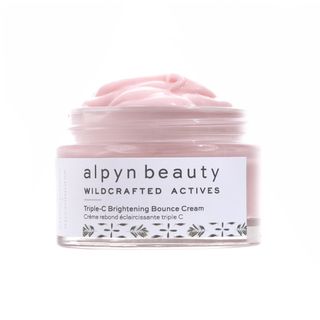
Alpyn Beauty Triple C Brightening Bounce Cream
Works for
3 of 3 advertised claims delivered
Evens skin tone5 ingredients credited for this claimModerate support
“Alpyn Beauty Triple Vitamin-C Brightening Bounce Cream contains three forms of clinically proven vitamin C and the polyphenol power of wild chokecherry to deliver visible brightening and skin-smoothing benefits.”
The following ingredient (ingredients) in this product might be helpful, but there is no evidence to confirm that it actually works: ascorbyl glucoside, glycyrrhiza glabra root extract.
Moisturizing18 ingredients credited for this claimGood support
“This hydrating, cream based night treatment is where wildcrafted meets clinical and will leave skin bright and hydrated.”
This product can help improve hydration of the skin with the two types of ingredients.
The first type is called “humectants”:
these ingredients help attract water.
When humectants are on the surface of the skin, they “pull in” the moisture from the outside environment, or from
within deeper layers of the skin. The following ingredients in this product do the job:
glycerin, sodium hyaluronate.
This product also contains ingredients called “occlusives”. They help reduce the speed with which our skin loses moisture to the outside environment. These ingredients also help soften the upper layer of the skin, so it feels less tight and nicer to the touch. The following ingredients in this product do the job: butyrospermum parkii butter, helianthus annuus seed oil.
Anti-aging7 ingredients credited for this claimModerate support
“Alpyn Beauty Triple Vitamin-C Brightening Bounce Cream contains three forms of clinically proven vitamin C and the polyphenol power of wild chokecherry to deliver visible brightening and skin-smoothing benefits.”
This product contains ascorbyl glucoside. This ingredient might be able to help reduce and prevent fine lines and wrinkles, improve skin elasticity and firmness, but there is not enough evidence that it actually works.
Anti-oxidationNot advertised by the brand · 14 ingredients credited for this claimModerate support
This product contains antioxidants (ascorbyl glucoside) that might be able to help neutralize free radicals in skin to lessen the damage it gets from the UV light (sun). There is not enough evidence to confirm their effectiveness in skin though.
Can it cause trouble?
Irritancy13 strong irritants: Citrus aurantium dulcis peel extract, Rosa damascena flower extract + 11 more — patch-test recommendedHigh risk
Comedogenic3 ingredients rated 2 or more on the 0–5 pore-clogging scale3 flagged


User reviews
Be the first — your take helps the next person decide.
Ingredients
Filter by role to see what each ingredient is doing.
Aloe barbadensis leaf juice~23–34%
- Irritation risk
- Medium
Traditionally used to treat sunburns, dermatitis and inflammation, but evidence for its effectiveness is lacking. The extract can contain humectants that help attract water into the skin
More about Aloe barbadensis leaf juiceGlycerin~3.5–5.3%
- Irritation risk
- Low
One of the best moisturizing ingredients. Naturally present in skin. It attracts water to the upper layer of the skin working as a humectant
More about GlycerinButyrospermum parkii butter~4.7–7.1%
- Irritation risk
- Low
- Comedogenicity
- 3/5
A great moisturising ingredient that softens the skin and reduces water loss from its upper layer. It also can be helpful in protecting skin from free radicals
More about Butyrospermum parkii butterHelianthus annuus seed oil~4–6%
- Irritation risk
- Low
A great emollient due to its high linoleic acid content. One of the most effective plant oils in helping skin hydration and repairing skin barrier function
More about Helianthus annuus seed oilHydrogenated ethylhexyl olivate~3–4.4%
- Irritation risk
- Low
Helps soften the upper layer of the skin
More about Hydrogenated ethylhexyl olivateAscorbic acid~2–3%
- Irritation risk
- High
The most well-researched antioxidant that works in skin. Helps neutralize free radicals supporting collagen production, helping to even out the skin tone and preventing early signs of aging
More about Ascorbic acidMagnesium ascorbyl phosphate~1.5–2.3%
- Irritation risk
- Medium
A derivative of vitamin C that is more stable, but less bioavailable than the pure form of vitamin C. It does not penetrate the skin well, but has been shown to convert to pure vitamin C once in skin. It can be helpful in stimulating collagen production and lightening the skin tone, but the required concentration is likely to be very high
More about Magnesium ascorbyl phosphateAscorbyl glucoside~1.4–2%
- Irritation risk
- Medium
A vitamin C derivative that is more stable but less potent than pure form of vitamin C. Has a potential to boost collagen production, nutralise free radicals and reduce hyperpigmentation, but the required concentration is likely to be much higher than for the pure form of vitamin C, limiting the ingredient's effectiveness in products
More about Ascorbyl glucosideWater~1.2–1.8%
Sodium phytate~1–1.5%
Sodium hyaluronate~0.9–1.3%
- Irritation risk
- Low
One of the best moisturizing ingredients. Attracts water into the upper layer of the skin
More about Sodium hyaluronateHydrogenated lecithin~0.6–1.35%
- Irritation risk
- Low
Helps to retain moisture by creating a protective barrier on the skin. Rich in fatty acids. Improves product texture and helps with the penetration of other ingredients.
More about Hydrogenated lecithinTheobroma cacao seed butter~0.6–1.35%
- Irritation risk
- Low
- Comedogenicity
- 3/5
Helps soften the upper layer of the skin and can be helpful in restoring the skin barrier function. Might have some anti-oxidant effect
More about Theobroma cacao seed butterPhyllanthus emblica fruit extract~0.5–1.15%
- Irritation risk
- Medium
A plant extract that might be helpful in neutralizing free radicals and have a skin lightening effect if used in high enough concentrations
More about Phyllanthus emblica fruit extractSesamum indicum seed oil~0.55–1.25%
- Irritation risk
- Low
A good moisturizing plant oil. Due to the high linoleic acid content, it helps soften the upper layer of the skin, reduce water loss and support skin barrier function
More about Sesamum indicum seed oilSimmondsia chinensis seed oil~0.55–1.25%
- Irritation risk
- Medium
Softens the upper layer of skin and helps restore the healthy skin barrier. Has shown to help calm down inflammation in skin. It is a stable oil, meaning that it retains its properties even when exposed to air.
More about Simmondsia chinensis seed oilPersea gratissima oil~0.55–1.25%
- Irritation risk
- Medium
An emollient that helps soften the skin and could be helpful in repairing its barrier function
More about Persea gratissima oilHydrogenated olive oil unsaponifiables~0.5–1.15%
- Irritation risk
- Low
Help soften the upper layer of the skin
More about Hydrogenated olive oil unsaponifiablesVitis vinifera seed oil~0.45–1.1%
- Irritation risk
- Medium
A great emollient that can also have anti-oxidant properties
More about Vitis vinifera seed oilCannabis sativa seed oil~0.45–1.05%
- Irritation risk
- Medium
A plant oil that due to its high linoleic acid content can help strengthen skin's barrier function and soften its upper layer
More about Cannabis sativa seed oilTocopherol~0.35–0.85%
- Irritation risk
- Low
Pure form of vitamin E. Can help moisturise and protect the skin from free radicals. Often used to help stabilise other ingredients or the formula itself
More about TocopherolRosa canina fruit oil~0.45–1%
- Irritation risk
- Medium
A great emollient. Contains vitamin E (tocopherol) which may give it some anti-oxidant properties. Can contain volatile compounds and can be irritating
More about Rosa canina fruit oilMoringa oleifera seed oil~0.4–0.95%
- Irritation risk
- Medium
A plant oil that helps soften the upper layer of the skin. Is unlikely to be helpful in restoring skin barrier function due to the low content of linoleic acid
More about Moringa oleifera seed oilAvena sativa bran extract~0.45–1%
- Irritation risk
- Medium
Citrus aurantium dulcis peel extract~0.35–0.8%
Rosa damascena flower extract~0.35–0.8%
Borago officinalis seed oil~0.4–0.95%
- Irritation risk
- Low
A plant oil that is effective in reducing irritation in skin, restore the barrier function and support its hydration
More about Borago officinalis seed oilRosa damascena flower extract~0.35–0.8%
Calendula officinalis flower extract~0.35–0.8%
- Irritation risk
- High
A plant extract that has some anti-oxidant and anti-bacterial properties. Can be irritating
More about Calendula officinalis flower extractChamomilla recutita flower extract~0.35–0.85%
- Irritation risk
- High
Plant extract that can have healing and anti-inflammatory properties. It is a potential allergen and can be irritating
More about Chamomilla recutita flower extractSalvia officinalis leaf extract~0.4–0.95%
- Irritation risk
- High
Sage leaf extract. It can be irritating
More about Salvia officinalis leaf extractRosa damascena extract~0.35–0.8%
- Irritation risk
- High
Oil of a very fragrant pink rose used as fragrance in cosmetics. Extensive research has shown it has mixed benefits. In the pro column, inhaling this flower’s scent seems to have relaxing properties and the plant’s petals contain skin-soothing and antioxidant compounds that can benefit skin. On the flipside, the numerous chemicals that create this rose’s distinctive fragrance pose a risk of causing skin aggravation.
More about Rosa damascena extractArctostaphylos uva ursi leaf extract~0.35–0.85%
- Irritation risk
- Low
Rosa damascena extract~0.35–0.8%
- Irritation risk
- High
Oil of a very fragrant pink rose used as fragrance in cosmetics. Extensive research has shown it has mixed benefits. In the pro column, inhaling this flower’s scent seems to have relaxing properties and the plant’s petals contain skin-soothing and antioxidant compounds that can benefit skin. On the flipside, the numerous chemicals that create this rose’s distinctive fragrance pose a risk of causing skin aggravation.
More about Rosa damascena extractEclipta prostrata extract~0.35–0.85%
- Irritation risk
- High
A plant extract that might help neutralize free radicals in skin. It can be irritating
More about Eclipta prostrata extractMelia azadirachta leaf extract~0.35–0.85%
- Irritation risk
- High
A plant extract that has anti-bacterial properties. Can be used to preserve the product. Can be irritating
More about Melia azadirachta leaf extractAlgin~0.35–0.85%
- Irritation risk
- Low
- Comedogenicity
- 3/5
Used to thicken product formulation. Can help attract water to the upper layer of the skin
More about AlginSclerotium gum~0.35–0.85%
- Irritation risk
- Low
Used to create gel-like formulas and stabilize emulsions
More about Sclerotium gumGlycyrrhiza glabra root extract~0.35–0.8%
- Irritation risk
- Medium
A plant extract that can help lighten the skin and calm down inflammation. Might be helpful in neutralizing free radicals
More about Glycyrrhiza glabra root extractBenzyl alcohol~0.35–0.8%
- Irritation risk
- High
A preservative. Can be used to mask unpleasant smell. Can be irritating
More about Benzyl alcoholDehydroacetic acid~0.3–0.6%
Potassium sorbate~0.3–0.6%
Citrus aurantium dulcis peel oil~0.35–0.85%
- Irritation risk
- High
An essentil oil from orange peel. Potential allergen and can be irritating
More about Citrus aurantium dulcis peel oilLavandula angustifolia oil~0.35–0.8%
- Irritation risk
- High
An essential oil. Potential allergen and can be irritating. It has some anti-bacterial properties
More about Lavandula angustifolia oilRosmarinus officinalis leaf extract~0.3–0.75%
- Irritation risk
- High
Can be helpful in reducing inflammation in skin, including inflamed acne. It can be irritating
More about Rosmarinus officinalis leaf extractJasminum officinale oil~0.15–0.65%
- Irritation risk
- Low
Citric acid~0.2–0.7%
- Irritation risk
- Medium
Can work as an exfoliant but is typically used to adjust the product pH
More about Citric acidCitral~0.15–0.55%
Limonene~0.15–0.55%
- Irritation risk
- High
A common frangrance that can easily irritate skin, especially if exposed to air, light or heat
More about LimoneneLinalool~0.15–0.55%
Benzyl alcohol~0.15–0.55%
- Irritation risk
- High
A preservative. Can be used to mask unpleasant smell. Can be irritating
More about Benzyl alcoholBenzyl benzoate~0.1–0.45%
- Irritation risk
- High
Fragrance with sweet balsamic smell. Help to preserve products and dissolve other ingredients. Could trigger allergic reactions and be irritating
More about Benzyl benzoateEugenol~0.1–0.45%
Ingredient list view
Aloe barbadensis leaf juice, Glycerin, Butyrospermum parkii butter, Helianthus annuus seed oil, Hydrogenated ethylhexyl olivate, Ascorbic acid, Magnesium ascorbyl phosphate, Ascorbyl glucoside, Water, Sodium phytate, Sodium hyaluronate, Hydrogenated lecithin, Theobroma cacao seed butter, Phyllanthus emblica fruit extract, Sesamum indicum seed oil, Simmondsia chinensis seed oil, Persea gratissima oil, Hydrogenated olive oil unsaponifiables, Vitis vinifera seed oil, Cannabis sativa seed oil, Tocopherol, Rosa canina fruit oil, Moringa oleifera seed oil, Avena sativa bran extract, Citrus aurantium dulcis peel extract, Rosa damascena flower extract, Borago officinalis seed oil, Rosa damascena flower extract, Calendula officinalis flower extract, Unknown, Chamomilla recutita flower extract, Salvia officinalis leaf extract, Rosa damascena extract, Arctostaphylos uva ursi leaf extract, Rosa damascena extract, Eclipta prostrata extract, Melia azadirachta leaf extract, Algin, Sclerotium gum, Glycyrrhiza glabra root extract, Benzyl alcohol, Dehydroacetic acid, Potassium sorbate, Citrus aurantium dulcis peel oil, Lavandula angustifolia oil, Rosmarinus officinalis leaf extract, Jasminum officinale oil, Citric acid, Citral, Limonene, Linalool, Benzyl alcohol, Benzyl benzoate, Eugenol
Compare prices
Retailers ranked by price — lowest first.


Worth comparing, line by line.
Match % combines shared ingredients, the first five ingredients, shared actives and hero ingredients, irritancy (lower counts in the alternative's favour), texture and body area. Only products in the same routine step are compared.
| Alpyn BeautyTriple C Brightening Bounce CreamYOUR PRODUCT | JASONVitamin E 25000 IU Facial Moisturizers | Brickell Men's ProductsClearing Scar Cream for Men | BrandPhytoLift Moisturizer | |
|---|---|---|---|---|
| Match | — | 82% | 80% | 80% |
| Price | $49.00 | $8.59−$40.41 | $40.00−$9.00 | — |
| Shared key ingredients | — | 4 of 18 | 6 of 18 | 3 of 18 |
| Key difference | — | Caprylic/Capric Triglyceride | Panthenol | Ricinus Communis Seed Oil |
| Irritancy | High | Medium | High | Medium |
| Drying alcohol | — | — | — | — |
| View product | Shop | Shop | Shop |

Sources cited in this review
Every concentration estimate and effectiveness label is anchored to one of these 37 studies and safety reviews.
- 1
- 2
- 3
- 4Effect of topically applied lipids on surfactant-irritated skinonlinelibrary.wiley.com
- 5
- 6

Affiliate links · As an Amazon Associate, WIMJ earns from qualifying purchases.