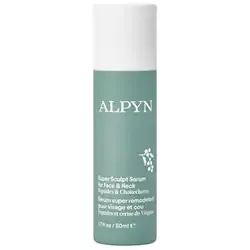
Alpyn Beauty Super Sculpt Serum For Face & Neck with Tri-Peptide Firming Complex
Works for
MoisturizingAcetyl hexapeptide-8, Acetyl octapeptide-3 + 13 moreWorks well
“Exfoliating hydrators plus hyaluronic acid visibly smooth lines for softer-looking skin.”
This product contains good ingredients to attract water to the upper layer of the skin. These ingredients are called "humectants": glycerin, lactobacillus ferment.
When humectants are on the surface of the skin, they “pull in” the moisture from the outside environment, or from within deeper layers of the skin. If the air is dry, humectants can speed up the moisture loss from the skin. This is why it is a good idea to use another product on top of this one to help "seal in" the moisture (look for ingredients like dimethicone, squalane, oils and butters).
The following ingredients in this product are especially good for supporting the skin barrier and helping with the hydration level: acetyl hexapeptide-8, acetyl octapeptide-3, acetyl tetrapeptide-2, urea
Anti-agingAcetyl hexapeptide-8, Acetyl octapeptide-3 + 3 moreMay help
“-Tri-Peptide Firming Complex: Helps visibly lift & soften the look of fine lines”
This product contains acetyl hexapeptide-8, acetyl octapeptide-3, acetyl tetrapeptide-2. There is some human evidence that these ingredients help reduce and prevent fine lines and wrinkles and improve skin elasticity and firmness, though it is smaller or less consistent than the evidence for the best anti-aging ingredients.
Can it cause trouble?
Irritancy13 flagged ingredientsMedium risk
ComedogenicClean of flagged comedogenic ingredientsNone flagged
User reviews
Be the first — your take helps the next person decide.
Ingredients
Filter by role to see what each ingredient is doing.
Water~45–55%
Propanediol~5.4–6.6%
- Irritation risk
- Low
Acts as a solvent for other ingredients. Speeds up the absorption of other ingredients into the skin
More about PropanediolHydrolyzed opuntia ficus-indica flower extract~4–4.9%
- Irritation risk
- High
A plant extract. Can help attract water the upper layer of the skin and might have some anti-oxidant properties
More about Hydrolyzed opuntia ficus-indica flower extractAloe barbadensis leaf juice~3–3.7%
- Irritation risk
- Medium
Traditionally used to treat sunburns, dermatitis and inflammation, but evidence for its effectiveness is lacking. The extract can contain humectants that help attract water into the skin
More about Aloe barbadensis leaf juiceGlycerin~2.4–3%
- Irritation risk
- Low
One of the best moisturizing ingredients. Naturally present in skin. It attracts water to the upper layer of the skin working as a humectant
More about GlycerinAcetyl hexapeptide-8~1.9–2.4%
- Irritation risk
- Low
A type of peptide. Peptides are excellent moisturizers and might be able support collagen production reducing fine lines and wrinkles
More about Acetyl hexapeptide-8Acetyl octapeptide-3~1.7–2%
- Irritation risk
- Low
A type of peptide. Peptides are excellent moisturizers and might be able support collagen production reducing fine lines and wrinkles
More about Acetyl octapeptide-3Acetyl tetrapeptide-2~1.4–1.8%
- Irritation risk
- Low
A type of peptide. Peptides are excellent moisturizers and might be able support collagen production reducing fine lines and wrinkles
More about Acetyl tetrapeptide-2Lactic acid~1.2–1.4%
- Irritation risk
- Medium
An exfoliating and moisturizing alpha-hydroxy acid (AHA). Typically causes less irritation than other AHAs, for example, glycolic acid. At high concentrations (about 15%), lactic acid can help reduce lines and wrinkles. Recent studies show that lactic acid can support the "good" bacteria living on skin's surface (healthy skin microbiome)
More about Lactic acidSodium hyaluronate~0.95–1.15%
- Irritation risk
- Low
One of the best moisturizing ingredients. Attracts water into the upper layer of the skin
More about Sodium hyaluronateUrea~0.7–1.05%
- Irritation risk
- Low
Naturally present in skin (urea makes up about 7% of natural moisturizing factors in skin). Attracts water to the upper layer of the skin. Also has a positive effect on the skin barrier beyond the humectant action. Can enhance penetration of other ingredients. Is an exfoliating ingredient when used in high concentrations
More about UreaPyrus malus fruit extract~0.55–0.85%
- Irritation risk
- Medium
Can have some moisturizing properties due to its sugar content
More about Pyrus malus fruit extractAcrylates/c10-30 alkyl acrylate crosspolymer~0.55–0.85%
- Irritation risk
- Medium
Maintains the texture of skincare products. Allows the product to spread evenly. Helps oil and water mix together
More about Acrylates/c10-30 alkyl acrylate crosspolymerHydrogenated ethylhexyl olivate~0.55–0.8%
- Irritation risk
- Low
Helps soften the upper layer of the skin
More about Hydrogenated ethylhexyl olivateSclerotium gum~0.45–0.7%
- Irritation risk
- Low
Used to create gel-like formulas and stabilize emulsions
More about Sclerotium gumSodium hydroxide~0.5–0.7%
Populus tremuloides bark extract~0.45–0.7%
- Irritation risk
- Low
Benzyl alcohol~0.35–0.65%
- Irritation risk
- High
A preservative. Can be used to mask unpleasant smell. Can be irritating
More about Benzyl alcoholSodium citrate~0.35–0.65%
- Irritation risk
- Medium
Helps to control the skin's pH level. Maintains the skin's natural film of amino-lactic acids and oils. Helps to preserve products
More about Sodium citrateDehydroacetic acid~0.3–0.55%
Benzoic acid~0.25–0.5%
Sodium gluconate~0.25–0.5%
Hydrogenated olive oil unsaponifiables~0.3–0.5%
- Irritation risk
- Low
Help soften the upper layer of the skin
More about Hydrogenated olive oil unsaponifiablesYeast amino acids~0.2–0.4%
- Irritation risk
- Low
Cucumis sativus seed oil~0.25–0.45%
- Irritation risk
- Low
Simmondsia chinensis seed oil~0.25–0.45%
- Irritation risk
- Medium
Softens the upper layer of skin and helps restore the healthy skin barrier. Has shown to help calm down inflammation in skin. It is a stable oil, meaning that it retains its properties even when exposed to air.
More about Simmondsia chinensis seed oilCaprylyl glycol~0.2–0.35%
- Irritation risk
- Medium
Helps preserve products and creates a nice product texture
More about Caprylyl glycolSodium benzoate~0.1–0.2%
Prunus virginiana bark extract~0.1–0.2%
- Irritation risk
- Low
Beta vulgaris root extract~0.1–0.15%
- Irritation risk
- Medium
A plant extract that might have some antioxidant properties, but mostly used in cosmetics for its color
More about Beta vulgaris root extractLeuconostoc/radish root ferment filtrate~0.05–0.1%
- Irritation risk
- Medium
A preservative that comes from radishes fermented by a bacteria. New research suggests that the preservation properties in the ingredient come from an ammonium salt that is not present naturally in radish root but used in its cultivation. Is problematic because the exact amount of the preservative agents is difficult to determine
More about Leuconostoc/radish root ferment filtrateLactobacillus ferment~0.05–0.1%
- Irritation risk
- Low
A fermentation product created by bacteria Lactobacillus. The fermented product has anti-bacterial properties and might be helpful in calming down inflammation, but studies are lacking. Helps attract water to the upper layer of the skin. Can be used as a preservative
More about Lactobacillus fermentIngredient list view
Water, Propanediol, Hydrolyzed opuntia ficus-indica flower extract, Aloe barbadensis leaf juice, Glycerin, Acetyl hexapeptide-8, Acetyl octapeptide-3, Acetyl tetrapeptide-2, Lactic acid, Sodium hyaluronate, Urea, Pyrus malus fruit extract, Acrylates/c10-30 alkyl acrylate crosspolymer, Hydrogenated ethylhexyl olivate, Sclerotium gum, Sodium hydroxide, Populus tremuloides bark extract, Benzyl alcohol, Sodium citrate, Dehydroacetic acid, Benzoic acid, Sodium gluconate, Hydrogenated olive oil unsaponifiables, Yeast amino acids, Cucumis sativus seed oil, Simmondsia chinensis seed oil, Caprylyl glycol, Sodium benzoate, Prunus virginiana bark extract, Beta vulgaris root extract, Leuconostoc/radish root ferment filtrate, Lactobacillus ferment
Compare prices
Retailers ranked by price — lowest first.

Worth comparing, line by line.
Match % combines shared ingredients, the first five ingredients, shared actives and hero ingredients, irritancy (lower counts in the alternative's favour), texture and body area. Only products in the same routine step are compared.
| Alpyn BeautySuper Sculpt Serum For Face & Neck with Tri-Peptide Firming ComplexYOUR PRODUCT | Luzern LaboratoriesLuzern WE3 Triple Action Serum Wrinkle Corrector | MaskadAnti aging serum | Peter Thomas RothPeptide 21 Wrinkle Resist Serum | |
|---|---|---|---|---|
| Match | — | 45% | 44% | 43% |
| Price | $62.00 | — | — | $125.00+$63.00 |
| Shared key ingredients | — | 4 of 9 | 4 of 9 | 5 of 9 |
| Key difference | — | Niacinamide | Copper Tripeptide-1 | Hexapeptide-11 |
| Irritancy | Medium | Low | Low | Medium |
| Drying alcohol | — | — | — | — |
| View product | Shop | Shop | Shop |


More alternatives: ZO Skin Health Peptide Facial Refining ConcentrateGood Molecules Super Peptide Serum
Product summary
"Alpyn Beauty - Super Sculpt Serum For Face & Neck with Tri-Peptide Firming Complex" is effective for: Moisturizing
This product could be helpful for: Anti-aging, but its actives are not the most effective or are not well-studied.
Ingredient callouts
- This product contains acids (lactic acid 1.20% - 1.40%). Their concentration is low, and they will not have a strong exfoliating effect. Instead, they work to support the skin natural acid mantle and to attract water (as humectants). Lactic acid is particularly good in attracting water to the upper layer of the skin and improving the skin barrier.
- Peptides (acetyl tetrapeptide-2 1.40% - 1.80%, acetyl octapeptide-3 1.70% - 2.00% and acetyl hexapeptide-8 1.90% - 2.40%). Peptides are a very big group of ingredients. They all consist of a different combination of aminoacids. Our skin produces Peptides naturally. Some of them work as natural antibiotics, promote wound-healing and production of collagen. The scientists are still studying how effective the topical application of Peptides is, but it is very likely that theynare helpful. Peptides might be able to support skin barrier restoration and even have an anti-aging benefit. At the very least, they certainly help attract water to the skin and support the hydration in this way.
- Humectants (lactobacillus ferment 0.05% - 0.10%, urea 0.70% - 1.05%, sodium hyaluronate 0.95% - 1.15%, acetyl octapeptide-3 1.70% - 2.00%, acetyl hexapeptide-8 1.90% - 2.40% and glycerin 2.40% - 3.00%). These ingredients help attract water to the upper layer of the skin and improve the skin hydration.
About the brand
According to Cruelty-Free Kitty "Alpyn Beauty" is cruelty free and so is its parent company.
Sources cited in this review
Every concentration estimate and effectiveness label is anchored to one of these 10 studies and safety reviews.
- 1
- 2Epidermal and dermal effects of topical lactic acidncbi.nlm.nih.gov
- 3Dual Effects of Alpha-Hydroxy Acids on the Skinpdfs.semanticscholar.org
- 4Hyaluronic acid: A key molecule in skin agingncbi.nlm.nih.gov
- 5
- 6Topical urea in skincare: A reviewpubmed.ncbi.nlm.nih.gov

Affiliate links · As an Amazon Associate, WIMJ earns from qualifying purchases.