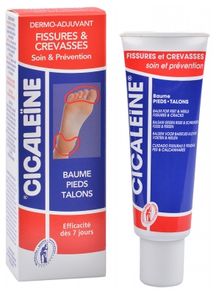
Akileïne Cicaleïne Foot and Heel Cracks Balm
Works for
1 of 1 advertised claim delivered
Moisturizing13 ingredients credited for this claimStrong support
“The moisturising action is immediate from the first application, and feels considerably more comfortable.”
This product can help improve hydration of the skin with the two types of ingredients.
The first type is called “humectants”:
these ingredients help attract water.
When humectants are on the surface of the skin, they “pull in” the moisture from the outside environment, or from
within deeper layers of the skin. The following ingredients in this product do the job:
glycerin, caprylyl glycol.
This product also contains ingredients called “occlusives”. They help reduce the speed with which our skin loses moisture to the outside environment. These ingredients also help soften the upper layer of the skin, so it feels less tight and nicer to the touch. The following ingredients in this product do the job: beeswax, caprylic/capric triglyceride.
The following ingredients in this product are especially good for supporting the skin barrier and helping with the hydration level: panthenol
Anti-oxidationNot advertised by the brand · 3 ingredients credited for this claimStrong support
This product contains antioxidants (glycyrrhetinic acid) that can help neutralize free radicals in skin. By doing so, they can lessen the damage the skin gets from the UV light (sun).
Evens skin toneNot advertised by the brand · 1 ingredient credited for this claimModerate support
The following ingredient (ingredients) in this product might be helpful, but there is no evidence to confirm that it actually works: glycyrrhetinic acid.
Anti-agingNot advertised by the brand · 2 ingredients credited for this claimModerate support
This product contains glycyrrhetinic acid. This ingredient help neutralize free radicals in skin. By doing so, they might be able to prevent early signs of aging (like fine lines and wrinkles), at least to some extent. These ingredients will not be able to "reverse" signs of aging.
Can it cause trouble?
Irritancy1 strong irritant: ParfumMedium risk
Comedogenic3 ingredients rated 2 or more on the 0–5 pore-clogging scale3 flagged
User reviews
Be the first — your take helps the next person decide.
Ingredients
Filter by role to see what each ingredient is doing.
Water~45–55%
Glycerin~5.3–6.4%
- Irritation risk
- Low
One of the best moisturizing ingredients. Naturally present in skin. It attracts water to the upper layer of the skin working as a humectant
More about GlycerinCaprylic/capric triglyceride~4.5–5.4%
- Irritation risk
- Medium
A good mix of fatty acids that forms a protective layer on the skin. Improves the shelf life of products. Derived from coconut and glycerin
More about Caprylic/capric triglycerideCetearyl alcohol~3–3.7%
- Irritation risk
- Low
- Comedogenicity
- 2/5
A non-drying alcohol. Works as an emollient. Helps water and oil mix together and creates a nice product texture
More about Cetearyl alcoholTrilinolein~2.3–2.9%
- Irritation risk
- Low
Peg-30 glyceryl stearate~2–2.4%
Panthenol~1.6–1.9%
- Irritation risk
- Low
Helps attract water to the upper layer of the skin and can help improve skin barrier function
More about PanthenolCera alba~1.8–2.2%
- Irritation risk
- Medium
Forms a protective barrier that holds water and keeps dry skin hydrated. Keeps an emulsion from separating into its oil and liquid components, and increases the thickness of a product. Can be an allergen
More about Cera albaBeeswax~1.3–1.6%
- Irritation risk
- Low
Forms a protective barrier that holds water and keeps dry skin hydrated. Keeps an emulsion from separating into its oil and liquid components, and increases the thickness of a product. Can be an allergen
More about BeeswaxTriolein~0.95–1.15%
Ethylhexylglycerin~0.65–1%
Polyacrylamide~0.6–0.9%
- Irritation risk
- Medium
Used to improve product texture and help oil and water mix together
More about PolyacrylamideParfum~0.45–0.7%
- Irritation risk
- High
An aromatic blend of unspecified and possibly irritating ingredients
More about ParfumTripalmitin~0.4–0.65%
- Irritation risk
- Low
Dimethicone~0.45–0.7%
- Irritation risk
- Low
A silicone that helps to reduce water loss from the surface of the skin. Can temporarily "fill in" lines and wrinkles, absorb oil, and create a nice product finish
More about DimethiconeTrilinolenin~0.4–0.65%
- Irritation risk
- Low
C13-14 isoparaffin~0.4–0.65%
- Irritation risk
- Low
Helps soften the upper layer of the skin, dissolve other ingredients and create a thicker product consistency
More about C13-14 isoparaffinGlycyrrhetinic acid~0.3–0.55%
- Irritation risk
- Medium
Active compound of licorice root. Works to calm down inflammation, as an anti-oxidant, and might be helpful in lightening the skin and reducing hyperpigmentation
More about Glycyrrhetinic acidPalmitoyl serine/silk amino acids methyl esters~0.25–0.5%
- Irritation risk
- Low
Tristearin~0.25–0.5%
- Irritation risk
- Low
Sodium cetearyl sulfate~0.4–0.6%
- Irritation risk
- Medium
Helps water and oil mix together and works as a cleansing agent
More about Sodium cetearyl sulfateSodium lauryl sulfate~0.55–0.8%
- Irritation risk
- High
- Comedogenicity
- 3/5
A cleansing agent (SLS). It can be irritating
More about Sodium lauryl sulfateHexanediol~0.25–0.45%
Caprylyl glycol~0.25–0.5%
- Irritation risk
- Medium
Helps preserve products and creates a nice product texture
More about Caprylyl glycolCentella asiatica extract~0.3–0.5%
- Irritation risk
- Medium
A plant extract that has been shown to be able to reduce inflammation in skin, support restoration of skin barrier function, as well as support collagen production. Contains active compounds called centelloids: asiaticoside, madecasosside, asiatic acid and madecassic acid. Might be helpful in preventing stretch marks. It can be itself be irritating though.
More about Centella asiatica extractTocopherol~0.25–0.45%
- Irritation risk
- Low
Pure form of vitamin E. Can help moisturise and protect the skin from free radicals. Often used to help stabilise other ingredients or the formula itself
More about TocopherolGlycine soja oil~0.2–0.4%
- Irritation risk
- Medium
- Comedogenicity
- 2/5
A good emollient that helps soften the skin and helps repair its barrier function. It can clog pores if used in high concentrations.
More about Glycine soja oilLaureth-7~0.2–0.35%
Citric acid~0.15–0.3%
- Irritation risk
- Medium
Can work as an exfoliant but is typically used to adjust the product pH
More about Citric acidPotassium sorbate~0.1–0.2%
Triarachidin~0.15–0.3%
Disodium phosphate~0.1–0.15%
- Irritation risk
- Low
Helps adjust the product pH and stabilize the formulation
More about Disodium phosphateHydrogenated palm glycerides citrate~0.1–0.2%
- Irritation risk
- Low
Helps soften the upper layer of the skin
More about Hydrogenated palm glycerides citratePotassium phosphate~0.05–0.15%
Ingredient list view
Water, Glycerin, Caprylic/capric triglyceride, Cetearyl alcohol, Trilinolein, Peg-30 glyceryl stearate, Panthenol, Cera alba, Beeswax, Triolein, Ethylhexylglycerin, Polyacrylamide, Parfum, Tripalmitin, Dimethicone, Trilinolenin, C13-14 isoparaffin, Glycyrrhetinic acid, Palmitoyl serine/silk amino acids methyl esters, Tristearin, Sodium cetearyl sulfate, Sodium lauryl sulfate, Hexanediol, Caprylyl glycol, Centella asiatica extract, Tocopherol, Glycine soja oil, Laureth-7, Citric acid, Potassium sorbate, Triarachidin, Disodium phosphate, Hydrogenated palm glycerides citrate, Potassium phosphate
Compare prices
Retailers ranked by price — lowest first.

Affiliate links · prices updated regularly
Worth comparing, line by line.
Match % combines shared ingredients, the first five ingredients, shared actives and hero ingredients, irritancy (lower counts in the alternative's favour), texture and body area. Only products in the same routine step are compared.
| AkileïneCicaleïne Foot and Heel Cracks BalmYOUR PRODUCT | Dr. MoritaHorse Oil Shea Butter Foot Cream | |
|---|---|---|
| Match | — | 51% |
| Price | $9.12 | $13.82+$4.70 |
| Shared key ingredients | — | 4 of 11 |
| Key difference | — | Galactoarabinan |
| Irritancy | Medium | Medium |
| Drying alcohol | — | — |
| View product | Shop |


Product summary
Based on the ingredient list, "Akileïne - Cicaleïne Foot and Heel Cracks Balm" can work well for skin moisturization. The formulation is based on a combination of good humectants and emollients. Both are needed to increase the skin hydration level. Panthenol, glycerin and caprylyl glycol in this product (humectants) attract water molecules to the upper layer of the skin (the water comes from the outside air or from the deeper layers of the skin if the air is dry). Glycine soja oil, beeswax, caprylic/capric triglyceride, cera alba and dimethicone in this product help decrease the water evoporation from the skin, so that it stays hydrated for longer. These ingredients also soften the skin and take away the feeling of tightness and dryness.
Ingredient callouts
- Panthenol (pro-vitamin B5) at about 1.60% - 1.90% concentration. In this concentration, Panthenol works effectively to improve the skin barrier and reduce inflammation.
Irritation risk
This formulation includes some common irritants, including ingredients that do not provide a benefit for the skin. We assess the overall irritancy of this moisturizer to be medium. For a detailed overview of all potential irritants: click here
You can see the detailed formula review with the breakdown of all actives in the product and the full ingredient list with estimated concentrations in the tables below.
Price
The product retails for 6.90£ in the United Kingdom.
For a detailed price comparison: click here.
Sources cited in this review
Every concentration estimate and effectiveness label is anchored to one of these 20 studies and safety reviews.
- 1
- 2Skin moisturizing effects of panthenol-based formulationspdfs.semanticscholar.org
- 3
- 4
- 5
- 6Final Report on the Safety Assessment of Dimethicone Copolyoljournals.sagepub.com

Affiliate links · As an Amazon Associate, WIMJ earns from qualifying purchases.