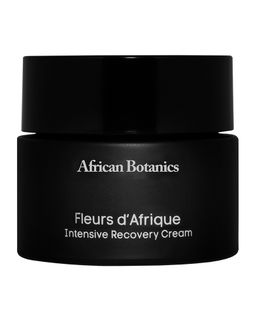
African Botanics Fleurs d'Afrique Intensive Recovery Cream
Works for
2 of 3 advertised claims delivered
Moisturizing21 ingredients credited for this claimStrong support
“Intensively hydrating, this floods cells with much-needed moisture”
This product can help improve hydration of the skin with the two types of ingredients.
The first type is called “humectants”:
these ingredients help attract water.
When humectants are on the surface of the skin, they “pull in” the moisture from the outside environment, or from
within deeper layers of the skin. The following ingredients in this product do the job:
cylindrotheca fusiformis extract, glycerin.
This product also contains ingredients called “occlusives”. They help reduce the speed with which our skin loses moisture to the outside environment. These ingredients also help soften the upper layer of the skin, so it feels less tight and nicer to the touch. The following ingredients in this product do the job: caprylic/capric triglyceride, cetyl alcohol.
The following ingredients in this product are especially good for supporting the skin barrier and helping with the hydration level: panthenol
Anti-aging8 ingredients credited for this claimModerate support
“A high concentration of advanced marine biotechnology - packed with age-defying and anti-inflammatory actives - then works to soothe irritation while minimising fine lines and signs of fatigue.”
This product contains centella asiatica leaf extract, resveratrol. These ingredients might be able to help reduce and prevent fine lines and wrinkles, improve skin elasticity and firmness, but there is not enough evidence that it actually works.
Anti-blemish3 ingredients credited for this claimWeak support
“Boasting impressive skin-revitalising and regenerative capabilities, these plant extracts help lessen lines, counteract blemishes, alleviate redness and combat sagging while deflecting skin-ageing free radical damage.”
Effective ingredients missing or their concentration is too low.
Anti-oxidationNot advertised by the brand · 15 ingredients credited for this claimStrong support
This product contains antioxidants (resveratrol, ubiquinone) that can help neutralize free radicals in skin. By doing so, they can lessen the damage the skin gets from the UV light (sun).
Can it cause trouble?
Irritancy4 strong irritants: Myrothamnus flabellifolia extract, Arnica montana flower extract + 2 more — patch-test recommendedHigh risk
ComedogenicClean of flagged comedogenic ingredientsNone flagged

User reviews
Be the first — your take helps the next person decide.
Ingredients
Filter by role to see what each ingredient is doing.
Jasminum grandiflorum flower wax~22–33%
- Irritation risk
- Low
Aloe ferox leaf extract~4.8–7.2%
- Irritation risk
- Low
Trichilia emetica seed butter~4.8–7.2%
- Irritation risk
- Low
Sodium hyaluronate~3.6–5.3%
- Irritation risk
- Low
One of the best moisturizing ingredients. Attracts water into the upper layer of the skin
More about Sodium hyaluronateHydrolyzed rice protein~2.9–4.4%
- Irritation risk
- Low
Helps attract water to the upper layer of the skin. Might have some anti-oxidant properties
More about Hydrolyzed rice proteinCentella asiatica leaf extract~2.1–3.2%
- Irritation risk
- Medium
A plant extract that has been shown to be able to reduce inflammation in skin, support restoration of skin barrier function, as well as support collagen production. It can be irritating to sensitive skin. Might be helpful in preventing stretch marks. It could, however, itself be irritating.
More about Centella asiatica leaf extractHydrolyzed soybean fiber~1.6–2.4%
Hydrolyzed soy protein~1.3–1.9%
- Irritation risk
- Low
Helps attract water to the upper layer of the skin. Might have some anti-aging, anti-oxidant, and skin lightening properties, but solid evidence is missing
More about Hydrolyzed soy proteinHydrolyzed millet~1.2–1.7%
- Irritation risk
- Low
Hydrolyzed pea~0.95–1.45%
- Irritation risk
- Low
Verbena officinalis extract~0.85–1.3%
- Irritation risk
- Low
Kigelia africana fruit extract~0.55–1.3%
- Irritation risk
- Low
Tocopherol~0.5–1.2%
- Irritation risk
- Low
Pure form of vitamin E. Can help moisturise and protect the skin from free radicals. Often used to help stabilise other ingredients or the formula itself
More about TocopherolCylindrotheca fusiformis extract~0.5–1.1%
- Irritation risk
- Low
Helps skin moisturization by attracting water to the upper layer of the skin. Might have some anti-oxidant properties but research confirming effectiveness in skin is lacking
More about Cylindrotheca fusiformis extractResveratrol~0.45–1.1%
- Irritation risk
- Medium
Helps neutralize free radicals in skin and might help reduce fine lines and wrinkles, as well as even out the skin tone
More about ResveratrolGlycine soja protein~0.55–1.25%
- Irritation risk
- Low
A plant extract that helps to attract water to the upper layer of the skin and soften it. It might be helpful in neutralizing free radicals. It might be somewhat helpful for evening out the skin tone. It might be able to support elastin production but solid research is lacking
More about Glycine soja proteinOxido reductases~0.45–1.05%
- Irritation risk
- Low
An enzyme. There is no evidence for its benefits in topical skincare
More about Oxido reductasesUbiquinone~0.45–1%
- Irritation risk
- Low
Coenzyme Q10. It helps neutralize free radicals in skin, improves skin hydration and might be helpful agains fine lines and wrinkles. It can be an allergen
More about UbiquinoneMyrothamnus flabellifolia extract~0.4–0.95%
- Irritation risk
- High
A fragrant plant extract with some antibacterial properties. Can be irritating
More about Myrothamnus flabellifolia extractPanthenol~0.4–0.9%
- Irritation risk
- Low
Helps attract water to the upper layer of the skin and can help improve skin barrier function
More about PanthenolMangifera indica seed butter~0.4–0.9%
- Irritation risk
- Low
Helps to soften the upper layer of the skin and might have some anti-oxidant effect
More about Mangifera indica seed butterSclerocarya birrea seed oil~0.45–1%
- Irritation risk
- Medium
An emollient that helps to soften the skin. It has a high contetn of oleic acid that might weaken the skin barrier. Might have some anti-oxidant properties. It might be somewhat helpful against hyperpigmentation.
More about Sclerocarya birrea seed oilAdansonia digitata fruit extract~0.45–1.05%
- Irritation risk
- Low
Citrullus lanatus seed oil~0.45–1%
- Irritation risk
- Low
Schinziophyton rautanenii kernel oil~0.45–1%
- Irritation risk
- Low
Cyclopia genistoides leaf extract~0.35–0.85%
- Irritation risk
- Low
Cucumis sativus fruit extract~0.35–0.85%
- Irritation risk
- Medium
Might be somewhat helpful in reducing hyperpigmentation and neutralizing free radicals but its typical concentration in a product is too low for having an effect
More about Cucumis sativus fruit extractCaprylic/capric triglyceride~0.45–1%
- Irritation risk
- Medium
A good mix of fatty acids that forms a protective layer on the skin. Improves the shelf life of products. Derived from coconut and glycerin
More about Caprylic/capric triglycerideCetyl alcohol~0.45–1%
- Irritation risk
- Low
A non-drying alcohol that works to soften the skin and stabilize product formulations helping oil and water mix together
More about Cetyl alcoholGlycerin~0.4–0.9%
- Irritation risk
- Low
One of the best moisturizing ingredients. Naturally present in skin. It attracts water to the upper layer of the skin working as a humectant
More about GlycerinMangifera indica seed butter~0.2–0.75%
- Irritation risk
- Low
Helps to soften the upper layer of the skin and might have some anti-oxidant effect
More about Mangifera indica seed butterCopper gluconate~0.2–0.75%
- Irritation risk
- Medium
Typically used to stabilize the product formulations. It is a salt of polyhydroxy acid (PHA) and in larger concentrations, can help shed the dead cells from the skin surface revealing smoother skin. It can help attract water to the upper layer of the skin. Might to be helpful against acne and clogged pores. Could be helpful in neutralizing free radicals, but solid research is missing
More about Copper gluconateNiacinamide~0.2–0.8%
- Irritation risk
- Low
Is proven to be effective in reducing blemishes, evening out skin tone and helping to improve lines and wrinkles. It helps the skin to repair sun damage, calm down inflammation and keep maintain good levels of moisture. The concentration of about 2% is effective for supporting the skin barrier and evening out the skin tone. Concentration of 4-6% is better for helping with acne and balancing the sebum production
More about NiacinamideAnthemis nobilis flower extract~0.2–0.7%
- Irritation risk
- High
A plant extract that one one hand, can contain compounds that can help calm down skin irritation, but, on the other hand, its other compounds (especially fragrant ones) can themselves be irritating
More about Anthemis nobilis flower extractRosa canina fruit oil~0.35–0.8%
- Irritation risk
- Medium
A great emollient. Contains vitamin E (tocopherol) which may give it some anti-oxidant properties. Can contain volatile compounds and can be irritating
More about Rosa canina fruit oilCaffeine~0.2–0.7%
- Irritation risk
- Medium
Might be helpful in neutralizing free radicals. Can have a dehydration effect that might somewhat decrease the look of puffy eyes
More about CaffeineTetrahexyldecyl ascorbate~0.15–0.7%
- Irritation risk
- Medium
Being a lipid soluble form of vitamin C, it is more stable than ascorbic acid, but still degrades quickly and needs to be stabilized in a formulation with another ingredient. It is claimed to penetrate skin better than pure vitamin C and have the the similar benefits, but solid studies of its effectiveness are lacking. Is likely to require a higher concentration in a product than pure vitamin C to be effective. It might be able to help reduce pore clogging.
More about Tetrahexyldecyl ascorbateSaccharide isomerate~0.15–0.65%
- Irritation risk
- Low
Helps attract water to the upper layer of the skin
More about Saccharide isomeratePearl powder~0.15–0.65%
- Irritation risk
- Low
Consists of 95% calcium carbonate that does not have any effect on the skin. The remaining 5% can include compounds that can help neutralize free radicals and support skin barrier function
More about Pearl powderArnica montana flower extract~0.15–0.55%
- Irritation risk
- High
A plant extract that can be irritating. It can have some anti-bacterial properties, but there are no evidence of a beneficial effect for skin
More about Arnica montana flower extractAspalathus linearis extract~0.15–0.55%
- Irritation risk
- Low
Calendula officinalis flower extract~0.1–0.4%
- Irritation risk
- High
A plant extract that has some anti-oxidant and anti-bacterial properties. Can be irritating
More about Calendula officinalis flower extractSynthetic fluorphlogopite~0.1–0.5%
- Irritation risk
- Low
A mineral that is used as an optical filter (makes the skin looks nicer through light reflection) and to improve the texture of cosmetic products
More about Synthetic fluorphlogopiteCitrus aurantium bergamia peel oil~0.1–0.4%
- Irritation risk
- High
Ethylhexylglycerin~0.05–0.3%
Phenoxyethanol~0.1–0.4%
- Irritation risk
- Low
A preservative. It helps prevent bacterial growth in cosmetic products
More about PhenoxyethanolIngredient list view
Jasminum grandiflorum flower wax, Aloe ferox leaf extract, Trichilia emetica seed butter, Sodium hyaluronate, Hydrolyzed rice protein, Centella asiatica leaf extract, Hydrolyzed soybean fiber, Hydrolyzed soy protein, Hydrolyzed millet, Hydrolyzed pea, Verbena officinalis extract, Kigelia africana fruit extract, Unknown, Tocopherol, Cylindrotheca fusiformis extract, Resveratrol, Unknown, Glycine soja protein, Oxido reductases, Ubiquinone, Myrothamnus flabellifolia extract, Panthenol, Mangifera indica seed butter, Sclerocarya birrea seed oil, Adansonia digitata fruit extract, Citrullus lanatus seed oil, Schinziophyton rautanenii kernel oil, Cyclopia genistoides leaf extract, Unknown, Cucumis sativus fruit extract, Caprylic/capric triglyceride, Cetyl alcohol, Glycerin, Unknown, Mangifera indica seed butter, Copper gluconate, Niacinamide, Anthemis nobilis flower extract, Rosa canina fruit oil, Caffeine, Tetrahexyldecyl ascorbate, Saccharide isomerate, Pearl powder, Arnica montana flower extract, Aspalathus linearis extract, Calendula officinalis flower extract, Synthetic fluorphlogopite, Citrus aurantium bergamia peel oil, Ethylhexylglycerin, Phenoxyethanol
Compare prices
Retailers ranked by price — lowest first.

Affiliate links · prices updated regularly
Worth comparing, line by line.
Match % combines shared ingredients, the first five ingredients, shared actives and hero ingredients, irritancy (lower counts in the alternative's favour), texture and body area. Only products in the same routine step are compared.
| African BotanicsFleurs d'Afrique Intensive Recovery CreamYOUR PRODUCT | OlayRegenerist Hyaluronic Acid + Peptide 24 Gel Face Moisturizer | Twelve Natural SkincareTwelve Ultra Revitalising Elixir | AfroditaHYALURON MINERAL Intensive moisturising gel | |
|---|---|---|---|---|
| Match | — | 77% | 77% | 77% |
| Price | $350.00 | $24.65−$325.35 | $55.53−$294.47 | — |
| Shared key ingredients | — | 4 of 15 | 4 of 15 | 4 of 15 |
| Key difference | — | Palmitoyl Pentapeptide-4 | Allantoin | Beta-Glucan |
| Irritancy | High | Low | Medium | Medium |
| Drying alcohol | — | — | — | — |
| View product | Shop | Shop | Shop |
Product summary
"African Botanics - Fleurs d'Afrique Intensive Recovery Cream" has a good moisturizing formula. This moisturizer uses a good combo of humectants and emollients. These both types of ingredients are essentials for improving the skin hydration and keeping the skin barrier healthy. Panthenol, cylindrotheca fusiformis extract, glycerin, saccharide isomerate and sodium hyaluronate in this product (humectants) attract water molecules to the upper layer of the skin (the water comes from the outside air or from the deeper layers of the skin if the air is dry). Cetyl alcohol and glycine soja protein in this product help decrease the water evoporation from the skin, so that it stays hydrated for longer. These ingredients also soften the skin and take away the feeling of tightness and dryness.
Ingredient callouts
- An effective concentration of Panthenol (pro-vitamin B5) - about 0.35% - 0.85%. Panthenol helps strengthen the skin barrier, improve hydration and reduce inflammation in skin.
Irritation risk
We assess the overall irritancy of this moisturizer to be high. For a detailed overview of all potential irritants: click here
You can see the detailed formula review with the breakdown of all actives in the product and the full ingredient list with estimated concentrations in the tables below.
Price
The product retails for 350.00$ in the United States and for 300.00£ in the United Kingdom.
For a detailed price comparison: click here.
Sources cited in this review
Every concentration estimate and effectiveness label is anchored to one of these 41 studies and safety reviews.
- 1Hyaluronic acid: A key molecule in skin agingncbi.nlm.nih.gov
- 2
- 3
- 4
- 5Centella asiatica in Dermatology: An Overviewonlinelibrary.wiley.com
- 6Contact dermatitis due to Madecassolonlinelibrary.wiley.com

Affiliate links · As an Amazon Associate, WIMJ earns from qualifying purchases.