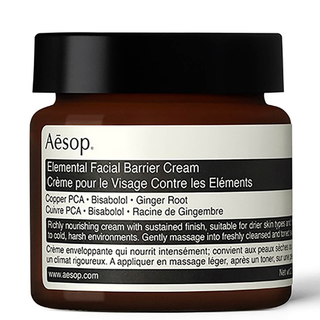
Aesop Elemental Facial Barrier Cream

Aesop Elemental Facial Barrier Cream

Efficacy75/100IrritancyHigh
Edit

Works for

1 of 1 advertised claim delivered

Moisturizing
15 ingredients credited for this claim
Good support
What the product description says
“Elemental Facial Barrier Cream”
From product name

This product can help improve hydration of the skin with the two types of ingredients.

The first type is called “humectants”:
these ingredients help attract water. When humectants are on the surface of the skin, they “pull in” the moisture from the outside environment, or from within deeper layers of the skin. The following ingredients in this product do the job: copper pca, glycerin.

This product also contains ingredients called “occlusives”. They help reduce the speed with which our skin loses moisture to the outside environment. These ingredients also help soften the upper layer of the skin, so it feels less tight and nicer to the touch. The following ingredients in this product do the job: butyrospermum parkii butter, copernicia cerifera wax.

Butyrospermum parkii butterKey active· Emollient, OcclusiveEffect: HighA great moisturising ingredient that softens the skin and reduces water loss from its upper layer. It also can be helpful in protecting skin from free radicals~2.4–2.9%
Copernicia cerifera waxKey active· Emollient, OcclusiveEffect: HighHelps to soften the upper layer of the skin and create a nice product consistency~0.45–0.7%
Copper pcaKey active· HumectantEffect: HighHelps attract water to the upper layer of the skin~0.2–0.35%
GlycerinKey active· HumectantEffect: HighOne of the best moisturizing ingredients. Naturally present in skin. It attracts water to the upper layer of the skin working as a humectant~3.7–4.6%
Helianthus annuus seed oilKey active· Emollient, OcclusiveEffect: HighA great emollient due to its high linoleic acid content. One of the most effective plant oils in helping skin hydration and repairing skin barrier function~0.4–0.65%
Ricinus communis seed oilKey active· Emollient, OcclusiveEffect: HighA plant oil that can help soften the skin. It might be helpful in calming down inflammation, but solid research is lacking. Is often used in lip products to create the needed product consistency~5.9–7.2%
Zinc pcaKey active· HumectantEffect: HighA compound that combines zinc with a hydrating ingredient PCA. Might to be helpful against acne and clogged pores. Can help calm down inflammation in skin. Could be helpful in reducing the formation of free radicals in skin. Might help to reduce fine lines in wrinkles, but solid evidence is missing~0.2–0.35%
Cetearyl alcoholKey active· EmollientEffect: MediumA non-drying alcohol. Works as an emollient. Helps water and oil mix together and creates a nice product texture~1.9–2.4%
Glyceryl stearate· EmollientEffect: LowAn emollient that softens the skin and forms a protective layer on its surface. Helps water and oil mix together~0.95–1.15%
Pentylene glycol· EmollientEffect: LowUsed to preserve products, dissolve other ingredients and create a nice product texture~0.2–0.35%
Stearic acid· EmollientEffect: LowHelps oil and water mix together and works as an emollient~1.7–2%
Rosa canina fruit oilUnder-dosedEffect: HighA great emollient. Contains vitamin E (tocopherol) which may give it some anti-oxidant properties. Can contain volatile compounds and can be irritating~0.7–1.05%
Caprylic/capric triglycerideUnder-dosedEffect: HighA good mix of fatty acids that forms a protective layer on the skin. Improves the shelf life of products. Derived from coconut and glycerin~0.5–0.7%
Coco-caprylateUnder-dosedEffect: MediumAn emollient that softens skin and creates a nice product texture~0.6–0.9%
TocopherolEffect: Low, below effective dosePure form of vitamin E. Can help moisturise and protect the skin from free radicals. Often used to help stabilise other ingredients or the formula itself~0.3–0.6%

Can it cause trouble?

Irritancy
9 strong irritants: Rosmarinus officinalis leaf oil, Lavandula angustifolia oil + 7 more — patch-test recommended
High risk
We flagged 22 ingredients with irritancy potential. Severity depends on your sensitivity threshold; the table lists the worst offenders first.
IngredientFunctionIrritationEst. amount
Rosmarinus officinalis leaf oilA plant oil with high content of volatile compounds that can irritate the skin. Can be used as a fragrance. Has anti-bacterial properties and might help neutralize free radicals on the surface of the skinHigh~0.25–0.45%est.
Lavandula angustifolia oilAn essential oil. Potential allergen and can be irritating. It has some anti-bacterial propertiesHigh~0.2–0.4%est.
Eugenia caryophyllus flower oilAn essential oil. Can be irritatingHigh~0.25–0.45%est.
Decyl glucosideHelps oil and water mix together. Can be irritatingHigh~0.3–0.55%est.
Citrus tangerina peel oilEssential oil that can be irritating. Can lead to photosensitivityHigh~0.15–0.25%est.
Zingiber officinale root extractA plant extract that can contain an irritating essential oil. Might have some anti-oxidant effect, but evidence is lackingHigh~0.1–0.15%est.
FarnesolAdded to create a nice product smell. Can be irritatingHigh~0.1–0.15%est.
EugenolA fragrance. Is a likely irritantHigh~0.05–0.1%est.
LinaloolA fragrance. Can be irritatingHigh~0.05–0.1%est.
LimoneneA common frangrance that can easily irritate skin, especially if exposed to air, light or heatHigh~0.05%est.
Ricinus communis seed oilA plant oil that can help soften the skin. It might be helpful in calming down inflammation, but solid research is lacking. Is often used in lip products to create the needed product consistencyMedium~5.9–7.2%est.
Pentaerythrityl tetraisostearateUsed to create a thicker product consistencyMedium~2.7–3.3%est.
Ceteareth-20Helps oil and water mix together. Has some emollient propertiesMedium~1.2–1.4%est.
Rosa canina fruit oilA great emollient. Contains vitamin E (tocopherol) which may give it some anti-oxidant properties. Can contain volatile compounds and can be irritatingMedium~0.7–1.05%est.
Coco-caprylateAn emollient that softens skin and creates a nice product textureMedium~0.6–0.9%est.
Disodium edtaStabilizes the product formulationMedium~0.45–0.65%est.
Caprylic/capric triglycerideA good mix of fatty acids that forms a protective layer on the skin. Improves the shelf life of products. Derived from coconut and glycerinMedium~0.5–0.7%est.
Benzoic acidA preservativeMedium~0.25–0.45%est.
Dehydroacetic acidA preservativeMedium~0.2–0.4%est.
Sodium citrateHelps to control the skin's pH level. Maintains the skin's natural film of amino-lactic acids and oils. Helps to preserve productsMedium~0.2–0.35%est.
EthylhexylglycerinA preservativeMedium~0.15–0.3%est.
Pentylene glycolUsed to preserve products, dissolve other ingredients and create a nice product textureMedium~0.2–0.35%est.
Comedogenic
3 ingredients rated 2 or more on the 0–5 pore-clogging scale
3 flagged
These ingredients have a comedogenic rating of 2 or more on a 0–5 scale; the table shows each one's rating. In leave-on products they can clog pores in acne-prone skin.
IngredientFunctionRatingEst. amount
Butyrospermum parkii butterA great moisturising ingredient that softens the skin and reduces water loss from its upper layer. It also can be helpful in protecting skin from free radicals3/5~2.4–2.9%est.
Cetearyl alcoholA non-drying alcohol. Works as an emollient. Helps water and oil mix together and creates a nice product texture2/5~1.9–2.4%est.
Ceteareth-20Helps oil and water mix together. Has some emollient properties2/5~1.2–1.4%est.
Edit
Cheaper Alternatives
Similar formulations, better price
No cheaper similar product found.

User reviews

Would you recommend?
No community reviews yet.

Be the first — your take helps the next person decide.

Write a review · ~30s

Ingredients

Filter by role to see what each ingredient is doing.

Water~45–55%
Formula
Irritation risk
Low

Plain old water

More about Water
Ricinus communis seed oil~5.9–7.2%
Key activeIrritant · medium
Irritation risk
Medium
Works for
MoisturizingAnti-inflammatory

A plant oil that can help soften the skin. It might be helpful in calming down inflammation, but solid research is lacking. Is often used in lip products to create the needed product consistency

More about Ricinus communis seed oil
Glycerin~3.7–4.6%
Key active
Irritation risk
Low
Works for
Moisturizing

One of the best moisturizing ingredients. Naturally present in skin. It attracts water to the upper layer of the skin working as a humectant

More about Glycerin
Pentaerythrityl tetraisostearate~2.7–3.3%
Irritant · medium
Irritation risk
Medium
Works for
Cleansing

Used to create a thicker product consistency

More about Pentaerythrityl tetraisostearate
Butyrospermum parkii butter~2.4–2.9%
Key activeComedogenic 3/5
Irritation risk
Low
Comedogenicity
3/5
Works for
MoisturizingAnti-oxidationAnti-aging

A great moisturising ingredient that softens the skin and reduces water loss from its upper layer. It also can be helpful in protecting skin from free radicals

More about Butyrospermum parkii butter
Cetearyl alcohol~1.9–2.4%
Key activeComedogenic 2/5
Irritation risk
Low
Comedogenicity
2/5
Works for
CleansingMoisturizing

A non-drying alcohol. Works as an emollient. Helps water and oil mix together and creates a nice product texture

More about Cetearyl alcohol
Stearic acid~1.7–2%
Formula
Irritation risk
Low
Works for
CleansingMoisturizing

Helps oil and water mix together and works as an emollient

More about Stearic acid
Hydrogenated castor oil stearate~1.4–1.7%
Formula
Ceteareth-20~1.2–1.4%
Comedogenic 2/5Irritant · medium
Irritation risk
Medium
Comedogenicity
2/5
Works for
Cleansing

Helps oil and water mix together. Has some emollient properties

More about Ceteareth-20
Glyceryl stearate~0.95–1.15%
Formula
Irritation risk
Low
Works for
CleansingMoisturizing

An emollient that softens the skin and forms a protective layer on its surface. Helps water and oil mix together

More about Glyceryl stearate
Rosa canina fruit oil~0.7–1.05%
Under-dosedIrritant · medium
Irritation risk
Medium
Works for
MoisturizingAnti-oxidation

A great emollient. Contains vitamin E (tocopherol) which may give it some anti-oxidant properties. Can contain volatile compounds and can be irritating

More about Rosa canina fruit oil
Coco-caprylate~0.6–0.9%
Under-dosedIrritant · medium
Irritation risk
Medium
Works for
Moisturizing

An emollient that softens skin and creates a nice product texture

More about Coco-caprylate
Phenoxyethanol~0.5–0.75%
Formula
Irritation risk
Low

A preservative. It helps prevent bacterial growth in cosmetic products

More about Phenoxyethanol
Fusanus spicatus wood oil~0.45–0.7%
Formula
Disodium edta~0.45–0.65%
Irritant · medium
Irritation risk
Medium

Stabilizes the product formulation

More about Disodium edta
Euphorbia cerifera wax~0.55–0.8%
Formula
Caprylic/capric triglyceride~0.5–0.7%
Under-dosedIrritant · medium
Irritation risk
Medium
Works for
Moisturizing

A good mix of fatty acids that forms a protective layer on the skin. Improves the shelf life of products. Derived from coconut and glycerin

More about Caprylic/capric triglyceride
Helianthus annuus seed oil~0.4–0.65%
Key active
Irritation risk
Low
Works for
Moisturizing

A great emollient due to its high linoleic acid content. One of the most effective plant oils in helping skin hydration and repairing skin barrier function

More about Helianthus annuus seed oil
Tocopherol~0.3–0.6%
Formula
Irritation risk
Low
Works for
Anti-oxidationMoisturizingAnti-inflammatoryAnti-aging

Pure form of vitamin E. Can help moisturise and protect the skin from free radicals. Often used to help stabilise other ingredients or the formula itself

More about Tocopherol
Copernicia cerifera wax~0.45–0.7%
Key active
Irritation risk
Low
Works for
Moisturizing

Helps to soften the upper layer of the skin and create a nice product consistency

More about Copernicia cerifera wax
Bisabolol~0.25–0.45%
Formula
Irritation risk
Low
Works for
Anti-inflammatoryReduces irritationAnti-oxidation

An active component of chamomile plant that historically has been used to calm down irritated skin. A recent study shows that bisabolol indeed can have some anti-inflammatory effect on skin, even though conclusive data is lacking. Bisabolol has a sweet floral scent and can be added to products for its aromatic properties

More about Bisabolol
Rosmarinus officinalis leaf oil~0.25–0.45%
Irritant · high
Irritation risk
High
Works for
Anti-oxidationAntibacterial

A plant oil with high content of volatile compounds that can irritate the skin. Can be used as a fragrance. Has anti-bacterial properties and might help neutralize free radicals on the surface of the skin

More about Rosmarinus officinalis leaf oil
Lavandula angustifolia oil~0.2–0.4%
Irritant · high
Irritation risk
High

An essential oil. Potential allergen and can be irritating. It has some anti-bacterial properties

More about Lavandula angustifolia oil
Zinc pca~0.2–0.35%
Key active
Irritation risk
Low
Works for
MoisturizingAnti-inflammatoryAnti-blemishAnti-oxidationAnti-aging

A compound that combines zinc with a hydrating ingredient PCA. Might to be helpful against acne and clogged pores. Can help calm down inflammation in skin. Could be helpful in reducing the formation of free radicals in skin. Might help to reduce fine lines in wrinkles, but solid evidence is missing

More about Zinc pca
Benzoic acid~0.25–0.45%
Irritant · medium
Irritation risk
Medium

A preservative

More about Benzoic acid
Eugenia caryophyllus flower oil~0.25–0.45%
Irritant · high
Irritation risk
High

An essential oil. Can be irritating

More about Eugenia caryophyllus flower oil
Decyl glucoside~0.3–0.55%
Irritant · high
Irritation risk
High
Works for
Cleansing

Helps oil and water mix together. Can be irritating

More about Decyl glucoside
Dehydroacetic acid~0.2–0.4%
Irritant · medium
Irritation risk
Medium

A preservative

More about Dehydroacetic acid
Copper pca~0.2–0.35%
Key active
Irritation risk
Low
Works for
Moisturizing

Helps attract water to the upper layer of the skin

More about Copper pca
Sodium citrate~0.2–0.35%
Irritant · medium
Irritation risk
Medium

Helps to control the skin's pH level. Maintains the skin's natural film of amino-lactic acids and oils. Helps to preserve products

More about Sodium citrate
Ormenis multicaulis oil~0.15–0.3%
Formula
Ethylhexylglycerin~0.15–0.3%
Irritant · medium
Irritation risk
Medium

A preservative

More about Ethylhexylglycerin
Citrus tangerina peel oil~0.15–0.25%
Irritant · high
Irritation risk
High

Essential oil that can be irritating. Can lead to photosensitivity

More about Citrus tangerina peel oil
Pentylene glycol~0.2–0.35%
Irritant · medium
Irritation risk
Medium
Works for
Moisturizing

Used to preserve products, dissolve other ingredients and create a nice product texture

More about Pentylene glycol
Zingiber officinale root extract~0.1–0.15%
Irritant · high
Irritation risk
High
Works for
Anti-oxidation

A plant extract that can contain an irritating essential oil. Might have some anti-oxidant effect, but evidence is lacking

More about Zingiber officinale root extract
Farnesol~0.1–0.15%
Irritant · high
Irritation risk
High

Added to create a nice product smell. Can be irritating

More about Farnesol
Eugenol~0.05–0.1%
Irritant · high
Irritation risk
High

A fragrance. Is a likely irritant

More about Eugenol
Linalool~0.05–0.1%
Irritant · high
Irritation risk
High

A fragrance. Can be irritating

More about Linalool
Limonene~0.05%
Irritant · high
Irritation risk
High

A common frangrance that can easily irritate skin, especially if exposed to air, light or heat

More about Limonene
Ingredient list view

Water, Ricinus communis seed oil, Glycerin, Pentaerythrityl tetraisostearate, Butyrospermum parkii butter, Cetearyl alcohol, Stearic acid, Hydrogenated castor oil stearate, Ceteareth-20, Glyceryl stearate, Rosa canina fruit oil, Coco-caprylate, Phenoxyethanol, Fusanus spicatus wood oil, Disodium edta, Euphorbia cerifera wax, Caprylic/capric triglyceride, Helianthus annuus seed oil, Tocopherol, Copernicia cerifera wax, Bisabolol, Rosmarinus officinalis leaf oil, Lavandula angustifolia oil, Zinc pca, Benzoic acid, Eugenia caryophyllus flower oil, Decyl glucoside, Dehydroacetic acid, Copper pca, Sodium citrate, Ormenis multicaulis oil, Ethylhexylglycerin, Citrus tangerina peel oil, Pentylene glycol, Zingiber officinale root extract, Farnesol, Eugenol, Linalool, Limonene

Compare prices

Retailers ranked by price — lowest first.

Amazon USPrice as of 10/15/2026 06:02 GMT
$65.00
Buy

Affiliate links · prices updated regularly · As an Amazon Associate, WIMJ earns from qualifying purchases.

Cheaper alternatives? See how this stacks up against similar formulas.
We compare ingredient profiles across our catalog — pick the closest match for your budget.
Open dupe finder

Sources cited in this review

Every concentration estimate and effectiveness label is anchored to one of these 24 studies and safety reviews.

  1. 1
  2. 2
  3. 3
  4. 4
  5. 5
  6. 6
Aesop Elemental Facial Barrier Cream
AesopElemental Facial Barrier Cream

Affiliate links · As an Amazon Associate, WIMJ earns from qualifying purchases.

As an Amazon Associate, WIMJ earns from qualifying purchases.