Works for
1 of 1 advertised claim delivered
Moisturizing25 ingredients credited for this claimGood support
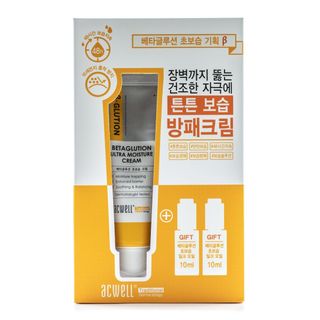
“Betaglution Ultra Moisture Cream”
This product can help improve hydration of the skin with the two types of ingredients.
The first type is called “humectants”:
these ingredients help attract water.
When humectants are on the surface of the skin, they “pull in” the moisture from the outside environment, or from
within deeper layers of the skin. The following ingredients in this product do the job:
avena sativa kernel flour, glycerin.
This product also contains ingredients called “occlusives”. They help reduce the speed with which our skin loses moisture to the outside environment. These ingredients also help soften the upper layer of the skin, so it feels less tight and nicer to the touch. The following ingredients in this product do the job: caprylic/capric triglyceride, dimethicone.
Can it cause trouble?
Irritancy4 strong irritants: Citrus aurantium bergamia fruit oil, Pelargonium graveolens flower oil + 2 more — patch-test recommendedHigh risk
Comedogenic5 ingredients rated 2 or more on the 0–5 pore-clogging scale5 flagged
User reviews
Be the first — your take helps the next person decide.
Ingredients
Filter by role to see what each ingredient is doing.
Water~45–55%
Dipropylene glycol~6.8–8.3%
- Irritation risk
- Low
Helps to dissolve other ingredients in a formulation. Slows down the rate of product drying
More about Dipropylene glycolGlycerin~4.2–5.1%
- Irritation risk
- Low
One of the best moisturizing ingredients. Naturally present in skin. It attracts water to the upper layer of the skin working as a humectant
More about GlycerinCaprylic/capric triglyceride~3.3–4%
- Irritation risk
- Medium
A good mix of fatty acids that forms a protective layer on the skin. Improves the shelf life of products. Derived from coconut and glycerin
More about Caprylic/capric triglycerideHydrogenated polydecene~2.3–2.8%
- Irritation risk
- Low
Helps to soften the upper layer of the skin and create a nice product texture
More about Hydrogenated polydecenePolyglyceryl-3 methylglucose distearate~2–2.4%
- Irritation risk
- Medium
Helps water and oil mix together
More about Polyglyceryl-3 methylglucose distearateDimethicone~1.8–2.1%
- Irritation risk
- Low
A silicone that helps to reduce water loss from the surface of the skin. Can temporarily "fill in" lines and wrinkles, absorb oil, and create a nice product finish
More about DimethiconeGlyceryl stearate~1.5–1.8%
- Irritation risk
- Low
An emollient that softens the skin and forms a protective layer on its surface. Helps water and oil mix together
More about Glyceryl stearateButylene glycol~1.1–1.4%
- Irritation risk
- Low
Used to create a nice product texture and help delivery of other ingredients. Might be somewhat helpful in attracting water to the upper layer of the skin
More about Butylene glycol1,2-hexanediol~0.7–1%
Behenyl alcohol~0.7–1.1%
- Irritation risk
- Low
Non-drying alcohol that helps water and oil mix together. Also serves as an emollient
More about Behenyl alcoholLimnanthes alba seed oil~0.6–0.85%
- Irritation risk
- Low
This oil's cmposition is closest to rapeseed oil. It is a very stable oil and serves as an emoillient
More about Limnanthes alba seed oilHydrogenated vegetable oil~0.5–0.75%
- Irritation risk
- Low
- Comedogenicity
- 2/5
An oil from a mixture of different vegetables. Helps soften the upper layer of the skin
More about Hydrogenated vegetable oilButyrospermum parkii butter~0.5–0.75%
- Irritation risk
- Low
- Comedogenicity
- 3/5
A great moisturising ingredient that softens the skin and reduces water loss from its upper layer. It also can be helpful in protecting skin from free radicals
More about Butyrospermum parkii butterCitrus aurantium bergamia fruit oil~0.35–0.6%
- Irritation risk
- High
A plant oil with a high content of volatile compounds that can irritate the skin and lead to allergic reactions. Can lead to photosensitivity
More about Citrus aurantium bergamia fruit oilPelargonium graveolens flower oil~0.45–0.65%
- Irritation risk
- High
An essential oil. Can be irritating. Can become an allergen with oxidation
More about Pelargonium graveolens flower oilMelia azadirachta flower extract~0.4–0.6%
- Irritation risk
- Medium
A plant extract that might be helpful to neutralize free radicals in skin
More about Melia azadirachta flower extractMelia azadirachta leaf extract~0.35–0.6%
- Irritation risk
- High
A plant extract that has anti-bacterial properties. Can be used to preserve the product. Can be irritating
More about Melia azadirachta leaf extractSparassis crispa extract~0.3–0.55%
- Irritation risk
- Low
Curcuma longa root extract~0.25–0.5%
- Irritation risk
- High
A plant extract that can contain an active compound curcumin, that may have some anti-inflammatory properties when applied to the skin, but solid research is lacking and the typical concentration used in skincare products is too low. Can be an irritant
More about Curcuma longa root extractOcimum sanctum leaf extract~0.25–0.5%
- Irritation risk
- High
A plant extract that is rich in a fragrance compound eugenol that is a frequent allergen and can be irritating. It might also contain anti-oxidants to help neutralize free radicals
More about Ocimum sanctum leaf extractGrifola frondosa fruiting body extract~0.3–0.55%
- Irritation risk
- Medium
Mushroom extract that helps attract water to the upper layer of the skin and might be able to stimulate sebum production in skin
More about Grifola frondosa fruiting body extractTheobroma cacao extract~0.25–0.5%
- Irritation risk
- Low
- Comedogenicity
- 3/5
Salvia officinalis oil~0.25–0.5%
- Irritation risk
- High
Pogostemon cablin oil~0.25–0.45%
- Irritation risk
- Low
Corallina officinalis extract~0.25–0.5%
- Irritation risk
- Low
- Comedogenicity
- 3/5
Red algae extract that helps attract water to the upper layer of the skin and might contain antioxidants
More about Corallina officinalis extractAvena sativa kernel flour~0.35–0.6%
- Irritation risk
- Low
A type of colloidal oatmeal. Can contain potent antioxidants and anti-inflammatory compounds. Is effective in supporting skin barrier
More about Avena sativa kernel flourOryza sativa bran~0.4–0.65%
- Irritation risk
- Low
Hordeum distichon extract~0.25–0.5%
- Irritation risk
- Low
Tremella fuciformis extract~0.25–0.45%
- Irritation risk
- Medium
A mushroom extract that might help attract water to the upper layer of the skin
More about Tremella fuciformis extractGlycine soja sprout extract~0.3–0.55%
- Irritation risk
- Low
Oryza sativa germ extract~0.3–0.55%
- Irritation risk
- Low
Phaseolus radiatus sprout extract~0.25–0.5%
- Irritation risk
- Low
Sesamum indicum sprout extract~0.25–0.5%
- Irritation risk
- Low
Triticum vulgare sprout extract~0.25–0.45%
- Irritation risk
- Low
Angelica tenuissima root extract~0.25–0.5%
- Irritation risk
- Low
Hierochloe odorata extract~0.25–0.5%
- Irritation risk
- Low
Lysimachia foenum-graecum extract~0.25–0.5%
- Irritation risk
- Low
Nardostachys chinensis root extract~0.25–0.5%
- Irritation risk
- Low
Nelumbo nucifera leaf extract~0.25–0.5%
- Irritation risk
- Low
Paeonia lactiflora root extract~0.25–0.5%
- Irritation risk
- Medium
A plant extract that might help neutralize free radicals and reduce hyperpigmentation, but the research on its effectiveness in skin is lacking
More about Paeonia lactiflora root extractRice ferment filtrate~0.25–0.45%
- Irritation risk
- Low
Helps attract water to the upper layer of the skin. Might have some anti-oxidant properties
More about Rice ferment filtrateTrehalose~0.25–0.5%
- Irritation risk
- Low
A sugar that attracts water to the upper layer of the skin
More about TrehaloseJojoba esters~0.3–0.55%
- Irritation risk
- Medium
An emollient made of jojoba oil. Helps soften the skin and support its barrier function
More about Jojoba estersCetearyl olivate~0.3–0.55%
Sorbitan olivate~0.3–0.5%
Peg-100 stearate~0.35–0.65%
- Irritation risk
- Low
Helps oil and water mix togehter and creates a nice product texture
More about Peg-100 stearateBeta-glucan~0.25–0.5%
- Irritation risk
- Low
Helps attract water to the upper layer of the skin, calm down inflammation and irritation, restore the barrier function and support wound healing. It can be helpful in reducing fine lines and wrinkles
More about Beta-glucanPolymethylsilsesquioxane~0.3–0.55%
- Irritation risk
- Low
A silicone that improves product texture and helps dissolve other ingredients. Can form a non-greasy film on the skin to prevent moisture loss
More about PolymethylsilsesquioxaneHydroxyethyl acrylate/sodium acryloyldimethyl taurate copolymer~0.25–0.5%
- Irritation risk
- Medium
A gelling agent that thickens the product consistency and leaves the skin with a velvety finish
More about Hydroxyethyl acrylate/sodium acryloyldimethyl taurate copolymerCaprylyl glycol~0.3–0.55%
- Irritation risk
- Medium
Helps preserve products and creates a nice product texture
More about Caprylyl glycolTocopheryl acetate~0.3–0.5%
- Irritation risk
- Medium
A more stable but less bio-available form of vitamin E compared to Tocopherol. Might help moisturize and protect the skin from free radicals, but mostly used in low concentrations to stabilize other ingredients.
More about Tocopheryl acetateEthylhexylglycerin~0.25–0.45%
Lecithin~0.3–0.55%
- Irritation risk
- Low
Used mostly for creating emulsions - helping oil and water mix together. Helps soften the upper layer of the skin
More about LecithinCitric acid~0.25–0.45%
- Irritation risk
- Medium
Can work as an exfoliant but is typically used to adjust the product pH
More about Citric acidTromethamine~0.25–0.45%
Dextrin~0.25–0.45%
- Irritation risk
- Low
A sugar that is used to stabilize the product formulation. Can help attract water to the upper layer of the skin
More about DextrinMaltodextrin~0.25–0.45%
- Irritation risk
- Low
Used to stabilize the product formulation and can help absorb oil
More about MaltodextrinHexadimethrine chloride~0.2–0.4%
- Irritation risk
- Low
Hydrogenated lecithin~0.2–0.35%
- Irritation risk
- Low
Helps to retain moisture by creating a protective barrier on the skin. Rich in fatty acids. Improves product texture and helps with the penetration of other ingredients.
More about Hydrogenated lecithinTocopherol~0.15–0.3%
- Irritation risk
- Low
Pure form of vitamin E. Can help moisturise and protect the skin from free radicals. Often used to help stabilise other ingredients or the formula itself
More about TocopherolPentylene glycol~0.25–0.4%
- Irritation risk
- Medium
Used to preserve products, dissolve other ingredients and create a nice product texture
More about Pentylene glycolOctanediol~0.15–0.3%
- Irritation risk
- Low
Cetearyl alcohol~0.15–0.3%
- Irritation risk
- Low
- Comedogenicity
- 2/5
A non-drying alcohol. Works as an emollient. Helps water and oil mix together and creates a nice product texture
More about Cetearyl alcoholCarbomer~0.1–0.2%
- Irritation risk
- Low
Helps create a thicker or gel-like product texture. It is not a surfactant but can be used in gentle cleansing formulations
More about CarbomerIngredient list view
Water, Dipropylene glycol, Glycerin, Caprylic/capric triglyceride, Hydrogenated polydecene, Polyglyceryl-3 methylglucose distearate, Dimethicone, Glyceryl stearate, Butylene glycol, 1,2-hexanediol, Behenyl alcohol, Limnanthes alba seed oil, Hydrogenated vegetable oil, Butyrospermum parkii butter, Citrus aurantium bergamia fruit oil, Pelargonium graveolens flower oil, Melia azadirachta flower extract, Melia azadirachta leaf extract, Sparassis crispa extract, Curcuma longa root extract, Ocimum sanctum leaf extract, Grifola frondosa fruiting body extract, Theobroma cacao extract, Salvia officinalis oil, Pogostemon cablin oil, Corallina officinalis extract, Avena sativa kernel flour, Oryza sativa bran, Hordeum distichon extract, Tremella fuciformis extract, Glycine soja sprout extract, Oryza sativa germ extract, Phaseolus radiatus sprout extract, Sesamum indicum sprout extract, Triticum vulgare sprout extract, Angelica tenuissima root extract, Hierochloe odorata extract, Lysimachia foenum-graecum extract, Nardostachys chinensis root extract, Nelumbo nucifera leaf extract, Paeonia lactiflora root extract, Rice ferment filtrate, Trehalose, Jojoba esters, Cetearyl olivate, Sorbitan olivate, Peg-100 stearate, Beta-glucan, Polymethylsilsesquioxane, Hydroxyethyl acrylate/sodium acryloyldimethyl taurate copolymer, Caprylyl glycol, Tocopheryl acetate, Ethylhexylglycerin, Lecithin, Citric acid, Tromethamine, Dextrin, Maltodextrin, Hexadimethrine chloride, Hydrogenated lecithin, Tocopherol, Pentylene glycol, Octanediol, Cetearyl alcohol, Carbomer
Compare prices
Retailers ranked by price — lowest first.

Affiliate links · prices updated regularly
Sources cited in this review
Every concentration estimate and effectiveness label is anchored to one of these 24 studies and safety reviews.
- 1
- 2Safety Assessment of Polyene Group as Used in Cosmeticscir-safety.org
- 3
- 4Final Report on the Safety Assessment of Dimethicone Copolyoljournals.sagepub.com
- 5
- 6

Affiliate links · As an Amazon Associate, WIMJ earns from qualifying purchases.