Works for:
based on ingredients and %- Cleansing
Doesn't work for:
based on ingredients and %- Exfoliation
Can it cause trouble?
- Irritation risk: high
- Comedogenic risk ingredients: 3
Key actives

Cleansing
What does the product description say?
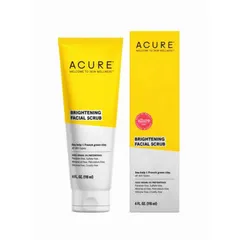
Acure Brightening Facial Scrub This Product Is a facial scrub to help cleanse and detox your skin Good For all skin types, particularly dry or dull skin Why We Love It Acure Brightening Facial Scrub uses sea kelp super-nutrients to soften and detox the skin, while lemon peel and French green clay cleanse.
Source: Credo Beauty
This product works by removing dirt and oil from the surface of the skin. It uses a combination of mild cleansing agents (glyceryl laurate, sodium cocoyl isethionate, sodium lauroamphoacetate, sodium lauroyl lactylate, sodium methyl cocoyl taurate) and should be able to cleanse the skin gently. Still keep in mind that any cleansing can disrupt the skin barrier, and most people do not need to cleanse their skin more than once per day.
Even though this formulation is mild, the following cleansing agents could trigger an irritation or allergy for some people: sodium methyl cocoyl taurate
Helps water and oil mix together and has an anti-microbial effect helping to preserve product formulations
Helps water and oil mix together. Can be used as a cleansing agent
Helps water and oil mix together
Helps oil and water mix together. Can be used as cleansing agent
Exfoliation
What does the product description say?
Brightening Facial Scrub
Source: From product name
This product does not contain effective exfoliating ingredients. It might be able to deliver physical exfoliation, that is scrub off some of the dead cells on the surface of the skin. We do not recommend physical exfoliation, because it is not uniform (some bits of skin can get exfoliated too much while others not at all). It can also traumatize the skin and aggrevate acne and other skin conditions.
How honest is this product?
| Promise | Can it deliver? |
|---|---|
| Cleansing | |
| Exfoliation |
Total Promises Fulfilled score: 50/100.
We receive a small commission for purchases made through these links at no cost for you. Thank you for your support! Learn more
Potential irritants
Comedogenic ingredients
User reviews (0)
Averages from community submissions.
No reviews yet for this product.
Be the first to share your experience!
Tried this product?
Help capture what the ingredient list can't—texture, finish, pilling, scent, and more. Answer what you can, skip the rest.
Takes ~30 seconds.
Reviews are shown in aggregate. No personal details.
Key Actives
A type of clay that consists mainly of aluminum silicate. Helps absorb oil and creates a thicker product consistency. Can be used to add a white color
A plant extract that can help neutralize free radicals in skin and even out the skin tone, but is typically used in products in a concentration that is too low to be effective
One of the best moisturizing ingredients. Naturally present in skin. It attracts water to the upper layer of the skin working as a humectant
Helps oil and water mix together. Can be used as cleansing agent
Naturally present in skin and helps to attract water to its upper layer
Helps water and oil mix together
Helps water and oil mix together and has an anti-microbial effect helping to preserve product formulations
Helps water and oil mix together. Can be used as a cleansing agent
Red algae extract that helps attract water to the upper layer of the skin and create a nicer product consistency
A great emollient due to its high linoleic acid content. One of the most effective plant oils in helping skin hydration and repairing skin barrier function
Potential irritants
Helps oil and water mix together. Can be used as cleansing agent
A plant extract that has some anti-oxidant and anti-bacterial properties. Can be irritating
Plant extract that can have healing and anti-inflammatory properties. It is a potential allergen and can be irritating
Plant extract that can be irritating and is a known allergen
Traditionally used to treat sunburns, dermatitis and inflammation, but evidence for its effectiveness is lacking. The extract can contain humectants that help attract water into the skin
Helps water and oil mix together and has an anti-microbial effect helping to preserve product formulations
Helps water and oil mix together. Can be used as a cleansing agent
An emollient that helps soften the skin but is not effective for restoring its barrier function. Might be helpful to calm down inflammation
A plant extract that can have some anti-oxidant effect in skin
A plant extract that might help neutralize free radicals in skin
A plant extract that might have some anti-oxidant properties, but evidence is lacking
A plant extract that can help neutralize free radicals in skin and even out the skin tone, but is typically used in products in a concentration that is too low to be effective
A plant extract that can help to attract water to the upper layer of the skin and might have some anti-oxidant and anti-inflammatory properties
Comedogenic ingredients
Red algae extract that helps attract water to the upper layer of the skin and create a nicer product consistency
A plant extract that can help to attract water to the upper layer of the skin and might have some anti-oxidant and anti-inflammatory properties
All ingredients
Traditionally used to treat sunburns, dermatitis and inflammation, but evidence for its effectiveness is lacking. The extract can contain humectants that help attract water into the skin
One of the best moisturizing ingredients. Naturally present in skin. It attracts water to the upper layer of the skin working as a humectant
Helps oil and water mix together. Can be used as cleansing agent
A type of clay that consists mainly of aluminum silicate. Helps absorb oil and creates a thicker product consistency. Can be used to add a white color
Can absorb oil. There is no research confirming other benefits for the skin
Naturally present in skin and helps to attract water to its upper layer
Helps water and oil mix together and has an anti-microbial effect helping to preserve product formulations
Helps water and oil mix together. Can be used as a cleansing agent
An emollient that helps soften the skin but is not effective for restoring its barrier function. Might be helpful to calm down inflammation
A plant extract that can have some anti-oxidant effect in skin
A plant extract that might help neutralize free radicals in skin
A plant extract that might have some anti-oxidant properties, but evidence is lacking
A plant extract that can help neutralize free radicals in skin and even out the skin tone, but is typically used in products in a concentration that is too low to be effective
A plant extract that has some anti-oxidant and anti-bacterial properties. Can be irritating
Plant extract that can have healing and anti-inflammatory properties. It is a potential allergen and can be irritating
Plant extract that might have help to neutralize free radicals in skin, but evidence of effectiveness is skin is lacking
Red algae extract that helps attract water to the upper layer of the skin and create a nicer product consistency
A plant extract that can help to attract water to the upper layer of the skin and might have some anti-oxidant and anti-inflammatory properties
A great emollient due to its high linoleic acid content. One of the most effective plant oils in helping skin hydration and repairing skin barrier function
Plant extract that can be irritating and is a known allergen
Used to create thicker product consistency and stabilize emulsions
Helps form a film on the surface of the skin and disperse other ingredients (like colorants) in cosmetics. Lac is a resinous substance secreted by parasite insects living on trees
Ingredient list view
Water, Aloe barbadensis leaf juice, Glycerin, Sodium methyl cocoyl taurate, Juglans regia shell powder, Kaolin, Clay, Sodium lauroamphoacetate, Citrus limon peel, Sodium pca, Sodium lauroyl lactylate, Glyceryl laurate, Sodium cocoyl isethionate, Olea europaea fruit oil, Laminaria digitata powder, Unknown, Euterpe oleracea fruit extract, Rubus fruticosus fruit extract, Rosa canina fruit extract, Punica granatum extract, Calendula officinalis flower extract, Chamomilla recutita flower extract, Aspalathus linearis leaf extract, Unknown, Chondrus crispus extract, Argania spinosa callus culture extract, Chlorella vulgaris extract, Helianthus annuus seed oil, Cymbopogon flexuosus leaf oil, Mentha viridis leaf oil, Salvia sclarea oil, Lavandula hybrida oil, Cellulose gum, Sodium levulinate, Lac, Potassium sorbate
- Glycerol and the skin: holistic approach to its origin and functions
- Safety Assessment of Alkyl Taurate Amides and Taurate Salts as Used in Cosmetics
- Final Report on the Safety Assessment of Sodium Cocoyl Isethionate
- Use of “natural” oils for moisturization: Review of olive, coconut, and sunflower seed oil
- Total Oxidant Scavenging Capacity of Euterpe oleracea Mart. (Açaí) Seeds and Identification of Their Polyphenolic Compounds
- Euterpe oleracea, Matricaria chamomilla, and Camellia sinensis as promising ingredients for development of skin care formulations
- Extract of Punica granatum inhibits skin photoaging induced by UVB irradiation
- Topical microemulsion containing Punica granatum extract: its control over skin erythema and melanin in healthy Asian subjects
- Safety Assessment of Punica granatum -Derived Ingredients as Used in Cosmetics
- Topical application of Calendula officinalis (L.): Formulation and evaluation of hydrophilic cream with antioxidant activity
- The seamy side of natural medicines: contact sensitization to arnica (Arnica montana L.) and marigold (Calendula officinalis L.)
- Final report on the safety assessment of Calendula officinalis extract and Calendula officinalis
- Contact dermatitis as an adverse reaction to some topically used European herbal medicinal products – part 1: Achillea millefolium–Curcuma longa
- Rooibos (Aspalathus linearis) beyond the farm gate: From herbal tea to potential phytopharmaceutical
- Effect of Olive and Sunflower Seed Oil on the Adult Skin Barrier: Implications for Neonatal Skin Care
- Topically Applied Sunflower Seed Oil Prevents Invasive Bacterial Infections in Preterm Infants in Egypt
- Effect of topically applied lipids on surfactant-irritated skin
- Impact of topical oils on the skin barrier: possible implications for neonatal health in developing countries