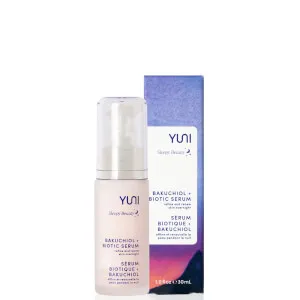
YUNI Sleepy Beauty Bakuchiol and Biotic Serum

YUNI Sleepy Beauty Bakuchiol and Biotic Serum

Efficacy87/100IrritancyHigh

Works for

Anti-aging
Bakuchiol
Works well
What the product description says
“Bakuchiol is used to support increased cell turnover and help stimulate collagen production, and has been described as a natural retinol alternative.”
Source: Recreate Yourself

This product can help reduce and prevent fine lines and wrinkles, improve skin elasticity and firmness because it contains bakuchiol.

Keep in mind that it typically takes at least 6 weeks to notice any results because the changes that are needed to improve fine lines and elasticity happen in the deeper layers of the skin. No topical anti-aging product can “erase” wrinkles or fully reverse signs of aging.

BakuchiolKey activeEffect: HighA plant extract that is, though different in chemical structure, acts similar to retinoids. First studies show that it can help reduce fine lines and wrinkles, improve skin tone, reduce clogged pores and blemishes, and reduce inflammation. There is no conclusive evidence that bakuchiol is as effective as retinol however. The study that directly compared retinol with bakuchiol used bakuchiol applied twice daily compared to once per day for the retinol. According to this study, bakuchiol is less irritating than retinol. Bakuchiol is extracted from seeds of Babchi plant. Other parts of the plant contain coumarins that could cause allergic and irritant reactions. These compounds should be removed in the extraction process when bakuchiol is produced, but it is a good idea to be cautious and stay away from products that include the Babchi plant extracts other than purified bakuchiol to avoid irritation~1.6–2.3%
Moisturizing
Glycerin, Galactoarabinan + 4 more
Works
What the product description says
“Biotic actives deliver probiotic benefits to help reinforce skin’s natural protective barrier.”
Source: Recreate Yourself

This product contains good ingredients to attract water to the upper layer of the skin. These ingredients are called "humectants": galactoarabinan, glycerin.

When humectants are on the surface of the skin, they “pull in” the moisture from the outside environment, or from within deeper layers of the skin. If the air is dry, humectants can speed up the moisture loss from the skin. This is why it is a good idea to use another product on top of this one to help "seal in" the moisture (look for ingredients like dimethicone, squalane, oils and butters).

GlycerinKey active· HumectantEffect: HighOne of the best moisturizing ingredients. Naturally present in skin. It attracts water to the upper layer of the skin working as a humectant~3.7–5.5%
GalactoarabinanKey active· HumectantEffect: HighHelps attract water to the upper layer of the skin~0.55–1.25%
Lactobacillus fermentKey active· HumectantEffect: HighA fermentation product created by bacteria Lactobacillus. The fermented product has anti-bacterial properties and might be helpful in calming down inflammation, but studies are lacking. Helps attract water to the upper layer of the skin. Can be used as a preservative~0.35–0.8%
Polyglyceryl-10 oleateKey activeEffect: MediumHelps soften the upper layer of the skin~0.05–0.25%
Caprylyl glycol· Humectant, EmollientEffect: LowHelps preserve products and creates a nice product texture~0.1–0.35%
Cucumis sativus fruit extractEffect: Low, below effective doseMight be somewhat helpful in reducing hyperpigmentation and neutralizing free radicals but its typical concentration in a product is too low for having an effect~0.1–0.45%
Anti-oxidation
Side benefit · Bakuchiol, Lactobacillus ferment + 1 more
Works well

This product contains antioxidants (bakuchiol) that can help neutralize free radicals in skin. By doing so, they can lessen the damage the skin gets from the UV light (sun).

BakuchiolKey activeEffect: HighA plant extract that is, though different in chemical structure, acts similar to retinoids. First studies show that it can help reduce fine lines and wrinkles, improve skin tone, reduce clogged pores and blemishes, and reduce inflammation. There is no conclusive evidence that bakuchiol is as effective as retinol however. The study that directly compared retinol with bakuchiol used bakuchiol applied twice daily compared to once per day for the retinol. According to this study, bakuchiol is less irritating than retinol. Bakuchiol is extracted from seeds of Babchi plant. Other parts of the plant contain coumarins that could cause allergic and irritant reactions. These compounds should be removed in the extraction process when bakuchiol is produced, but it is a good idea to be cautious and stay away from products that include the Babchi plant extracts other than purified bakuchiol to avoid irritation~1.6–2.3%
Lactobacillus fermentEffect: LowA fermentation product created by bacteria Lactobacillus. The fermented product has anti-bacterial properties and might be helpful in calming down inflammation, but studies are lacking. Helps attract water to the upper layer of the skin. Can be used as a preservative~0.35–0.8%
Cucumis sativus fruit extractEffect: Low, below effective doseMight be somewhat helpful in reducing hyperpigmentation and neutralizing free radicals but its typical concentration in a product is too low for having an effect~0.1–0.45%
Evens skin tone
Side benefit · Bakuchiol
Works well

This product can help reduce hypepigmentation and even out the skin tone because it contains the following effective ingredients: bakuchiol

Keep in mind that you would need to apply any topical skincare targetted at hypigmentation consistently for a couple of months to get a result. No topical skincare product can help get rid of hyperpigmentation (including post-acne marks and age spots) instantly.

BakuchiolKey activeEffect: HighA plant extract that is, though different in chemical structure, acts similar to retinoids. First studies show that it can help reduce fine lines and wrinkles, improve skin tone, reduce clogged pores and blemishes, and reduce inflammation. There is no conclusive evidence that bakuchiol is as effective as retinol however. The study that directly compared retinol with bakuchiol used bakuchiol applied twice daily compared to once per day for the retinol. According to this study, bakuchiol is less irritating than retinol. Bakuchiol is extracted from seeds of Babchi plant. Other parts of the plant contain coumarins that could cause allergic and irritant reactions. These compounds should be removed in the extraction process when bakuchiol is produced, but it is a good idea to be cautious and stay away from products that include the Babchi plant extracts other than purified bakuchiol to avoid irritation~1.6–2.3%
Anti-blemish
Side benefit · Bakuchiol
May help

This product might be able to help reduce blemishes and clogged pores because it contains bakuchiol.

BakuchiolKey activeEffect: HighA plant extract that is, though different in chemical structure, acts similar to retinoids. First studies show that it can help reduce fine lines and wrinkles, improve skin tone, reduce clogged pores and blemishes, and reduce inflammation. There is no conclusive evidence that bakuchiol is as effective as retinol however. The study that directly compared retinol with bakuchiol used bakuchiol applied twice daily compared to once per day for the retinol. According to this study, bakuchiol is less irritating than retinol. Bakuchiol is extracted from seeds of Babchi plant. Other parts of the plant contain coumarins that could cause allergic and irritant reactions. These compounds should be removed in the extraction process when bakuchiol is produced, but it is a good idea to be cautious and stay away from products that include the Babchi plant extracts other than purified bakuchiol to avoid irritation~1.6–2.3%

Can it cause trouble?

Irritancy
4 strong irritants: Withania somnifera root extract, Rosa damascena extract + 2 more — patch-test recommended
High risk
We flagged 16 ingredients with irritancy potential. Severity depends on your sensitivity threshold; the table lists the worst offenders first.
IngredientFunctionIrritationEst. amount
Withania somnifera root extract—High~1.3–1.9%est.
Chamomilla recutita flower extractPlant extract that can have healing and anti-inflammatory properties. It is a potential allergen and can be irritatingHigh~0.9–1.35%est.
Rosa damascena extractOil of a very fragrant pink rose used as fragrance in cosmetics. Extensive research has shown it has mixed benefits. In the pro column, inhaling this flower’s scent seems to have relaxing properties and the plant’s petals contain skin-soothing and antioxidant compounds that can benefit skin. On the flipside, the numerous chemicals that create this rose’s distinctive fragrance pose a risk of causing skin aggravation.High~0.2–0.7%est.
Decyl glucosideHelps oil and water mix together. Can be irritatingHigh~0.15–0.55%est.
CitronellolA fragrance. Can be irritatingHigh~0.01–0.05%est.
GeraniolA fragrance. Can be irritatingHigh~0.01–0.05%est.
Citric acidCan work as an exfoliant but is typically used to adjust the product pHMedium~3.4–5.1%est.
1,2-hexanediolA preservativeMedium~1.1–1.7%est.
BakuchiolA plant extract that is, though different in chemical structure, acts similar to retinoids. First studies show that it can help reduce fine lines and wrinkles, improve skin tone, reduce clogged pores and blemishes, and reduce inflammation. There is no conclusive evidence that bakuchiol is as effective as retinol however. The study that directly compared retinol with bakuchiol used bakuchiol applied twice daily compared to once per day for the retinol. According to this study, bakuchiol is less irritating than retinol. Bakuchiol is extracted from seeds of Babchi plant. Other parts of the plant contain coumarins that could cause allergic and irritant reactions. These compounds should be removed in the extraction process when bakuchiol is produced, but it is a good idea to be cautious and stay away from products that include the Babchi plant extracts other than purified bakuchiol to avoid irritationMedium~1.6–2.3%est.
GalactoarabinanHelps attract water to the upper layer of the skinMedium~0.55–1.25%est.
Cucumis sativus fruit extractMight be somewhat helpful in reducing hyperpigmentation and neutralizing free radicals but its typical concentration in a product is too low for having an effectMedium~0.1–0.45%est.
HydroxyacetophenoneUsed to increase effectiveness of preservativesMedium~0.1–0.4%est.
Caprylyl/capryl glucosideHelps oil and water mix together. Can be used as a cleansing agentMedium~0.15–0.55%est.
Polyglyceryl-10 laurateHelps water and oil mix togetherMedium~0.1–0.4%est.
Lauryl glucosideHelps oil and water mix togetherMedium~0.1–0.5%est.
Caprylyl glycolHelps preserve products and creates a nice product textureMedium~0.1–0.35%est.
Comedogenic
Clean of flagged comedogenic ingredients
None flagged

User reviews

Would you recommend?
No community reviews yet.

Be the first — your take helps the next person decide.

Ingredients

Filter by role to see what each ingredient is doing.

Water~40–60%
Formula
Irritation risk
Low

Plain old water

More about Water
Glycerin~3.7–5.5%
Key active
Irritation risk
Low
Works for
Moisturizing

One of the best moisturizing ingredients. Naturally present in skin. It attracts water to the upper layer of the skin working as a humectant

More about Glycerin
Citric acid~3.4–5.1%
Irritant · medium
Irritation risk
Medium

Can work as an exfoliant but is typically used to adjust the product pH

More about Citric acid
Polyacrylate crosspolymer-11~2.5–3.8%
Formula
Irritation risk
Low

Helps stabilize product formulations

More about Polyacrylate crosspolymer-11
1,2-hexanediol~1.1–1.7%
Irritant · medium
Irritation risk
Medium

A preservative

More about 1,2-hexanediol
Bakuchiol~1.6–2.3%
Key activeIrritant · medium
Irritation risk
Medium
Works for
Anti-oxidationAnti-inflammatoryAnti-blemishEvens skin toneAnti-aging

A plant extract that is, though different in chemical structure, acts similar to retinoids. First studies show that it can help reduce fine lines and wrinkles, improve skin tone, reduce clogged pores and blemishes, and reduce inflammation. There is no conclusive evidence that bakuchiol is as effective as retinol however. The study that directly compared retinol with bakuchiol used bakuchiol applied twice daily compared to once per day for the retinol. According to this study, bakuchiol is less irritating than retinol. Bakuchiol is extracted from seeds of Babchi plant. Other parts of the plant contain coumarins that could cause allergic and irritant reactions. These compounds should be removed in the extraction process when bakuchiol is produced, but it is a good idea to be cautious and stay away from products that include the Babchi plant extracts other than purified bakuchiol to avoid irritation

More about Bakuchiol
Withania somnifera root extract~1.3–1.9%
Irritant · high
Passiflora incarnata fruit extract~1.1–1.7%
Formula
Chamomilla recutita flower extract~0.9–1.35%
Irritant · high
Irritation risk
High
Works for
Anti-inflammatory

Plant extract that can have healing and anti-inflammatory properties. It is a potential allergen and can be irritating

More about Chamomilla recutita flower extract
Galactoarabinan~0.55–1.25%
Key activeIrritant · medium
Irritation risk
Medium
Works for
Moisturizing

Helps attract water to the upper layer of the skin

More about Galactoarabinan
Lactobacillus ferment~0.35–0.8%
Key active
Irritation risk
Low
Works for
MoisturizingAnti-inflammatoryAnti-oxidationReduces irritation

A fermentation product created by bacteria Lactobacillus. The fermented product has anti-bacterial properties and might be helpful in calming down inflammation, but studies are lacking. Helps attract water to the upper layer of the skin. Can be used as a preservative

More about Lactobacillus ferment
Rosa damascena extract~0.2–0.7%
Irritant · high
Irritation risk
High

Oil of a very fragrant pink rose used as fragrance in cosmetics. Extensive research has shown it has mixed benefits. In the pro column, inhaling this flower’s scent seems to have relaxing properties and the plant’s petals contain skin-soothing and antioxidant compounds that can benefit skin. On the flipside, the numerous chemicals that create this rose’s distinctive fragrance pose a risk of causing skin aggravation.

More about Rosa damascena extract
Cucumis sativus fruit extract~0.1–0.45%
Irritant · medium
Irritation risk
Medium
Works for
Anti-oxidationMoisturizing

Might be somewhat helpful in reducing hyperpigmentation and neutralizing free radicals but its typical concentration in a product is too low for having an effect

More about Cucumis sativus fruit extract
Hydroxyacetophenone~0.1–0.4%
Irritant · medium
Irritation risk
Medium

Used to increase effectiveness of preservatives

More about Hydroxyacetophenone
Decyl glucoside~0.15–0.55%
Irritant · high
Irritation risk
High
Works for
Cleansing

Helps oil and water mix together. Can be irritating

More about Decyl glucoside
Maltodextrin~0.1–0.35%
Formula
Irritation risk
Low
Works for
Mattifying

Used to stabilize the product formulation and can help absorb oil

More about Maltodextrin
Caprylyl/capryl glucoside~0.15–0.55%
Irritant · medium
Irritation risk
Medium
Works for
Cleansing

Helps oil and water mix together. Can be used as a cleansing agent

More about Caprylyl/capryl glucoside
Polyglyceryl-10 laurate~0.1–0.4%
Irritant · medium
Irritation risk
Medium
Works for
Cleansing

Helps water and oil mix together

More about Polyglyceryl-10 laurate
Lauryl glucoside~0.1–0.5%
Irritant · medium
Irritation risk
Medium
Works for
Cleansing

Helps oil and water mix together

More about Lauryl glucoside
Mica~0.1–0.35%
Formula
Irritation risk
Low

Creates an illusion of smoother and more radiant skin tone. Adds shimmer to the skin by reflecting light

More about Mica
Polyglyceryl-10 oleate~0.05–0.25%
Key active
Irritation risk
Low
Works for
Moisturizing

Helps soften the upper layer of the skin

More about Polyglyceryl-10 oleate
Xylitol~0.05–0.25%
Formula
Irritation risk
Low

Helps attract water to the upper layer of the skin and repair the skin barrier function

More about Xylitol
Caprylic acid~0.1–0.4%
Formula
Irritation risk
Low
Works for
Cleansing
More about Caprylic acid
Caprylyl glycol~0.1–0.35%
Irritant · medium
Irritation risk
Medium
Works for
Moisturizing

Helps preserve products and creates a nice product texture

More about Caprylyl glycol
Iron oxides~0.05–0.2%
Formula
Irritation risk
Low
Works for
Sun protection

An umbrella term for the following three colorants: CI 77491, CI 77492, CI 77499. They might be able to offer some protection against visible light, but the degree of the protection is not clear

More about Iron oxides
Titanium dioxide~0.1–0.4%
Formula
Irritation risk
Low
Works for
Sun protection

Works as a UV filter when used in high concentrations. It is photostable and is effective mostly against the UVB light, with some protection in the UVA range. In small concentrations, used for its ability to improve the color of cosmetic products. Is usually well tolerated by the skin

More about Titanium dioxide
Silica~0.1–0.45%
Formula
Irritation risk
Low

Used to absorb oil and can temporarily mattify skin

More about Silica
Tin oxide~0.1–0.3%
Formula
Irritation risk
Low

A colorant that can add a pearl-like appearance to the formulation

More about Tin oxide
Citronellol~0.01–0.05%
Irritant · high
Irritation risk
High

A fragrance. Can be irritating

More about Citronellol
Geraniol~0.01–0.05%
Irritant · high
Irritation risk
High

A fragrance. Can be irritating

More about Geraniol
Ingredient list view

Water, Glycerin, Citric acid, Polyacrylate crosspolymer-11, 1,2-hexanediol, Bakuchiol, Withania somnifera root extract, Passiflora incarnata fruit extract, Chamomilla recutita flower extract, Galactoarabinan, Lactobacillus ferment, Rosa damascena extract, Cucumis sativus fruit extract, Hydroxyacetophenone, Decyl glucoside, Maltodextrin, Caprylyl/capryl glucoside, Polyglyceryl-10 laurate, Lauryl glucoside, Mica, Polyglyceryl-10 oleate, Xylitol, Caprylic acid, Caprylyl glycol, Iron oxides, Titanium dioxide, Silica, Tin oxide, Citronellol, Geraniol

Compare prices

Retailers ranked by price — lowest first.

🇦🇺 Recreate Yourself (AU)30 ml
≈ $28.27 Out of stock
Check

Affiliate links · As an Amazon Associate, WIMJ earns from qualifying purchases.

Worth comparing, line by line.

Match % combines shared ingredients, the first five ingredients, shared actives and hero ingredients, irritancy (lower counts in the alternative's favour), texture and body area. Only products in the same routine step are compared.

Side-by-side comparison of this product against its closest alternatives
YUNISleepy Beauty Bakuchiol and Biotic SerumYOUR PRODUCTFollainFIRMING SERUM: Collagen BoostBy WishtrendPore Smoothing Bakuchiol SerumRoutinelyReset bakuchiol serum
Match—92%91%91%
Price——$13.00$54.73
Shared key ingredients—3 of 42 of 42 of 4
Key difference—NiacinamideNiacinamideDiglycerin
Irritancy High Medium Medium Low
Drying alcohol————
View product Shop Shop Shop

More alternatives: SKIN&LAB retinol repair serumViegano Bakuchiol + Tocopherol Vegan Revitalizing Serum

Cheaper alternatives? See how this stacks up against similar formulas.
We compare ingredient profiles across our catalog — pick the closest match for your budget.
Open dupe finder

Sources cited in this review

Every concentration estimate and effectiveness label is anchored to one of these 12 studies and safety reviews.

  1. 1
  2. 2
  3. 3
  4. 4
  5. 5
  6. 6
YUNI Sleepy Beauty Bakuchiol and Biotic Serum
YUNISleepy Beauty Bakuchiol and Biotic Serum

Affiliate links · As an Amazon Associate, WIMJ earns from qualifying purchases.

As an Amazon Associate, WIMJ earns from qualifying purchases.