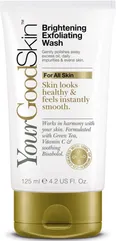
Works for
CleansingCocamidopropyl betaine, Lauryl glucoside + 6 moreCleanses gently
“Brightening Exfoliating Wash”
This product works by removing dirt and oil from the surface of the skin. It uses a combination of mild cleansing agents (cocamidopropyl betaine, coco-glucoside, disodium laureth sulfosuccinate, glyceryl oleate, lauryl glucoside, sodium cocoamphoacetate, xanthan gum) and should be able to cleanse the skin gently. Still keep in mind that any cleansing can disrupt the skin barrier, and most people do not need to cleanse their skin more than once per day.
Even though this formulation is mild, the following cleansing agents could trigger an irritation or allergy for some people: cocamidopropyl betaine, coco-glucoside, glyceryl oleate
ExfoliationNo ingredient credited for this claimNot delivered
“Brightening Exfoliating Wash”
This product does not contain effective exfoliating ingredients. It might be able to deliver physical exfoliation, that is scrub off some of the dead cells on the surface of the skin. We do not recommend physical exfoliation, because it is not uniform (some bits of skin can get exfoliated too much while others not at all). It can also traumatize the skin and aggrevate acne and other skin conditions.
Can it cause trouble?
Irritancy11 flagged ingredientsLow risk
ComedogenicClean of flagged comedogenic ingredientsNone flagged
User reviews
Be the first — your take helps the next person decide.
Ingredients
Filter by role to see what each ingredient is doing.
Water~40–60%
Glycerin~4–6%
- Irritation risk
- Low
One of the best moisturizing ingredients. Naturally present in skin. It attracts water to the upper layer of the skin working as a humectant
More about GlycerinCocamidopropyl betaine~4.8–7.2%
- Irritation risk
- High
Helps water and oil mix together. Used as a cleansing ingredient. Could be an allergen
More about Cocamidopropyl betaineLauryl glucoside~3.3–4.9%
Disodium laureth sulfosuccinate~2.2–3.3%
Sodium cocoamphoacetate~1.8–2.8%
- Irritation risk
- Medium
Helps oil and water mix together and works as a cleansing agent. Creates foam
More about Sodium cocoamphoacetateSodium chloride~1.5–2.2%
- Irritation risk
- Low
Used to stabilize mixtures of oil and water, and create thicker, gel-like product textures
More about Sodium chloridePolyacrylate crosspolymer-6~1.2–1.9%
- Irritation risk
- Low
Coco-glucoside~1.1–1.6%
- Irritation risk
- High
Used as a cleansing agent (surfactant) in cleansers. Helps water and oil mix together in lotions. Can be irritating
More about Coco-glucosideHydrated silica~1–1.6%
Glyceryl oleate~0.5–1.15%
- Irritation risk
- High
Helps oil and water mix together. Can be irritating
More about Glyceryl oleateCitric acid~0.4–0.9%
- Irritation risk
- Medium
Can work as an exfoliant but is typically used to adjust the product pH
More about Citric acidPhenoxyethanol~0.35–0.8%
- Irritation risk
- Low
A preservative. It helps prevent bacterial growth in cosmetic products
More about PhenoxyethanolBetaine~0.3–0.75%
- Irritation risk
- Low
Helps attract water to the upper layer of the skin and improves the product texture
More about BetaineXanthan gum~0.2–0.75%
- Irritation risk
- Low
Used to create a thicker product consistency
More about Xanthan gumPanthenol~0.2–0.75%
- Irritation risk
- Low
Helps attract water to the upper layer of the skin and can help improve skin barrier function
More about PanthenolSodium benzoate~0.25–0.5%
Ascorbyl glucoside~0.15–0.55%
- Irritation risk
- Medium
A vitamin C derivative that is more stable but less potent than pure form of vitamin C. Has a potential to boost collagen production, nutralise free radicals and reduce hyperpigmentation, but the required concentration is likely to be much higher than for the pure form of vitamin C, limiting the ingredient's effectiveness in products
More about Ascorbyl glucosideTetrasodium edta~0.1–0.5%
Bisabolol~0.1–0.4%
- Irritation risk
- Low
An active component of chamomile plant that historically has been used to calm down irritated skin. A recent study shows that bisabolol indeed can have some anti-inflammatory effect on skin, even though conclusive data is lacking. Bisabolol has a sweet floral scent and can be added to products for its aromatic properties
More about BisabololT-butyl alcohol~0.1–0.4%
- Irritation risk
- Medium
Used to dissolve other ingredients and to improve smell of products. It could be irritating
More about T-butyl alcoholPotassium hydroxide~0.1–0.4%
Camellia sinensis leaf extract~0.1–0.35%
- Irritation risk
- Low
Can contain potent anti-oxidant compounds (abbreviated ECG, GCG, EGC, and EGCG) that might help protect the skin from free radicals. Can help calm down inflammation and has some anti-bacterial properties. Unfortunately, these antioxidants are unstable and lose their effectiveness very quickly in products. The concentration of the antioxidant compounds in the extract also tends to be low to be effective in topical formulation
More about Camellia sinensis leaf extractLecithin~0.1–0.4%
- Irritation risk
- Low
Used mostly for creating emulsions - helping oil and water mix together. Helps soften the upper layer of the skin
More about LecithinAscorbyl palmitate~0.05–0.2%
- Irritation risk
- Medium
Being a lipid soluble form of vitamin C, it is more stable and can penetrate the skin better than L-Ascorbic acid. It is effective in protecting the skin from free radicals, as well as evening the skin tone, but is less effective in stimulating collagen production compared to L-Ascorbic acid.
More about Ascorbyl palmitateTocopherol~0.05–0.2%
- Irritation risk
- Low
Pure form of vitamin E. Can help moisturise and protect the skin from free radicals. Often used to help stabilise other ingredients or the formula itself
More about TocopherolHydrogenated palm glycerides citrate~0.05–0.25%
- Irritation risk
- Low
Helps soften the upper layer of the skin
More about Hydrogenated palm glycerides citrateIngredient list view
Water, Glycerin, Cocamidopropyl betaine, Lauryl glucoside, Disodium laureth sulfosuccinate, Sodium cocoamphoacetate, Sodium chloride, Polyacrylate crosspolymer-6, Coco-glucoside, Hydrated silica, Glyceryl oleate, Citric acid, Phenoxyethanol, Betaine, Xanthan gum, Panthenol, Sodium benzoate, Ascorbyl glucoside, Tetrasodium edta, Bisabolol, T-butyl alcohol, Potassium hydroxide, Camellia sinensis leaf extract, Lecithin, Ascorbyl palmitate, Tocopherol, Hydrogenated palm glycerides citrate
Compare prices
Retailers ranked by price — lowest first.
Worth comparing, line by line.
Match % combines shared ingredients, the first five ingredients, shared actives and hero ingredients, irritancy (lower counts in the alternative's favour), texture and body area. Only products in the same routine step are compared.
| YourGoodSkinBrightening Exfoliating WashYOUR PRODUCT | NaturiumThe Calmer Ceramide Body Wash | Pierre Fabre Health CareDexeryl Essentiel Cleansing Cream | Spotles SKNJelly Cleanser | |
|---|---|---|---|---|
| Match | — | 32% | 31% | 31% |
| Price | — | $14.43 | $6.61 | $8.90 |
| Shared key ingredients | — | 5 of 13 | 6 of 13 | 5 of 13 |
| Key difference | — | Ceramide Eop | Mineral Oil | Gluconolactone |
| Irritancy | Low | Low | Low | Low |
| Drying alcohol | — | — | — | — |
| View product | Shop | Shop | Shop |


More alternatives: Alphanova Baby Organic Nourishing Foaming GelSkincare by Dr V Micellar Gel Wash
Sources cited in this review
Every concentration estimate and effectiveness label is anchored to one of these 12 studies and safety reviews.
- 1
- 2
- 3Allergen of the Year—Alkyl Glucosidepracticeupdate.com
- 4
- 5Skin moisturizing effects of panthenol-based formulationspdfs.semanticscholar.org
- 6

Affiliate links · As an Amazon Associate, WIMJ earns from qualifying purchases.