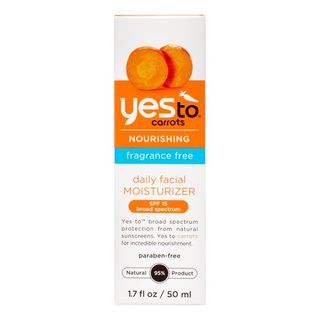
Yes to Carrots Daily Moisturizer SPF15 Fragrance Free
Works for
1 of 2 advertised claims delivered
Sun protectionSPF 15 · 2 UV filters · Broad spectrumWeak protectionSPF under 30
This product offers broad spectrum sun protection, but it is weak. We recommend to use a broad spectrum sunscreen with at least SPF 30.
This product can be considered "reef safe" because it does not contain the UV filters (oxybenzone and octinoxate) that can be harmful to coral reefs when present in the water in high concentrations.
Moisturizing14 ingredients credited for this claimGood support
“Carrots Daily Moisturizer SPF15 Fragrance Free”
This product can help improve hydration of the skin with the two types of ingredients.
The first type is called “humectants”:
these ingredients help attract water.
When humectants are on the surface of the skin, they “pull in” the moisture from the outside environment, or from
within deeper layers of the skin. The following ingredients in this product do the job:
glycerin, aloe barbadensis leaf juice.
This product also contains ingredients called “occlusives”. They help reduce the speed with which our skin loses moisture to the outside environment. These ingredients also help soften the upper layer of the skin, so it feels less tight and nicer to the touch. The following ingredients in this product do the job: butyrospermum parkii butter, caprylic/capric triglyceride.
Can it cause trouble?
Irritancy8 flagged ingredientsLow risk
Comedogenic4 ingredients rated 2 or more on the 0–5 pore-clogging scale4 flagged
User reviews
Be the first — your take helps the next person decide.
Ingredients
Filter by role to see what each ingredient is doing.
Zinc oxide3.2%
- Irritation risk
- Low
A broad spectrum sunblock (protects from both UVA and UVB rays). Is suitable for most sensitive skins. In small concentrations, can be used as a colorant
More about Zinc oxideTitanium dioxide2.9%
- Irritation risk
- Low
Works as a UV filter when used in high concentrations. It is photostable and is effective mostly against the UVB light, with some protection in the UVA range. In small concentrations, used for its ability to improve the color of cosmetic products. Is usually well tolerated by the skin
More about Titanium dioxideWater~45–55%
Ethylhexyl palmitate~5.1–6.2%
- Irritation risk
- Low
- Comedogenicity
- 3/5
An emollient that helps soften the skin and create a nice product texture
More about Ethylhexyl palmitateAloe barbadensis leaf juice~4.6–5.6%
- Irritation risk
- Medium
Traditionally used to treat sunburns, dermatitis and inflammation, but evidence for its effectiveness is lacking. The extract can contain humectants that help attract water into the skin
More about Aloe barbadensis leaf juiceHelianthus annuus seed oil~3.7–4.5%
- Irritation risk
- Low
A great emollient due to its high linoleic acid content. One of the most effective plant oils in helping skin hydration and repairing skin barrier function
More about Helianthus annuus seed oilGlycerin~3.1–3.8%
- Irritation risk
- Low
One of the best moisturizing ingredients. Naturally present in skin. It attracts water to the upper layer of the skin working as a humectant
More about GlycerinCaprylic/capric triglyceride~2.6–3.2%
- Irritation risk
- Medium
A good mix of fatty acids that forms a protective layer on the skin. Improves the shelf life of products. Derived from coconut and glycerin
More about Caprylic/capric triglycerideCetearyl alcohol~2.2–2.7%
- Irritation risk
- Low
- Comedogenicity
- 2/5
A non-drying alcohol. Works as an emollient. Helps water and oil mix together and creates a nice product texture
More about Cetearyl alcoholPrunus amygdalus dulcis oil~1.9–2.4%
- Irritation risk
- Low
An emollient that softens the skin
More about Prunus amygdalus dulcis oilMagnesium aluminum silicate~1.6–2%
- Irritation risk
- Low
Might be helpful in restoring skin barrier function and, when combined with zinc carbonate and malonic acid, reducing fine lines and wrinkles by stimulating elastin production. Also helps stabilize the product formulation
More about Magnesium aluminum silicateCoco-glucoside~1.3–1.6%
- Irritation risk
- High
Used as a cleansing agent (surfactant) in cleansers. Helps water and oil mix together in lotions. Can be irritating
More about Coco-glucosidePhenoxyethanol~0.5–1%
- Irritation risk
- Low
A preservative. It helps prevent bacterial growth in cosmetic products
More about PhenoxyethanolDaucus carota sativa root extract~0.8–1.2%
- Irritation risk
- Low
Carrot extract. Might have anti-oxidant properties and be used to add orange color
More about Daucus carota sativa root extractCucurbita pepo seed oil~0.75–1.1%
- Irritation risk
- Low
Helps soften the upper layer of the skin
More about Cucurbita pepo seed oilButyrospermum parkii butter~0.7–1.05%
- Irritation risk
- Low
- Comedogenicity
- 3/5
A great moisturising ingredient that softens the skin and reduces water loss from its upper layer. It also can be helpful in protecting skin from free radicals
More about Butyrospermum parkii butterCetyl alcohol~0.6–0.95%
- Irritation risk
- Low
A non-drying alcohol that works to soften the skin and stabilize product formulations helping oil and water mix together
More about Cetyl alcoholXanthan gum~0.6–0.85%
- Irritation risk
- Low
Used to create a thicker product consistency
More about Xanthan gumCyamopsis tetragonoloba gum~0.6–0.85%
- Irritation risk
- Low
Maris limus extract~0.55–0.85%
- Irritation risk
- Low
Glycine soja oil~0.55–0.8%
- Irritation risk
- Medium
- Comedogenicity
- 2/5
A good emollient that helps soften the skin and helps repair its barrier function. It can clog pores if used in high concentrations.
More about Glycine soja oilTocopherol~0.5–0.75%
- Irritation risk
- Low
Pure form of vitamin E. Can help moisturise and protect the skin from free radicals. Often used to help stabilise other ingredients or the formula itself
More about TocopherolAluminum hydroxide~0.5–0.7%
- Irritation risk
- Low
Is used to add opaque (non-transparent) appearance to formulations. Can be used to coat other ingredients for even dispersion. This is a different ingredient compared to the ones used in antipersperants (aluminium chloride and aluminium chlorohydrate)
More about Aluminum hydroxideGluconolactone~0.4–0.6%
- Irritation risk
- Medium
A polyhydroxy acid (PHA) that helps shed the dead cells from the skin surface revealing smoother skin. Is believed to be genter than AHAs. It helps attract water to the upper layer of the skin and can stimulate production of skin's own hyaluronic acid resulting in improved hydration levels. It has been shown to be helpful against acne and clogged pores if used consistently (e.g over a period of 12 weeks) in high enough concentration. It can help reduce fine lines and wrinkles and improve skin tone with long-term application. Can help neutralize free radicals
More about GluconolactoneGlyceryl isostearate~0.45–0.7%
Hydrated silica~0.45–0.7%
Polyhydroxystearic acid~0.3–0.55%
- Irritation risk
- Medium
Used to create a thicker product consistency and stabilize the formulation
More about Polyhydroxystearic acidSodium benzoate~0.25–0.4%
Triethoxycaprylylsilane~0.2–0.4%
- Irritation risk
- Low
A type of silicone that helps oil and water mix well together. Helps to disperse other ingredients, e.g. pigments, evenly in a formulation
More about TriethoxycaprylylsilaneCalcium gluconate~0.2–0.4%
- Irritation risk
- Low
Helps attract water to the upper layer of the skin and helps to improve appearance of the product
More about Calcium gluconateCitric acid~0.05–0.15%
- Irritation risk
- Medium
Can work as an exfoliant but is typically used to adjust the product pH
More about Citric acidPotassium hydroxide~0.1–0.2%
Ingredient list view
Zinc oxide, Titanium dioxide, Water, Ethylhexyl palmitate, Aloe barbadensis leaf juice, Helianthus annuus seed oil, Glycerin, Caprylic/capric triglyceride, Cetearyl alcohol, Prunus amygdalus dulcis oil, Magnesium aluminum silicate, Coco-glucoside, Phenoxyethanol, Daucus carota sativa root extract, Cucurbita pepo seed oil, Butyrospermum parkii butter, Cetyl alcohol, Xanthan gum, Cyamopsis tetragonoloba gum, Maris limus extract, Glycine soja oil, Tocopherol, Aluminum hydroxide, Gluconolactone, Glyceryl isostearate, Hydrated silica, Polyhydroxystearic acid, Sodium benzoate, Triethoxycaprylylsilane, Calcium gluconate, Citric acid, Potassium hydroxide
Compare prices
Retailers ranked by price — lowest first.

Affiliate links · prices updated regularly
Worth comparing, line by line.
Match % combines shared ingredients, the first five ingredients, shared actives and hero ingredients, irritancy (lower counts in the alternative's favour), texture and body area. Only products in the same routine step are compared.
| Yes toCarrots Daily Moisturizer SPF15 Fragrance FreeYOUR PRODUCT | NEOSTRATATargeted Treatment Sheer Physical Protection SPF50 Cream | Rodan + FieldsREVERSE Brightening Defense Fluid Lotion SPF 50 | Farmacy BeautyGreen Defense Daily Mineral Sunscreen | |
|---|---|---|---|---|
| Match | — | 53% | 52% | 52% |
| Price | $8.99 | $44.95+$35.96 | $49.50+$40.51 | $36.00+$27.01 |
| Shared key ingredients | — | 4 of 11 | 5 of 11 | 4 of 11 |
| Key difference | — | Lactobionic Acid | Niacinamide | Bisabolol |
| Irritancy | Low | Low | Low | Low |
| SPF | SPF 15 | SPF 50 | SPF 50 | SPF 30 |
| Drying alcohol | — | — | — | — |
| View product | Shop | Shop | Shop |



Product summary
"Yes to - Carrots Daily Moisturizer SPF15 Fragrance Free" offers broad spectrum protection. It means that it protects from both UVA and UVB rays (you can remember UVB as "burning" sunlight - they cause sunburn. You can remember UVA rays as "aging" - they do not lead to sunburn, but they cause photodamage and contribute to early signs of skin aging and hyperpigmentation). On the negative side, the SPF of this moisturizer is not high enough. We recommend to use a sunscreen with at least SPF 30 daily.
Because it includes good moisturizing ingredients, it can also work as a hydrating day cream.
Sunscreen filters
This moisturizer is a mineral sunscreen. It uses titanium dioxide and zinc oxide for sun protection. Both titanium dioxide and zinc oxide almost never irritate even the most sensitive skin and eyes, but can leave a white cast.
Irritation risk
This moisturizer contains actives that can be irritating. We assess the overall irritancy of this moisturizer to be low. For a detailed overview of all potential irritants: click here
You can see the detailed formula review with the breakdown of all actives in the product and the full ingredient list with estimated concentrations in the tables below.
About the brand
According to Cruelty-Free Kitty "Yes to" is cruelty free and so is its parent company.
Price
The product retails for 11.43$ in the United States.
For a detailed price comparison: click here.
Sources cited in this review
Every concentration estimate and effectiveness label is anchored to one of these 29 studies and safety reviews.
- 1A review of inorganic UV filters zinc oxide and titanium dioxideonlinelibrary.wiley.com
- 2
- 3
- 4
- 5
- 6

Affiliate links · As an Amazon Associate, WIMJ earns from qualifying purchases.