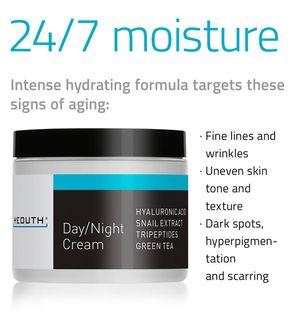
YEOUTH Day/Night Cream with Snail Extract, Hyaluronic Acid, Green Tea, Peptides
Works for
2 of 3 advertised claims delivered
MoisturizingPalmitoyl tripeptide-38, Panthenol + 23 moreStrong evidence
“Day/Night Cream with Snail Extract, Hyaluronic Acid, Green Tea, Peptides”
This product can help improve hydration of the skin with the two types of ingredients.
The first type is called “humectants”:
these ingredients help attract water.
When humectants are on the surface of the skin, they “pull in” the moisture from the outside environment, or from
within deeper layers of the skin. The following ingredients in this product do the job:
glycerin, glycine.
This product also contains ingredients called “occlusives”. They help reduce the speed with which our skin loses moisture to the outside environment. These ingredients also help soften the upper layer of the skin, so it feels less tight and nicer to the touch. The following ingredients in this product do the job: caprylic/capric triglyceride, dimethicone.
The following ingredients in this product are especially good for supporting the skin barrier and helping with the hydration level: copper tripeptide-1, palmitoyl tripeptide-38, panthenol, urea
Anti-agingCopper tripeptide-1, Palmitoyl tripeptide-38 + 3 moreModerate evidence
“Green tea has superb antioxidant and anti-aging benefits that can help protect the skin from signs of aging by neutralizing damaging free radicals.”
This product contains copper tripeptide-1, palmitoyl tripeptide-38. These ingredients might be able to help reduce and prevent fine lines and wrinkles, improve skin elasticity and firmness, but there is not enough evidence that it actually works.
Evens skin toneGlycine soja protein, Camellia sinensis leaf extractLimited evidence
“Watch the appearance of fine lines, wrinkles, hyperpigmentation, and scars fade with regular use.”
This product contains ingredients (glycine soja protein) that could help reduce hyperpigmentation (for example, post-acne marks or age spots) in theory, but there is not enough evidence that they actually work.
Anti-oxidationNot advertised by the brand · Camellia sinensis extract, Glycine soja protein + 5 moreModerate evidence
This product contains antioxidants (camellia sinensis extract) that might be able to help neutralize free radicals in skin to lessen the damage it gets from the UV light (sun). There is not enough evidence to confirm their effectiveness in skin though.
Can it cause trouble?
Irritancy2 strong irritants: Arnica montana flower extract, ParfumMedium risk
Comedogenic2 ingredients rated 2 or more on the 0–5 pore-clogging scale2 flagged
User reviews
Be the first — your take helps the next person decide.
Ingredients
Filter by role to see what each ingredient is doing.
Water~45–55%
Glycerin~4.7–5.7%
- Irritation risk
- Low
One of the best moisturizing ingredients. Naturally present in skin. It attracts water to the upper layer of the skin working as a humectant
More about GlycerinCaprylic/capric triglyceride~4.2–5.1%
- Irritation risk
- Medium
A good mix of fatty acids that forms a protective layer on the skin. Improves the shelf life of products. Derived from coconut and glycerin
More about Caprylic/capric triglycerideButylene glycol~3–3.7%
- Irritation risk
- Low
Used to create a nice product texture and help delivery of other ingredients. Might be somewhat helpful in attracting water to the upper layer of the skin
More about Butylene glycolCetearyl alcohol~2.4–2.9%
- Irritation risk
- Low
- Comedogenicity
- 2/5
A non-drying alcohol. Works as an emollient. Helps water and oil mix together and creates a nice product texture
More about Cetearyl alcoholCoco-caprylate/caprate~2–2.4%
- Irritation risk
- Low
Helps to soften the upper layer of the skin without creating a greasy texture
More about Coco-caprylate/caprateGlyceryl stearate~1.7–2%
- Irritation risk
- Low
An emollient that softens the skin and forms a protective layer on its surface. Helps water and oil mix together
More about Glyceryl stearateDimethicone~1.6–1.9%
- Irritation risk
- Low
A silicone that helps to reduce water loss from the surface of the skin. Can temporarily "fill in" lines and wrinkles, absorb oil, and create a nice product finish
More about DimethiconeStearic acid~1.3–1.6%
- Irritation risk
- Low
Helps oil and water mix together and works as an emollient
More about Stearic acidCetearyl olivate~1–1.2%
Sorbitan olivate~0.7–1.05%
Glycerin~0.65–0.95%
- Irritation risk
- Low
One of the best moisturizing ingredients. Naturally present in skin. It attracts water to the upper layer of the skin working as a humectant
More about GlycerinHydroxypropyl cyclodextrin~0.6–0.85%
- Irritation risk
- Medium
Used to stabilize product formulations and help soften the upper layer of the skin
More about Hydroxypropyl cyclodextrinPalmitoyl tripeptide-38~0.5–0.7%
- Irritation risk
- Low
A type of peptide. Peptides are excellent moisturizers and might be able support collagen production reducing fine lines and wrinkles
More about Palmitoyl tripeptide-38Sodium hyaluronate~0.45–0.7%
- Irritation risk
- Low
One of the best moisturizing ingredients. Attracts water into the upper layer of the skin
More about Sodium hyaluronatePanthenol~0.45–0.65%
- Irritation risk
- Low
Helps attract water to the upper layer of the skin and can help improve skin barrier function
More about PanthenolGlycine~0.4–0.65%
- Irritation risk
- Low
Helps to attract water to the upper layer of the skin and can help restore the skin barrier function
More about GlycineSorbitol~0.35–0.65%
- Irritation risk
- Low
Helps attract water to the upper layer of the skin and improves the product texture
More about SorbitolGlycine soja protein~0.4–0.6%
- Irritation risk
- Low
A plant extract that helps to attract water to the upper layer of the skin and soften it. It might be helpful in neutralizing free radicals. It might be somewhat helpful for evening out the skin tone. It might be able to support elastin production but solid research is lacking
More about Glycine soja proteinCopper tripeptide-1~0.3–0.55%
- Irritation risk
- Low
A naturally occurring peptide. One of the most studied peptides in dermatology. It is sometimes abbreviated GHK-Cu. Belongs to the class of carrier peptides. It stimulates both synthesis and breakdown of collagen in skin. It is released in skin wounds and inflammation to support healing. It accelerates wound-healing of the skin and can stimulate hair growth. There are preliminary studies that confirm that copper tripeptide can help support collagen production reducing fine lines and wrinkles and decrease inflammation in skin.
More about Copper tripeptide-1Snail secretion filtrate~0.3–0.5%
- Irritation risk
- Medium
Typically contains hyaluronic acid that helps attract water to the upper layer of the skin. Might contain allantoin that is helpful in calming down inflammation. There is no evidence that it can have any further benefits for the skin, especially when used in skincare products
More about Snail secretion filtrateOryza sativa bran oil~0.3–0.55%
- Irritation risk
- Low
Helps soften the upper layer of the skin and might have some anti-oxidant properties
More about Oryza sativa bran oilSimmondsia chinensis seed oil~0.3–0.55%
- Irritation risk
- Medium
Softens the upper layer of skin and helps restore the healthy skin barrier. Has shown to help calm down inflammation in skin. It is a stable oil, meaning that it retains its properties even when exposed to air.
More about Simmondsia chinensis seed oilPolyacrylamide~0.3–0.55%
- Irritation risk
- Medium
Used to improve product texture and help oil and water mix together
More about PolyacrylamideC13-14 isoparaffin~0.3–0.55%
- Irritation risk
- Low
Helps soften the upper layer of the skin, dissolve other ingredients and create a thicker product consistency
More about C13-14 isoparaffinLaureth-7~0.25–0.5%
Sodium hydroxide~0.25–0.45%
Carbomer~0.25–0.5%
- Irritation risk
- Low
Helps create a thicker or gel-like product texture. It is not a surfactant but can be used in gentle cleansing formulations
More about CarbomerCarrageenan~0.3–0.5%
- Irritation risk
- Medium
- Comedogenicity
- 3/5
Helps thicken the product formula and create a nice product formulation
More about CarrageenanAvena sativa kernel extract~0.25–0.5%
- Irritation risk
- Low
An effective moisturizing and skin barrier repair ingredient. Helps calm down inflammation and has some anti-oxidant properties
More about Avena sativa kernel extractArnica montana flower extract~0.2–0.4%
- Irritation risk
- High
A plant extract that can be irritating. It can have some anti-bacterial properties, but there are no evidence of a beneficial effect for skin
More about Arnica montana flower extractRubus idaeus fruit extract~0.25–0.4%
- Irritation risk
- Medium
A fruit extract that might have some anti-oxidant properties but evidence of effectiveness in skin is lacking
More about Rubus idaeus fruit extractCamellia sinensis leaf extract~0.25–0.5%
- Irritation risk
- Low
Can contain potent anti-oxidant compounds (abbreviated ECG, GCG, EGC, and EGCG) that might help protect the skin from free radicals. Can help calm down inflammation and has some anti-bacterial properties. Unfortunately, these antioxidants are unstable and lose their effectiveness very quickly in products. The concentration of the antioxidant compounds in the extract also tends to be low to be effective in topical formulation
More about Camellia sinensis leaf extractAnthemis nobilis flower extract~0.2–0.4%
- Irritation risk
- High
A plant extract that one one hand, can contain compounds that can help calm down skin irritation, but, on the other hand, its other compounds (especially fragrant ones) can themselves be irritating
More about Anthemis nobilis flower extractCamellia sinensis extract~0.25–0.45%
- Irritation risk
- Low
Tea extract. Might be helpful in neutralizing free radicals in skin
More about Camellia sinensis extractPanax ginseng root extract~0.25–0.5%
- Irritation risk
- High
A plant extract that might have some anti-inflammatory properties, but solid evidence is lacking. It can be irritating
More about Panax ginseng root extractCentella asiatica extract~0.3–0.5%
- Irritation risk
- Medium
A plant extract that has been shown to be able to reduce inflammation in skin, support restoration of skin barrier function, as well as support collagen production. Contains active compounds called centelloids: asiaticoside, madecasosside, asiatic acid and madecassic acid. Might be helpful in preventing stretch marks. It can be itself be irritating though.
More about Centella asiatica extractUrea~0.25–0.45%
- Irritation risk
- Low
Naturally present in skin (urea makes up about 7% of natural moisturizing factors in skin). Attracts water to the upper layer of the skin. Also has a positive effect on the skin barrier beyond the humectant action. Can enhance penetration of other ingredients. Is an exfoliating ingredient when used in high concentrations
More about UreaPhenoxyethanol~0.25–0.45%
- Irritation risk
- Low
A preservative. It helps prevent bacterial growth in cosmetic products
More about PhenoxyethanolEthylhexylglycerin~0.25–0.45%
Disodium edta~0.2–0.4%
Parfum~0.2–0.35%
- Irritation risk
- High
An aromatic blend of unspecified and possibly irritating ingredients
More about ParfumParaffinum liquidum~0.2–0.4%
- Irritation risk
- Low
Mineral oil. One of the most effective and well studied occlusive and emollient moisturizing ingredients. Helps reduce moisture loss in skin and repair skin barrier function
More about Paraffinum liquidumTriclosan~0.15–0.3%
- Irritation risk
- Low
Polyethylene~0.3–0.5%
Glycol~0.15–0.3%
- Irritation risk
- Low
Formaldehyde~0.15–0.3%
- Irritation risk
- Low
Urea~0.1–0.2%
- Irritation risk
- Low
Naturally present in skin (urea makes up about 7% of natural moisturizing factors in skin). Attracts water to the upper layer of the skin. Also has a positive effect on the skin barrier beyond the humectant action. Can enhance penetration of other ingredients. Is an exfoliating ingredient when used in high concentrations
More about UreaIngredient list view
Water, Glycerin, Caprylic/capric triglyceride, Butylene glycol, Cetearyl alcohol, Coco-caprylate/caprate, Glyceryl stearate, Dimethicone, Stearic acid, Cetearyl olivate, Sorbitan olivate, Glycerin, Hydroxypropyl cyclodextrin, Palmitoyl tripeptide-38, Sodium hyaluronate, Panthenol, Glycine, Sorbitol, Glycine soja protein, Copper tripeptide-1, Snail secretion filtrate, Oryza sativa bran oil, Simmondsia chinensis seed oil, Polyacrylamide, C13-14 isoparaffin, Laureth-7, Sodium hydroxide, Carbomer, Carrageenan, Avena sativa kernel extract, Arnica montana flower extract, Rubus idaeus fruit extract, Camellia sinensis leaf extract, Anthemis nobilis flower extract, Camellia sinensis extract, Panax ginseng root extract, Centella asiatica extract, Urea, Unknown, Phenoxyethanol, Ethylhexylglycerin, Disodium edta, Parfum, Paraffinum liquidum, Triclosan, Polyethylene, Glycol, Formaldehyde, Unknown, Urea
Compare prices
Retailers ranked by price — lowest first.

Affiliate links · prices updated regularly
Product summary
"YEOUTH - Day/Night Cream with Snail Extract, Hyaluronic Acid, Green Tea, Peptides" is a well-rounded moisturizing product. The formulation is based on a combination of good humectants and emollients. Both are needed to increase the skin hydration level. Panthenol, urea, glycerin, glycine and snail secretion filtrate in this product (humectants) attract water molecules to the upper layer of the skin (the water comes from the outside air or from the deeper layers of the skin if the air is dry). Oryza sativa bran oil, caprylic/capric triglyceride, dimethicone, cetearyl alcohol and coco-caprylate/caprate in this product help decrease the water evoporation from the skin, so that it stays hydrated for longer. These ingredients also soften the skin and take away the feeling of tightness and dryness.
Ingredient callouts
- We like that this moisturizer contains peptides (copper tripeptide-1 0.30% - 0.55% and palmitoyl tripeptide-38 0.50% - 0.70%). There are many different kind of peptides and they are naturally present in our skin. They all are a combination of amino-acids. Some of them work as natural anti-biotics, promote wound-healing and production of collagen. The science is still not settled on how effective peptides in skincare are, but it is very likely that they have a benefit. Peptides might help restore the skin barrier and fight the signs of aging. At the very least, peptides work as humectants: they attract water to the upper layer of the skin and improve its hydration.
Irritation risk
This formulation includes some common irritants, including ingredients that do not provide a benefit for the skin. We assess the overall irritancy of this moisturizer to be medium. For a detailed overview of all potential irritants: click here
You can see the detailed formula review with the breakdown of all actives in the product and the full ingredient list with estimated concentrations in the tables below.
Price
The product retails for 136.46A$ in Australia, for 23.60£ in the United Kingdom and for 24.95$ in the United States.
For a detailed price comparison: click here.
Sources cited in this review
Every concentration estimate and effectiveness label is anchored to one of these 35 studies and safety reviews.
- 1
- 2Safety Assessment of Alkyl Esters as Used in Cosmeticscir-safety.org
- 3
- 4Final Report on the Safety Assessment of Dimethicone Copolyoljournals.sagepub.com
- 5Hyaluronic acid: A key molecule in skin agingncbi.nlm.nih.gov
- 6

Affiliate links · As an Amazon Associate, WIMJ earns from qualifying purchases.