Works for
MoisturizingGlycerin, Caprylic/capric triglyceride + 3 moreWorks
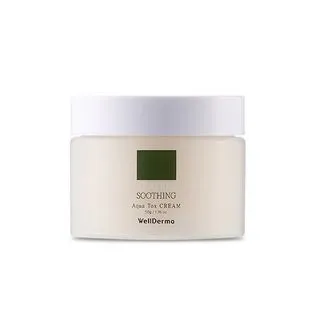
“A moisturizing cream with 10000ppm Tea Tree Extract that instantly soothes dry, blemished skin.”
This product can help improve hydration of the skin with the two types of ingredients.
The first type is called “humectants”:
these ingredients help attract water.
When humectants are on the surface of the skin, they “pull in” the moisture from the outside environment, or from
within deeper layers of the skin. The following ingredients in this product do the job:
glycerin, dextrin.
This product also contains ingredients called “occlusives”. They help reduce the speed with which our skin loses moisture to the outside environment. These ingredients also help soften the upper layer of the skin, so it feels less tight and nicer to the touch. The following ingredients in this product do the job: caprylic/capric triglyceride, dimethicone.
Can it cause trouble?
Irritancy11 strong irritants: Alcohol, Limonene + 9 more — patch-test recommendedHigh risk
Comedogenic2 ingredients rated 2 or more on the 0–5 pore-clogging scale2 flagged
User reviews
Be the first — your take helps the next person decide.
Ingredients
Filter by role to see what each ingredient is doing.
Water~40–60%
Carbomer~6.1–9.1%
- Irritation risk
- Low
Helps create a thicker or gel-like product texture. It is not a surfactant but can be used in gentle cleansing formulations
More about CarbomerAmmonium acryloyldimethyltaurate/vp copolymer~3.8–5.8%
- Irritation risk
- Low
Increases thickness of a product. Texture enhancer for oil-in-water emulsions
More about Ammonium acryloyldimethyltaurate/vp copolymerXanthan gum~2–3%
- Irritation risk
- Low
Used to create a thicker product consistency
More about Xanthan gumGlycerin~2–3%
- Irritation risk
- Low
One of the best moisturizing ingredients. Naturally present in skin. It attracts water to the upper layer of the skin working as a humectant
More about GlycerinHydroxyacetophenone~1.5–2.3%
Disodium edta~0.5–1%
Caprylic/capric triglyceride~1.2–1.8%
- Irritation risk
- Medium
A good mix of fatty acids that forms a protective layer on the skin. Improves the shelf life of products. Derived from coconut and glycerin
More about Caprylic/capric triglycerideDimethicone~0.95–1.45%
- Irritation risk
- Low
A silicone that helps to reduce water loss from the surface of the skin. Can temporarily "fill in" lines and wrinkles, absorb oil, and create a nice product finish
More about DimethiconeCetearyl alcohol~0.55–1.3%
- Irritation risk
- Low
- Comedogenicity
- 2/5
A non-drying alcohol. Works as an emollient. Helps water and oil mix together and creates a nice product texture
More about Cetearyl alcoholC14-22 alcohols~0.45–1%
- Irritation risk
- Low
A non-drying alcohol that helps stabilize product formulations
More about C14-22 alcoholsC12-20 alkyl glucoside~0.35–0.85%
- Irritation risk
- Medium
Helps water and oil mix together
More about C12-20 alkyl glucosideDimethicone/vinyl dimethicone crosspolymer~0.35–0.75%
- Irritation risk
- Low
Used to stabilize product formulations and create a nice product texture
More about Dimethicone/vinyl dimethicone crosspolymerTromethamine~0.2–0.75%
Alcohol~0.2–0.7%
- Irritation risk
- High
Can be drying and contribute to skin irritation. Used in formulars to dissolve other ingredients, create a thinner product consistency or for its antibacterial properties
More about AlcoholEthylhexylglycerin~0.15–0.7%
Limonene~0.15–0.6%
- Irritation risk
- High
A common frangrance that can easily irritate skin, especially if exposed to air, light or heat
More about LimoneneCitrus aurantium dulcis peel oil~0.15–0.6%
- Irritation risk
- High
An essentil oil from orange peel. Potential allergen and can be irritating
More about Citrus aurantium dulcis peel oilCitronellol~0.1–0.45%
Linalool~0.1–0.4%
Citrus aurantium bergamia fruit oil~0.1–0.45%
- Irritation risk
- High
A plant oil with a high content of volatile compounds that can irritate the skin and lead to allergic reactions. Can lead to photosensitivity
More about Citrus aurantium bergamia fruit oilPogostemon cablin oil~0.1–0.35%
- Irritation risk
- Low
Citrus nobilis peel oil~0.1–0.4%
- Irritation risk
- High
A plant oil with high content of volatile compounds that, especially when exposed to air, can cause allergic reactions and irritate the skin
More about Citrus nobilis peel oilGeraniol~0.1–0.4%
Lavandula angustifolia oil~0.1–0.4%
- Irritation risk
- High
An essential oil. Potential allergen and can be irritating. It has some anti-bacterial properties
More about Lavandula angustifolia oilPelargonium graveolens flower oil~0.1–0.35%
- Irritation risk
- High
An essential oil. Can be irritating. Can become an allergen with oxidation
More about Pelargonium graveolens flower oilMenthyl lactate~0.05–0.25%
Melaleuca alternifolia (tea tree) extract~0.05–0.3%
- Irritation risk
- Low
1,2-hexanediol~0.05–0.2%
Dextrin~0.01–0.1%
- Irritation risk
- Low
A sugar that is used to stabilize the product formulation. Can help attract water to the upper layer of the skin
More about DextrinTheobroma cacao extract~0.05–0.1%
- Irritation risk
- Low
- Comedogenicity
- 3/5
Ingredient list view
Water, Carbomer, Ammonium acryloyldimethyltaurate/vp copolymer, Xanthan gum, Glycerin, Hydroxyacetophenone, Disodium edta, Caprylic/capric triglyceride, Dimethicone, Cetearyl alcohol, C14-22 alcohols, C12-20 alkyl glucoside, Dimethicone/vinyl dimethicone crosspolymer, Tromethamine, Alcohol, Ethylhexylglycerin, Limonene, Citrus aurantium dulcis peel oil, Citronellol, Linalool, Citrus aurantium bergamia fruit oil, Pogostemon cablin oil, Citrus nobilis peel oil, Geraniol, Lavandula angustifolia oil, Pelargonium graveolens flower oil, Menthyl lactate, Melaleuca alternifolia (tea tree) extract, 1,2-hexanediol, Dextrin, Theobroma cacao extract
Worth comparing, line by line.
Match % combines shared ingredients, the first five ingredients, shared actives and hero ingredients, irritancy (lower counts in the alternative's favour), texture and body area. Only products in the same routine step are compared.
| WelldermaTeaTree Soothing Aqua Tox CreamYOUR PRODUCT | SimpleWater Boost Skin Quench Night Cream for Dehyrdated Skin | CiracleAnti-Redness K Cream | ZYMOGENNutri Active Ferment Cream | |
|---|---|---|---|---|
| Match | — | 45% | 44% | 44% |
| Price | — | — | $23.10 | $22.20 |
| Shared key ingredients | — | 3 of 3 | 3 of 3 | 3 of 3 |
| Key difference | — | Benzophenone-4 | Niacinamide | Adenosine |
| Irritancy | High | Medium | Medium | Medium |
| Drying alcohol | Contains drying alcohol | — | — | — |
| View product | Shop | Shop | Shop |


More alternatives: COSRX The Retinol 0.1 CreamThe Saem Gold Lifting Cream
Sources cited in this review
Every concentration estimate and effectiveness label is anchored to one of these 12 studies and safety reviews.
- 1
- 2
- 3Final Report on the Safety Assessment of Dimethicone Copolyoljournals.sagepub.com
- 4
- 5Safety Assessment of Decyl Glucoside and Other Alkyl Glucosides as Used in Cosmeticsciteseerx.ist.psu.edu
- 6Safety Assessment of Tromethamine as Used in Cosmeticscir-safety.org
