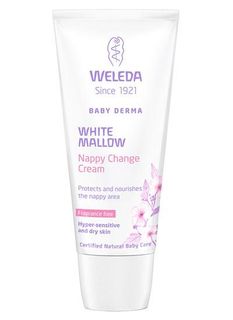
Weleda Baby Derma White Mallow Nappy Change Cream
Works for
1 of 1 advertised claim delivered
Moisturizing13 ingredients credited for this claimStrong support
“What it is Weleda Baby Derma White Mallow Nappy Change Cream is especially formulated for hypersensitive and dry skin to protect and nourish the nappy area.”
This product can help improve hydration of the skin with the two types of ingredients.
The first type is called “humectants”:
these ingredients help attract water.
When humectants are on the surface of the skin, they “pull in” the moisture from the outside environment, or from
within deeper layers of the skin. The following ingredients in this product do the job:
glycerin.
This product also contains ingredients called “occlusives”. They help reduce the speed with which our skin loses moisture to the outside environment. These ingredients also help soften the upper layer of the skin, so it feels less tight and nicer to the touch. The following ingredients in this product do the job: beeswax, cera alba.
The following ingredients in this product are especially good for supporting the skin barrier and helping with the hydration level: lanolin
Can it cause trouble?
Irritancy5 flagged ingredientsLow risk
Comedogenic1 ingredient rated 2 or more on the 0–5 pore-clogging scale1 flagged
User reviews
Be the first — your take helps the next person decide.
Ingredients
Filter by role to see what each ingredient is doing.
Water~45–55%
Zinc oxide~12–15%
- Irritation risk
- Low
A broad spectrum sunblock (protects from both UVA and UVB rays). Is suitable for most sensitive skins. In small concentrations, can be used as a colorant
More about Zinc oxideCocos nucifera oil~5.7–6.9%
- Irritation risk
- Low
- Comedogenicity
- 3/5
An emollient. Found to be as effective as a moisturizer for dry skin as mineral oil. Could be comedogenic
More about Cocos nucifera oilPrunus amygdalus dulcis seed~3.7–4.5%
- Irritation risk
- Low
Helps soften the upper layer of the skin
More about Prunus amygdalus dulcis seedSesamum indicum seed oil~3–3.7%
- Irritation risk
- Low
A good moisturizing plant oil. Due to the high linoleic acid content, it helps soften the upper layer of the skin, reduce water loss and support skin barrier function
More about Sesamum indicum seed oilGlycerin~2.6–3.1%
- Irritation risk
- Low
One of the best moisturizing ingredients. Naturally present in skin. It attracts water to the upper layer of the skin working as a humectant
More about GlycerinLanolin~2.3–2.8%
- Irritation risk
- Low
Sebum of wool-bearing animals (most commonly sheep). Helps soften the upper layer of the skin and reduce the skin water loss. In rare cases could be an allergen. Not suitable for vegans
More about LanolinHydrolyzed beeswax~1.8–2.2%
Glyceryl oleate~1.3–1.5%
- Irritation risk
- High
Helps oil and water mix together. Can be irritating
More about Glyceryl oleateBeeswax~1–1.2%
- Irritation risk
- Low
Forms a protective barrier that holds water and keeps dry skin hydrated. Keeps an emulsion from separating into its oil and liquid components, and increases the thickness of a product. Can be an allergen
More about BeeswaxCera alba~0.8–1.15%
- Irritation risk
- Medium
Forms a protective barrier that holds water and keeps dry skin hydrated. Keeps an emulsion from separating into its oil and liquid components, and increases the thickness of a product. Can be an allergen
More about Cera albaBorago officinalis seed oil~0.6–0.95%
- Irritation risk
- Low
A plant oil that is effective in reducing irritation in skin, restore the barrier function and support its hydration
More about Borago officinalis seed oilHelianthus annuus seed oil unsaponifiables~0.45–0.7%
- Irritation risk
- Low
A great emollient due to its high linoleic acid content. One of the most effective plant oils in helping skin hydration and repairing skin barrier function
More about Helianthus annuus seed oil unsaponifiablesAlthaea officinalis root extract~0.25–0.45%
- Irritation risk
- High
A plant extract that can help attract water to the upper layer of the skin and might help to reduce inflammation
More about Althaea officinalis root extractViola tricolor extract~0.25–0.45%
- Irritation risk
- Medium
A plant extract that might have an anti-inflammatory effect in skin
More about Viola tricolor extractGlyceryl caprylate~0.15–0.3%
- Irritation risk
- Low
An emollient that can also help water and oil mix together, as well as prevent bacteria growth in products
More about Glyceryl caprylateSodium caproyl/lauroyl lactylate~0.2–0.35%
Lactic acid~0.05–0.1%
- Irritation risk
- Medium
An exfoliating and moisturizing alpha-hydroxy acid (AHA). Typically causes less irritation than other AHAs, for example, glycolic acid. At high concentrations (about 15%), lactic acid can help reduce lines and wrinkles. Recent studies show that lactic acid can support the "good" bacteria living on skin's surface (healthy skin microbiome)
More about Lactic acidIngredient list view
Water, Zinc oxide, Cocos nucifera oil, Prunus amygdalus dulcis seed, Sesamum indicum seed oil, Glycerin, Lanolin, Hydrolyzed beeswax, Glyceryl oleate, Beeswax, Cera alba, Borago officinalis seed oil, Helianthus annuus seed oil unsaponifiables, Althaea officinalis root extract, Viola tricolor extract, Glyceryl caprylate, Sodium caproyl/lauroyl lactylate, Lactic acid
Compare prices
Retailers ranked by price — lowest first.
Product summary
Based on the ingredients included, "Weleda - Baby Derma White Mallow Nappy Change Cream" works well for moisturizing the skin. The formulation is based on a combination of good humectants and emollients. Both are needed to increase the skin hydration level. Humectants in this product (glycerin) help to increase the water content in the upper layer of the skin. (These ingredients do so by "capturing" water molecules from the outside air or from within the deeper layers of the skin). Lanolin, borago officinalis seed oil, helianthus annuus seed oil unsaponifiables, sesamum indicum seed oil and beeswax in this product help decrease the water evoporation from the skin, so that it stays hydrated for longer. These ingredients also soften the skin and take away the feeling of tightness and dryness.
Irritation risk
There are actives in this product that can be irritating. We assess the overall irritancy of this moisturizer to be low. For a detailed overview of all potential irritants: click here
You can see the detailed formula review with the breakdown of all actives in the product and the full ingredient list with estimated concentrations in the tables below.
About the brand
According to Cruelty-Free Kitty "Weleda" is cruelty free and so is its parent company.
Price
The product retails for 13.00£ in the United Kingdom.
For a detailed price comparison: click here.
Sources cited in this review
Every concentration estimate and effectiveness label is anchored to one of these 17 studies and safety reviews.
- 1A review of inorganic UV filters zinc oxide and titanium dioxideonlinelibrary.wiley.com
- 2
- 3
- 4
- 5
- 6

Affiliate links · As an Amazon Associate, WIMJ earns from qualifying purchases.