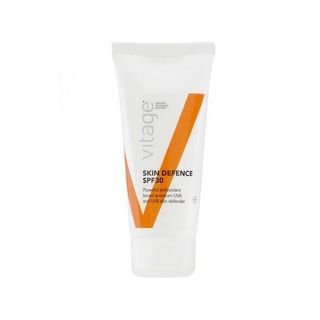
Vitage Skin Defense SPF 30
Works for
2 of 2 advertised claims delivered
Sun protectionSPF 30 · 4 UV filtersBroad spectrum
This product offers a good level of protection against both UVB and UVA rays.
This sunscreen uses organic (so-called "chemical") sunscreen filters. Organic, or "chemical" filters usually provide reliable sun protection and rarely leave a white cast. Sunscreens with organic filters can sting eyes.
Anti-aging3 ingredients credited for this claimStrong evidence
“Vitage Skin Defense SPF 30 is a daily skin defender to help protect against every day environmental stresses that lead to premature skin ageing, containing antioxidant Organic Maté and a potent cocktail ofantioxidant vitamins.”
This product can help prevent early signs of skin aging because it offers a good level of broad spectrum sun protection. Sun damage is the main cause of premature skin aging, and protecting your skin from the sun is the best anti-aging strategy.
Evens skin toneNot advertised by the brand · 1 ingredient credited for this claimStrong evidence
This product offers broad spectrum sun protection. It means that it can prevent hyperpigmentation and help keep the skin tone even (sun damage is the main factor causing age spots, darkening of post-acne marks and other discolorations).
MoisturizingNot advertised by the brand · 14 ingredients credited for this claimGood evidence
This product can help improve hydration of the skin with the two types of ingredients.
The first type is called “humectants”:
these ingredients help attract water.
When humectants are on the surface of the skin, they “pull in” the moisture from the outside environment, or from
within deeper layers of the skin. The following ingredients in this product do the job:
glycerin, sodium hyaluronate.
This product also contains ingredients called “occlusives”. They help reduce the speed with which our skin loses moisture to the outside environment. These ingredients also help soften the upper layer of the skin, so it feels less tight and nicer to the touch. The following ingredients in this product do the job: dimethicone, methicone.
Anti-oxidationNot advertised by the brand · 3 ingredients credited for this claimModerate evidence
This product contains antioxidants (ilex paraguariensis leaf extract, malpighia punicifolia fruit extract) that might be able to help neutralize free radicals in skin to lessen the damage it gets from the UV light (sun). There is not enough evidence to confirm their effectiveness in skin though.
Can it cause trouble?
Irritancy13 strong irritants: Parfum, Rosa damascena extract + 11 more — patch-test recommendedHigh risk
Comedogenic2 ingredients rated 2 or more on the 0–5 pore-clogging scale2 flagged
User reviews
Be the first — your take helps the next person decide.
Ingredients
Filter by role to see what each ingredient is doing.
Water~45–55%
Ethylhexyl methoxycinnamate~6.3–7.6%
- Irritation risk
- High
Octinoxate. When used in higher concentrations, works as a sunscreen protecting the skin from UVB rays. When used in lower concentration, helps to preserve the product formulation. Is shown to be harmful to coral reefs - consider avoiding bathing in coral reef areas when wearing a product with this ingredient. It can be irritating
More about Ethylhexyl methoxycinnamateEthylhexyl stearate~4.7–5.8%
- Irritation risk
- Low
Helps soften the upper layer of the skin
More about Ethylhexyl stearateButyl methoxydibenzoylmethane~3.7–4.5%
- Irritation risk
- Medium
Avobenzone. An organic, or so-called "chemical" UV filter. Protects against both UVA and UVB rays. Needs to be combined with other filters in a formulation to be stable.
More about Butyl methoxydibenzoylmethaneZinc oxide~3.8–4.6%
- Irritation risk
- Low
A broad spectrum sunblock (protects from both UVA and UVB rays). Is suitable for most sensitive skins. In small concentrations, can be used as a colorant
More about Zinc oxideCetearyl alcohol~2.2–2.7%
- Irritation risk
- Low
- Comedogenicity
- 2/5
A non-drying alcohol. Works as an emollient. Helps water and oil mix together and creates a nice product texture
More about Cetearyl alcoholCyclopentasiloxane~2–2.4%
- Irritation risk
- Low
A silicone that helps improve the product texture and spreadability. Can absorb oil creating a short-term mattifying effect on the skin
More about CyclopentasiloxaneGlyceryl stearate~1.7–2.1%
- Irritation risk
- Low
An emollient that softens the skin and forms a protective layer on its surface. Helps water and oil mix together
More about Glyceryl stearatePeg-100 stearate~1.4–1.7%
- Irritation risk
- Low
Helps oil and water mix togehter and creates a nice product texture
More about Peg-100 stearateDimethicone~1.3–1.5%
- Irritation risk
- Low
A silicone that helps to reduce water loss from the surface of the skin. Can temporarily "fill in" lines and wrinkles, absorb oil, and create a nice product finish
More about DimethiconeCaprylic/capric triglyceride~0.9–1.1%
- Irritation risk
- Medium
A good mix of fatty acids that forms a protective layer on the skin. Improves the shelf life of products. Derived from coconut and glycerin
More about Caprylic/capric triglyceridePotassium cetyl phosphate~0.65–1%
- Irritation risk
- Medium
Helps oil and water mix together
More about Potassium cetyl phosphateAloe barbadensis leaf juice~0.5–0.75%
- Irritation risk
- Medium
Traditionally used to treat sunburns, dermatitis and inflammation, but evidence for its effectiveness is lacking. The extract can contain humectants that help attract water into the skin
More about Aloe barbadensis leaf juicePhenoxyethanol~0.45–0.7%
- Irritation risk
- Low
A preservative. It helps prevent bacterial growth in cosmetic products
More about PhenoxyethanolRhus verniciflua peel wax~0.45–0.65%
- Irritation risk
- Low
Caprylyl glycol~0.45–0.7%
- Irritation risk
- Medium
Helps preserve products and creates a nice product texture
More about Caprylyl glycolPeg-10 dimethicone~0.45–0.7%
- Irritation risk
- Low
A silicone that works to soften the upper layer of the skin and reduce its water loss
More about Peg-10 dimethiconePolyacrylate-15~0.4–0.65%
- Irritation risk
- Low
Hexylglycerin~0.3–0.6%
- Irritation risk
- Low
Citric acid~0.3–0.55%
- Irritation risk
- Medium
Can work as an exfoliant but is typically used to adjust the product pH
More about Citric acidXanthan gum~0.3–0.55%
- Irritation risk
- Low
Used to create a thicker product consistency
More about Xanthan gumParfum~0.25–0.45%
- Irritation risk
- High
An aromatic blend of unspecified and possibly irritating ingredients
More about ParfumMethicone~0.25–0.5%
- Irritation risk
- Low
A type of silicone that helps soften the upper layer of the skin and reduces the water loss from the skin surface
More about MethiconeC11-15 pareth-7~0.25–0.5%
C11-15 pareth-40~0.3–0.6%
Disodium edta~0.25–0.5%
Alcohol~0.25–0.45%
- Irritation risk
- High
Can be drying and contribute to skin irritation. Used in formulars to dissolve other ingredients, create a thinner product consistency or for its antibacterial properties
More about AlcoholGlycerin~0.3–0.55%
- Irritation risk
- Low
One of the best moisturizing ingredients. Naturally present in skin. It attracts water to the upper layer of the skin working as a humectant
More about GlycerinSodium laureth-12 sulfate~0.55–0.85%
Disodium lauryl sulfosuccinate~0.3–0.55%
- Irritation risk
- Medium
Used as a cleansing agent. Helps water and oil mix together
More about Disodium lauryl sulfosuccinateLecithin~0.3–0.55%
- Irritation risk
- Low
Used mostly for creating emulsions - helping oil and water mix together. Helps soften the upper layer of the skin
More about LecithinLaminaria ochroleuca extract~0.25–0.45%
- Irritation risk
- Low
- Comedogenicity
- 3/5
Helps attract water to the upper layer of the skin
More about Laminaria ochroleuca extractBittern~0.25–0.45%
- Irritation risk
- Low
Rosa damascena extract~0.25–0.45%
- Irritation risk
- High
Oil of a very fragrant pink rose used as fragrance in cosmetics. Extensive research has shown it has mixed benefits. In the pro column, inhaling this flower’s scent seems to have relaxing properties and the plant’s petals contain skin-soothing and antioxidant compounds that can benefit skin. On the flipside, the numerous chemicals that create this rose’s distinctive fragrance pose a risk of causing skin aggravation.
More about Rosa damascena extractMalpighia punicifolia fruit extract~0.25–0.5%
- Irritation risk
- Low
A fruit extract that might help neutralize free radicals. The concentrations typically used in cosmetics are too small to have an effect
More about Malpighia punicifolia fruit extractGuar hydroxypropyltrimonium chloride~0.25–0.5%
- Irritation risk
- Low
Helps water and oil mix together and create a nice product texture
More about Guar hydroxypropyltrimonium chlorideSodium hyaluronate~0.25–0.45%
- Irritation risk
- Low
One of the best moisturizing ingredients. Attracts water into the upper layer of the skin
More about Sodium hyaluronateBht~0.25–0.5%
Tocopheryl acetate~0.3–0.55%
- Irritation risk
- Medium
A more stable but less bio-available form of vitamin E compared to Tocopherol. Might help moisturize and protect the skin from free radicals, but mostly used in low concentrations to stabilize other ingredients.
More about Tocopheryl acetateIlex paraguariensis leaf extract~0.25–0.45%
- Irritation risk
- High
A plant extract that can help neutralize free radicals in skin. Can contain fragrand compounds like linalool that can be irritating
More about Ilex paraguariensis leaf extractMaltodextrin~0.25–0.5%
- Irritation risk
- Low
Used to stabilize the product formulation and can help absorb oil
More about MaltodextrinBenzophenone-4~0.45–0.7%
- Irritation risk
- High
Sulisobenzone. A UV filter. Is typically used to improve the product stability under exposure to UV light. It is effective against both UVA and UVB rays. It can be used is larger concentrations as a sun protection ingredient for the skin, but can be irritating
More about Benzophenone-4Potassium sorbate~0.25–0.5%
Retinyl palmitate~0.25–0.45%
- Irritation risk
- High
Three steps removed from the active form of vitamin A - retinoic acid. To have an effect in the skin, it first needs to be converted twice to become the retinoic acid. This means it is less potent than retinol, but could also be less irritating. Once converted to the retinoic acid in the skin, it helps against all signs of aging, improves skin cell turnover and helps fight blemishes and clogged pores. However, in many cosmetic formulations, it is used in a concentration that is too low to have the full effect
More about Retinyl palmitateBenzyl salicylate~0.2–0.4%
Butylphenyl methylpropional~0.2–0.35%
- Irritation risk
- High
A fragrance. Can trigger allergic reactions and be irritating
More about Butylphenyl methylpropionalHydroxyisohexyl 3-cyclohexene carboxaldehyde~0.15–0.3%
- Irritation risk
- High
A fragrance. Can be irritating
More about Hydroxyisohexyl 3-cyclohexene carboxaldehydeHexyl cinnamal~0.15–0.3%
Linalool~0.15–0.3%
Citronellol~0.15–0.3%
Alpha-isomethyl ionone~0.1–0.2%
- Irritation risk
- High
A fragrance. Potential allergen and can be irritating
More about Alpha-isomethyl iononeEugenol~0.1–0.2%
Ingredient list view
Water, Ethylhexyl methoxycinnamate, Ethylhexyl stearate, Butyl methoxydibenzoylmethane, Zinc oxide, Cetearyl alcohol, Cyclopentasiloxane, Glyceryl stearate, Peg-100 stearate, Dimethicone, Caprylic/capric triglyceride, Potassium cetyl phosphate, Aloe barbadensis leaf juice, Phenoxyethanol, Rhus verniciflua peel wax, Caprylyl glycol, Peg-10 dimethicone, Polyacrylate-15, Hexylglycerin, Citric acid, Xanthan gum, Parfum, Methicone, C11-15 pareth-7, C11-15 pareth-40, Disodium edta, Alcohol, Glycerin, Sodium laureth-12 sulfate, Disodium lauryl sulfosuccinate, Lecithin, Laminaria ochroleuca extract, Bittern, Rosa damascena extract, Malpighia punicifolia fruit extract, Guar hydroxypropyltrimonium chloride, Sodium hyaluronate, Bht, Tocopheryl acetate, Ilex paraguariensis leaf extract, Maltodextrin, Benzophenone-4, Potassium sorbate, Retinyl palmitate, Benzyl salicylate, Butylphenyl methylpropional, Hydroxyisohexyl 3-cyclohexene carboxaldehyde, Hexyl cinnamal, Linalool, Citronellol, Alpha-isomethyl ionone, Eugenol
Compare prices
Retailers ranked by price — lowest first.
Product summary
We believe that "Vitage - Skin Defense SPF 30" can provide reliable sun protection based on the ingredients listed. We love that it can protect from both UVA and UVB rays (not all sunscreens with SPF ratings give UVA protection. UVA rays do not cause sunburn, but still damage our skin and lead to early aging).
It also works as a moisturizer, so you do not have to use an additional hydrating product. Like all broad-spectrum sunscreens, this product has an anti-aging benefit.
Sunscreen filters
This sunscreen uses a mixture of both mineral and organic (so-called "chemical") UV filters. The organic filters in the product are: avobenzone and octinoxate. As for the mineral filters, this sunscreen uses zinc oxide.
Irritation risk
This product contains a bunch of common irritants, including ingredients that do not provide any known benefit for the skin. It might not be the best choice if your skin is sensitive. We assess the overall irritancy of it to be high. For a detailed overview of all potential irritants: click here
You can see the detailed formula review with the breakdown of all actives in the product and the full ingredient list with estimated concentrations in the tables below.
Sources cited in this review
Every concentration estimate and effectiveness label is anchored to one of these 16 studies and safety reviews.
- 1A review of inorganic UV filters zinc oxide and titanium dioxideonlinelibrary.wiley.com
- 2
- 3
- 4
- 5
- 6

Affiliate links · As an Amazon Associate, WIMJ earns from qualifying purchases.