Works for:
based on ingredients and %- Cleansing
Can it cause trouble?
- Irritation risk: high
- Comedogenic risk ingredients: 1
Key actives

Works for
Cleansing
What does the product description say?
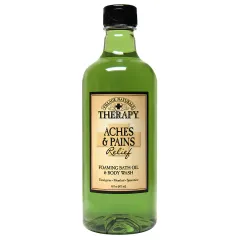
Foaming Bath Oil & Body Wash Aches & Pains Relief
Source: From product name
This product works by removing dirt and oil from the surface of the skin.
It contains the following cleansing agents that tend to be harsh on the skin: sodium laureth sulfate.
Keep in mind that cleansing can disrupt the skin barrier, and most people do not need to cleanse their skin more than once per day.
Used as a cleansing agent. Helps water and oil mix together
Helps oil and water mix together and works as a cleansing agent
Helps dissolve other ingredients
Works as a foaming cleansing agent
How honest is this product?
| Promise | Can it deliver? |
|---|---|
| Cleansing |
Total Promises Fulfilled score: 75/100.
We receive a small commission for purchases made through these links at no cost for you. Thank you for your support! Learn more
Potential irritants
Comedogenic ingredients
User reviews (0)
Averages from community submissions.
No reviews yet for this product.
Be the first to share your experience!
Tried this product?
Help capture what the ingredient list can't—texture, finish, pilling, scent, and more. Answer what you can, skip the rest.
Takes ~30 seconds.
Reviews are shown in aggregate. No personal details.
| Product | Similarity | Price | Irritancy |
|---|---|---|---|
 Village Naturals Therapy Foaming Bath Oil & Body Wash Aches & Pains Relief | Current | $5.99 | |
 La Roche-Posay Lipikar Nourishing Shower Gel | 34% | ≈ $15.40 | |
 Palmolive Naturals Body Wash Milk & Cherry Blossom Shower Gel | 32% | - | |
 Kopari Beauty Coconut Shower Oil | 32% | $17.00 | |
 Carex Nourishing Shower Cream | 32% | ≈ $0.40 | |
 Nivea Japan Cream Care Body Wash Italian Premium Honey | 32% | $17.80 |
Key Actives
Three steps removed from the active form of vitamin A - retinoic acid. To have an effect in the skin, it first needs to be converted twice to become the retinoic acid. This means it is less potent than retinol, but could also be less irritating. Once converted to the retinoic acid in the skin, it helps against all signs of aging, improves skin cell turnover and helps fight blemishes and clogged pores. However, in many cosmetic formulations, it is used in a concentration that is too low to have the full effect
A great emollient that can also have anti-oxidant properties
Works as a foaming cleansing agent
One of the best moisturizing ingredients. Naturally present in skin. It attracts water to the upper layer of the skin working as a humectant
Used as a cleansing agent. Helps water and oil mix together
Helps dissolve other ingredients
Helps oil and water mix together and works as a cleansing agent
Potential irritants
An aromatic blend of unspecified and possibly irritating ingredients
An essential oil that can be very irritating. Has some anti-bacterial properties
Plant extract that can have healing and anti-inflammatory properties. It is a potential allergen and can be irritating
A plant extract that has an anti-bacterial effect
A plant extract that can help calm down inflammation in skin. Can, however, itself be irritating
The most well-researched antioxidant that works in skin. Helps neutralize free radicals supporting collagen production, helping to even out the skin tone and preventing early signs of aging
Three steps removed from the active form of vitamin A - retinoic acid. To have an effect in the skin, it first needs to be converted twice to become the retinoic acid. This means it is less potent than retinol, but could also be less irritating. Once converted to the retinoic acid in the skin, it helps against all signs of aging, improves skin cell turnover and helps fight blemishes and clogged pores. However, in many cosmetic formulations, it is used in a concentration that is too low to have the full effect
Helps oil and water mix together and can enhance the penetration of other ingredients into the skin. It can be irritating
A preservative. Is a frequent allergen in cosmetics
Used as a cleansing agent. Helps water and oil mix together
An emollient that helps soften the skin but is not effective for restoring its barrier function. Might be helpful to calm down inflammation
A great emollient that can also have anti-oxidant properties
Helps oil and water mix together and works as a cleansing agent
A plant extract that might have some anti-oxidant properties, but evidence is lacking
Traditionally used to treat sunburns, dermatitis and inflammation, but evidence for its effectiveness is lacking. The extract can contain humectants that help attract water into the skin
A more stable but less bio-available form of vitamin E compared to Tocopherol. Might help moisturize and protect the skin from free radicals, but mostly used in low concentrations to stabilize other ingredients.
Can work as an exfoliant but is typically used to adjust the product pH
Comedogenic ingredients
All ingredients
One of the best moisturizing ingredients. Naturally present in skin. It attracts water to the upper layer of the skin working as a humectant
Used as a cleansing agent. Helps water and oil mix together
An aromatic blend of unspecified and possibly irritating ingredients
An emollient that helps soften the skin but is not effective for restoring its barrier function. Might be helpful to calm down inflammation
A great emollient that can also have anti-oxidant properties
Helps oil and water mix together and works as a cleansing agent
An essential oil that can be very irritating. Has some anti-bacterial properties
A plant extract that might have some anti-oxidant properties, but evidence is lacking
Traditionally used to treat sunburns, dermatitis and inflammation, but evidence for its effectiveness is lacking. The extract can contain humectants that help attract water into the skin
Plant extract that can have healing and anti-inflammatory properties. It is a potential allergen and can be irritating
A plant extract that has an anti-bacterial effect
A plant extract that can help calm down inflammation in skin. Can, however, itself be irritating
The most well-researched antioxidant that works in skin. Helps neutralize free radicals supporting collagen production, helping to even out the skin tone and preventing early signs of aging
A more stable but less bio-available form of vitamin E compared to Tocopherol. Might help moisturize and protect the skin from free radicals, but mostly used in low concentrations to stabilize other ingredients.
Three steps removed from the active form of vitamin A - retinoic acid. To have an effect in the skin, it first needs to be converted twice to become the retinoic acid. This means it is less potent than retinol, but could also be less irritating. Once converted to the retinoic acid in the skin, it helps against all signs of aging, improves skin cell turnover and helps fight blemishes and clogged pores. However, in many cosmetic formulations, it is used in a concentration that is too low to have the full effect
Helps oil and water mix together and can enhance the penetration of other ingredients into the skin. It can be irritating
Helps soften the upper layer of the skin and create a nice product finish
Can work as an exfoliant but is typically used to adjust the product pH
A preservative. Is a frequent allergen in cosmetics
Ingredient list view
Water, Sodium laureth sulfate, Glycerin, Cocamide mea, Cocamidopropyl hydroxysultaine, Peg-6 caprylic/capric glycerides, Parfum, Olea europaea fruit oil, Vitis vinifera seed oil, Olive oil peg-7 esters, Menthol, Camphor, Eucalyptus globulus leaf oil, Mentha viridis leaf oil, Eucalyptus globulus leaf extract, Gaultheria procumbens leaf extract, Rosa canina fruit extract, Aloe barbadensis leaf juice, Chamomilla recutita flower extract, Symphytum officinale leaf extract, Hamamelis virginiana leaf extract, Ascorbic acid, Tocopheryl acetate, Retinyl palmitate, Propylene glycol, Polyquaternium-10, Citric acid, Tetrasodium edta, Methylchloroisothiazolinone, Methylisothiazolinone, Unknown, Ci 17200, Ci 19140
- Surfactants and experimental irritant contact dermatitis
- Glycerol and the skin: holistic approach to its origin and functions
- Use of “natural” oils for moisturization: Review of olive, coconut, and sunflower seed oil
- Symphytum Species: A Comprehensive Review on Chemical Composition, Food Applications and Phytopharmacology
- Propylene Glycol
- Skin-sensitizing and irritant properties of propylene glycol
- Augmentation of sebaceous lipogenesis by an ethanol extract of Grifola frondosa (Maitake mushroom) in hamsters in vivo and in vitro
- Methylisothiazolinone contact allergy: a review
- Analysis of Dyes in Cosmetics: Challenges and Recent Developments