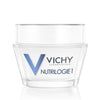
Vichy Nutrilogie 1 Intense Moistursier For Dry Skin
Works for
1 of 1 advertised claim delivered
Moisturizing17 ingredients credited for this claimStrong support
“Nutrilogie 1 Intense Moistursier For Dry Skin”
This product can help improve hydration of the skin with the two types of ingredients.
The first type is called “humectants”:
these ingredients help attract water.
When humectants are on the surface of the skin, they “pull in” the moisture from the outside environment, or from
within deeper layers of the skin. The following ingredients in this product do the job:
arginine pca, glycerin.
This product also contains ingredients called “occlusives”. They help reduce the speed with which our skin loses moisture to the outside environment. These ingredients also help soften the upper layer of the skin, so it feels less tight and nicer to the touch. The following ingredients in this product do the job: dimethicone, cholesterol.
The following ingredients in this product are especially good for supporting the skin barrier and helping with the hydration level: hydroxypalmitoyl sphinganine
Anti-oxidationNot advertised by the brand · 3 ingredients credited for this claimStrong support
This product contains antioxidants (arginine pca) that can help neutralize free radicals in skin. By doing so, they can lessen the damage the skin gets from the UV light (sun).
Anti-agingNot advertised by the brand · 2 ingredients credited for this claimModerate support
This product contains arginine pca. This ingredient help neutralize free radicals in skin. By doing so, they might be able to prevent early signs of aging (like fine lines and wrinkles), at least to some extent. These ingredients will not be able to "reverse" signs of aging.
Can it cause trouble?
Irritancy2 strong irritants: Coriandrum sativum fruit oil, ParfumMedium risk
Comedogenic2 ingredients rated 2 or more on the 0–5 pore-clogging scale2 flagged
User reviews
Be the first — your take helps the next person decide.
Ingredients
Filter by role to see what each ingredient is doing.
Water~45–55%
Prunus armeniaca kernel oil~5–6.1%
- Irritation risk
- Medium
An emollient that helps soften the skin
More about Prunus armeniaca kernel oilIsocetyl stearate~4.1–5%
- Irritation risk
- Low
An emollient that helps soften the skin
More about Isocetyl stearateGlycerin~3–3.7%
- Irritation risk
- Low
One of the best moisturizing ingredients. Naturally present in skin. It attracts water to the upper layer of the skin working as a humectant
More about GlycerinHydrogenated polyisobutene~2.4–3%
- Irritation risk
- Low
Used to improve the product consistency and soften the upper layer of the skin
More about Hydrogenated polyisobuteneSucrose tristearate~2–2.4%
- Irritation risk
- Medium
Helps oil and water mix together
More about Sucrose tristearateDimethicone~1.7–2.1%
- Irritation risk
- Low
A silicone that helps to reduce water loss from the surface of the skin. Can temporarily "fill in" lines and wrinkles, absorb oil, and create a nice product finish
More about DimethiconePolysorbate 61~1.5–1.8%
Stearyl alcohol~1.3–1.6%
- Irritation risk
- Low
An emollient that helps soften the skin
More about Stearyl alcoholBht~0.95–1.2%
Stearic acid~0.95–1.15%
- Irritation risk
- Low
Helps oil and water mix together and works as an emollient
More about Stearic acidMacadamia ternifolia seed oil~0.65–1%
- Irritation risk
- Medium
Plant oil from nuts that helps soften the upper layer of the skin. Contains a high concentration of oleic acid that can weaken skin's barrier function and increase water-loss while enhancing penetration of other ingredients
More about Macadamia ternifolia seed oilCarbomer~0.55–0.85%
- Irritation risk
- Low
Helps create a thicker or gel-like product texture. It is not a surfactant but can be used in gentle cleansing formulations
More about CarbomerGlycine soja oil~0.55–0.8%
- Irritation risk
- Medium
- Comedogenicity
- 2/5
A good emollient that helps soften the skin and helps repair its barrier function. It can clog pores if used in high concentrations.
More about Glycine soja oilTriethanolamine~0.5–0.75%
- Irritation risk
- Medium
Used to adjust pH of the product and can help improve the product's smell
More about TriethanolamineCoriandrum sativum fruit oil~0.45–0.7%
- Irritation risk
- High
A plant oil that is used as a fragrance. Can be irritating
More about Coriandrum sativum fruit oilArginine pca~0.45–0.7%
- Irritation risk
- Low
An amino-acid. Helps attract water to the upper layer of the skin and can help neutralize free radicals in skin
More about Arginine pcaMyristic acid~0.45–0.7%
- Irritation risk
- Medium
- Comedogenicity
- 3/5
Helps oil and water mix together. Could be comedogenic
More about Myristic acidCholesterol~0.45–0.65%
- Irritation risk
- Low
An emollient that is naturally found in skin
More about Cholesterol2-oleamido-1,3-octadecanediol~0.25–0.5%
- Irritation risk
- Low
Helps soften the upper layer of the skin and slow down the water loss over time
More about 2-oleamido-1,3-octadecanediolPalmitic acid~0.3–0.55%
- Irritation risk
- Low
An emollient that is naturally present in skin and helps soften it
More about Palmitic acidSimmondsia chinensis seed oil~0.3–0.5%
- Irritation risk
- Medium
Softens the upper layer of skin and helps restore the healthy skin barrier. Has shown to help calm down inflammation in skin. It is a stable oil, meaning that it retains its properties even when exposed to air.
More about Simmondsia chinensis seed oilPhenoxyethanol~0.2–0.35%
- Irritation risk
- Low
A preservative. It helps prevent bacterial growth in cosmetic products
More about PhenoxyethanolTocopherol~0.2–0.35%
- Irritation risk
- Low
Pure form of vitamin E. Can help moisturise and protect the skin from free radicals. Often used to help stabilise other ingredients or the formula itself
More about TocopherolDisodium edta~0.15–0.25%
Caprylyl glycol~0.15–0.3%
- Irritation risk
- Medium
Helps preserve products and creates a nice product texture
More about Caprylyl glycolHydroxypalmitoyl sphinganine~0.1–0.2%
- Irritation risk
- Low
A type of lipid similar to ceramides naturally present in skin. Helps to soften the upper layer of the skin and supports the skin barrier function to keep it hydrated. Can help to prevent inflammation in skin
More about Hydroxypalmitoyl sphinganinePassiflora edulis seed oil~0.15–0.25%
- Irritation risk
- High
A good emollient helping to soften the skin. Might have some anti-oxidant properties. Adds a fragrance to the product
More about Passiflora edulis seed oilParfum~0.05–0.1%
- Irritation risk
- High
An aromatic blend of unspecified and possibly irritating ingredients
More about ParfumIngredient list view
Water, Prunus armeniaca kernel oil, Isocetyl stearate, Glycerin, Hydrogenated polyisobutene, Sucrose tristearate, Dimethicone, Polysorbate 61, Stearyl alcohol, Bht, Stearic acid, Macadamia ternifolia seed oil, Carbomer, Glycine soja oil, Triethanolamine, Coriandrum sativum fruit oil, Unknown, Arginine pca, Myristic acid, Cholesterol, 2-oleamido-1,3-octadecanediol, Palmitic acid, Simmondsia chinensis seed oil, Phenoxyethanol, Tocopherol, Disodium edta, Caprylyl glycol, Hydroxypalmitoyl sphinganine, Passiflora edulis seed oil, Parfum
Compare prices
Retailers ranked by price — lowest first.

Affiliate links · prices updated regularly
Product summary
"Vichy - Nutrilogie 1 Intense Moistursier For Dry Skin" is effective for: Moisturizing and Anti-oxidation
This moisturizer could be helpful for: Anti-aging, but its actives are not the most effective or are not well-studied.
Price
The product retails for 20.00£ in the United Kingdom.
For a detailed price comparison: click here.
Sources cited in this review
Every concentration estimate and effectiveness label is anchored to one of these 12 studies and safety reviews.
- 1
- 2
- 3
- 4Final Report on the Safety Assessment of Dimethicone Copolyoljournals.sagepub.com
- 5
- 6Oil composition of coriander (Coriandrum sativum L.) fruit-seedslink.springer.com

Affiliate links · As an Amazon Associate, WIMJ earns from qualifying purchases.