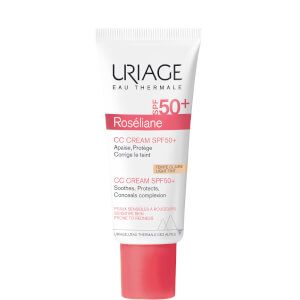
Uriage Roséliane Anti-Redness CC Cream SPF50+
Works for
4 of 4 advertised claims delivered
Sun protectionSPF 50 · 6 UV filtersBroad spectrum
This product offers a good level of protection against both UVB and UVA rays.
This sunscreen uses organic (so-called "chemical") sunscreen filters. Organic, or "chemical" filters usually provide reliable sun protection and rarely leave a white cast. Sunscreens with organic filters can sting eyes.
Anti-agingAsiaticoside, TocopherolStrong evidence
“Roséliane Anti-Redness CC Cream SPF50+”
This product can help prevent early signs of skin aging because it offers a good level of broad spectrum sun protection. Sun damage is the main cause of premature skin aging, and protecting your skin from the sun is the best anti-aging strategy.
These ingredients in the product might also be helpful for reducing and preventing fine lines, wrinkles, and skin elasticity, even though there is no conclusive evidence for their effectiveness: asiaticoside.
MoisturizingPhytosphingosine, Asparagopsis armata extract + 14 moreStrong evidence
“SPF50+ wards off damaging UVA and UVB rays, while the brand’s Thermal Water reinforces the natural moisture barrier.”
This product can help soften the skin and reduce its moisture loss with emollients and occlusives: dimethicone, brassica campestris sterols.
Keep in mind that this product does not contain effective ingredients to attract water to the upper layer of the skin. This is why an additional product with humectants like glycerin or hyaluronic acid can be helpful (apply it before this product for the best results).
The following ingredients in this product are especially good for supporting the skin barrier and helping with the hydration level: phytosphingosine
Evens skin toneNo ingredient credited for this claimStrong evidence
“Easy to apply, the formula helps to conceal the look of redness and uneven tone.”
This product offers broad spectrum sun protection. It means that it can prevent hyperpigmentation and help keep the skin tone even (sun damage is the main factor causing age spots, darkening of post-acne marks and other discolorations).
Anti-oxidationNot advertised by the brand · Asiaticoside, Asparagopsis armata extract + 4 moreStrong evidence
This product contains antioxidants (asiaticoside) that can help neutralize free radicals in skin. By doing so, they can lessen the damage the skin gets from the UV light (sun).
Can it cause trouble?
Irritancy1 strong irritant: ParfumMedium risk
ComedogenicClean of flagged comedogenic ingredientsNone flagged

User reviews
Be the first — your take helps the next person decide.
Ingredients
Filter by role to see what each ingredient is doing.
Water~45–55%
Ci 77891~10–12%
- Irritation risk
- Low
Titanium dioxide~5.9–7.2%
- Irritation risk
- Low
Works as a UV filter when used in high concentrations. It is photostable and is effective mostly against the UVB light, with some protection in the UVA range. In small concentrations, used for its ability to improve the color of cosmetic products. Is usually well tolerated by the skin
More about Titanium dioxideEthylhexyl methoxycinnamate~4.4–5.4%
- Irritation risk
- High
Octinoxate. When used in higher concentrations, works as a sunscreen protecting the skin from UVB rays. When used in lower concentration, helps to preserve the product formulation. Is shown to be harmful to coral reefs - consider avoiding bathing in coral reef areas when wearing a product with this ingredient. It can be irritating
More about Ethylhexyl methoxycinnamateDiethylamino hydroxybenzoyl hexyl benzoate~4.1–5%
- Irritation risk
- Medium
Uvinul A Plus. A new generation broad spectrum sunscreen that offers an effective protection especially in the UVA range. It is stable in formulations. Unfortunately, is not approved by the FDA (US) yet
More about Diethylamino hydroxybenzoyl hexyl benzoateDicaprylyl carbonate~2.9–3.6%
- Irritation risk
- Low
Helps products spread more easily and works as an emollient to soften skin
More about Dicaprylyl carbonateEthylhexyl salicylate~3–3.7%
- Irritation risk
- Low
Octisalate. A UV filter. It offers some protection against the sun rays that cause sunburn (UVB), but does not protect against the most aging sun rays (UVA). It loses its effectiveness quickly when exposed to sunlight. It is an organic, or so called "chemical" sunscreen
More about Ethylhexyl salicylateEthylhexyl triazone~2.6–3.2%
- Irritation risk
- Medium
Uvinul T. A UV filter. Effective against UVB rays. It is photostable. Can increase water resistance properties of the sunscreen. Unfortunately, not approved by the FDA (US) yet
More about Ethylhexyl triazoneDimethicone~1.7–2.1%
- Irritation risk
- Low
A silicone that helps to reduce water loss from the surface of the skin. Can temporarily "fill in" lines and wrinkles, absorb oil, and create a nice product finish
More about DimethiconePolymethyl methacrylate~1.4–1.8%
- Irritation risk
- Low
Is used to enhance product texture and can help to optically mask skin imperfections
More about Polymethyl methacrylateC20-22 alkyl phosphate~1.2–1.4%
C20-22 alcohols~1–1.3%
- Irritation risk
- Low
Hydrogenated palm kernel glycerides~1–1.2%
- Irritation risk
- Low
Help soften the upper layer of the skin
More about Hydrogenated palm kernel glyceridesBis-ethylhexyloxyphenol methoxyphenyl triazine~1.1–1.4%
- Irritation risk
- Medium
Tinosorb S. One of the most effective broad spectrum sunscreen ingredients. Protects from both UVA and UVB rays. It is photostable. Unfortunately, not approved by FDA (US) yet.
More about Bis-ethylhexyloxyphenol methoxyphenyl triazineDiisopropyl sebacate~0.95–1.15%
- Irritation risk
- Low
Helps soften the upper layer of the skin without creatng a greasy finish
More about Diisopropyl sebacatePropylene glycol dicaprylate/dicaprate~0.95–1.2%
- Irritation risk
- Low
C12-15 alkyl benzoate~0.8–1.2%
- Irritation risk
- Low
Enhances the product texture and makes it more spreadable. Helps reduce water loss from the outer layer of skin. Extands the shelf life by preventing bacteria growth
More about C12-15 alkyl benzoateDiisopropyl adipate~0.75–1.15%
- Irritation risk
- Low
Helps soften the upper layer of the skin
More about Diisopropyl adipatePropanediol~0.75–1.1%
- Irritation risk
- Low
Acts as a solvent for other ingredients. Speeds up the absorption of other ingredients into the skin
More about PropanediolCi 77492~0.65–1%
Iron oxides~0.7–1.05%
- Irritation risk
- Low
An umbrella term for the following three colorants: CI 77491, CI 77492, CI 77499. They might be able to offer some protection against visible light, but the degree of the protection is not clear
More about Iron oxidesButylene glycol~0.65–0.95%
- Irritation risk
- Low
Used to create a nice product texture and help delivery of other ingredients. Might be somewhat helpful in attracting water to the upper layer of the skin
More about Butylene glycolPhenoxyethanol~0.65–1%
- Irritation risk
- Low
A preservative. It helps prevent bacterial growth in cosmetic products
More about PhenoxyethanolDecyl glucoside~0.7–1%
- Irritation risk
- High
Helps oil and water mix together. Can be irritating
More about Decyl glucosideTriacontanyl pvp~0.65–0.95%
- Irritation risk
- Low
Hydrogenated palm glycerides~0.7–1%
- Irritation risk
- Low
An emollient that softens the skin
More about Hydrogenated palm glyceridesParfum~0.6–0.9%
- Irritation risk
- High
An aromatic blend of unspecified and possibly irritating ingredients
More about ParfumChlorphenesin~0.16–0.32%
Xanthan gum~0.65–0.95%
- Irritation risk
- Low
Used to create a thicker product consistency
More about Xanthan gumCi 77491~0.6–0.95%
- Irritation risk
- Low
A red colorant made of iron oxide. Typically is not irritating
More about Ci 77491Iron oxides~0.6–0.9%
- Irritation risk
- Low
An umbrella term for the following three colorants: CI 77491, CI 77492, CI 77499. They might be able to offer some protection against visible light, but the degree of the protection is not clear
More about Iron oxidesMica~0.6–0.95%
- Irritation risk
- Low
Creates an illusion of smoother and more radiant skin tone. Adds shimmer to the skin by reflecting light
More about MicaTriethoxycaprylylsilane~0.65–0.95%
- Irritation risk
- Low
A type of silicone that helps oil and water mix well together. Helps to disperse other ingredients, e.g. pigments, evenly in a formulation
More about TriethoxycaprylylsilaneBrassica campestris sterols~0.65–0.95%
- Irritation risk
- Low
Help soften the upper layer of the skin
More about Brassica campestris sterolsO-cymen-5-ol~0.05–0.1%
Tocopheryl acetate~0.6–0.9%
- Irritation risk
- Medium
A more stable but less bio-available form of vitamin E compared to Tocopherol. Might help moisturize and protect the skin from free radicals, but mostly used in low concentrations to stabilize other ingredients.
More about Tocopheryl acetateSodium hydroxide~0.55–0.8%
Ci 77499~0.5–0.8%
Iron oxides~0.5–0.75%
- Irritation risk
- Low
An umbrella term for the following three colorants: CI 77491, CI 77492, CI 77499. They might be able to offer some protection against visible light, but the degree of the protection is not clear
More about Iron oxidesPhytosphingosine~0.55–0.85%
- Irritation risk
- Low
A type of lipid that is naturally present in skin. It might help in repairing skin barrier function and has anti-bacterial effect
More about PhytosphingosineRaspberry seed oil/palm oil aminopropanediol esters~0.5–0.75%
- Irritation risk
- Medium
Helps soften the upper layer of the skin
More about Raspberry seed oil/palm oil aminopropanediol estersSilica~0.6–0.85%
Sorbitol~0.45–0.65%
- Irritation risk
- Low
Helps attract water to the upper layer of the skin and improves the product texture
More about SorbitolAsiaticoside~0.3–0.55%
- Irritation risk
- Medium
An active compound of Centella Asiatica plant extract. In combination with other active compounds of Centella Asiatica extract (madecasosside, asiatic acid and madecassic acid), asiaticoside has been shown to be helpful in wound-healing, restoring skin barrier function and supporting collagen production in skin. It can, however, itself be irritating
More about AsiaticosideBht~0.35–0.65%
Maltodextrin~0.3–0.55%
- Irritation risk
- Low
Used to stabilize the product formulation and can help absorb oil
More about MaltodextrinAsparagopsis armata extract~0.25–0.45%
- Irritation risk
- Low
Red seaweed extract. Can help attract water to the upper layer of the skin and might have some antioxidant effect
More about Asparagopsis armata extractPanax ginseng root extract~0.25–0.45%
- Irritation risk
- High
A plant extract that might have some anti-inflammatory properties, but solid evidence is lacking. It can be irritating
More about Panax ginseng root extractTocopherol~0.2–0.4%
- Irritation risk
- Low
Pure form of vitamin E. Can help moisturise and protect the skin from free radicals. Often used to help stabilise other ingredients or the formula itself
More about TocopherolAscophyllum nodosum extract~0.2–0.35%
- Irritation risk
- Low
Brown seaweed extract. Can help attract water to the upper layer of the skin and might have some antioxidant effect
More about Ascophyllum nodosum extractTin oxide~0.2–0.4%
- Irritation risk
- Low
A colorant that can add a pearl-like appearance to the formulation
More about Tin oxidePotassium sorbate~0.15–0.3%
Ingredient list view
Water, Ci 77891, Titanium dioxide, Ethylhexyl methoxycinnamate, Diethylamino hydroxybenzoyl hexyl benzoate, Dicaprylyl carbonate, Ethylhexyl salicylate, Ethylhexyl triazone, Dimethicone, Polymethyl methacrylate, C20-22 alkyl phosphate, C20-22 alcohols, Hydrogenated palm kernel glycerides, Bis-ethylhexyloxyphenol methoxyphenyl triazine, Diisopropyl sebacate, Propylene glycol dicaprylate/dicaprate, C12-15 alkyl benzoate, Diisopropyl adipate, Propanediol, Ci 77492, Iron oxides, Butylene glycol, Phenoxyethanol, Decyl glucoside, Triacontanyl pvp, Hydrogenated palm glycerides, Parfum, Chlorphenesin, Xanthan gum, Ci 77491, Iron oxides, Mica, Triethoxycaprylylsilane, Brassica campestris sterols, O-cymen-5-ol, Tocopheryl acetate, Sodium hydroxide, Ci 77499, Iron oxides, Phytosphingosine, Raspberry seed oil/palm oil aminopropanediol esters, Silica, Sorbitol, Asiaticoside, Bht, Maltodextrin, Asparagopsis armata extract, Panax ginseng root extract, Tocopherol, Ascophyllum nodosum extract, Tin oxide, Potassium sorbate
Compare prices
Retailers ranked by price — lowest first.


Worth comparing, line by line.
Match % combines shared ingredients, the first five ingredients, shared actives and hero ingredients, irritancy (lower counts in the alternative's favour), texture and body area. Only products in the same routine step are compared.
| UriageRoséliane Anti-Redness CC Cream SPF50+YOUR PRODUCT | CeraVeCrème Hydratante Visage SPF30 | SKIN 1004.Madagascar Centella Probio-Cica Glow Sun Ampoule PA++++ SPF50+ | NorevaActipur Anti-Imperfection Sun Care SPF50+ Light Tint | |
|---|---|---|---|---|
| Match | — | 53% | 52% | 52% |
| Price | $23.51 | — | $12.82−$10.69 | $12.38−$11.13 |
| Shared key ingredients | — | 4 of 11 | 5 of 11 | 4 of 11 |
| Key difference | — | Niacinamide | Niacinamide | Ceramide Np |
| Irritancy | Medium | Low | Low | Medium |
| SPF | SPF 50 | SPF 30 | SPF 50 | SPF 50 |
| Drying alcohol | — | — | — | — |
| View product | Shop | Shop | Shop |


Product summary
We believe that "Uriage - Roséliane Anti-Redness CC Cream SPF50+" can provide reliable sun protection based on the ingredients listed. It can protect from both UVA and UVB rays. This is great news because not all sunscreens with SPF ratings give UVA protection. (UVA rays do not cause sunburn, but still damage our skin and lead to early aging).
It contains good moisturizing ingredients and can double as a hydrating day cream. Like all broad-spectrum sunscreens, this product has an anti-aging benefit.
Sunscreen filters
This is a "mixed" sunscreen in the sense that it uses both mineral and organic (so-called "chemical") sun filters. The organic filters in the product are: tinosorb s, uvinul a plus, octinoxate, octisalate and uvinul t. As for the mineral filters, this sunscreen uses titanium dioxide.
Irritation risk
This formulation includes some common irritants, including ingredients that do not provide a benefit for the skin. We assess the overall irritancy of it to be medium. For a detailed overview of all potential irritants: click here
You can see the detailed formula review with the breakdown of all actives in the product and the full ingredient list with estimated concentrations in the tables below.
Price
The product retails at around 17.77£ in the United Kingdom and for 17.59$ in the United States.
For a detailed price comparison: click here.
Sources cited in this review
Every concentration estimate and effectiveness label is anchored to one of these 13 studies and safety reviews.
- 1
- 2Final Report on the Safety Assessment of Dimethicone Copolyoljournals.sagepub.com
- 3
- 4
- 5Allergic contact dermatitis caused by isopropyl methylphenol, a new haptenonlinelibrary.wiley.com
- 6Centella asiatica in cosmetologyncbi.nlm.nih.gov

Affiliate links · As an Amazon Associate, WIMJ earns from qualifying purchases.