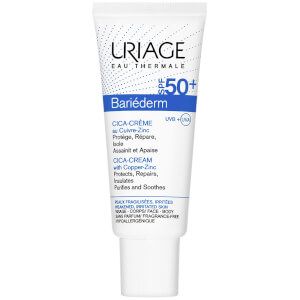
Uriage Bariéderm Cica-Cream with Copper-Zinc SPF50+
Works for
1 of 2 advertised claims delivered
Sun protectionSPF 50 · 1 UV filter · Broad spectrumWeak protectionLow filter dose
This product uses a single UV filter (zinc oxide) in a relatively low concentration and might not be able to provide a reliable sun protection.
This product can be considered "reef safe" because it does not contain the UV filters (oxybenzone and octinoxate) that can be harmful to coral reefs when present in the water in high concentrations.
MoisturizingParaffinum liquidum, Panthenol + 9 moreStrong evidence
“D-Panthenol intensely soothes sensations of discomfort to provide immediate relief while Hyaluronic Acid moisturises and nourishes.”
This product can help improve hydration of the skin with the two types of ingredients.
The first type is called “humectants”:
these ingredients help attract water.
When humectants are on the surface of the skin, they “pull in” the moisture from the outside environment, or from
within deeper layers of the skin. The following ingredients in this product do the job:
glycerin, hyaluronic acid.
This product also contains ingredients called “occlusives”. They help reduce the speed with which our skin loses moisture to the outside environment. These ingredients also help soften the upper layer of the skin, so it feels less tight and nicer to the touch. The following ingredients in this product do the job: dimethicone, propylheptyl caprylate.
The following ingredients in this product are especially good for supporting the skin barrier and helping with the hydration level: panthenol, paraffinum liquidum
Can it cause trouble?
Irritancy5 flagged ingredientsLow risk
Comedogenic1 ingredient rated 2 or more on the 0–5 pore-clogging scale1 flagged
User reviews
Ingredients
Filter by role to see what each ingredient is doing.
Water~45–55%
Paraffinum liquidum~6.2–7.6%
- Irritation risk
- Low
Mineral oil. One of the most effective and well studied occlusive and emollient moisturizing ingredients. Helps reduce moisture loss in skin and repair skin barrier function
More about Paraffinum liquidumSodium chloride~4.1–5%
- Irritation risk
- Low
Used to stabilize mixtures of oil and water, and create thicker, gel-like product textures
More about Sodium chlorideZinc oxide~3.7–4.5%
- Irritation risk
- Low
A broad spectrum sunblock (protects from both UVA and UVB rays). Is suitable for most sensitive skins. In small concentrations, can be used as a colorant
More about Zinc oxideCetyl peg/ppg-10/1 dimethicone~2.2–2.7%
- Irritation risk
- Low
A type of silicone that helps water and oil mix together. Can help to soften upper layer of the skin
More about Cetyl peg/ppg-10/1 dimethiconePropylheptyl caprylate~1.9–2.3%
- Irritation risk
- Low
Helps soften the upper layer of the skin
More about Propylheptyl caprylateButylene glycol~1.6–1.9%
- Irritation risk
- Low
Used to create a nice product texture and help delivery of other ingredients. Might be somewhat helpful in attracting water to the upper layer of the skin
More about Butylene glycolHydrogenated polydecene~1.4–1.7%
- Irritation risk
- Low
Helps to soften the upper layer of the skin and create a nice product texture
More about Hydrogenated polydecenePanthenol~1.1–1.4%
- Irritation risk
- Low
Helps attract water to the upper layer of the skin and can help improve skin barrier function
More about PanthenolGlycerin~1.1–1.4%
- Irritation risk
- Low
One of the best moisturizing ingredients. Naturally present in skin. It attracts water to the upper layer of the skin working as a humectant
More about GlycerinDimethicone~0.95–1.15%
- Irritation risk
- Low
A silicone that helps to reduce water loss from the surface of the skin. Can temporarily "fill in" lines and wrinkles, absorb oil, and create a nice product finish
More about DimethiconeDisteardimonium hectorite~0.7–1.05%
- Irritation risk
- Low
A type of clay that is used to thicken the product consistency
More about Disteardimonium hectoritePolyglyceryl-3 diisostearate~0.7–1.05%
- Irritation risk
- Medium
- Comedogenicity
- 3/5
Helps oil and water mix together
More about Polyglyceryl-3 diisostearateMagnesium sulfate~0.7–1%
Methylpropanediol~0.6–0.85%
Tocopheryl acetate~0.55–0.85%
- Irritation risk
- Medium
A more stable but less bio-available form of vitamin E compared to Tocopherol. Might help moisturize and protect the skin from free radicals, but mostly used in low concentrations to stabilize other ingredients.
More about Tocopheryl acetateTriacontanyl pvp~0.5–0.75%
- Irritation risk
- Low
Copper gluconate~0.4–0.6%
- Irritation risk
- Medium
Typically used to stabilize the product formulations. It is a salt of polyhydroxy acid (PHA) and in larger concentrations, can help shed the dead cells from the skin surface revealing smoother skin. It can help attract water to the upper layer of the skin. Might to be helpful against acne and clogged pores. Could be helpful in neutralizing free radicals, but solid research is missing
More about Copper gluconatePropanediol~0.4–0.6%
- Irritation risk
- Low
Acts as a solvent for other ingredients. Speeds up the absorption of other ingredients into the skin
More about PropanediolPropylene carbonate~0.35–0.65%
- Irritation risk
- Low
Is used to dissolve other ingredients and create nice product texture
More about Propylene carbonateCitric acid~0.25–0.5%
- Irritation risk
- Medium
Can work as an exfoliant but is typically used to adjust the product pH
More about Citric acidGlutamylamidoethyl indole~0.25–0.5%
- Irritation risk
- Low
Polyquaternium-61~0.25–0.45%
- Irritation risk
- Low
Hyaluronic acid~0.2–0.35%
- Irritation risk
- Low
One of the best moisturizing ingredients. Attracts water into the upper layer of the skin. Naturally present in skin. Typically has large molecule size unless advertised otherwise on the product label. Helps support skin's barrier function and may help to reduce inflammation
More about Hyaluronic acidSilanetriol~0.1–0.2%
- Irritation risk
- Low
Borage seed oil aminopropanediol amides~0.1–0.15%
- Irritation risk
- Low
Ingredient list view
Water, Paraffinum liquidum, Sodium chloride, Zinc oxide, Cetyl peg/ppg-10/1 dimethicone, Propylheptyl caprylate, Butylene glycol, Hydrogenated polydecene, Panthenol, Glycerin, Dimethicone, Disteardimonium hectorite, Polyglyceryl-3 diisostearate, Magnesium sulfate, Methylpropanediol, Tocopheryl acetate, Triacontanyl pvp, Copper gluconate, Propanediol, Propylene carbonate, Citric acid, Glutamylamidoethyl indole, Polyquaternium-61, Hyaluronic acid, Silanetriol, Borage seed oil aminopropanediol amides
Compare prices
Retailers ranked by price — lowest first.

Product summary
"Uriage - Bariéderm Cica-Cream with Copper-Zinc SPF50+" uses a single UV filter (zinc oxide) in a relatively low concentration and might not be able to provide reliable sun protection.
It also works as a moisturizer, so you do not have to use an additional hydrating product.
Sunscreen filters
This moisturizer is a mineral sunscreen. It uses zinc oxide for sun protection. Zinc oxide almost never irritates the skin or stings eyes, but it can leave a white cast.
Irritation risk
This product does not contain known common irritants and is suitable for sensitive skin. We assess the overall irritancy of this moisturizer to be low. For a detailed overview of all potential irritants: click here
You can see the detailed formula review with the breakdown of all actives in the product and the full ingredient list with estimated concentrations in the tables below.
What our users say
Based on 1 review 100% recommend this product- When it comes to comedogenicity, the reviewer found that it does not clog pores.
- As for the white cast, it did not leave a noticeable white residue for the reviewer.
- When it comes to using this sunscreen under makeup, the user found that it pills under a foundation.
- As for using this sunscreen in the eye area, the reviewer reported that it does not sting eyes.
Price
The product retails for 10.99$ in the United States and for 10.99£ in the United Kingdom.
For a detailed price comparison: click here.
Sources cited in this review
Every concentration estimate and effectiveness label is anchored to one of these 16 studies and safety reviews.
- 1A review on the extensive skin benefits of mineral oilncbi.nlm.nih.gov
- 2A review of inorganic UV filters zinc oxide and titanium dioxideonlinelibrary.wiley.com
- 3
- 4
- 5
- 6

Affiliate links · As an Amazon Associate, WIMJ earns from qualifying purchases.