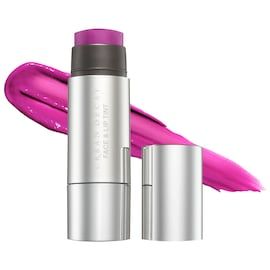
Urban Decay Multitasking Face + Lip Tint
Works for
1 of 1 advertised claim delivered
MoisturizingGlycerin, Helianthus annuus seed oil + 10 moreGood evidence
“A moisturizing face and lip tint that creates buildable, sheer color that stays put for a healthy-looking flush and a hydrated, glowy finish.”
This product can help improve hydration of the skin with the two types of ingredients.
The first type is called “humectants”:
these ingredients help attract water.
When humectants are on the surface of the skin, they “pull in” the moisture from the outside environment, or from
within deeper layers of the skin. The following ingredients in this product do the job:
glycerin.
This product also contains ingredients called “occlusives”. They help reduce the speed with which our skin loses moisture to the outside environment. These ingredients also help soften the upper layer of the skin, so it feels less tight and nicer to the touch. The following ingredients in this product do the job: bis-diglyceryl polyacyladipate-2, cera microcristallina.
Can it cause trouble?
Irritancy2 strong irritants: Zingiber officinale root extract, Rosmarinus officinalis leaf extractMedium risk
Comedogenic1 ingredient rated 2 or more on the 0–5 pore-clogging scale1 flagged
User reviews
Be the first — your take helps the next person decide.
Ingredients
Filter by role to see what each ingredient is doing.
C15-19 alkane~26–32%
- Irritation risk
- Low
Helps soften the upper layer of the skin and create a nice product texture
More about C15-19 alkaneOctyldodecanol~5.9–7.2%
- Irritation risk
- Low
An emollient that helps to soften the skin and create a pleasant product texture and stabilize the formulation
More about OctyldodecanolBis-diglyceryl polyacyladipate-2~6.1–7.4%
- Irritation risk
- Low
Helps soften the upper layer of the skin and reduce water loss from its surface
More about Bis-diglyceryl polyacyladipate-2Pentaerythrityl tetraisostearate~4.6–5.6%
- Irritation risk
- Medium
Used to create a thicker product consistency
More about Pentaerythrityl tetraisostearateTridecyl trimellitate~3.5–4.3%
- Irritation risk
- Medium
Used to create a thicker product consistency and soften the upper layer of the skin
More about Tridecyl trimellitatePolyethylene~2.7–3.3%
Sucrose tetrastearate triacetate~2–2.5%
Raphanus sativus seed extract~1.6–2%
- Irritation risk
- Low
Leuconostoc/radish root ferment filtrate~1.4–1.7%
- Irritation risk
- Medium
A preservative that comes from radishes fermented by a bacteria. New research suggests that the preservation properties in the ingredient come from an ammonium salt that is not present naturally in radish root but used in its cultivation. Is problematic because the exact amount of the preservative agents is difficult to determine
More about Leuconostoc/radish root ferment filtrateDicalcium phosphate~1.6–2%
- Irritation risk
- Low
Cera microcristallina~1.3–1.5%
- Irritation risk
- Low
Helps to soften the upper layer of the skin, reduce water loss from its surface and create a thicker product consistency
More about Cera microcristallinaMicrocrystalline wax~1–1.2%
Cera microcristallina~1.1–1.3%
- Irritation risk
- Low
Helps to soften the upper layer of the skin, reduce water loss from its surface and create a thicker product consistency
More about Cera microcristallinaSynthetic fluorphlogopite~0.9–1.1%
- Irritation risk
- Low
A mineral that is used as an optical filter (makes the skin looks nicer through light reflection) and to improve the texture of cosmetic products
More about Synthetic fluorphlogopiteSilica silylate~0.9–1.1%
Calcium sodium borosilicate~0.75–1.1%
Tocopheryl acetate~0.7–1%
- Irritation risk
- Medium
A more stable but less bio-available form of vitamin E compared to Tocopherol. Might help moisturize and protect the skin from free radicals, but mostly used in low concentrations to stabilize other ingredients.
More about Tocopheryl acetatePentaerythrityl tetra-di-t-butyl hydroxyhydrocinnamate~0.65–1%
- Irritation risk
- Low
Used to increase stability of product formulations
More about Pentaerythrityl tetra-di-t-butyl hydroxyhydrocinnamateAlumina~0.8–1.15%
- Irritation risk
- Low
The same compound that is used safely in dental implants and bone cements. In cosmetics, it is used to improve the consistency of products
More about AluminaAluminum hydroxide~0.7–1.05%
- Irritation risk
- Low
Is used to add opaque (non-transparent) appearance to formulations. Can be used to coat other ingredients for even dispersion. This is a different ingredient compared to the ones used in antipersperants (aluminium chloride and aluminium chlorohydrate)
More about Aluminum hydroxideHelianthus annuus seed oil~0.65–1%
- Irritation risk
- Low
A great emollient due to its high linoleic acid content. One of the most effective plant oils in helping skin hydration and repairing skin barrier function
More about Helianthus annuus seed oilArgania spinosa kernel oil~0.65–1%
- Irritation risk
- Medium
An emollient that helps soften the upper layer of the skin. Might have some weak anti-oxidant properties
More about Argania spinosa kernel oilSclerocarya birrea seed oil~0.65–0.95%
- Irritation risk
- Medium
An emollient that helps to soften the skin. It has a high contetn of oleic acid that might weaken the skin barrier. Might have some anti-oxidant properties. It might be somewhat helpful against hyperpigmentation.
More about Sclerocarya birrea seed oilCarthamus tinctorius seed oil~0.65–0.95%
- Irritation risk
- Low
An emollient that helps soften the skin and might help calm down inflammation
More about Carthamus tinctorius seed oilTalc~0.7–1.05%
Colophonium~0.65–1%
- Irritation risk
- Low
Rosin~0.65–0.95%
- Irritation risk
- Low
Helps to create a film on the surface of the skin and create a thicker product texture
More about RosinTin oxide~0.7–1.05%
- Irritation risk
- Low
A colorant that can add a pearl-like appearance to the formulation
More about Tin oxideZingiber officinale root extract~0.5–0.8%
- Irritation risk
- High
A plant extract that can contain an irritating essential oil. Might have some anti-oxidant effect, but evidence is lacking
More about Zingiber officinale root extractRosmarinus officinalis leaf extract~0.55–0.8%
- Irritation risk
- High
Can be helpful in reducing inflammation in skin, including inflamed acne. It can be irritating
More about Rosmarinus officinalis leaf extractSaccharomyces/xylinum/black tea ferment~0.55–0.85%
- Irritation risk
- Low
A fermented sweet black tea. There is no studies on particular benefits of this ingredient in skin. It can help attract water to the upper layer of the skin, and might have some anti-oxidant effect. It is used in skincare for mostly marketing purposes because of the popularity of kombucha drinks
More about Saccharomyces/xylinum/black tea fermentGlycerin~0.6–0.9%
- Irritation risk
- Low
One of the best moisturizing ingredients. Naturally present in skin. It attracts water to the upper layer of the skin working as a humectant
More about GlycerinHydroxyethylcellulose~0.65–0.95%
- Irritation risk
- Low
Used to thicken product formulations and create gel-like textures
More about HydroxyethylcellulosePhenoxyethanol~0.6–0.85%
- Irritation risk
- Low
A preservative. It helps prevent bacterial growth in cosmetic products
More about PhenoxyethanolSodium citrate~0.55–0.85%
- Irritation risk
- Medium
Helps to control the skin's pH level. Maintains the skin's natural film of amino-lactic acids and oils. Helps to preserve products
More about Sodium citrateCitric acid~0.55–0.85%
- Irritation risk
- Medium
Can work as an exfoliant but is typically used to adjust the product pH
More about Citric acidPotassium sorbate~0.3–0.6%
Biotin~0.6–0.85%
- Irritation risk
- Low
Might have some moisturising properties. Is not effective when applied topically beyond some moisturizing effect
More about BiotinCi 77891~0.55–0.8%
- Irritation risk
- Low
Titanium dioxide~0.6–0.9%
- Irritation risk
- Low
Works as a UV filter when used in high concentrations. It is photostable and is effective mostly against the UVB light, with some protection in the UVA range. In small concentrations, used for its ability to improve the color of cosmetic products. Is usually well tolerated by the skin
More about Titanium dioxideCi 45410~0.55–0.85%
Ci 77491~0.55–0.8%
- Irritation risk
- Low
A red colorant made of iron oxide. Typically is not irritating
More about Ci 77491Ci 77492~0.5–0.75%
Iron oxides~0.4–0.6%
- Irritation risk
- Low
An umbrella term for the following three colorants: CI 77491, CI 77492, CI 77499. They might be able to offer some protection against visible light, but the degree of the protection is not clear
More about Iron oxidesCi 15985~0.35–0.65%
Ci 19140~0.3–0.55%
Ci 15850~0.3–0.55%
Ci 19140~0.3–0.55%
Ci 42090~0.3–0.55%
Blue 1 lake~0.25–0.45%
Ci 15850~0.25–0.45%
Ingredient list view
C15-19 alkane, Octyldodecanol, Bis-diglyceryl polyacyladipate-2, Pentaerythrityl tetraisostearate, Tridecyl trimellitate, Polyethylene, Sucrose tetrastearate triacetate, Raphanus sativus seed extract, Leuconostoc/radish root ferment filtrate, Unknown, Dicalcium phosphate, Cera microcristallina, Microcrystalline wax, Cera microcristallina, Synthetic fluorphlogopite, Silica silylate, Calcium sodium borosilicate, Tocopheryl acetate, Pentaerythrityl tetra-di-t-butyl hydroxyhydrocinnamate, Alumina, Aluminum hydroxide, Helianthus annuus seed oil, Argania spinosa kernel oil, Sclerocarya birrea seed oil, Carthamus tinctorius seed oil, Talc, Colophonium, Rosin, Tin oxide, Zingiber officinale root extract, Rosmarinus officinalis leaf extract, Saccharomyces/xylinum/black tea ferment, Glycerin, Hydroxyethylcellulose, Phenoxyethanol, Sodium citrate, Citric acid, Potassium sorbate, Biotin, Ci 77891, Titanium dioxide, Ci 45410, Ci 77491, Ci 77492, Iron oxides, Ci 15985, Ci 19140, Ci 15850, Ci 19140, Ci 42090, Blue 1 lake, Ci 15850
Compare prices
Retailers ranked by price — lowest first.
Affiliate links · prices updated regularly
Sources cited in this review
Every concentration estimate and effectiveness label is anchored to one of these 20 studies and safety reviews.
- 1
- 2
- 3
- 4
- 5
- 6

Affiliate links · As an Amazon Associate, WIMJ earns from qualifying purchases.