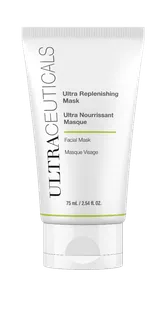
Ultraceuticals Ultra Replenishing Mask
Works for
MoisturizingLinoleic acid, Ceramide 3 + 22 moreWorks well
“It contains a powerful blend of moisturizing agents featuring Hyaluronic Acid with skin conditioning ingredients Shea Butter, Panthenol, Ceramide 3, and Vitamin E to help replenish vital hydration levels and support the skin's lipid barrier.”
This product can help improve hydration of the skin with the two types of ingredients.
The first type is called “humectants”:
these ingredients help attract water.
When humectants are on the surface of the skin, they “pull in” the moisture from the outside environment, or from
within deeper layers of the skin. The following ingredients in this product do the job:
glycerin, polyglycerin-3.
This product also contains ingredients called “occlusives”. They help reduce the speed with which our skin loses moisture to the outside environment. These ingredients also help soften the upper layer of the skin, so it feels less tight and nicer to the touch. The following ingredients in this product do the job: butyrospermum parkii butter, cocos nucifera oil.
The following ingredients in this product are especially good for supporting the skin barrier and helping with the hydration level: ceramide 3, linoleic acid, panthenol, urea
Anti-oxidationSide benefit · Squalene, Butyrospermum parkii butter + 3 moreMay help
This product contains antioxidants (squalene) that can help neutralize free radicals in skin to lessen the damage it gets from the UV light (sun). There is some human evidence for this effect in skin, though it is smaller or less consistent than the evidence for the best antioxidants.
Can it cause trouble?
Irritancy3 strong irritants: Lavandula angustifolia oil, Pelargonium graveolens oil + 1 more — patch-test recommendedHigh risk
Comedogenic6 ingredients rated 2 or more on the 0–5 pore-clogging scale6 flagged

User reviews
Be the first — your take helps the next person decide.
Ingredients
Filter by role to see what each ingredient is doing.
Water~45–55%
Sodium lactate~6.8–8.3%
- Irritation risk
- Medium
Helps attract water to the upper layer of the skin. Is often used to adjust the pH level of the product
More about Sodium lactateGlycerin~4.2–5.1%
- Irritation risk
- Low
One of the best moisturizing ingredients. Naturally present in skin. It attracts water to the upper layer of the skin working as a humectant
More about GlycerinButyrospermum parkii butter~3.3–4%
- Irritation risk
- Low
- Comedogenicity
- 3/5
A great moisturising ingredient that softens the skin and reduces water loss from its upper layer. It also can be helpful in protecting skin from free radicals
More about Butyrospermum parkii butterCetyl alcohol~2.3–2.8%
- Irritation risk
- Low
A non-drying alcohol that works to soften the skin and stabilize product formulations helping oil and water mix together
More about Cetyl alcoholUrea~1.8–2.2%
- Irritation risk
- Low
Naturally present in skin (urea makes up about 7% of natural moisturizing factors in skin). Attracts water to the upper layer of the skin. Also has a positive effect on the skin barrier beyond the humectant action. Can enhance penetration of other ingredients. Is an exfoliating ingredient when used in high concentrations
More about UreaDicaprylyl carbonate~1.6–2%
- Irritation risk
- Low
Helps products spread more easily and works as an emollient to soften skin
More about Dicaprylyl carbonateOlive oil decyl esters~1.4–1.7%
- Irritation risk
- Low
Glyceryl stearate~1.2–1.5%
- Irritation risk
- Low
An emollient that softens the skin and forms a protective layer on its surface. Helps water and oil mix together
More about Glyceryl stearateJojoba esters~1–1.2%
- Irritation risk
- Medium
An emollient made of jojoba oil. Helps soften the skin and support its barrier function
More about Jojoba estersPeg-75 stearate~0.7–1.05%
Sodium hyaluronate~0.55–0.85%
- Irritation risk
- Low
One of the best moisturizing ingredients. Attracts water into the upper layer of the skin
More about Sodium hyaluronatePanthenol~0.55–0.8%
- Irritation risk
- Low
Helps attract water to the upper layer of the skin and can help improve skin barrier function
More about PanthenolCholesterol~0.55–0.8%
- Irritation risk
- Low
An emollient that is naturally found in skin
More about CholesterolCeramide 3~0.5–0.75%
- Irritation risk
- Low
A type of lipid similar to ceramides naturally present in skin. Helps to soften the upper layer of the skin and supports the skin barrier function to keep it hydrated. Can help to prevent inflammation in skin
More about Ceramide 3Sodium pca~0.45–0.65%
- Irritation risk
- Low
Naturally present in skin and helps to attract water to its upper layer
More about Sodium pcaLinoleic acid~0.55–0.85%
- Irritation risk
- Low
An excellent emollient. Helps soften the skin, restore its barrier function, and can help to calm down inflammation. It can be helpful to prevent blemishes and clogged pores
More about Linoleic acidLinolenic acid~0.5–0.7%
- Irritation risk
- Medium
An emollient that helps soften the skin and calm down inflammation
More about Linolenic acidSqualene~0.4–0.65%
- Irritation risk
- Low
- Comedogenicity
- 2/5
An oil that is naturally part of skin sebum that helps to soften its upper layer, reduce water loss and neutralize free radicals. It might be comedogenic. Avoid applying large concentrations (or pure oil) before sun exposure as oxidized squalene can clog pores and lead to skin irritation. Today squalene is mostly derived from vegetable oils or synthetized by yeast
More about SqualeneTocopherol~0.3–0.6%
- Irritation risk
- Low
Pure form of vitamin E. Can help moisturise and protect the skin from free radicals. Often used to help stabilise other ingredients or the formula itself
More about TocopherolTocopheryl acetate~0.3–0.55%
- Irritation risk
- Medium
A more stable but less bio-available form of vitamin E compared to Tocopherol. Might help moisturize and protect the skin from free radicals, but mostly used in low concentrations to stabilize other ingredients.
More about Tocopheryl acetateLecithin~0.4–0.6%
- Irritation risk
- Low
Used mostly for creating emulsions - helping oil and water mix together. Helps soften the upper layer of the skin
More about LecithinHelianthus annuus seed wax~0.3–0.6%
- Irritation risk
- Low
Helps soften the upper layer of the skin and support skin's barrier function while creating a thicker product consistency
More about Helianthus annuus seed waxAcacia decurrens flower wax~0.3–0.55%
Polyglycerin-3~0.3–0.55%
- Irritation risk
- Low
Helps to attract water to the upper layer of the skin
More about Polyglycerin-3Cocos nucifera oil~0.3–0.5%
- Irritation risk
- Low
- Comedogenicity
- 3/5
An emollient. Found to be as effective as a moisturizer for dry skin as mineral oil. Could be comedogenic
More about Cocos nucifera oilCucumis sativus fruit extract~0.3–0.55%
- Irritation risk
- Medium
Might be somewhat helpful in reducing hyperpigmentation and neutralizing free radicals but its typical concentration in a product is too low for having an effect
More about Cucumis sativus fruit extractLavandula angustifolia oil~0.3–0.55%
- Irritation risk
- High
An essential oil. Potential allergen and can be irritating. It has some anti-bacterial properties
More about Lavandula angustifolia oilPelargonium graveolens oil~0.3–0.5%
Ceteth-20~0.45–0.7%
Steareth-20~0.4–0.65%
Water~0.3–0.55%
Sodium lactate~0.3–0.55%
- Irritation risk
- Medium
Helps attract water to the upper layer of the skin. Is often used to adjust the pH level of the product
More about Sodium lactateGlycerin~0.3–0.6%
- Irritation risk
- Low
One of the best moisturizing ingredients. Naturally present in skin. It attracts water to the upper layer of the skin working as a humectant
More about GlycerinButyrospermum parkii butter~0.35–0.6%
- Irritation risk
- Low
- Comedogenicity
- 3/5
A great moisturising ingredient that softens the skin and reduces water loss from its upper layer. It also can be helpful in protecting skin from free radicals
More about Butyrospermum parkii butterCetyl alcohol~0.35–0.6%
- Irritation risk
- Low
A non-drying alcohol that works to soften the skin and stabilize product formulations helping oil and water mix together
More about Cetyl alcoholUrea~0.3–0.55%
- Irritation risk
- Low
Naturally present in skin (urea makes up about 7% of natural moisturizing factors in skin). Attracts water to the upper layer of the skin. Also has a positive effect on the skin barrier beyond the humectant action. Can enhance penetration of other ingredients. Is an exfoliating ingredient when used in high concentrations
More about UreaDicaprylyl carbonate~0.3–0.6%
- Irritation risk
- Low
Helps products spread more easily and works as an emollient to soften skin
More about Dicaprylyl carbonateOlive oil decyl esters~0.3–0.55%
- Irritation risk
- Low
Glyceryl stearate~0.35–0.65%
- Irritation risk
- Low
An emollient that softens the skin and forms a protective layer on its surface. Helps water and oil mix together
More about Glyceryl stearateJojoba esters~0.35–0.6%
- Irritation risk
- Medium
An emollient made of jojoba oil. Helps soften the skin and support its barrier function
More about Jojoba estersPeg-75 stearate~0.3–0.55%
Sodium hyaluronate~0.3–0.55%
- Irritation risk
- Low
One of the best moisturizing ingredients. Attracts water into the upper layer of the skin
More about Sodium hyaluronatePanthenol~0.3–0.55%
- Irritation risk
- Low
Helps attract water to the upper layer of the skin and can help improve skin barrier function
More about PanthenolCholesterol~0.35–0.65%
- Irritation risk
- Low
An emollient that is naturally found in skin
More about CholesterolCeramide 3~0.35–0.6%
- Irritation risk
- Low
A type of lipid similar to ceramides naturally present in skin. Helps to soften the upper layer of the skin and supports the skin barrier function to keep it hydrated. Can help to prevent inflammation in skin
More about Ceramide 3Sodium pca~0.3–0.55%
- Irritation risk
- Low
Naturally present in skin and helps to attract water to its upper layer
More about Sodium pcaLinoleic acid~0.45–0.65%
- Irritation risk
- Low
An excellent emollient. Helps soften the skin, restore its barrier function, and can help to calm down inflammation. It can be helpful to prevent blemishes and clogged pores
More about Linoleic acidLinolenic acid~0.4–0.6%
- Irritation risk
- Medium
An emollient that helps soften the skin and calm down inflammation
More about Linolenic acidSqualene~0.35–0.6%
- Irritation risk
- Low
- Comedogenicity
- 2/5
An oil that is naturally part of skin sebum that helps to soften its upper layer, reduce water loss and neutralize free radicals. It might be comedogenic. Avoid applying large concentrations (or pure oil) before sun exposure as oxidized squalene can clog pores and lead to skin irritation. Today squalene is mostly derived from vegetable oils or synthetized by yeast
More about SqualeneTocopherol~0.3–0.55%
- Irritation risk
- Low
Pure form of vitamin E. Can help moisturise and protect the skin from free radicals. Often used to help stabilise other ingredients or the formula itself
More about TocopherolTocopheryl acetate~0.3–0.55%
- Irritation risk
- Medium
A more stable but less bio-available form of vitamin E compared to Tocopherol. Might help moisturize and protect the skin from free radicals, but mostly used in low concentrations to stabilize other ingredients.
More about Tocopheryl acetateLecithin~0.35–0.6%
- Irritation risk
- Low
Used mostly for creating emulsions - helping oil and water mix together. Helps soften the upper layer of the skin
More about LecithinHelianthus annuus seed wax~0.3–0.6%
- Irritation risk
- Low
Helps soften the upper layer of the skin and support skin's barrier function while creating a thicker product consistency
More about Helianthus annuus seed waxAcacia decurrens flower wax~0.3–0.55%
Polyglycerin-3~0.3–0.55%
- Irritation risk
- Low
Helps to attract water to the upper layer of the skin
More about Polyglycerin-3Cocos nucifera oil~0.25–0.5%
- Irritation risk
- Low
- Comedogenicity
- 3/5
An emollient. Found to be as effective as a moisturizer for dry skin as mineral oil. Could be comedogenic
More about Cocos nucifera oilCucumis sativus fruit extract~0.3–0.5%
- Irritation risk
- Medium
Might be somewhat helpful in reducing hyperpigmentation and neutralizing free radicals but its typical concentration in a product is too low for having an effect
More about Cucumis sativus fruit extractLavandula angustifolia oil~0.25–0.5%
- Irritation risk
- High
An essential oil. Potential allergen and can be irritating. It has some anti-bacterial properties
More about Lavandula angustifolia oilPelargonium graveolens oil~0.25–0.45%
Ceteth-20~0.4–0.6%
Steareth-20~0.3–0.6%
Sodium acrylates copolymer~0.2–0.35%
- Irritation risk
- Medium
Used to create a thicker product consistency
More about Sodium acrylates copolymerXanthan gum~0.2–0.4%
- Irritation risk
- Low
Used to create a thicker product consistency
More about Xanthan gumDisodium edta~0.15–0.3%
Caprylyl glycol~0.2–0.35%
- Irritation risk
- Medium
Helps preserve products and creates a nice product texture
More about Caprylyl glycolCaprylhydroxamic acid~0.15–0.25%
Potassium sorbate~0.15–0.3%
Lactic acid~0.15–0.25%
- Irritation risk
- Medium
An exfoliating and moisturizing alpha-hydroxy acid (AHA). Typically causes less irritation than other AHAs, for example, glycolic acid. At high concentrations (about 15%), lactic acid can help reduce lines and wrinkles. Recent studies show that lactic acid can support the "good" bacteria living on skin's surface (healthy skin microbiome)
More about Lactic acidSodium hydroxide~0.1–0.15%
Linalool~0.05–0.15%
Ingredient list view
Water, Sodium lactate, Glycerin, Butyrospermum parkii butter, Cetyl alcohol, Urea, Dicaprylyl carbonate, Olive oil decyl esters, Glyceryl stearate, Jojoba esters, Peg-75 stearate, Sodium hyaluronate, Panthenol, Cholesterol, Ceramide 3, Sodium pca, Linoleic acid, Linolenic acid, Squalene, Tocopherol, Tocopheryl acetate, Lecithin, Helianthus annuus seed wax, Acacia decurrens flower wax, Polyglycerin-3, Cocos nucifera oil, Cucumis sativus fruit extract, Lavandula angustifolia oil, Pelargonium graveolens oil, Ceteth-20, Steareth-20, Unknown, Water, Sodium lactate, Glycerin, Butyrospermum parkii butter, Cetyl alcohol, Urea, Dicaprylyl carbonate, Olive oil decyl esters, Glyceryl stearate, Jojoba esters, Peg-75 stearate, Sodium hyaluronate, Panthenol, Cholesterol, Ceramide 3, Sodium pca, Linoleic acid, Linolenic acid, Squalene, Tocopherol, Tocopheryl acetate, Lecithin, Helianthus annuus seed wax, Acacia decurrens flower wax, Polyglycerin-3, Cocos nucifera oil, Cucumis sativus fruit extract, Lavandula angustifolia oil, Pelargonium graveolens oil, Ceteth-20, Steareth-20, Sodium acrylates copolymer, Xanthan gum, Disodium edta, Caprylyl glycol, Caprylhydroxamic acid, Potassium sorbate, Lactic acid, Sodium hydroxide, Linalool
Compare prices
Retailers ranked by price — lowest first.
Affiliate links · As an Amazon Associate, WIMJ earns from qualifying purchases.
Worth comparing, line by line.
Match % combines shared ingredients, the first five ingredients, shared actives and hero ingredients, irritancy (lower counts in the alternative's favour), texture and body area. Only products in the same routine step are compared.
| UltraceuticalsUltra Replenishing MaskYOUR PRODUCT | OsequePure Noble Water Mineral Mask Sheet | EmbryolisseAnti Age Comfort Mask | CliniqueMoisture Surge Overnight Mask | |
|---|---|---|---|---|
| Match | — | 52% | 46% | 44% |
| Price | — | $4.70 | $30.00 | $8.27 |
| Shared key ingredients | — | 6 of 17 | 7 of 17 | 4 of 17 |
| Key difference | — | Oligopeptide-1 | Retinyl Palmitate | Caffeine |
| Irritancy | High | Medium | Medium | Medium |
| Drying alcohol | — | — | — | — |
| View product | Shop | Shop | Shop |


More alternatives: Colleen Rothschild Beauty Intense Hydrating MaskU Beauty The Barrier Bioactive Treatment
Product summary
"Ultraceuticals - Ultra Replenishing Mask" is effective for: Moisturizing
Ingredient callouts
- Ceramides (ceramide 3 0.50% - 0.75% and ceramide 3 0.35% - 0.60%). Ceramides are a type of lipids that our skin produces itself. They are a building block of the skin's barrier. Ceramides used in skincare are synthetic or extracted from plants. They work well for softening the skin surface and "patch holes" in the skin's barrier.
- Panthenol (pro-vitamin B5) at about 0.55% - 0.80% concentration. In this concentration, Panthenol works effectively to improve the skin barrier and reduce inflammation.
- We love that there is also Linoleic Acid in this product (0.55% - 0.85%). Linoleic Acid is one of the skin's natural emollients. It supports the skin barrier and can even help reduce clogged pores.
- Humectants (urea 0.30% - 0.55%, urea 1.80% - 2.20%, sodium pca 0.30% - 0.55%, sodium pca 0.45% - 0.65%, sodium lactate 0.30% - 0.55%, sodium lactate 6.80% - 8.30%, sodium hyaluronate 0.30% - 0.55%, sodium hyaluronate 0.55% - 0.85%, polyglycerin-3 0.30% - 0.55%, panthenol 0.30% - 0.55%, polyglycerin-3 0.30% - 0.55%, panthenol 0.55% - 0.80%, glycerin 4.20% - 5.10% and glycerin 0.30% - 0.60%). These ingredients help attract water to the upper layer of the skin and improve the skin hydration.
Price
The product retails for 85.00$ in the United States.
For a detailed price comparison: click here.
Sources cited in this review
Every concentration estimate and effectiveness label is anchored to one of these 19 studies and safety reviews.
- 1
- 2Topical urea in skincare: A reviewpubmed.ncbi.nlm.nih.gov
- 3Hyaluronic acid: A key molecule in skin agingncbi.nlm.nih.gov
- 4
- 5Skin moisturizing effects of panthenol-based formulationspdfs.semanticscholar.org
- 6

Affiliate links · As an Amazon Associate, WIMJ earns from qualifying purchases.