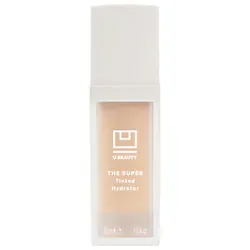
U Beauty The SUPER Tinted Hydrator Tinted Moisturizer Vitamin E + Antioxidants
Works for
Anti-agingGlycolic acid, Lactobionic acid + 8 moreWorks well
“Peptides: Short-chain amino acids help optimize the skin’s own natural collagen and visible firmness for plumper-looking skin.”
This product can help reduce and prevent fine lines and wrinkles, improve skin elasticity and firmness because it contains glycolic acid, lactobionic acid.
These ingredients in the product can also be helpful, even though there is less evidence for their effectiveness: acetyl hexapeptide-37, n-prolyl palmitoyl tripeptide-56 acetate, palmitoyl tripeptide-8.
Keep in mind that it typically takes at least 6 weeks to notice any results because the changes that are needed to improve fine lines and elasticity happen in the deeper layers of the skin. No topical anti-aging product can “erase” wrinkles or fully reverse signs of aging.
MoisturizingPanthenol, Linoleic acid + 37 moreWorks well
“The SUPER Tinted Hydrator Tinted Moisturizer Vitamin E + Antioxidants”
This product can help improve hydration of the skin with the two types of ingredients.
The first type is called “humectants”:
these ingredients help attract water.
When humectants are on the surface of the skin, they “pull in” the moisture from the outside environment, or from
within deeper layers of the skin. The following ingredients in this product do the job:
dextran, glycerin.
This product also contains ingredients called “occlusives”. They help reduce the speed with which our skin loses moisture to the outside environment. These ingredients also help soften the upper layer of the skin, so it feels less tight and nicer to the touch. The following ingredients in this product do the job: butyrospermum parkii butter, cera alba.
The following ingredients in this product are especially good for supporting the skin barrier and helping with the hydration level: acetyl hexapeptide-37, lactobionic acid, linoleic acid, n-prolyl palmitoyl tripeptide-56 acetate, palmitoyl tripeptide-8, panthenol
Anti-oxidationSide benefit · Lactobionic acid, Superoxide dismutase + 9 moreWorks well
This product contains antioxidants (glutathione, lactobionic acid, superoxide dismutase) that can help neutralize free radicals in skin. By doing so, they can lessen the damage the skin gets from the UV light (sun).
ExfoliationSide benefit · Mandelic acid, Lactobionic acid + 1 moreWorks well
This product can help exfoliate the skin. In other words, it helps break down the bonds between dead cells on the surface of the skin and speed up the skin turnover. Skin often appears softer and brighter after exfoliation, but overdoing it can result in disrupted skin barrier. The following ingredient is doing the exfoliating job in this product: glycolic acid, lactobionic acid, mandelic acid.
Evens skin toneSide benefit · Mandelic acid, Lactobionic acid + 2 moreWorks well
This product can help reduce hypepigmentation and even out the skin tone because it contains the following effective ingredients: glutathione, glycolic acid, lactobionic acid, mandelic acid
Keep in mind that you would need to apply any topical skincare targetted at hypigmentation consistently for a couple of months to get a result. No topical skincare product can help get rid of hyperpigmentation (including post-acne marks and age spots) instantly.
Can it cause trouble?
Irritancy1 strong irritant: Passiflora incarnata seed oilMedium risk
Comedogenic2 ingredients rated 2 or more on the 0–5 pore-clogging scale2 flagged
User reviews
Be the first — your take helps the next person decide.
Ingredients
Filter by role to see what each ingredient is doing.
Water~45–55%
Squalane~4.9–5.9%
- Irritation risk
- Low
An oil naturally present in skin. Works as an emollient to soften the skin and form a protective layer on its surface without a greasy feeling.
More about SqualanePentylene glycol~4.3–5.3%
- Irritation risk
- Medium
Used to preserve products, dissolve other ingredients and create a nice product texture
More about Pentylene glycolOctyldodecanol~3.1–3.7%
- Irritation risk
- Low
An emollient that helps to soften the skin and create a pleasant product texture and stabilize the formulation
More about OctyldodecanolButyrospermum parkii butter~2.4–2.9%
- Irritation risk
- Low
- Comedogenicity
- 3/5
A great moisturising ingredient that softens the skin and reduces water loss from its upper layer. It also can be helpful in protecting skin from free radicals
More about Butyrospermum parkii butterArgania spinosa kernel oil~1.9–2.3%
- Irritation risk
- Medium
An emollient that helps soften the upper layer of the skin. Might have some weak anti-oxidant properties
More about Argania spinosa kernel oilPersea gratissima oil~1.6–1.9%
- Irritation risk
- Medium
An emollient that helps soften the skin and could be helpful in repairing its barrier function
More about Persea gratissima oilTitanium dioxide~1.9–2.3%
- Irritation risk
- Low
Works as a UV filter when used in high concentrations. It is photostable and is effective mostly against the UVB light, with some protection in the UVA range. In small concentrations, used for its ability to improve the color of cosmetic products. Is usually well tolerated by the skin
More about Titanium dioxideVitis vinifera seed oil~1.2–1.4%
- Irritation risk
- Medium
A great emollient that can also have anti-oxidant properties
More about Vitis vinifera seed oilPrunus amygdalus dulcis seed~0.8–1.2%
- Irritation risk
- Low
Helps soften the upper layer of the skin
More about Prunus amygdalus dulcis seedIsononyl isononanoate~0.7–1%
- Irritation risk
- Low
Forms a protective film on the surface of the skin to prevent moisture loss. Gives a velvety feel to products while reducing tackiness
More about Isononyl isononanoateEthylhexyl stearate~0.6–0.9%
- Irritation risk
- Low
Helps soften the upper layer of the skin
More about Ethylhexyl stearateCetyl peg/ppg-10/1 dimethicone~0.5–0.75%
- Irritation risk
- Low
A type of silicone that helps water and oil mix together. Can help to soften upper layer of the skin
More about Cetyl peg/ppg-10/1 dimethiconeSorbitol~0.45–0.7%
- Irritation risk
- Low
Helps attract water to the upper layer of the skin and improves the product texture
More about SorbitolDisteardimonium hectorite~0.45–0.65%
- Irritation risk
- Low
A type of clay that is used to thicken the product consistency
More about Disteardimonium hectoriteMagnesium sulfate~0.45–0.7%
Methyldihydrojasmonate~0.4–0.65%
Panthenol~0.35–0.6%
- Irritation risk
- Low
Helps attract water to the upper layer of the skin and can help improve skin barrier function
More about PanthenolSynthetic fluorphlogopite~0.35–0.6%
- Irritation risk
- Low
A mineral that is used as an optical filter (makes the skin looks nicer through light reflection) and to improve the texture of cosmetic products
More about Synthetic fluorphlogopitePassiflora incarnata seed oil~0.3–0.55%
- Irritation risk
- High
A plant oil that can help soften the upper layer of the skin. Contains essential oil that can be irritating
More about Passiflora incarnata seed oilTocopherol~0.25–0.5%
- Irritation risk
- Low
Pure form of vitamin E. Can help moisturise and protect the skin from free radicals. Often used to help stabilise other ingredients or the formula itself
More about TocopherolTocopheryl acetate~0.25–0.5%
- Irritation risk
- Medium
A more stable but less bio-available form of vitamin E compared to Tocopherol. Might help moisturize and protect the skin from free radicals, but mostly used in low concentrations to stabilize other ingredients.
More about Tocopheryl acetateAscorbyl palmitate~0.2–0.4%
- Irritation risk
- Medium
Being a lipid soluble form of vitamin C, it is more stable and can penetrate the skin better than L-Ascorbic acid. It is effective in protecting the skin from free radicals, as well as evening the skin tone, but is less effective in stimulating collagen production compared to L-Ascorbic acid.
More about Ascorbyl palmitateSodium ascorbyl phosphate~0.25–0.45%
- Irritation risk
- Medium
A stable derivative of vitamin C. It is oil-soluble which means it is more likely to penetrate the skin compared to the pure form of vitamin C (which is water-soluble), but it is less bio-available and is way less effective in stimulating collagen and reducing wrinkles compared to the pure form of vitamin C (L-ascorbic acid) and its other derivatives (for example, magnesium ascorbyl phosphate). At the same time, this vitamin C derivative has been shown in studies to be effective in reducing acne, blemishes and clogged pores. It is less irritating then the pure form of vitamin C
More about Sodium ascorbyl phosphateLinoleic acid~0.35–0.6%
- Irritation risk
- Low
An excellent emollient. Helps soften the skin, restore its barrier function, and can help to calm down inflammation. It can be helpful to prevent blemishes and clogged pores
More about Linoleic acidPalmitoyl tripeptide-8~0.2–0.4%
Oleic acid~0.25–0.5%
- Irritation risk
- Medium
Helps soften the upper layer of the skin. At the same time, it can weaken the skin's barrier enhancing penetration of other ingredients and increasing the risk of skin dryness
More about Oleic acidPalmitic acid~0.25–0.5%
- Irritation risk
- Low
An emollient that is naturally present in skin and helps soften it
More about Palmitic acidSodium hyaluronate~0.2–0.4%
- Irritation risk
- Low
One of the best moisturizing ingredients. Attracts water into the upper layer of the skin
More about Sodium hyaluronateSodium acetylated hyaluronate~0.2–0.4%
- Irritation risk
- Low
A type of hyaluronic acid that works as an excellent moisturizer by attracting water into the upper layer of the skin. Is typically feels less sticky on the skin compared to the usual hyaluronic acid
More about Sodium acetylated hyaluronateStearic acid~0.35–0.6%
- Irritation risk
- Low
Helps oil and water mix together and works as an emollient
More about Stearic acidSodium hyaluronate crosspolymer~0.2–0.4%
- Irritation risk
- Medium
Attracts water into the upper layer of the skin
More about Sodium hyaluronate crosspolymerHydrolyzed hyaluronic acid~0.2–0.4%
- Irritation risk
- Low
One of the best moisturizing ingredients. Attracts water into the upper layer of the skin. A version of it is naturally present in skin
More about Hydrolyzed hyaluronic acidHydrolyzed sodium hyaluronate~0.2–0.4%
- Irritation risk
- Low
Attracts water into the upper layer of the skin
More about Hydrolyzed sodium hyaluronateGlutathione~0.25–0.4%
- Irritation risk
- Medium
A peptide that can help neutralize free radicals in skin and reduce melanin production resulting in skin lightening effect and reduction in hyperpigmentation. It can also help attract moisture to the upper layer of the skin
More about GlutathioneSuperoxide dismutase~0.25–0.45%
- Irritation risk
- Low
An antioxidant enzyme that is naturally present in skin. It can help support skin barrier function and reduce inflammation in skin. It is used in topical medications for inflammatory skin conditions including atopic dermatitis (eczema) and psoriasis. There are three types of natural Superoxide Dismutase in human skin. The compound used in topical treatments and cosmetics are mimics of typically one of these natural variants
More about Superoxide dismutaseLactobionic acid~0.25–0.45%
- Irritation risk
- Medium
A polyhydroxy acid (PHA) that helps shed dead cells from the surface of the skin revealing a smoother, more even skin. PHAs tend to be gentler on the skin compared to AHAs (for example, glycolic acid). It also has hydrating properties and helps attract water to the upper layer of the skin. It can help calm down inflammation in skin and support restoration of the barrier function. It has an anti-oxidant effect as well. It can help reduce fine line, wrinkles and improve skin elasticity
More about Lactobionic acidMandelic acid~0.25–0.45%
- Irritation risk
- High
Helps shed the upper layer of dead cells from the surface of the skin revealing smoother, brighter skin. It can help to reduce hyperpigmentation. It has anti-bacterial properties, and might help to reduce blemishes, as well as fine lines and wrinkles. It is considered to be gentler than glycolic acid
More about Mandelic acidGlycolic acid~0.25–0.45%
- Irritation risk
- High
An alpha-hydroxy acid (AHA) that helps to remove the dead skin cells on the surface of the skin reveling a more even, smoother complexation. It is also able to stimulate collagen production with long-term use. Could help to reduce pore congestion. It can be irritating to the skin. Apply sunscreen daily if using products with glycolic acid
More about Glycolic acidLinolenic acid~0.3–0.55%
- Irritation risk
- Medium
An emollient that helps soften the skin and calm down inflammation
More about Linolenic acidAcetyl hexapeptide-37~0.25–0.45%
- Irritation risk
- Low
A type of peptide. Peptides are excellent moisturizers and might be able support collagen production reducing fine lines and wrinkles
More about Acetyl hexapeptide-37N-prolyl palmitoyl tripeptide-56 acetate~0.25–0.45%
- Irritation risk
- Low
A type of peptide. Peptides are excellent moisturizers and might be able support collagen production reducing fine lines and wrinkles
More about N-prolyl palmitoyl tripeptide-56 acetateBeta-glucan~0.25–0.45%
- Irritation risk
- Low
Helps attract water to the upper layer of the skin, calm down inflammation and irritation, restore the barrier function and support wound healing. It can be helpful in reducing fine lines and wrinkles
More about Beta-glucanCera alba~0.35–0.65%
- Irritation risk
- Medium
Forms a protective barrier that holds water and keeps dry skin hydrated. Keeps an emulsion from separating into its oil and liquid components, and increases the thickness of a product. Can be an allergen
More about Cera albaXanthan gum~0.25–0.45%
- Irritation risk
- Low
Used to create a thicker product consistency
More about Xanthan gumGlycerin~0.3–0.5%
- Irritation risk
- Low
One of the best moisturizing ingredients. Naturally present in skin. It attracts water to the upper layer of the skin working as a humectant
More about GlycerinDextran~0.25–0.45%
- Irritation risk
- Low
Helps attract water to the most upper layer of the skin. Derived from sugar
More about DextranPolyglyceryl-4 diisostearate/polyhydroxystearate/sebacate~0.25–0.5%
- Irritation risk
- Medium
Helps water and oil mix together
More about Polyglyceryl-4 diisostearate/polyhydroxystearate/sebacateAcacia decurrens/jojoba/sunflower seed cera/polyglyceryl-3 esters~0.3–0.5%
- Irritation risk
- Low
Butylene glycol~0.25–0.45%
- Irritation risk
- Low
Used to create a nice product texture and help delivery of other ingredients. Might be somewhat helpful in attracting water to the upper layer of the skin
More about Butylene glycolCaprylic/capric triglyceride~0.3–0.55%
- Irritation risk
- Medium
A good mix of fatty acids that forms a protective layer on the skin. Improves the shelf life of products. Derived from coconut and glycerin
More about Caprylic/capric triglycerideDiisostearoyl polyglyceryl-3 dimer dilinoleate~0.25–0.5%
- Irritation risk
- Low
Propylene carbonate~0.25–0.5%
- Irritation risk
- Low
Is used to dissolve other ingredients and create nice product texture
More about Propylene carbonatePolyglyceryl-3 oleate~0.25–0.5%
- Irritation risk
- Medium
Helps oil and water mix together
More about Polyglyceryl-3 oleateEthylene/propylene/styrene copolymer~0.25–0.45%
- Irritation risk
- Low
Used to create a thicker product consistency
More about Ethylene/propylene/styrene copolymerSorbitan oleate~0.25–0.5%
- Irritation risk
- Medium
- Comedogenicity
- 2/5
Helps oil and water mix together
More about Sorbitan oleateTriethoxycaprylylsilane~0.25–0.45%
- Irritation risk
- Low
A type of silicone that helps oil and water mix well together. Helps to disperse other ingredients, e.g. pigments, evenly in a formulation
More about TriethoxycaprylylsilaneMica~0.25–0.45%
- Irritation risk
- Low
Creates an illusion of smoother and more radiant skin tone. Adds shimmer to the skin by reflecting light
More about MicaHydroxyphenyl propamidobenzoic acid~0.2–0.4%
- Irritation risk
- Low
Might help to reduce inflammation in skin, but solid research is lacking
More about Hydroxyphenyl propamidobenzoic acidAlumina~0.35–0.6%
- Irritation risk
- Low
The same compound that is used safely in dental implants and bone cements. In cosmetics, it is used to improve the consistency of products
More about AluminaCaprylyl glycol~0.25–0.4%
- Irritation risk
- Medium
Helps preserve products and creates a nice product texture
More about Caprylyl glycolSilica~0.3–0.55%
Decyl glucoside~0.25–0.45%
- Irritation risk
- High
Helps oil and water mix together. Can be irritating
More about Decyl glucosidePolysorbate 20~0.15–0.3%
Tin oxide~0.2–0.4%
- Irritation risk
- Low
A colorant that can add a pearl-like appearance to the formulation
More about Tin oxideCitric acid~0.1–0.2%
- Irritation risk
- Medium
Can work as an exfoliant but is typically used to adjust the product pH
More about Citric acidEthylhexylglycerin~0.1–0.2%
Phenethyl alcohol~0.05–0.1%
Iron oxides~0.05–0.1%
- Irritation risk
- Low
An umbrella term for the following three colorants: CI 77491, CI 77492, CI 77499. They might be able to offer some protection against visible light, but the degree of the protection is not clear
More about Iron oxidesIngredient list view
Water, Squalane, Pentylene glycol, Octyldodecanol, Butyrospermum parkii butter, Argania spinosa kernel oil, Persea gratissima oil, Titanium dioxide, Vitis vinifera seed oil, Prunus amygdalus dulcis seed, Isononyl isononanoate, Ethylhexyl stearate, Cetyl peg/ppg-10/1 dimethicone, Sorbitol, Disteardimonium hectorite, Magnesium sulfate, Methyldihydrojasmonate, Panthenol, Synthetic fluorphlogopite, Passiflora incarnata seed oil, Tocopherol, Tocopheryl acetate, Ascorbyl palmitate, Sodium ascorbyl phosphate, Linoleic acid, Palmitoyl tripeptide-8, Oleic acid, Palmitic acid, Sodium hyaluronate, Sodium acetylated hyaluronate, Stearic acid, Sodium hyaluronate crosspolymer, Hydrolyzed hyaluronic acid, Hydrolyzed sodium hyaluronate, Glutathione, Superoxide dismutase, Lactobionic acid, Mandelic acid, Glycolic acid, Linolenic acid, Acetyl hexapeptide-37, N-prolyl palmitoyl tripeptide-56 acetate, Beta-glucan, Cera alba, Xanthan gum, Glycerin, Dextran, Polyglyceryl-4 diisostearate/polyhydroxystearate/sebacate, Acacia decurrens/jojoba/sunflower seed cera/polyglyceryl-3 esters, Butylene glycol, Caprylic/capric triglyceride, Diisostearoyl polyglyceryl-3 dimer dilinoleate, Propylene carbonate, Polyglyceryl-3 oleate, Ethylene/propylene/styrene copolymer, Sorbitan oleate, Triethoxycaprylylsilane, Mica, Hydroxyphenyl propamidobenzoic acid, Alumina, Caprylyl glycol, Silica, Decyl glucoside, Polysorbate 20, Tin oxide, Citric acid, Ethylhexylglycerin, Phenethyl alcohol, Iron oxides
Compare prices
Retailers ranked by price — lowest first.

Worth comparing, line by line.
Match % combines shared ingredients, the first five ingredients, shared actives and hero ingredients, irritancy (lower counts in the alternative's favour), texture and body area. Only products in the same routine step are compared.
| U BeautyThe SUPER Tinted Hydrator Tinted Moisturizer Vitamin E + AntioxidantsYOUR PRODUCT | THE FACE SHOPDr.Belmeur Daily Repair Moisturizer | CeramedxSoothing Facial Lotion | ILIAThe Base Face Milk Lightweight Moisturizer with Hyaluronic Acid | |
|---|---|---|---|---|
| Match | — | 39% | 37% | 36% |
| Price | $108.00 | $21.90−$86.10 | $15.99−$92.01 | $26.65−$81.35 |
| Shared key ingredients | — | 6 of 29 | 7 of 29 | 6 of 29 |
| Key difference | — | Niacinamide | Ceramide Np | Hyaluronic Acid |
| Irritancy | Medium | Low | Low | Low |
| Drying alcohol | — | — | — | — |
| View product | Shop | Shop | Shop |
More alternatives: THE ROUTE The Everything Day - Skin Rhythm Multi-TaskerIt Cosmetics Confidence in a Cream Barrier Boost Skin Barrier Repair Moisturizer
Sources cited in this review
Every concentration estimate and effectiveness label is anchored to one of these 57 studies and safety reviews.
- 1
- 2Safety Assessment of Magnesium Sulfate as Used in Cosmeticsncbi.nlm.nih.gov
- 3Skin moisturizing effects of panthenol-based formulationspdfs.semanticscholar.org
- 4
- 5
- 6Vitamin E in dermatologyncbi.nlm.nih.gov

Affiliate links · As an Amazon Associate, WIMJ earns from qualifying purchases.