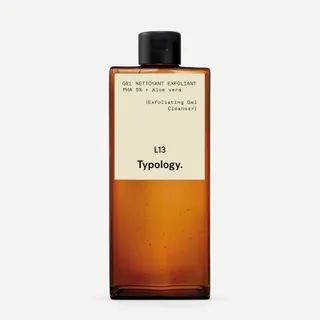
Typology Exfoliating Face Gel Cleanser — 5% PHA + Aloe Vera
Works for
ExfoliationGluconolactoneWorks well
“Product name: Exfoliating Face Gel Cleanser — 5% PHA + Aloe Vera”
This product can help exfoliate the skin. In other words, it helps break down the bonds between dead cells on the surface of the skin and speed up the skin turnover. Skin often appears softer and brighter after exfoliation, but overdoing it can result in disrupted skin barrier. The following ingredient is doing the exfoliating job in this product: gluconolactone.
CleansingCoco-glucoside, Coco-betaine + 1 moreCleanses gently
“Product name: Exfoliating Face Gel Cleanser — 5% PHA + Aloe Vera”
This product works by removing dirt and oil from the surface of the skin. It uses a combination of mild cleansing agents (coco-betaine, coco-glucoside, xanthan gum) and should be able to cleanse the skin gently. Still keep in mind that any cleansing can disrupt the skin barrier, and most people do not need to cleanse their skin more than once per day.
Even though this formulation is mild, the following cleansing agents could trigger an irritation or allergy for some people: coco-betaine, coco-glucoside
Anti-blemishGluconolactone, InulinNot delivered
“74% of testers found the number of blemishes and blackheads appears reduced*”
This product contains ingredients (gluconolactone) that could help reduce blemishes and clogged pores in theory, but there is not enough evidence that they actually work.
Can it cause trouble?
Irritancy2 strong irritants: Citrus aurantium dulcis peel oil, LimoneneMedium risk
ComedogenicClean of flagged comedogenic ingredientsNone flagged
User reviews
Be the first — your take helps the next person decide.
Ingredients
Filter by role to see what each ingredient is doing.
Water~45–55%
Coco-glucoside~9.8–12%
- Irritation risk
- High
Used as a cleansing agent (surfactant) in cleansers. Helps water and oil mix together in lotions. Can be irritating
More about Coco-glucosideGluconolactone~4.4–5.4%
- Irritation risk
- Medium
A polyhydroxy acid (PHA) that helps shed the dead cells from the skin surface revealing smoother skin. Is believed to be genter than AHAs. It helps attract water to the upper layer of the skin and can stimulate production of skin's own hyaluronic acid resulting in improved hydration levels. It has been shown to be helpful against acne and clogged pores if used consistently (e.g over a period of 12 weeks) in high enough concentration. It can help reduce fine lines and wrinkles and improve skin tone with long-term application. Can help neutralize free radicals
More about GluconolactoneCoco-betaine~4.3–5.3%
- Irritation risk
- High
Helps oil and water mix together and works as a cleansing agent. Can be allergenic
More about Coco-betaineGlycerin~2.5–3%
- Irritation risk
- Low
One of the best moisturizing ingredients. Naturally present in skin. It attracts water to the upper layer of the skin working as a humectant
More about GlycerinXanthan gum~1.8–2.2%
- Irritation risk
- Low
Used to create a thicker product consistency
More about Xanthan gumSodium hydroxide~1.6–1.9%
Aloe barbadensis leaf juice powder~1.3–1.6%
- Irritation risk
- Medium
Traditionally used to treat sunburns, dermatitis and inflammation, but evidence for its effectiveness is lacking. The extract can contain humectants that help attract water into the skin
More about Aloe barbadensis leaf juice powderCitrus aurantium dulcis peel oil~1.1–1.4%
- Irritation risk
- High
An essentil oil from orange peel. Potential allergen and can be irritating
More about Citrus aurantium dulcis peel oilInulin~0.9–1.1%
- Irritation risk
- Low
Helps attract water to the upper layer of the skin. Is claimed to support the growth of "good" bacteria in skin (as a "prebiotic"), but the research is lacking
More about InulinSodium chloride~0.7–1.05%
- Irritation risk
- Low
Used to stabilize mixtures of oil and water, and create thicker, gel-like product textures
More about Sodium chlorideBenzyl alcohol~0.45–0.65%
- Irritation risk
- High
A preservative. Can be used to mask unpleasant smell. Can be irritating
More about Benzyl alcoholCitric acid~0.45–0.7%
- Irritation risk
- Medium
Can work as an exfoliant but is typically used to adjust the product pH
More about Citric acidSodium citrate~0.3–0.6%
- Irritation risk
- Medium
Helps to control the skin's pH level. Maintains the skin's natural film of amino-lactic acids and oils. Helps to preserve products
More about Sodium citrateDehydroacetic acid~0.2–0.4%
Glucose~0.2–0.35%
- Irritation risk
- Low
Helps attract water to the upper layer of the skin. Could be helpful in restoring the skin barrier function
More about GlucoseSucrose~0.15–0.25%
- Irritation risk
- Low
Can help attract water to the upper layer of the skin. In crystal form, it can work as a gentle exfoliant, gentler than the salt scrub. Helps stabilize the emulsion
More about SucroseFructose~0.1–0.2%
- Irritation risk
- Low
Helps attract water to the upper layer of the skin
More about FructoseLimonene~0.05–0.15%
- Irritation risk
- High
A common frangrance that can easily irritate skin, especially if exposed to air, light or heat
More about LimoneneIngredient list view
Water, Coco-glucoside, Gluconolactone, Coco-betaine, Glycerin, Xanthan gum, Sodium hydroxide, Aloe barbadensis leaf juice powder, Citrus aurantium dulcis peel oil, Inulin, Sodium chloride, Benzyl alcohol, Citric acid, Sodium citrate, Dehydroacetic acid, Glucose, Sucrose, Fructose, Limonene
Compare prices
Retailers ranked by price — lowest first.
Worth comparing, line by line.
Match % combines shared ingredients, the first five ingredients, shared actives and hero ingredients, irritancy (lower counts in the alternative's favour), texture and body area. Only products in the same routine step are compared.
| TypologyExfoliating Face Gel Cleanser — 5% PHA + Aloe VeraYOUR PRODUCT | Spotles SKNJelly Cleanser | SVRSebiaclear Foaming Cleansing Gel | CeraVeRenewing SA Cleanser | |
|---|---|---|---|---|
| Match | — | 57% | 56% | 55% |
| Price | $36.90 | $8.90−$28.00 | $15.36−$21.54 | $15.99−$20.91 |
| Shared key ingredients | — | 3 of 8 | 4 of 8 | 3 of 8 |
| Key difference | — | Betaine | Sarcosine | Salicylic Acid |
| Irritancy | Medium | Low | Medium | Low |
| Drying alcohol | — | — | — | — |
| View product | Shop | Shop | Shop |


More alternatives: Filorga Age-Purify Clean Smoothing Purifying Cleansing GelAcnecide Purifide Ph Control Face Wash
Sources cited in this review
Every concentration estimate and effectiveness label is anchored to one of these 17 studies and safety reviews.
- 1
- 2Allergen of the Year—Alkyl Glucosidepracticeupdate.com
- 3
- 4
- 5
- 6

Affiliate links · As an Amazon Associate, WIMJ earns from qualifying purchases.