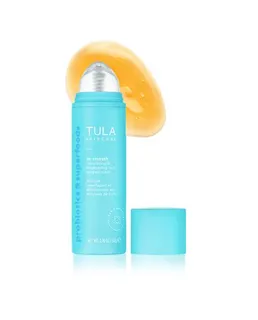
Tula resurfacing & brightening fruit enzyme mask

Tula resurfacing & brightening fruit enzyme mask

Efficacy100/100IrritancyHigh

Works for

Exfoliation
Glycolic acid, Lactobacillus/punica granatum fruit ferment extract + 3 more
Works well
What the product description says
“This powerful gel-like resurfacing enzyme mask reveals smoother & brighter-looking skin in a matter of minutes.”
Source: Tula

This product can help exfoliate the skin. In other words, it helps break down the bonds between dead cells on the surface of the skin and speed up the skin turnover. Skin often appears softer and brighter after exfoliation, but overdoing it can result in disrupted skin barrier. The following ingredient is doing the exfoliating job in this product: glycolic acid.

Glycolic acidKey activeEffect: HighAn alpha-hydroxy acid (AHA) that helps to remove the dead skin cells on the surface of the skin reveling a more even, smoother complexation. It is also able to stimulate collagen production with long-term use. Could help to reduce pore congestion. It can be irritating to the skin. Apply sunscreen daily if using products with glycolic acid~6–7.3%
Lactobacillus/punica granatum fruit ferment extractEffect: LowAn enzyme-based exfoliant~1.4–1.7%
Salix nigra bark extractEffect: LowA plant extract that might contain salicylic acid~0.55–0.8%
GluconolactoneUnder-dosedA polyhydroxy acid (PHA) that helps shed the dead cells from the skin surface revealing smoother skin. Is believed to be genter than AHAs. It helps attract water to the upper layer of the skin and can stimulate production of skin's own hyaluronic acid resulting in improved hydration levels. It has been shown to be helpful against acne and clogged pores if used consistently (e.g over a period of 12 weeks) in high enough concentration. It can help reduce fine lines and wrinkles and improve skin tone with long-term application. Can help neutralize free radicals~0.5–0.7%
Lactic acidUnder-dosedAn exfoliating and moisturizing alpha-hydroxy acid (AHA). Typically causes less irritation than other AHAs, for example, glycolic acid. At high concentrations (about 15%), lactic acid can help reduce lines and wrinkles. Recent studies show that lactic acid can support the "good" bacteria living on skin's surface (healthy skin microbiome)~0.2–0.4%
Evens skin tone
Glycolic acid, Lactobacillus/punica granatum fruit ferment extract + 2 more
Works well
What the product description says
“Natural pineapple, pumpkin & pomegranate enzymes combine with AHA, BHA & PHA gentle acids to quickly exfoliate & polish skin—plus help soften & even the look of tone with each use.”
Source: Tula

This product can help reduce hypepigmentation and even out the skin tone because it contains the following effective ingredients: glycolic acid

Keep in mind that you would need to apply any topical skincare targetted at hypigmentation consistently for a couple of months to get a result. No topical skincare product can help get rid of hyperpigmentation (including post-acne marks and age spots) instantly.

Glycolic acidKey activeEffect: HighAn alpha-hydroxy acid (AHA) that helps to remove the dead skin cells on the surface of the skin reveling a more even, smoother complexation. It is also able to stimulate collagen production with long-term use. Could help to reduce pore congestion. It can be irritating to the skin. Apply sunscreen daily if using products with glycolic acid~6–7.3%
Lactobacillus/punica granatum fruit ferment extractEffect: LowAn enzyme-based exfoliant~1.4–1.7%
GluconolactoneUnder-dosedA polyhydroxy acid (PHA) that helps shed the dead cells from the skin surface revealing smoother skin. Is believed to be genter than AHAs. It helps attract water to the upper layer of the skin and can stimulate production of skin's own hyaluronic acid resulting in improved hydration levels. It has been shown to be helpful against acne and clogged pores if used consistently (e.g over a period of 12 weeks) in high enough concentration. It can help reduce fine lines and wrinkles and improve skin tone with long-term application. Can help neutralize free radicals~0.5–0.7%
Lactic acidUnder-dosedAn exfoliating and moisturizing alpha-hydroxy acid (AHA). Typically causes less irritation than other AHAs, for example, glycolic acid. At high concentrations (about 15%), lactic acid can help reduce lines and wrinkles. Recent studies show that lactic acid can support the "good" bacteria living on skin's surface (healthy skin microbiome)~0.2–0.4%
Anti-aging
Side benefit · Glycolic acid, Lactococcus ferment lysate + 2 more
Works well

This product can help reduce and prevent fine lines and wrinkles, improve skin elasticity and firmness because it contains glycolic acid.

Keep in mind that it typically takes at least 6 weeks to notice any results because the changes that are needed to improve fine lines and elasticity happen in the deeper layers of the skin. No topical anti-aging product can “erase” wrinkles or fully reverse signs of aging.

Glycolic acidKey activeEffect: HighAn alpha-hydroxy acid (AHA) that helps to remove the dead skin cells on the surface of the skin reveling a more even, smoother complexation. It is also able to stimulate collagen production with long-term use. Could help to reduce pore congestion. It can be irritating to the skin. Apply sunscreen daily if using products with glycolic acid~6–7.3%
Lactococcus ferment lysateEffect: LowConsists of remains of dead bacteria cells. Is likely helpful in attracting water to the upper layer of the skin. Might be helpful in reducing inflammation and neutralizing free radicals in skin~1.6–2%
GluconolactoneUnder-dosedA polyhydroxy acid (PHA) that helps shed the dead cells from the skin surface revealing smoother skin. Is believed to be genter than AHAs. It helps attract water to the upper layer of the skin and can stimulate production of skin's own hyaluronic acid resulting in improved hydration levels. It has been shown to be helpful against acne and clogged pores if used consistently (e.g over a period of 12 weeks) in high enough concentration. It can help reduce fine lines and wrinkles and improve skin tone with long-term application. Can help neutralize free radicals~0.5–0.7%
Lactic acidUnder-dosedAn exfoliating and moisturizing alpha-hydroxy acid (AHA). Typically causes less irritation than other AHAs, for example, glycolic acid. At high concentrations (about 15%), lactic acid can help reduce lines and wrinkles. Recent studies show that lactic acid can support the "good" bacteria living on skin's surface (healthy skin microbiome)~0.2–0.4%
Moisturizing
Side benefit · Glycerin, Lactococcus ferment lysate + 6 more
Works

This product contains good ingredients to attract water to the upper layer of the skin. These ingredients are called "humectants": glycerin, butylene glycol.

When humectants are on the surface of the skin, they “pull in” the moisture from the outside environment, or from within deeper layers of the skin. If the air is dry, humectants can speed up the moisture loss from the skin. This is why it is a good idea to use another product on top of this one to help "seal in" the moisture (look for ingredients like dimethicone, squalane, oils and butters).

GlycerinKey active· HumectantEffect: HighOne of the best moisturizing ingredients. Naturally present in skin. It attracts water to the upper layer of the skin working as a humectant~3–3.7%
Lactococcus ferment lysateKey activeEffect: HighConsists of remains of dead bacteria cells. Is likely helpful in attracting water to the upper layer of the skin. Might be helpful in reducing inflammation and neutralizing free radicals in skin~1.6–2%
Corallina officinalis extractKey activeEffect: HighRed algae extract that helps attract water to the upper layer of the skin and might contain antioxidants~0.4–0.6%
Butylene glycol· HumectantEffect: LowUsed to create a nice product texture and help delivery of other ingredients. Might be somewhat helpful in attracting water to the upper layer of the skin~4–4.9%
Ananas sativus fruit extractEffect: LowA fruit extract that might help to attract water to the upper layer of the skin, but there is no evidence for any other benefits to the skin~0.25–0.45%
Caprylyl glycol· Humectant, EmollientEffect: LowHelps preserve products and creates a nice product texture~0.1–0.2%
GluconolactoneUnder-dosedA polyhydroxy acid (PHA) that helps shed the dead cells from the skin surface revealing smoother skin. Is believed to be genter than AHAs. It helps attract water to the upper layer of the skin and can stimulate production of skin's own hyaluronic acid resulting in improved hydration levels. It has been shown to be helpful against acne and clogged pores if used consistently (e.g over a period of 12 weeks) in high enough concentration. It can help reduce fine lines and wrinkles and improve skin tone with long-term application. Can help neutralize free radicals~0.5–0.7%
Lactic acidUnder-dosedAn exfoliating and moisturizing alpha-hydroxy acid (AHA). Typically causes less irritation than other AHAs, for example, glycolic acid. At high concentrations (about 15%), lactic acid can help reduce lines and wrinkles. Recent studies show that lactic acid can support the "good" bacteria living on skin's surface (healthy skin microbiome)~0.2–0.4%

Can it cause trouble?

Irritancy
3 strong irritants: Lactobacillus/papaya fruit ferment extract, Ocimum basilicum flower/leaf extract + 1 more — patch-test recommended
High risk
We flagged 20 ingredients with irritancy potential. Severity depends on your sensitivity threshold; the table lists the worst offenders first.
IngredientFunctionIrritationEst. amount
Glycolic acidAn alpha-hydroxy acid (AHA) that helps to remove the dead skin cells on the surface of the skin reveling a more even, smoother complexation. It is also able to stimulate collagen production with long-term use. Could help to reduce pore congestion. It can be irritating to the skin. Apply sunscreen daily if using products with glycolic acidHigh~6–7.3%est.
Lactobacillus/punica granatum fruit ferment extractAn enzyme-based exfoliantHigh~1.4–1.7%est.
Melia azadirachta leaf extractA plant extract that has anti-bacterial properties. Can be used to preserve the product. Can be irritatingHigh~0.35–0.65%est.
Curcuma longa root extractA plant extract that can contain an active compound curcumin, that may have some anti-inflammatory properties when applied to the skin, but solid research is lacking and the typical concentration used in skincare products is too low. Can be an irritantHigh~0.3–0.55%est.
Ocimum basilicum flower/leaf extractUsed as a fragrance. Canbe irritatingHigh~0.2–0.35%est.
Ocimum sanctum leaf extractA plant extract that is rich in a fragrance compound eugenol that is a frequent allergen and can be irritating. It might also contain anti-oxidants to help neutralize free radicalsHigh~0.2–0.35%est.
Aloe barbadensis flower extractA plant extract that might have some anti-oxidant effectHigh~0.25–0.45%est.
Salix nigra bark extractA plant extract that might contain salicylic acidMedium~0.55–0.8%est.
GluconolactoneA polyhydroxy acid (PHA) that helps shed the dead cells from the skin surface revealing smoother skin. Is believed to be genter than AHAs. It helps attract water to the upper layer of the skin and can stimulate production of skin's own hyaluronic acid resulting in improved hydration levels. It has been shown to be helpful against acne and clogged pores if used consistently (e.g over a period of 12 weeks) in high enough concentration. It can help reduce fine lines and wrinkles and improve skin tone with long-term application. Can help neutralize free radicalsMedium~0.5–0.7%est.
Melia azadirachta flower extractA plant extract that might be helpful to neutralize free radicals in skinMedium~0.45–0.65%est.
Leuconostoc/radish root ferment filtrateA preservative that comes from radishes fermented by a bacteria. New research suggests that the preservation properties in the ingredient come from an ammonium salt that is not present naturally in radish root but used in its cultivation. Is problematic because the exact amount of the preservative agents is difficult to determineMedium~0.35–0.65%est.
Coccinia indica fruit extractA plant extract that might have some anti-oxidant effect helping neutralize free radicals in skinMedium~0.3–0.5%est.
Rubus fruticosus fruit extractA plant extract that might help neutralize free radicals in skinMedium~0.25–0.45%est.
Ananas sativus fruit extractA fruit extract that might help to attract water to the upper layer of the skin, but there is no evidence for any other benefits to the skinMedium~0.25–0.45%est.
Lactic acidAn exfoliating and moisturizing alpha-hydroxy acid (AHA). Typically causes less irritation than other AHAs, for example, glycolic acid. At high concentrations (about 15%), lactic acid can help reduce lines and wrinkles. Recent studies show that lactic acid can support the "good" bacteria living on skin's surface (healthy skin microbiome)Medium~0.2–0.4%est.
Solanum melongena fruit extractEggplant fruit extract. Might have some anti-oxidant effectMedium~0.2–0.35%est.
Potassium sorbateA preservativeMedium~0.1–0.2%est.
Caprylyl glycolHelps preserve products and creates a nice product textureMedium~0.1–0.2%est.
1,2-hexanediolA preservativeMedium~0.05–0.1%est.
Comedogenic
1 ingredient rated 2 or more on the 0–5 pore-clogging scale
1 flagged
These ingredients have a comedogenic rating of 2 or more on a 0–5 scale; the table shows each one's rating. In leave-on products they can clog pores in acne-prone skin.
IngredientFunctionRatingEst. amount
Corallina officinalis extractRed algae extract that helps attract water to the upper layer of the skin and might contain antioxidants3/5~0.4–0.6%est.

User reviews

Would you recommend?
No community reviews yet.

Be the first — your take helps the next person decide.

Ingredients

Filter by role to see what each ingredient is doing.

Water~45–55%
Formula
Irritation risk
Low

Plain old water

More about Water
Glycolic acid~6–7.3%
Key activeIrritant · high
Irritation risk
High
Works for
Evens skin toneExfoliationAnti-agingAnti-blemish

An alpha-hydroxy acid (AHA) that helps to remove the dead skin cells on the surface of the skin reveling a more even, smoother complexation. It is also able to stimulate collagen production with long-term use. Could help to reduce pore congestion. It can be irritating to the skin. Apply sunscreen daily if using products with glycolic acid

More about Glycolic acid
Butylene glycol~4–4.9%
Formula
Irritation risk
Low
Works for
Moisturizing

Used to create a nice product texture and help delivery of other ingredients. Might be somewhat helpful in attracting water to the upper layer of the skin

More about Butylene glycol
Glycerin~3–3.7%
Key active
Irritation risk
Low
Works for
Moisturizing

One of the best moisturizing ingredients. Naturally present in skin. It attracts water to the upper layer of the skin working as a humectant

More about Glycerin
Sodium hydroxide~2.3–2.8%
Formula
Irritation risk
Low

Used to adjust the product's pH

More about Sodium hydroxide
Polyacrylate crosspolymer-6~1.9–2.3%
Formula
Lactococcus ferment lysate~1.6–2%
Key active
Irritation risk
Low
Works for
MoisturizingAnti-oxidationAnti-agingAnti-inflammatory

Consists of remains of dead bacteria cells. Is likely helpful in attracting water to the upper layer of the skin. Might be helpful in reducing inflammation and neutralizing free radicals in skin

More about Lactococcus ferment lysate
Lactobacillus/punica granatum fruit ferment extract~1.4–1.7%
Irritant · high
Irritation risk
High
Works for
ExfoliationEvens skin tone

An enzyme-based exfoliant

More about Lactobacillus/punica granatum fruit ferment extract
Lactobacillus/papaya fruit ferment extract~1.3–1.6%
Irritant · high
Lactobacillus/pumpkin fruit ferment filtrate~0.9–1.15%
Formula
Cichorium intybus root extract~0.65–1%
Formula
Salix nigra bark extract~0.55–0.8%
Irritant · medium
Irritation risk
Medium
Works for
Exfoliation

A plant extract that might contain salicylic acid

More about Salix nigra bark extract
Gluconolactone~0.5–0.7%
Under-dosedIrritant · medium
Irritation risk
Medium
Works for
ExfoliationEvens skin toneAnti-agingMoisturizingAnti-blemishAnti-oxidation

A polyhydroxy acid (PHA) that helps shed the dead cells from the skin surface revealing smoother skin. Is believed to be genter than AHAs. It helps attract water to the upper layer of the skin and can stimulate production of skin's own hyaluronic acid resulting in improved hydration levels. It has been shown to be helpful against acne and clogged pores if used consistently (e.g over a period of 12 weeks) in high enough concentration. It can help reduce fine lines and wrinkles and improve skin tone with long-term application. Can help neutralize free radicals

More about Gluconolactone
Melia azadirachta flower extract~0.45–0.65%
Irritant · medium
Irritation risk
Medium
Works for
Anti-oxidation

A plant extract that might be helpful to neutralize free radicals in skin

More about Melia azadirachta flower extract
Corallina officinalis extract~0.4–0.6%
Key activeComedogenic 3/5
Irritation risk
Low
Comedogenicity
3/5
Works for
MoisturizingAnti-oxidation

Red algae extract that helps attract water to the upper layer of the skin and might contain antioxidants

More about Corallina officinalis extract
Melia azadirachta leaf extract~0.35–0.65%
Irritant · high
Irritation risk
High
Works for
AntibacterialAnti-blemish

A plant extract that has anti-bacterial properties. Can be used to preserve the product. Can be irritating

More about Melia azadirachta leaf extract
Leuconostoc/radish root ferment filtrate~0.35–0.65%
Irritant · medium
Irritation risk
Medium

A preservative that comes from radishes fermented by a bacteria. New research suggests that the preservation properties in the ingredient come from an ammonium salt that is not present naturally in radish root but used in its cultivation. Is problematic because the exact amount of the preservative agents is difficult to determine

More about Leuconostoc/radish root ferment filtrate
Curcuma longa root extract~0.3–0.55%
Irritant · high
Irritation risk
High
Works for
Anti-inflammatory

A plant extract that can contain an active compound curcumin, that may have some anti-inflammatory properties when applied to the skin, but solid research is lacking and the typical concentration used in skincare products is too low. Can be an irritant

More about Curcuma longa root extract
Coccinia indica fruit extract~0.3–0.5%
Irritant · medium
Irritation risk
Medium
Works for
Anti-oxidation

A plant extract that might have some anti-oxidant effect helping neutralize free radicals in skin

More about Coccinia indica fruit extract
Vinegar~0.25–0.5%
Formula
Irritation risk
Low
More about Vinegar
Rubus fruticosus fruit extract~0.25–0.45%
Irritant · medium
Irritation risk
Medium
Works for
Anti-oxidation

A plant extract that might help neutralize free radicals in skin

More about Rubus fruticosus fruit extract
Ananas sativus fruit extract~0.25–0.45%
Irritant · medium
Irritation risk
Medium
Works for
Moisturizing

A fruit extract that might help to attract water to the upper layer of the skin, but there is no evidence for any other benefits to the skin

More about Ananas sativus fruit extract
Lactic acid~0.2–0.4%
Under-dosedIrritant · medium
Irritation risk
Medium
Works for
Evens skin toneMoisturizingExfoliationAnti-aging

An exfoliating and moisturizing alpha-hydroxy acid (AHA). Typically causes less irritation than other AHAs, for example, glycolic acid. At high concentrations (about 15%), lactic acid can help reduce lines and wrinkles. Recent studies show that lactic acid can support the "good" bacteria living on skin's surface (healthy skin microbiome)

More about Lactic acid
Ocimum basilicum flower/leaf extract~0.2–0.35%
Irritant · high
Irritation risk
High

Used as a fragrance. Canbe irritating

More about Ocimum basilicum flower/leaf extract
Ocimum sanctum leaf extract~0.2–0.35%
Irritant · high
Irritation risk
High
Works for
Anti-oxidation

A plant extract that is rich in a fragrance compound eugenol that is a frequent allergen and can be irritating. It might also contain anti-oxidants to help neutralize free radicals

More about Ocimum sanctum leaf extract
Aloe barbadensis flower extract~0.25–0.45%
Irritant · high
Irritation risk
High
Works for
Anti-oxidation

A plant extract that might have some anti-oxidant effect

More about Aloe barbadensis flower extract
Solanum melongena fruit extract~0.2–0.35%
Irritant · medium
Irritation risk
Medium
Works for
Anti-oxidation

Eggplant fruit extract. Might have some anti-oxidant effect

More about Solanum melongena fruit extract
Sodium benzoate~0.1–0.2%
Formula
Irritation risk
Low

A preservative

More about Sodium benzoate
Sodium chloride~0.15–0.3%
Formula
Irritation risk
Low

Used to stabilize mixtures of oil and water, and create thicker, gel-like product textures

More about Sodium chloride
Potassium sorbate~0.1–0.2%
Irritant · medium
Irritation risk
Medium

A preservative

More about Potassium sorbate
Caramel~0.1–0.15%
Formula
Irritation risk
Low
More about Caramel
Caprylyl glycol~0.1–0.2%
Irritant · medium
Irritation risk
Medium
Works for
Moisturizing

Helps preserve products and creates a nice product texture

More about Caprylyl glycol
1,2-hexanediol~0.05–0.1%
Irritant · medium
Irritation risk
Medium

A preservative

More about 1,2-hexanediol
Ingredient list view

Water, Glycolic acid, Butylene glycol, Glycerin, Sodium hydroxide, Polyacrylate crosspolymer-6, Lactococcus ferment lysate, Lactobacillus/punica granatum fruit ferment extract, Lactobacillus/papaya fruit ferment extract, Lactobacillus/pumpkin fruit ferment filtrate, Cichorium intybus root extract, Salix nigra bark extract, Gluconolactone, Melia azadirachta flower extract, Corallina officinalis extract, Melia azadirachta leaf extract, Leuconostoc/radish root ferment filtrate, Curcuma longa root extract, Coccinia indica fruit extract, Vinegar, Rubus fruticosus fruit extract, Ananas sativus fruit extract, Lactic acid, Ocimum basilicum flower/leaf extract, Ocimum sanctum leaf extract, Aloe barbadensis flower extract, Solanum melongena fruit extract, Sodium benzoate, Sodium chloride, Potassium sorbate, Caramel, Caprylyl glycol, 1,2-hexanediol

Compare prices

Retailers ranked by price — lowest first.

Amazon US
Price unavailable Out of stock
Check

Affiliate links · As an Amazon Associate, WIMJ earns from qualifying purchases.

Worth comparing, line by line.

Match % combines shared ingredients, the first five ingredients, shared actives and hero ingredients, irritancy (lower counts in the alternative's favour), texture and body area. Only products in the same routine step are compared.

Side-by-side comparison of this product against its closest alternatives
Tularesurfacing & brightening fruit enzyme maskYOUR PRODUCThellobubbleDeep Dive Exfoliating MaskTypologyMask Set for Enlarged Pores and Blackheads — 10% AHA + 10% PHANo7Laboratories Resurfacing Peel 15% Glycolic Acid
Match—64%64%59%
Price—$18.00$49.90$42.99
Shared key ingredients—5 of 63 of 63 of 6
Key difference—Azelaic AcidLactic Acid—
Irritancy High Medium Low Medium
Drying alcohol——— Contains drying alcohol
View product Shop Shop Shop

More alternatives: Bliss Clear Genius Clarifying Liquid PeelBubble Skincare Moon Walk Gentle Exfoliating Serum

Cheaper alternatives? Browse formulas in the same category.
We compare ingredient profiles across our catalog — pick the closest match for your budget.
Open dupe finder

Sources cited in this review

Every concentration estimate and effectiveness label is anchored to one of these 22 studies and safety reviews.

  1. 1
  2. 2
  3. 3
  4. 4
  5. 5
  6. 6
Tula resurfacing & brightening fruit enzyme mask
Tularesurfacing & brightening fruit enzyme mask

Affiliate links · As an Amazon Associate, WIMJ earns from qualifying purchases.

As an Amazon Associate, WIMJ earns from qualifying purchases.