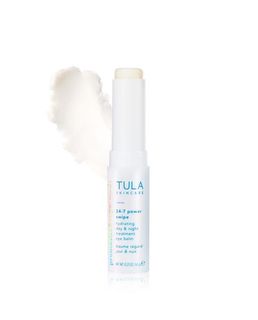
Tula Hydrating Day & Night Treatment Eye Balm
Works for
1 of 2 advertised claims delivered
Moisturizing27 ingredients credited for this claimGood support
“Hydrating Day & Night Treatment Eye Balm”
This product can help improve hydration of the skin with the two types of ingredients.
The first type is called “humectants”:
these ingredients help attract water.
When humectants are on the surface of the skin, they “pull in” the moisture from the outside environment, or from
within deeper layers of the skin. The following ingredients in this product do the job:
glycerin, lactobacillus ferment.
This product also contains ingredients called “occlusives”. They help reduce the speed with which our skin loses moisture to the outside environment. These ingredients also help soften the upper layer of the skin, so it feels less tight and nicer to the touch. The following ingredients in this product do the job: squalane, helianthus annuus seed wax.
Anti-aging2 ingredients credited for this claimLimited support
“What it is A potent, hydrating eye balm that visibly firms and reduce the look of fine lines, wrinkles, and puffiness.”
This product does not contain ingredients that are able to reduce fine lines and wrinkles or help with skin elasticity, but it can improve the look of the skin temporarily through moisturization. Well-moisturized skin might also be able to repair the sun damage better.This ingredient - lactococcus ferment lysate - could be helpful for preventing or repairing signs of aging in theory, but there is no evidence that it actually works.
Can it cause trouble?
Irritancy22 flagged ingredientsMedium risk
Comedogenic1 ingredient rated 2 or more on the 0–5 pore-clogging scale1 flagged
User reviews
Be the first — your take helps the next person decide.
Ingredients
Filter by role to see what each ingredient is doing.
Squalane~26–38%
- Irritation risk
- Low
An oil naturally present in skin. Works as an emollient to soften the skin and form a protective layer on its surface without a greasy feeling.
More about SqualaneHydrogenated polyisobutene~5.8–8.7%
- Irritation risk
- Low
Used to improve the product consistency and soften the upper layer of the skin
More about Hydrogenated polyisobuteneIsoamyl laurate~5.1–7.7%
- Irritation risk
- Medium
Helps stabilize emulsions and create a nice product texture
More about Isoamyl lauratePolyethylene~3.5–5.3%
Water~2.4–3.6%
Synthetic wax~2.1–3.1%
- Irritation risk
- Low
Used to stabilize product formulations and thicken product consistency
More about Synthetic waxPolymethyl methacrylate~1.7–2.5%
- Irritation risk
- Low
Is used to enhance product texture and can help to optically mask skin imperfections
More about Polymethyl methacrylateButylene glycol~1.4–2.1%
- Irritation risk
- Low
Used to create a nice product texture and help delivery of other ingredients. Might be somewhat helpful in attracting water to the upper layer of the skin
More about Butylene glycolSilica~1.4–2.2%
Glycerin~0.95–1.45%
- Irritation risk
- Low
One of the best moisturizing ingredients. Naturally present in skin. It attracts water to the upper layer of the skin working as a humectant
More about GlycerinLactococcus ferment lysate~0.5–1.2%
- Irritation risk
- Low
Consists of remains of dead bacteria cells. Is likely helpful in attracting water to the upper layer of the skin. Might be helpful in reducing inflammation and neutralizing free radicals in skin
More about Lactococcus ferment lysatePolyglyceryl-4 diisostearate/polyhydroxystearate/sebacate~0.45–1.05%
- Irritation risk
- Medium
Helps water and oil mix together
More about Polyglyceryl-4 diisostearate/polyhydroxystearate/sebacatePolyglyceryl-4 isostearate~0.4–0.95%
- Irritation risk
- Medium
Helps water and oil mix together
More about Polyglyceryl-4 isostearateCoco-caprylate/caprate~0.4–0.95%
- Irritation risk
- Low
Helps to soften the upper layer of the skin without creating a greasy texture
More about Coco-caprylate/caprateJojoba esters~0.4–0.9%
- Irritation risk
- Medium
An emollient made of jojoba oil. Helps soften the skin and support its barrier function
More about Jojoba estersCitrullus lanatus fruit extract~0.35–0.75%
- Irritation risk
- Medium
A plant extract that can contain an antioxidant compound
More about Citrullus lanatus fruit extractPyrus malus fruit extract~0.3–0.75%
- Irritation risk
- Medium
Can have some moisturizing properties due to its sugar content
More about Pyrus malus fruit extractLactobacillus~0.2–0.8%
- Irritation risk
- Low
A non-living ingredient made by fermentation with the bacteria Lactobacillus. It can help attract water to the upper layer of the skin and might help reduce inflammation
More about LactobacillusLactobacillus ferment~0.2–0.7%
- Irritation risk
- Low
A fermentation product created by bacteria Lactobacillus. The fermented product has anti-bacterial properties and might be helpful in calming down inflammation, but studies are lacking. Helps attract water to the upper layer of the skin. Can be used as a preservative
More about Lactobacillus fermentPolymnia sonchifolia root juice~0.2–0.7%
- Irritation risk
- High
A plant extract that helps attract water to the upper layer of the skin and might have some anti-oxidant properties
More about Polymnia sonchifolia root juiceLactic acid~0.15–0.65%
- Irritation risk
- Medium
An exfoliating and moisturizing alpha-hydroxy acid (AHA). Typically causes less irritation than other AHAs, for example, glycolic acid. At high concentrations (about 15%), lactic acid can help reduce lines and wrinkles. Recent studies show that lactic acid can support the "good" bacteria living on skin's surface (healthy skin microbiome)
More about Lactic acidAlpha-glucan oligosaccharide~0.2–0.75%
- Irritation risk
- Low
Helps attract water to the upper layer of the skin
More about Alpha-glucan oligosaccharideProline~0.15–0.65%
Sodium hyaluronate~0.15–0.6%
- Irritation risk
- Low
One of the best moisturizing ingredients. Attracts water into the upper layer of the skin
More about Sodium hyaluronateRice amino acids~0.15–0.6%
- Irritation risk
- Low
Help attract water to the upper layer of the skin
More about Rice amino acidsBeta vulgaris root extract~0.15–0.6%
- Irritation risk
- Medium
A plant extract that might have some antioxidant properties, but mostly used in cosmetics for its color
More about Beta vulgaris root extractInulin~0.15–0.6%
- Irritation risk
- Low
Helps attract water to the upper layer of the skin. Is claimed to support the growth of "good" bacteria in skin (as a "prebiotic"), but the research is lacking
More about InulinCaffeine~0.15–0.55%
- Irritation risk
- Medium
Might be helpful in neutralizing free radicals. Can have a dehydration effect that might somewhat decrease the look of puffy eyes
More about CaffeineTheobroma cacao seed extract~0.15–0.6%
- Irritation risk
- Low
- Comedogenicity
- 3/5
Chenopodium quinoa seed extract~0.15–0.6%
- Irritation risk
- Low
Helps soften the upper layer of the skin
More about Chenopodium quinoa seed extractCurcuma longa root extract~0.15–0.55%
- Irritation risk
- High
A plant extract that can contain an active compound curcumin, that may have some anti-inflammatory properties when applied to the skin, but solid research is lacking and the typical concentration used in skincare products is too low. Can be an irritant
More about Curcuma longa root extractVaccinium angustifolium fruit extract~0.15–0.55%
- Irritation risk
- Medium
A plant extract tha can have anti-oxidant properties, but evidence of effectiveness in skin is lacking
More about Vaccinium angustifolium fruit extractHydrolyzed soy protein~0.15–0.6%
- Irritation risk
- Low
Helps attract water to the upper layer of the skin. Might have some anti-aging, anti-oxidant, and skin lightening properties, but solid evidence is missing
More about Hydrolyzed soy proteinPolyglyceryl-3 polyricinoleate~0.15–0.65%
- Irritation risk
- Medium
Helps oil and water mix together
More about Polyglyceryl-3 polyricinoleateHelianthus annuus seed wax~0.2–0.75%
- Irritation risk
- Low
Helps soften the upper layer of the skin and support skin's barrier function while creating a thicker product consistency
More about Helianthus annuus seed waxAcacia decurrens flower wax~0.15–0.7%
Maltodextrin~0.15–0.65%
- Irritation risk
- Low
Used to stabilize the product formulation and can help absorb oil
More about MaltodextrinPolyglycerin-3~0.15–0.6%
- Irritation risk
- Low
Helps to attract water to the upper layer of the skin
More about Polyglycerin-3Sodium lactate~0.15–0.6%
- Irritation risk
- Medium
Helps attract water to the upper layer of the skin. Is often used to adjust the pH level of the product
More about Sodium lactateCaesalpinia spinosa fruit extract~0.15–0.6%
- Irritation risk
- Low
Lens esculenta fruit extract~0.15–0.6%
- Irritation risk
- Medium
A plant extract containing sugars that might help attract water to the upper layer of the skin. Is claimed by the manufacturer to help reduce pore size but evidence is lacking
More about Lens esculenta fruit extractSorbitan isostearate~0.15–0.6%
- Irritation risk
- Low
Helps oil and water mix together
More about Sorbitan isostearateHydrolyzed adansonia digitata extract~0.2–0.75%
- Irritation risk
- Low
Kappaphycus alvarezii extract~0.15–0.65%
- Irritation risk
- Low
A red algae extract that can help attract water to the upper layer of the skin and might have some antioxidant properties
More about Kappaphycus alvarezii extractTocopheryl acetate~0.15–0.6%
- Irritation risk
- Medium
A more stable but less bio-available form of vitamin E compared to Tocopherol. Might help moisturize and protect the skin from free radicals, but mostly used in low concentrations to stabilize other ingredients.
More about Tocopheryl acetateXanthan gum~0.15–0.65%
- Irritation risk
- Low
Used to create a thicker product consistency
More about Xanthan gumSodium chloride~0.15–0.65%
- Irritation risk
- Low
Used to stabilize mixtures of oil and water, and create thicker, gel-like product textures
More about Sodium chlorideDisteardimonium hectorite~0.15–0.6%
- Irritation risk
- Low
A type of clay that is used to thicken the product consistency
More about Disteardimonium hectoriteCaprylic/capric triglyceride~0.3–0.7%
- Irritation risk
- Medium
A good mix of fatty acids that forms a protective layer on the skin. Improves the shelf life of products. Derived from coconut and glycerin
More about Caprylic/capric triglycerideSodium phytate~0.15–0.6%
Sodium pca~0.15–0.55%
- Irritation risk
- Low
Naturally present in skin and helps to attract water to its upper layer
More about Sodium pcaHexylene glycol~0.1–0.5%
- Irritation risk
- Medium
Helps create a more spreadable product texture
More about Hexylene glycolCaprylyl glycol~0.15–0.6%
- Irritation risk
- Medium
Helps preserve products and creates a nice product texture
More about Caprylyl glycol1,2-hexanediol~0.1–0.45%
Phenoxyethanol~0.1–0.45%
- Irritation risk
- Low
A preservative. It helps prevent bacterial growth in cosmetic products
More about PhenoxyethanolSodium benzoate~0.1–0.35%
Potassium sorbate~0.1–0.35%
Ingredient list view
Squalane, Hydrogenated polyisobutene, Isoamyl laurate, Polyethylene, Water, Synthetic wax, Polymethyl methacrylate, Butylene glycol, Silica, Glycerin, Lactococcus ferment lysate, Polyglyceryl-4 diisostearate/polyhydroxystearate/sebacate, Polyglyceryl-4 isostearate, Coco-caprylate/caprate, Jojoba esters, Citrullus lanatus fruit extract, Pyrus malus fruit extract, Lactobacillus, Lactobacillus ferment, Polymnia sonchifolia root juice, Lactic acid, Alpha-glucan oligosaccharide, Proline, Sodium hyaluronate, Rice amino acids, Beta vulgaris root extract, Inulin, Caffeine, Theobroma cacao seed extract, Chenopodium quinoa seed extract, Curcuma longa root extract, Vaccinium angustifolium fruit extract, Hydrolyzed soy protein, Polyglyceryl-3 polyricinoleate, Helianthus annuus seed wax, Acacia decurrens flower wax, Maltodextrin, Polyglycerin-3, Sodium lactate, Caesalpinia spinosa fruit extract, Lens esculenta fruit extract, Sorbitan isostearate, Hydrolyzed adansonia digitata extract, Kappaphycus alvarezii extract, Tocopheryl acetate, Xanthan gum, Sodium chloride, Disteardimonium hectorite, Caprylic/capric triglyceride, Sodium phytate, Sodium pca, Hexylene glycol, Caprylyl glycol, 1,2-hexanediol, Phenoxyethanol, Sodium benzoate, Potassium sorbate
Compare prices
Retailers ranked by price — lowest first.

Sources cited in this review
Every concentration estimate and effectiveness label is anchored to one of these 20 studies and safety reviews.
- 1
- 2
- 3Safety Assessment of Alkyl Esters as Used in Cosmeticscir-safety.org
- 4Analyzing Lycopene Content in Fruitssciencedirect.com
- 5
- 6

Affiliate links · As an Amazon Associate, WIMJ earns from qualifying purchases.