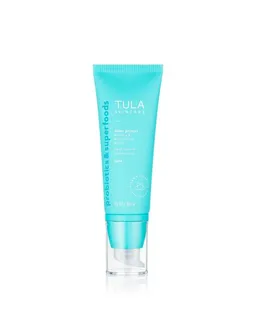
Tula blurring & moisturizing primer - Cosmos - Deep / Regular
Works for
MoisturizingPhytosphingosine, Centella asiatica extract + 28 moreWorks well
“blurring & moisturizing primer - Cosmos - Deep / Regular”
This product can help improve hydration of the skin with the two types of ingredients.
The first type is called “humectants”:
these ingredients help attract water.
When humectants are on the surface of the skin, they “pull in” the moisture from the outside environment, or from
within deeper layers of the skin. The following ingredients in this product do the job:
glycerin, lactobacillus ferment.
This product also contains ingredients called “occlusives”. They help reduce the speed with which our skin loses moisture to the outside environment. These ingredients also help soften the upper layer of the skin, so it feels less tight and nicer to the touch. The following ingredients in this product do the job: dimethicone, peg-10 dimethicone.
The following ingredients in this product are especially good for supporting the skin barrier and helping with the hydration level: phytosphingosine
Evens skin toneSide benefit · Tranexamic acid, Pinus pinaster bark extract + 3 moreWorks well
This product can help reduce hypepigmentation and even out the skin tone because it contains the following effective ingredients: tranexamic acid
The following ingredient (ingredients) in this product might be helpful, but there is no evidence to confirm that it actually can help even out the skin tone: glycyrrhiza glabra root extract, pinus pinaster bark extract.
Keep in mind that you would need to apply any topical skincare targetted at hypigmentation consistently for a couple of months to get a result. No topical skincare product can help get rid of hyperpigmentation (including post-acne marks and age spots) instantly.
Anti-oxidationSide benefit · Centella asiatica extract, Camellia sinensis leaf extract + 11 moreMay help
This product contains antioxidants (camellia sinensis leaf extract, centella asiatica extract, pinus pinaster bark extract) that can help neutralize free radicals in skin to lessen the damage it gets from the UV light (sun). There is some human evidence for this effect in skin, though it is smaller or less consistent than the evidence for the best antioxidants.
Anti-agingSide benefit · Centella asiatica extract, Camellia sinensis leaf extract + 3 moreMay help
This product contains centella asiatica extract. There is some human evidence that this ingredient helps reduce and prevent fine lines and wrinkles and improve skin elasticity and firmness, though it is smaller or less consistent than the evidence for the best anti-aging ingredients.
Can it cause trouble?
Irritancy1 strong irritant: Rosmarinus officinalis leaf extract — patch-test recommendedHigh risk
Comedogenic15 ingredients rated 2 or more on the 0–5 pore-clogging scale15 flagged
User reviews
Be the first — your take helps the next person decide.
Ingredients
Filter by role to see what each ingredient is doing.
Water~40–60%
Isododecane~5.2–7.7%
- Irritation risk
- Low
An emollient that helps soften the skin and can decrease moisture loss. Helps create a nice product texture
More about IsododecaneCyclopentasiloxane~3.8–5.6%
- Irritation risk
- Low
A silicone that helps improve the product texture and spreadability. Can absorb oil creating a short-term mattifying effect on the skin
More about CyclopentasiloxanePhenyl trimethicone~2.8–4.2%
- Irritation risk
- Low
A type of silicone that can decrease loss of moisture from the skin surface. It helps create a nice product texture
More about Phenyl trimethiconeDimethicone~2.2–3.2%
- Irritation risk
- Low
A silicone that helps to reduce water loss from the surface of the skin. Can temporarily "fill in" lines and wrinkles, absorb oil, and create a nice product finish
More about DimethiconeEthylhexyl palmitate~1.8–2.6%
- Irritation risk
- Low
- Comedogenicity
- 3/5
An emollient that helps soften the skin and create a nice product texture
More about Ethylhexyl palmitateCyclohexasiloxane~1.5–2.2%
- Irritation risk
- Low
A silicone that serves as an emollient. Helps create a nice non-greasy feels
More about CyclohexasiloxaneGlycerin~1.3–2%
- Irritation risk
- Low
One of the best moisturizing ingredients. Naturally present in skin. It attracts water to the upper layer of the skin working as a humectant
More about GlycerinPeg-10 dimethicone~1.1–1.6%
- Irritation risk
- Low
A silicone that works to soften the upper layer of the skin and reduce its water loss
More about Peg-10 dimethiconePeg-9 polydimethylsiloxyethyl dimethicone~0.8–1.25%
- Irritation risk
- Medium
A type of silicone that helps water and oil mix together
More about Peg-9 polydimethylsiloxyethyl dimethiconeCetyl peg/ppg-10/1 dimethicone~0.5–1.15%
- Irritation risk
- Low
A type of silicone that helps water and oil mix together. Can help to soften upper layer of the skin
More about Cetyl peg/ppg-10/1 dimethiconeDisteardimonium hectorite~0.4–1%
- Irritation risk
- Low
A type of clay that is used to thicken the product consistency
More about Disteardimonium hectoriteLactococcus ferment lysate~0.35–0.85%
- Irritation risk
- Low
Consists of remains of dead bacteria cells. Is likely helpful in attracting water to the upper layer of the skin. Might be helpful in reducing inflammation and neutralizing free radicals in skin
More about Lactococcus ferment lysateLactobacillus ferment~0.35–0.8%
- Irritation risk
- Low
A fermentation product created by bacteria Lactobacillus. The fermented product has anti-bacterial properties and might be helpful in calming down inflammation, but studies are lacking. Helps attract water to the upper layer of the skin. Can be used as a preservative
More about Lactobacillus fermentLactobacillus~0.3–0.7%
- Irritation risk
- Low
A non-living ingredient made by fermentation with the bacteria Lactobacillus. It can help attract water to the upper layer of the skin and might help reduce inflammation
More about LactobacillusCentella asiatica extract~0.35–0.85%
- Irritation risk
- Medium
A plant extract that has been shown to be able to reduce inflammation in skin, support restoration of skin barrier function, as well as support collagen production. Contains active compounds called centelloids: asiaticoside, madecasosside, asiatic acid and madecassic acid. Might be helpful in preventing stretch marks. It can be itself be irritating though.
More about Centella asiatica extractPolygonum cuspidatum root extract~0.3–0.75%
- Irritation risk
- Medium
A plant extract that can contain resveratrol, an antioxidant that can help neutralize free radicals in skin. The effectiveness depends on the extract quality and concentration in the product
More about Polygonum cuspidatum root extractScutellaria baicalensis root extract~0.15–0.7%
- Irritation risk
- High
A plant extract that might contain a compound baicalin that could be helpful in neutralizing free radicals and reducing inflammation in skin. The baicalin concentration in skincare products is often too low for an effective action. Can be used for its fragrant properties
More about Scutellaria baicalensis root extractBeta vulgaris root extract~0.15–0.65%
- Irritation risk
- Medium
A plant extract that might have some antioxidant properties, but mostly used in cosmetics for its color
More about Beta vulgaris root extractInulin~0.15–0.65%
- Irritation risk
- Low
Helps attract water to the upper layer of the skin. Is claimed to support the growth of "good" bacteria in skin (as a "prebiotic"), but the research is lacking
More about InulinCamellia sinensis leaf extract~0.15–0.65%
- Irritation risk
- Low
Can contain potent anti-oxidant compounds (abbreviated ECG, GCG, EGC, and EGCG) that might help protect the skin from free radicals. Can help calm down inflammation and has some anti-bacterial properties. Unfortunately, these antioxidants are unstable and lose their effectiveness very quickly in products. The concentration of the antioxidant compounds in the extract also tends to be low to be effective in topical formulation
More about Camellia sinensis leaf extractChamomilla recutita flower extract~0.15–0.55%
- Irritation risk
- High
Plant extract that can have healing and anti-inflammatory properties. It is a potential allergen and can be irritating
More about Chamomilla recutita flower extractRosmarinus officinalis leaf extract~0.15–0.5%
- Irritation risk
- High
Can be helpful in reducing inflammation in skin, including inflamed acne. It can be irritating
More about Rosmarinus officinalis leaf extractAlpha-glucan oligosaccharide~0.15–0.65%
- Irritation risk
- Low
Helps attract water to the upper layer of the skin
More about Alpha-glucan oligosaccharidePolymnia sonchifolia root juice~0.15–0.55%
- Irritation risk
- High
A plant extract that helps attract water to the upper layer of the skin and might have some anti-oxidant properties
More about Polymnia sonchifolia root juiceGlycyrrhiza glabra root extract~0.15–0.5%
- Irritation risk
- Medium
A plant extract that can help lighten the skin and calm down inflammation. Might be helpful in neutralizing free radicals
More about Glycyrrhiza glabra root extractCurcuma longa root extract~0.15–0.5%
- Irritation risk
- High
A plant extract that can contain an active compound curcumin, that may have some anti-inflammatory properties when applied to the skin, but solid research is lacking and the typical concentration used in skincare products is too low. Can be an irritant
More about Curcuma longa root extractSalvia hispanica seed oil~0.15–0.6%
- Irritation risk
- Low
Chia seed oil. Helps to soften the upper layer of the skin and might be helpful in repairing skin barrier
More about Salvia hispanica seed oilLactic acid~0.15–0.55%
- Irritation risk
- Medium
An exfoliating and moisturizing alpha-hydroxy acid (AHA). Typically causes less irritation than other AHAs, for example, glycolic acid. At high concentrations (about 15%), lactic acid can help reduce lines and wrinkles. Recent studies show that lactic acid can support the "good" bacteria living on skin's surface (healthy skin microbiome)
More about Lactic acidTocopherol~0.15–0.55%
- Irritation risk
- Low
Pure form of vitamin E. Can help moisturise and protect the skin from free radicals. Often used to help stabilise other ingredients or the formula itself
More about TocopherolButylene glycol~0.15–0.55%
- Irritation risk
- Low
Used to create a nice product texture and help delivery of other ingredients. Might be somewhat helpful in attracting water to the upper layer of the skin
More about Butylene glycolBisabolol~0.1–0.45%
- Irritation risk
- Low
An active component of chamomile plant that historically has been used to calm down irritated skin. A recent study shows that bisabolol indeed can have some anti-inflammatory effect on skin, even though conclusive data is lacking. Bisabolol has a sweet floral scent and can be added to products for its aromatic properties
More about BisabololMaltodextrin~0.15–0.55%
- Irritation risk
- Low
Used to stabilize the product formulation and can help absorb oil
More about Maltodextrin1,2-hexanediol~0.15–0.55%
Tocopheryl acetate~0.15–0.6%
- Irritation risk
- Medium
A more stable but less bio-available form of vitamin E compared to Tocopherol. Might help moisturize and protect the skin from free radicals, but mostly used in low concentrations to stabilize other ingredients.
More about Tocopheryl acetateCellulose acetate~0.15–0.6%
- Irritation risk
- Low
Acrylates/ammonium methacrylate copolymer~0.15–0.6%
- Irritation risk
- Low
Boron nitride~0.15–0.55%
- Irritation risk
- Low
Helps to absord oil and evenly disperse other ingredients (for example, pigment) in product formulation
More about Boron nitrideEthylhexylglycerin~0.15–0.55%
Hdi/trimethylol hexyllactone crosspolymer~0.15–0.55%
- Irritation risk
- Low
Used to create a silky product texture and add volume to products
More about Hdi/trimethylol hexyllactone crosspolymerMagnesium stearate~0.15–0.6%
Mica~0.15–0.65%
- Irritation risk
- Low
Creates an illusion of smoother and more radiant skin tone. Adds shimmer to the skin by reflecting light
More about MicaPolyglyceryl-4 isostearate~0.15–0.6%
- Irritation risk
- Medium
Helps water and oil mix together
More about Polyglyceryl-4 isostearatePolymethylsilsesquioxane~0.15–0.6%
- Irritation risk
- Low
A silicone that improves product texture and helps dissolve other ingredients. Can form a non-greasy film on the skin to prevent moisture loss
More about PolymethylsilsesquioxanePropylene carbonate~0.15–0.65%
- Irritation risk
- Low
Is used to dissolve other ingredients and create nice product texture
More about Propylene carbonatePropylene glycol stearate~0.15–0.55%
Silica silylate~0.15–0.65%
Sodium benzoate~0.25–0.5%
Sodium chloride~0.15–0.65%
- Irritation risk
- Low
Used to stabilize mixtures of oil and water, and create thicker, gel-like product textures
More about Sodium chloridePhenoxyethanol~0.15–0.6%
- Irritation risk
- Low
A preservative. It helps prevent bacterial growth in cosmetic products
More about PhenoxyethanolTitanium dioxide~0.2–0.75%
- Irritation risk
- Low
Works as a UV filter when used in high concentrations. It is photostable and is effective mostly against the UVB light, with some protection in the UVA range. In small concentrations, used for its ability to improve the color of cosmetic products. Is usually well tolerated by the skin
More about Titanium dioxideIron oxides~0.1–0.5%
- Irritation risk
- Low
An umbrella term for the following three colorants: CI 77491, CI 77492, CI 77499. They might be able to offer some protection against visible light, but the degree of the protection is not clear
More about Iron oxidesIron oxides~0.1–0.5%
- Irritation risk
- Low
An umbrella term for the following three colorants: CI 77491, CI 77492, CI 77499. They might be able to offer some protection against visible light, but the degree of the protection is not clear
More about Iron oxidesIron oxides~0.1–0.5%
- Irritation risk
- Low
An umbrella term for the following three colorants: CI 77491, CI 77492, CI 77499. They might be able to offer some protection against visible light, but the degree of the protection is not clear
More about Iron oxidesWater~0.15–0.55%
Isododecane~0.15–0.55%
- Irritation risk
- Low
An emollient that helps soften the skin and can decrease moisture loss. Helps create a nice product texture
More about IsododecaneCyclopentasiloxane~0.15–0.65%
- Irritation risk
- Low
A silicone that helps improve the product texture and spreadability. Can absorb oil creating a short-term mattifying effect on the skin
More about CyclopentasiloxanePhenyl trimethicone~0.15–0.6%
- Irritation risk
- Low
A type of silicone that can decrease loss of moisture from the skin surface. It helps create a nice product texture
More about Phenyl trimethiconeCyclohexasiloxane~0.15–0.65%
- Irritation risk
- Low
A silicone that serves as an emollient. Helps create a nice non-greasy feels
More about CyclohexasiloxaneDimethicone~0.15–0.7%
- Irritation risk
- Low
A silicone that helps to reduce water loss from the surface of the skin. Can temporarily "fill in" lines and wrinkles, absorb oil, and create a nice product finish
More about DimethiconeEthylhexyl palmitate~0.15–0.65%
- Irritation risk
- Low
- Comedogenicity
- 3/5
An emollient that helps soften the skin and create a nice product texture
More about Ethylhexyl palmitateGlycerin~0.15–0.65%
- Irritation risk
- Low
One of the best moisturizing ingredients. Naturally present in skin. It attracts water to the upper layer of the skin working as a humectant
More about GlycerinCetyl peg/ppg-10/1 dimethicone~0.15–0.55%
- Irritation risk
- Low
A type of silicone that helps water and oil mix together. Can help to soften upper layer of the skin
More about Cetyl peg/ppg-10/1 dimethiconePeg-10 dimethicone~0.15–0.65%
- Irritation risk
- Low
A silicone that works to soften the upper layer of the skin and reduce its water loss
More about Peg-10 dimethiconePeg-9 polydimethylsiloxyethyl dimethicone~0.15–0.6%
- Irritation risk
- Medium
A type of silicone that helps water and oil mix together
More about Peg-9 polydimethylsiloxyethyl dimethiconeDisteardimonium hectorite~0.15–0.55%
- Irritation risk
- Low
A type of clay that is used to thicken the product consistency
More about Disteardimonium hectoriteLactococcus ferment lysate~0.15–0.55%
- Irritation risk
- Low
Consists of remains of dead bacteria cells. Is likely helpful in attracting water to the upper layer of the skin. Might be helpful in reducing inflammation and neutralizing free radicals in skin
More about Lactococcus ferment lysatePinus pinaster bark extract~0.15–0.6%
- Irritation risk
- Medium
A plant extract that might help neutralize free radicals and reduce hyperpigmentation, but evidence of effectiveness of topical application is lacking. It can be an INCI name for the trademarked ingredient Pycnogenol (but could also be a different type of this plant's bark extract)
More about Pinus pinaster bark extractGlycyrrhiza glabra root extract~0.1–0.5%
- Irritation risk
- Medium
A plant extract that can help lighten the skin and calm down inflammation. Might be helpful in neutralizing free radicals
More about Glycyrrhiza glabra root extractCurcuma longa root extract~0.15–0.5%
- Irritation risk
- High
A plant extract that can contain an active compound curcumin, that may have some anti-inflammatory properties when applied to the skin, but solid research is lacking and the typical concentration used in skincare products is too low. Can be an irritant
More about Curcuma longa root extractSalvia hispanica seed oil~0.15–0.6%
- Irritation risk
- Low
Chia seed oil. Helps to soften the upper layer of the skin and might be helpful in repairing skin barrier
More about Salvia hispanica seed oilLactic acid~0.15–0.55%
- Irritation risk
- Medium
An exfoliating and moisturizing alpha-hydroxy acid (AHA). Typically causes less irritation than other AHAs, for example, glycolic acid. At high concentrations (about 15%), lactic acid can help reduce lines and wrinkles. Recent studies show that lactic acid can support the "good" bacteria living on skin's surface (healthy skin microbiome)
More about Lactic acidPropanediol~0.15–0.6%
- Irritation risk
- Low
Acts as a solvent for other ingredients. Speeds up the absorption of other ingredients into the skin
More about PropanediolTocopherol~0.15–0.55%
- Irritation risk
- Low
Pure form of vitamin E. Can help moisturise and protect the skin from free radicals. Often used to help stabilise other ingredients or the formula itself
More about TocopherolTocopheryl acetate~0.15–0.6%
- Irritation risk
- Medium
A more stable but less bio-available form of vitamin E compared to Tocopherol. Might help moisturize and protect the skin from free radicals, but mostly used in low concentrations to stabilize other ingredients.
More about Tocopheryl acetateXanthan gum~0.15–0.6%
- Irritation risk
- Low
Used to create a thicker product consistency
More about Xanthan gumCaprylic/capric triglyceride~0.15–0.7%
- Irritation risk
- Medium
A good mix of fatty acids that forms a protective layer on the skin. Improves the shelf life of products. Derived from coconut and glycerin
More about Caprylic/capric triglycerideCellulose acetate~0.15–0.6%
- Irritation risk
- Low
Docosahexaenoic acid~0.15–0.55%
- Irritation risk
- Low
Eicosapentaenoic acid~0.15–0.6%
- Irritation risk
- Low
Acrylates/ammonium methacrylate copolymer~0.15–0.6%
- Irritation risk
- Low
Boron nitride~0.15–0.55%
- Irritation risk
- Low
Helps to absord oil and evenly disperse other ingredients (for example, pigment) in product formulation
More about Boron nitrideEthylhexylglycerin~0.15–0.55%
Hdi/trimethylol hexyllactone crosspolymer~0.15–0.55%
- Irritation risk
- Low
Used to create a silky product texture and add volume to products
More about Hdi/trimethylol hexyllactone crosspolymerMagnesium stearate~0.15–0.6%
Mica~0.15–0.65%
- Irritation risk
- Low
Creates an illusion of smoother and more radiant skin tone. Adds shimmer to the skin by reflecting light
More about MicaPhosphatidylcholine~0.15–0.6%
- Irritation risk
- Medium
Used to enhance the delivery of other ingredients
More about PhosphatidylcholinePhytosphingosine~0.15–0.65%
- Irritation risk
- Low
A type of lipid that is naturally present in skin. It might help in repairing skin barrier function and has anti-bacterial effect
More about PhytosphingosinePolyglyceryl-4 isostearate~0.15–0.6%
- Irritation risk
- Medium
Helps water and oil mix together
More about Polyglyceryl-4 isostearatePolymethylsilsesquioxane~0.15–0.6%
- Irritation risk
- Low
A silicone that improves product texture and helps dissolve other ingredients. Can form a non-greasy film on the skin to prevent moisture loss
More about PolymethylsilsesquioxanePropylene carbonate~0.15–0.65%
- Irritation risk
- Low
Is used to dissolve other ingredients and create nice product texture
More about Propylene carbonatePropylene glycol stearate~0.15–0.55%
Silica silylate~0.15–0.65%
Sodium benzoate~0.25–0.5%
Sodium chloride~0.15–0.65%
- Irritation risk
- Low
Used to stabilize mixtures of oil and water, and create thicker, gel-like product textures
More about Sodium chlorideSorbitol~0.15–0.55%
- Irritation risk
- Low
Helps attract water to the upper layer of the skin and improves the product texture
More about SorbitolTetrasodium glutamate diacetate~0.15–0.55%
- Irritation risk
- Low
Helps stabilize the product formulation
More about Tetrasodium glutamate diacetatePhenoxyethanol~0.15–0.6%
- Irritation risk
- Low
A preservative. It helps prevent bacterial growth in cosmetic products
More about PhenoxyethanolTitanium dioxide~0.2–0.75%
- Irritation risk
- Low
Works as a UV filter when used in high concentrations. It is photostable and is effective mostly against the UVB light, with some protection in the UVA range. In small concentrations, used for its ability to improve the color of cosmetic products. Is usually well tolerated by the skin
More about Titanium dioxideIron oxides~0.1–0.5%
- Irritation risk
- Low
An umbrella term for the following three colorants: CI 77491, CI 77492, CI 77499. They might be able to offer some protection against visible light, but the degree of the protection is not clear
More about Iron oxidesIron oxides~0.1–0.5%
- Irritation risk
- Low
An umbrella term for the following three colorants: CI 77491, CI 77492, CI 77499. They might be able to offer some protection against visible light, but the degree of the protection is not clear
More about Iron oxidesIron oxides~0.1–0.5%
- Irritation risk
- Low
An umbrella term for the following three colorants: CI 77491, CI 77492, CI 77499. They might be able to offer some protection against visible light, but the degree of the protection is not clear
More about Iron oxidesWater~0.15–0.55%
Isododecane~0.15–0.55%
- Irritation risk
- Low
An emollient that helps soften the skin and can decrease moisture loss. Helps create a nice product texture
More about IsododecaneCyclopentasiloxane~0.15–0.65%
- Irritation risk
- Low
A silicone that helps improve the product texture and spreadability. Can absorb oil creating a short-term mattifying effect on the skin
More about CyclopentasiloxanePhenyl trimethicone~0.15–0.6%
- Irritation risk
- Low
A type of silicone that can decrease loss of moisture from the skin surface. It helps create a nice product texture
More about Phenyl trimethiconeGlycerin~0.15–0.65%
- Irritation risk
- Low
One of the best moisturizing ingredients. Naturally present in skin. It attracts water to the upper layer of the skin working as a humectant
More about GlycerinDimethicone~0.15–0.7%
- Irritation risk
- Low
A silicone that helps to reduce water loss from the surface of the skin. Can temporarily "fill in" lines and wrinkles, absorb oil, and create a nice product finish
More about DimethiconeEthylhexyl palmitate~0.15–0.65%
- Irritation risk
- Low
- Comedogenicity
- 3/5
An emollient that helps soften the skin and create a nice product texture
More about Ethylhexyl palmitateCyclohexasiloxane~0.15–0.65%
- Irritation risk
- Low
A silicone that serves as an emollient. Helps create a nice non-greasy feels
More about CyclohexasiloxanePeg-10 dimethicone~0.15–0.65%
- Irritation risk
- Low
A silicone that works to soften the upper layer of the skin and reduce its water loss
More about Peg-10 dimethiconePeg-9 polydimethylsiloxyethyl dimethicone~0.15–0.6%
- Irritation risk
- Medium
A type of silicone that helps water and oil mix together
More about Peg-9 polydimethylsiloxyethyl dimethiconeCetyl peg/ppg-10/1 dimethicone~0.15–0.55%
- Irritation risk
- Low
A type of silicone that helps water and oil mix together. Can help to soften upper layer of the skin
More about Cetyl peg/ppg-10/1 dimethiconeDisteardimonium hectorite~0.15–0.55%
- Irritation risk
- Low
A type of clay that is used to thicken the product consistency
More about Disteardimonium hectoriteLactococcus ferment lysate~0.15–0.55%
- Irritation risk
- Low
Consists of remains of dead bacteria cells. Is likely helpful in attracting water to the upper layer of the skin. Might be helpful in reducing inflammation and neutralizing free radicals in skin
More about Lactococcus ferment lysateLactobacillus ferment~0.15–0.55%
- Irritation risk
- Low
A fermentation product created by bacteria Lactobacillus. The fermented product has anti-bacterial properties and might be helpful in calming down inflammation, but studies are lacking. Helps attract water to the upper layer of the skin. Can be used as a preservative
More about Lactobacillus fermentLactobacillus~0.15–0.55%
- Irritation risk
- Low
A non-living ingredient made by fermentation with the bacteria Lactobacillus. It can help attract water to the upper layer of the skin and might help reduce inflammation
More about LactobacillusBuddleja davidii extract~0.15–0.55%
- Irritation risk
- Low
Ethylcellulose~0.15–0.6%
- Irritation risk
- Low
Beta vulgaris root extract~0.15–0.55%
- Irritation risk
- Medium
A plant extract that might have some antioxidant properties, but mostly used in cosmetics for its color
More about Beta vulgaris root extractInulin~0.15–0.55%
- Irritation risk
- Low
Helps attract water to the upper layer of the skin. Is claimed to support the growth of "good" bacteria in skin (as a "prebiotic"), but the research is lacking
More about InulinCurcuma longa root extract~0.15–0.5%
- Irritation risk
- High
A plant extract that can contain an active compound curcumin, that may have some anti-inflammatory properties when applied to the skin, but solid research is lacking and the typical concentration used in skincare products is too low. Can be an irritant
More about Curcuma longa root extractAlpha-glucan oligosaccharide~0.15–0.65%
- Irritation risk
- Low
Helps attract water to the upper layer of the skin
More about Alpha-glucan oligosaccharidePolymnia sonchifolia root juice~0.15–0.55%
- Irritation risk
- High
A plant extract that helps attract water to the upper layer of the skin and might have some anti-oxidant properties
More about Polymnia sonchifolia root juicePinus pinaster bark extract~0.15–0.6%
- Irritation risk
- Medium
A plant extract that might help neutralize free radicals and reduce hyperpigmentation, but evidence of effectiveness of topical application is lacking. It can be an INCI name for the trademarked ingredient Pycnogenol (but could also be a different type of this plant's bark extract)
More about Pinus pinaster bark extractGlycyrrhiza glabra root extract~0.1–0.5%
- Irritation risk
- Medium
A plant extract that can help lighten the skin and calm down inflammation. Might be helpful in neutralizing free radicals
More about Glycyrrhiza glabra root extractLactic acid~0.15–0.55%
- Irritation risk
- Medium
An exfoliating and moisturizing alpha-hydroxy acid (AHA). Typically causes less irritation than other AHAs, for example, glycolic acid. At high concentrations (about 15%), lactic acid can help reduce lines and wrinkles. Recent studies show that lactic acid can support the "good" bacteria living on skin's surface (healthy skin microbiome)
More about Lactic acidSilica dimethyl silylate~0.15–0.65%
Lauric acid~0.2–0.75%
- Irritation risk
- Medium
- Comedogenicity
- 3/5
Helps water and oil mix together. Has anti-bacterial properties that might be helpful in preventing blemishes
More about Lauric acidTranexamic acid~0.15–0.55%
- Irritation risk
- Low
An amino acid that is effective in reducing hyperpigmentation and evening out the skin tone. It can also help in skin barrier recovery. It is used to treat melasma, especially with injections and when taken orally
More about Tranexamic acidZea mays starch~0.15–0.55%
- Irritation risk
- Medium
- Comedogenicity
- 3/5
Used to thicken the product's consistency
More about Zea mays starchMannitol~0.15–0.55%
- Irritation risk
- Low
Helps to attract water to the upper layer of the skin
More about MannitolPolyglyceryl-10 stearate~0.15–0.55%
- Irritation risk
- Medium
Helps water and oil mix together and softens the upper layer of the skin
More about Polyglyceryl-10 stearateMaltodextrin~0.15–0.55%
- Irritation risk
- Low
Used to stabilize the product formulation and can help absorb oil
More about MaltodextrinButylene glycol~0.15–0.55%
- Irritation risk
- Low
Used to create a nice product texture and help delivery of other ingredients. Might be somewhat helpful in attracting water to the upper layer of the skin
More about Butylene glycol1,2-hexanediol~0.15–0.55%
Propanediol~0.15–0.6%
- Irritation risk
- Low
Acts as a solvent for other ingredients. Speeds up the absorption of other ingredients into the skin
More about PropanediolTocopherol~0.15–0.55%
- Irritation risk
- Low
Pure form of vitamin E. Can help moisturise and protect the skin from free radicals. Often used to help stabilise other ingredients or the formula itself
More about TocopherolTocopheryl acetate~0.15–0.6%
- Irritation risk
- Medium
A more stable but less bio-available form of vitamin E compared to Tocopherol. Might help moisturize and protect the skin from free radicals, but mostly used in low concentrations to stabilize other ingredients.
More about Tocopheryl acetateXanthan gum~0.15–0.6%
- Irritation risk
- Low
Used to create a thicker product consistency
More about Xanthan gumCaprylic/capric triglyceride~0.15–0.7%
- Irritation risk
- Medium
A good mix of fatty acids that forms a protective layer on the skin. Improves the shelf life of products. Derived from coconut and glycerin
More about Caprylic/capric triglycerideCellulose acetate~0.15–0.6%
- Irritation risk
- Low
Docosahexaenoic acid~0.15–0.55%
- Irritation risk
- Low
Eicosapentaenoic acid~0.15–0.6%
- Irritation risk
- Low
Acrylates/ammonium methacrylate copolymer~0.15–0.6%
- Irritation risk
- Low
Ethylhexylglycerin~0.15–0.55%
Hdi/trimethylol hexyllactone crosspolymer~0.15–0.55%
- Irritation risk
- Low
Used to create a silky product texture and add volume to products
More about Hdi/trimethylol hexyllactone crosspolymerMica~0.15–0.65%
- Irritation risk
- Low
Creates an illusion of smoother and more radiant skin tone. Adds shimmer to the skin by reflecting light
More about MicaPhosphatidylcholine~0.15–0.6%
- Irritation risk
- Medium
Used to enhance the delivery of other ingredients
More about PhosphatidylcholinePhytosphingosine~0.15–0.65%
- Irritation risk
- Low
A type of lipid that is naturally present in skin. It might help in repairing skin barrier function and has anti-bacterial effect
More about PhytosphingosinePolyglyceryl-4 isostearate~0.15–0.6%
- Irritation risk
- Medium
Helps water and oil mix together
More about Polyglyceryl-4 isostearatePolymethylsilsesquioxane~0.15–0.6%
- Irritation risk
- Low
A silicone that improves product texture and helps dissolve other ingredients. Can form a non-greasy film on the skin to prevent moisture loss
More about PolymethylsilsesquioxanePropylene carbonate~0.15–0.65%
- Irritation risk
- Low
Is used to dissolve other ingredients and create nice product texture
More about Propylene carbonatePropylene glycol stearate~0.15–0.55%
Silica silylate~0.15–0.65%
Sodium benzoate~0.25–0.5%
Sodium chloride~0.15–0.65%
- Irritation risk
- Low
Used to stabilize mixtures of oil and water, and create thicker, gel-like product textures
More about Sodium chlorideSorbitol~0.15–0.55%
- Irritation risk
- Low
Helps attract water to the upper layer of the skin and improves the product texture
More about SorbitolTetrasodium glutamate diacetate~0.15–0.55%
- Irritation risk
- Low
Helps stabilize the product formulation
More about Tetrasodium glutamate diacetatePhenoxyethanol~0.15–0.6%
- Irritation risk
- Low
A preservative. It helps prevent bacterial growth in cosmetic products
More about PhenoxyethanolTitanium dioxide~0.2–0.75%
- Irritation risk
- Low
Works as a UV filter when used in high concentrations. It is photostable and is effective mostly against the UVB light, with some protection in the UVA range. In small concentrations, used for its ability to improve the color of cosmetic products. Is usually well tolerated by the skin
More about Titanium dioxideIron oxides~0.1–0.5%
- Irritation risk
- Low
An umbrella term for the following three colorants: CI 77491, CI 77492, CI 77499. They might be able to offer some protection against visible light, but the degree of the protection is not clear
More about Iron oxidesIron oxides~0.1–0.5%
- Irritation risk
- Low
An umbrella term for the following three colorants: CI 77491, CI 77492, CI 77499. They might be able to offer some protection against visible light, but the degree of the protection is not clear
More about Iron oxidesIron oxides~0.1–0.5%
- Irritation risk
- Low
An umbrella term for the following three colorants: CI 77491, CI 77492, CI 77499. They might be able to offer some protection against visible light, but the degree of the protection is not clear
More about Iron oxidesWater~0.15–0.55%
Isododecane~0.15–0.55%
- Irritation risk
- Low
An emollient that helps soften the skin and can decrease moisture loss. Helps create a nice product texture
More about IsododecaneCyclopentasiloxane~0.15–0.65%
- Irritation risk
- Low
A silicone that helps improve the product texture and spreadability. Can absorb oil creating a short-term mattifying effect on the skin
More about CyclopentasiloxanePhenyl trimethicone~0.15–0.6%
- Irritation risk
- Low
A type of silicone that can decrease loss of moisture from the skin surface. It helps create a nice product texture
More about Phenyl trimethiconeGlycerin~0.15–0.65%
- Irritation risk
- Low
One of the best moisturizing ingredients. Naturally present in skin. It attracts water to the upper layer of the skin working as a humectant
More about GlycerinDimethicone~0.15–0.7%
- Irritation risk
- Low
A silicone that helps to reduce water loss from the surface of the skin. Can temporarily "fill in" lines and wrinkles, absorb oil, and create a nice product finish
More about DimethiconeEthylhexyl palmitate~0.15–0.65%
- Irritation risk
- Low
- Comedogenicity
- 3/5
An emollient that helps soften the skin and create a nice product texture
More about Ethylhexyl palmitateCyclohexasiloxane~0.15–0.65%
- Irritation risk
- Low
A silicone that serves as an emollient. Helps create a nice non-greasy feels
More about CyclohexasiloxanePeg-10 dimethicone~0.15–0.65%
- Irritation risk
- Low
A silicone that works to soften the upper layer of the skin and reduce its water loss
More about Peg-10 dimethiconePeg-9 polydimethylsiloxyethyl dimethicone~0.15–0.6%
- Irritation risk
- Medium
A type of silicone that helps water and oil mix together
More about Peg-9 polydimethylsiloxyethyl dimethiconeCetyl peg/ppg-10/1 dimethicone~0.15–0.55%
- Irritation risk
- Low
A type of silicone that helps water and oil mix together. Can help to soften upper layer of the skin
More about Cetyl peg/ppg-10/1 dimethiconeDisteardimonium hectorite~0.15–0.55%
- Irritation risk
- Low
A type of clay that is used to thicken the product consistency
More about Disteardimonium hectoriteMica~0.15–0.65%
- Irritation risk
- Low
Creates an illusion of smoother and more radiant skin tone. Adds shimmer to the skin by reflecting light
More about MicaLactococcus ferment lysate~0.15–0.55%
- Irritation risk
- Low
Consists of remains of dead bacteria cells. Is likely helpful in attracting water to the upper layer of the skin. Might be helpful in reducing inflammation and neutralizing free radicals in skin
More about Lactococcus ferment lysateLactobacillus ferment~0.15–0.55%
- Irritation risk
- Low
A fermentation product created by bacteria Lactobacillus. The fermented product has anti-bacterial properties and might be helpful in calming down inflammation, but studies are lacking. Helps attract water to the upper layer of the skin. Can be used as a preservative
More about Lactobacillus fermentLactobacillus~0.15–0.55%
- Irritation risk
- Low
A non-living ingredient made by fermentation with the bacteria Lactobacillus. It can help attract water to the upper layer of the skin and might help reduce inflammation
More about LactobacillusBuddleja davidii extract~0.15–0.55%
- Irritation risk
- Low
Ethylcellulose~0.15–0.6%
- Irritation risk
- Low
Beta vulgaris root extract~0.15–0.55%
- Irritation risk
- Medium
A plant extract that might have some antioxidant properties, but mostly used in cosmetics for its color
More about Beta vulgaris root extractInulin~0.15–0.55%
- Irritation risk
- Low
Helps attract water to the upper layer of the skin. Is claimed to support the growth of "good" bacteria in skin (as a "prebiotic"), but the research is lacking
More about InulinCurcuma longa root extract~0.15–0.5%
- Irritation risk
- High
A plant extract that can contain an active compound curcumin, that may have some anti-inflammatory properties when applied to the skin, but solid research is lacking and the typical concentration used in skincare products is too low. Can be an irritant
More about Curcuma longa root extractAlpha-glucan oligosaccharide~0.15–0.65%
- Irritation risk
- Low
Helps attract water to the upper layer of the skin
More about Alpha-glucan oligosaccharidePinus pinaster bark extract~0.15–0.6%
- Irritation risk
- Medium
A plant extract that might help neutralize free radicals and reduce hyperpigmentation, but evidence of effectiveness of topical application is lacking. It can be an INCI name for the trademarked ingredient Pycnogenol (but could also be a different type of this plant's bark extract)
More about Pinus pinaster bark extractGlycyrrhiza glabra root extract~0.1–0.5%
- Irritation risk
- Medium
A plant extract that can help lighten the skin and calm down inflammation. Might be helpful in neutralizing free radicals
More about Glycyrrhiza glabra root extractLactic acid~0.15–0.55%
- Irritation risk
- Medium
An exfoliating and moisturizing alpha-hydroxy acid (AHA). Typically causes less irritation than other AHAs, for example, glycolic acid. At high concentrations (about 15%), lactic acid can help reduce lines and wrinkles. Recent studies show that lactic acid can support the "good" bacteria living on skin's surface (healthy skin microbiome)
More about Lactic acidSilica dimethyl silylate~0.15–0.65%
Lauric acid~0.2–0.75%
- Irritation risk
- Medium
- Comedogenicity
- 3/5
Helps water and oil mix together. Has anti-bacterial properties that might be helpful in preventing blemishes
More about Lauric acidTranexamic acid~0.15–0.55%
- Irritation risk
- Low
An amino acid that is effective in reducing hyperpigmentation and evening out the skin tone. It can also help in skin barrier recovery. It is used to treat melasma, especially with injections and when taken orally
More about Tranexamic acidZea mays starch~0.15–0.55%
- Irritation risk
- Medium
- Comedogenicity
- 3/5
Used to thicken the product's consistency
More about Zea mays starchMannitol~0.15–0.55%
- Irritation risk
- Low
Helps to attract water to the upper layer of the skin
More about MannitolPolyglyceryl-10 stearate~0.15–0.55%
- Irritation risk
- Medium
Helps water and oil mix together and softens the upper layer of the skin
More about Polyglyceryl-10 stearatePolymnia sonchifolia root juice~0.15–0.55%
- Irritation risk
- High
A plant extract that helps attract water to the upper layer of the skin and might have some anti-oxidant properties
More about Polymnia sonchifolia root juiceMaltodextrin~0.15–0.55%
- Irritation risk
- Low
Used to stabilize the product formulation and can help absorb oil
More about MaltodextrinButylene glycol~0.15–0.55%
- Irritation risk
- Low
Used to create a nice product texture and help delivery of other ingredients. Might be somewhat helpful in attracting water to the upper layer of the skin
More about Butylene glycol1,2-hexanediol~0.15–0.55%
Propanediol~0.15–0.6%
- Irritation risk
- Low
Acts as a solvent for other ingredients. Speeds up the absorption of other ingredients into the skin
More about PropanediolPolyester-1~0.15–0.6%
- Irritation risk
- Low
Tocopherol~0.15–0.55%
- Irritation risk
- Low
Pure form of vitamin E. Can help moisturise and protect the skin from free radicals. Often used to help stabilise other ingredients or the formula itself
More about TocopherolTocopheryl acetate~0.15–0.6%
- Irritation risk
- Medium
A more stable but less bio-available form of vitamin E compared to Tocopherol. Might help moisturize and protect the skin from free radicals, but mostly used in low concentrations to stabilize other ingredients.
More about Tocopheryl acetateXanthan gum~0.15–0.6%
- Irritation risk
- Low
Used to create a thicker product consistency
More about Xanthan gumCaprylic/capric triglyceride~0.15–0.7%
- Irritation risk
- Medium
A good mix of fatty acids that forms a protective layer on the skin. Improves the shelf life of products. Derived from coconut and glycerin
More about Caprylic/capric triglycerideDocosahexaenoic acid~0.15–0.55%
- Irritation risk
- Low
Eicosapentaenoic acid~0.15–0.6%
- Irritation risk
- Low
Ethylhexylglycerin~0.15–0.55%
Hdi/trimethylol hexyllactone crosspolymer~0.15–0.55%
- Irritation risk
- Low
Used to create a silky product texture and add volume to products
More about Hdi/trimethylol hexyllactone crosspolymerPhosphatidylcholine~0.15–0.6%
- Irritation risk
- Medium
Used to enhance the delivery of other ingredients
More about PhosphatidylcholinePhytosphingosine~0.15–0.65%
- Irritation risk
- Low
A type of lipid that is naturally present in skin. It might help in repairing skin barrier function and has anti-bacterial effect
More about PhytosphingosinePolyglyceryl-4 isostearate~0.15–0.6%
- Irritation risk
- Medium
Helps water and oil mix together
More about Polyglyceryl-4 isostearatePolymethylsilsesquioxane~0.15–0.6%
- Irritation risk
- Low
A silicone that improves product texture and helps dissolve other ingredients. Can form a non-greasy film on the skin to prevent moisture loss
More about PolymethylsilsesquioxanePropylene carbonate~0.15–0.65%
- Irritation risk
- Low
Is used to dissolve other ingredients and create nice product texture
More about Propylene carbonateSilica silylate~0.15–0.65%
Sodium benzoate~0.25–0.5%
Sodium chloride~0.15–0.65%
- Irritation risk
- Low
Used to stabilize mixtures of oil and water, and create thicker, gel-like product textures
More about Sodium chlorideSorbitol~0.15–0.55%
- Irritation risk
- Low
Helps attract water to the upper layer of the skin and improves the product texture
More about SorbitolTetrasodium glutamate diacetate~0.15–0.55%
- Irritation risk
- Low
Helps stabilize the product formulation
More about Tetrasodium glutamate diacetatePhenoxyethanol~0.15–0.6%
- Irritation risk
- Low
A preservative. It helps prevent bacterial growth in cosmetic products
More about PhenoxyethanolTitanium dioxide~0.2–0.75%
- Irritation risk
- Low
Works as a UV filter when used in high concentrations. It is photostable and is effective mostly against the UVB light, with some protection in the UVA range. In small concentrations, used for its ability to improve the color of cosmetic products. Is usually well tolerated by the skin
More about Titanium dioxideIron oxides~0.1–0.5%
- Irritation risk
- Low
An umbrella term for the following three colorants: CI 77491, CI 77492, CI 77499. They might be able to offer some protection against visible light, but the degree of the protection is not clear
More about Iron oxidesIron oxides~0.1–0.5%
- Irritation risk
- Low
An umbrella term for the following three colorants: CI 77491, CI 77492, CI 77499. They might be able to offer some protection against visible light, but the degree of the protection is not clear
More about Iron oxidesIron oxides~0.1–0.5%
- Irritation risk
- Low
An umbrella term for the following three colorants: CI 77491, CI 77492, CI 77499. They might be able to offer some protection against visible light, but the degree of the protection is not clear
More about Iron oxidesWater~0.15–0.55%
Isododecane~0.15–0.55%
- Irritation risk
- Low
An emollient that helps soften the skin and can decrease moisture loss. Helps create a nice product texture
More about IsododecaneCyclopentasiloxane~0.15–0.65%
- Irritation risk
- Low
A silicone that helps improve the product texture and spreadability. Can absorb oil creating a short-term mattifying effect on the skin
More about CyclopentasiloxanePhenyl trimethicone~0.15–0.6%
- Irritation risk
- Low
A type of silicone that can decrease loss of moisture from the skin surface. It helps create a nice product texture
More about Phenyl trimethiconeCyclohexasiloxane~0.15–0.65%
- Irritation risk
- Low
A silicone that serves as an emollient. Helps create a nice non-greasy feels
More about CyclohexasiloxaneDimethicone~0.15–0.7%
- Irritation risk
- Low
A silicone that helps to reduce water loss from the surface of the skin. Can temporarily "fill in" lines and wrinkles, absorb oil, and create a nice product finish
More about DimethiconeEthylhexyl palmitate~0.15–0.65%
- Irritation risk
- Low
- Comedogenicity
- 3/5
An emollient that helps soften the skin and create a nice product texture
More about Ethylhexyl palmitateGlycerin~0.15–0.65%
- Irritation risk
- Low
One of the best moisturizing ingredients. Naturally present in skin. It attracts water to the upper layer of the skin working as a humectant
More about GlycerinPeg-10 dimethicone~0.15–0.65%
- Irritation risk
- Low
A silicone that works to soften the upper layer of the skin and reduce its water loss
More about Peg-10 dimethiconePeg-9 polydimethylsiloxyethyl dimethicone~0.15–0.6%
- Irritation risk
- Medium
A type of silicone that helps water and oil mix together
More about Peg-9 polydimethylsiloxyethyl dimethiconeCetyl peg/ppg-10/1 dimethicone~0.15–0.55%
- Irritation risk
- Low
A type of silicone that helps water and oil mix together. Can help to soften upper layer of the skin
More about Cetyl peg/ppg-10/1 dimethiconeDisteardimonium hectorite~0.15–0.55%
- Irritation risk
- Low
A type of clay that is used to thicken the product consistency
More about Disteardimonium hectoriteMica~0.15–0.65%
- Irritation risk
- Low
Creates an illusion of smoother and more radiant skin tone. Adds shimmer to the skin by reflecting light
More about MicaLactococcus ferment lysate~0.15–0.55%
- Irritation risk
- Low
Consists of remains of dead bacteria cells. Is likely helpful in attracting water to the upper layer of the skin. Might be helpful in reducing inflammation and neutralizing free radicals in skin
More about Lactococcus ferment lysateLactobacillus ferment~0.15–0.55%
- Irritation risk
- Low
A fermentation product created by bacteria Lactobacillus. The fermented product has anti-bacterial properties and might be helpful in calming down inflammation, but studies are lacking. Helps attract water to the upper layer of the skin. Can be used as a preservative
More about Lactobacillus fermentLactobacillus~0.15–0.55%
- Irritation risk
- Low
A non-living ingredient made by fermentation with the bacteria Lactobacillus. It can help attract water to the upper layer of the skin and might help reduce inflammation
More about LactobacillusBeta vulgaris root extract~0.15–0.55%
- Irritation risk
- Medium
A plant extract that might have some antioxidant properties, but mostly used in cosmetics for its color
More about Beta vulgaris root extractInulin~0.15–0.55%
- Irritation risk
- Low
Helps attract water to the upper layer of the skin. Is claimed to support the growth of "good" bacteria in skin (as a "prebiotic"), but the research is lacking
More about InulinAlpha-glucan oligosaccharide~0.15–0.65%
- Irritation risk
- Low
Helps attract water to the upper layer of the skin
More about Alpha-glucan oligosaccharidePolymnia sonchifolia root juice~0.15–0.55%
- Irritation risk
- High
A plant extract that helps attract water to the upper layer of the skin and might have some anti-oxidant properties
More about Polymnia sonchifolia root juicePinus pinaster bark extract~0.15–0.6%
- Irritation risk
- Medium
A plant extract that might help neutralize free radicals and reduce hyperpigmentation, but evidence of effectiveness of topical application is lacking. It can be an INCI name for the trademarked ingredient Pycnogenol (but could also be a different type of this plant's bark extract)
More about Pinus pinaster bark extractGlycyrrhiza glabra root extract~0.1–0.5%
- Irritation risk
- Medium
A plant extract that can help lighten the skin and calm down inflammation. Might be helpful in neutralizing free radicals
More about Glycyrrhiza glabra root extractCurcuma longa root extract~0.15–0.5%
- Irritation risk
- High
A plant extract that can contain an active compound curcumin, that may have some anti-inflammatory properties when applied to the skin, but solid research is lacking and the typical concentration used in skincare products is too low. Can be an irritant
More about Curcuma longa root extractSalvia hispanica seed oil~0.15–0.6%
- Irritation risk
- Low
Chia seed oil. Helps to soften the upper layer of the skin and might be helpful in repairing skin barrier
More about Salvia hispanica seed oilLactic acid~0.15–0.55%
- Irritation risk
- Medium
An exfoliating and moisturizing alpha-hydroxy acid (AHA). Typically causes less irritation than other AHAs, for example, glycolic acid. At high concentrations (about 15%), lactic acid can help reduce lines and wrinkles. Recent studies show that lactic acid can support the "good" bacteria living on skin's surface (healthy skin microbiome)
More about Lactic acidMaltodextrin~0.15–0.55%
- Irritation risk
- Low
Used to stabilize the product formulation and can help absorb oil
More about MaltodextrinButylene glycol~0.15–0.55%
- Irritation risk
- Low
Used to create a nice product texture and help delivery of other ingredients. Might be somewhat helpful in attracting water to the upper layer of the skin
More about Butylene glycol1,2-hexanediol~0.15–0.55%
Propanediol~0.15–0.6%
- Irritation risk
- Low
Acts as a solvent for other ingredients. Speeds up the absorption of other ingredients into the skin
More about PropanediolTocopherol~0.15–0.55%
- Irritation risk
- Low
Pure form of vitamin E. Can help moisturise and protect the skin from free radicals. Often used to help stabilise other ingredients or the formula itself
More about TocopherolTocopheryl acetate~0.15–0.6%
- Irritation risk
- Medium
A more stable but less bio-available form of vitamin E compared to Tocopherol. Might help moisturize and protect the skin from free radicals, but mostly used in low concentrations to stabilize other ingredients.
More about Tocopheryl acetateXanthan gum~0.15–0.6%
- Irritation risk
- Low
Used to create a thicker product consistency
More about Xanthan gumCaprylic/capric triglyceride~0.15–0.7%
- Irritation risk
- Medium
A good mix of fatty acids that forms a protective layer on the skin. Improves the shelf life of products. Derived from coconut and glycerin
More about Caprylic/capric triglycerideCellulose acetate~0.15–0.6%
- Irritation risk
- Low
Docosahexaenoic acid~0.15–0.55%
- Irritation risk
- Low
Eicosapentaenoic acid~0.15–0.6%
- Irritation risk
- Low
Acrylates/ammonium methacrylate copolymer~0.15–0.6%
- Irritation risk
- Low
Ethylhexylglycerin~0.15–0.55%
Hdi/trimethylol hexyllactone crosspolymer~0.15–0.55%
- Irritation risk
- Low
Used to create a silky product texture and add volume to products
More about Hdi/trimethylol hexyllactone crosspolymerPhosphatidylcholine~0.15–0.6%
- Irritation risk
- Medium
Used to enhance the delivery of other ingredients
More about PhosphatidylcholinePhytosphingosine~0.15–0.65%
- Irritation risk
- Low
A type of lipid that is naturally present in skin. It might help in repairing skin barrier function and has anti-bacterial effect
More about PhytosphingosinePolyglyceryl-4 isostearate~0.15–0.6%
- Irritation risk
- Medium
Helps water and oil mix together
More about Polyglyceryl-4 isostearatePolymethylsilsesquioxane~0.15–0.6%
- Irritation risk
- Low
A silicone that improves product texture and helps dissolve other ingredients. Can form a non-greasy film on the skin to prevent moisture loss
More about PolymethylsilsesquioxanePropylene carbonate~0.15–0.65%
- Irritation risk
- Low
Is used to dissolve other ingredients and create nice product texture
More about Propylene carbonatePropylene glycol stearate~0.15–0.55%
Silica silylate~0.15–0.65%
Sodium benzoate~0.25–0.5%
Sodium chloride~0.15–0.65%
- Irritation risk
- Low
Used to stabilize mixtures of oil and water, and create thicker, gel-like product textures
More about Sodium chlorideSorbitol~0.15–0.55%
- Irritation risk
- Low
Helps attract water to the upper layer of the skin and improves the product texture
More about SorbitolTetrasodium glutamate diacetate~0.15–0.55%
- Irritation risk
- Low
Helps stabilize the product formulation
More about Tetrasodium glutamate diacetatePhenoxyethanol~0.15–0.6%
- Irritation risk
- Low
A preservative. It helps prevent bacterial growth in cosmetic products
More about PhenoxyethanolTitanium dioxide~0.2–0.75%
- Irritation risk
- Low
Works as a UV filter when used in high concentrations. It is photostable and is effective mostly against the UVB light, with some protection in the UVA range. In small concentrations, used for its ability to improve the color of cosmetic products. Is usually well tolerated by the skin
More about Titanium dioxideIron oxides~0.1–0.5%
- Irritation risk
- Low
An umbrella term for the following three colorants: CI 77491, CI 77492, CI 77499. They might be able to offer some protection against visible light, but the degree of the protection is not clear
More about Iron oxidesIron oxides~0.1–0.5%
- Irritation risk
- Low
An umbrella term for the following three colorants: CI 77491, CI 77492, CI 77499. They might be able to offer some protection against visible light, but the degree of the protection is not clear
More about Iron oxidesIron oxides~0.1–0.5%
- Irritation risk
- Low
An umbrella term for the following three colorants: CI 77491, CI 77492, CI 77499. They might be able to offer some protection against visible light, but the degree of the protection is not clear
More about Iron oxidesWater~0.15–0.55%
Isododecane~0.15–0.55%
- Irritation risk
- Low
An emollient that helps soften the skin and can decrease moisture loss. Helps create a nice product texture
More about IsododecaneCyclopentasiloxane~0.15–0.65%
- Irritation risk
- Low
A silicone that helps improve the product texture and spreadability. Can absorb oil creating a short-term mattifying effect on the skin
More about CyclopentasiloxanePhenyl trimethicone~0.15–0.6%
- Irritation risk
- Low
A type of silicone that can decrease loss of moisture from the skin surface. It helps create a nice product texture
More about Phenyl trimethiconeCyclohexasiloxane~0.15–0.65%
- Irritation risk
- Low
A silicone that serves as an emollient. Helps create a nice non-greasy feels
More about CyclohexasiloxaneDimethicone~0.15–0.7%
- Irritation risk
- Low
A silicone that helps to reduce water loss from the surface of the skin. Can temporarily "fill in" lines and wrinkles, absorb oil, and create a nice product finish
More about DimethiconeEthylhexyl palmitate~0.15–0.65%
- Irritation risk
- Low
- Comedogenicity
- 3/5
An emollient that helps soften the skin and create a nice product texture
More about Ethylhexyl palmitateGlycerin~0.15–0.65%
- Irritation risk
- Low
One of the best moisturizing ingredients. Naturally present in skin. It attracts water to the upper layer of the skin working as a humectant
More about GlycerinPeg-10 dimethicone~0.15–0.65%
- Irritation risk
- Low
A silicone that works to soften the upper layer of the skin and reduce its water loss
More about Peg-10 dimethiconePeg-9 polydimethylsiloxyethyl dimethicone~0.15–0.6%
- Irritation risk
- Medium
A type of silicone that helps water and oil mix together
More about Peg-9 polydimethylsiloxyethyl dimethiconeCetyl peg/ppg-10/1 dimethicone~0.15–0.55%
- Irritation risk
- Low
A type of silicone that helps water and oil mix together. Can help to soften upper layer of the skin
More about Cetyl peg/ppg-10/1 dimethiconeDisteardimonium hectorite~0.15–0.55%
- Irritation risk
- Low
A type of clay that is used to thicken the product consistency
More about Disteardimonium hectoriteMica~0.15–0.65%
- Irritation risk
- Low
Creates an illusion of smoother and more radiant skin tone. Adds shimmer to the skin by reflecting light
More about MicaLactococcus ferment lysate~0.15–0.55%
- Irritation risk
- Low
Consists of remains of dead bacteria cells. Is likely helpful in attracting water to the upper layer of the skin. Might be helpful in reducing inflammation and neutralizing free radicals in skin
More about Lactococcus ferment lysateLactobacillus ferment~0.15–0.55%
- Irritation risk
- Low
A fermentation product created by bacteria Lactobacillus. The fermented product has anti-bacterial properties and might be helpful in calming down inflammation, but studies are lacking. Helps attract water to the upper layer of the skin. Can be used as a preservative
More about Lactobacillus fermentLactobacillus~0.15–0.55%
- Irritation risk
- Low
A non-living ingredient made by fermentation with the bacteria Lactobacillus. It can help attract water to the upper layer of the skin and might help reduce inflammation
More about LactobacillusBeta vulgaris root extract~0.15–0.55%
- Irritation risk
- Medium
A plant extract that might have some antioxidant properties, but mostly used in cosmetics for its color
More about Beta vulgaris root extractInulin~0.15–0.55%
- Irritation risk
- Low
Helps attract water to the upper layer of the skin. Is claimed to support the growth of "good" bacteria in skin (as a "prebiotic"), but the research is lacking
More about InulinAlpha-glucan oligosaccharide~0.15–0.65%
- Irritation risk
- Low
Helps attract water to the upper layer of the skin
More about Alpha-glucan oligosaccharidePolymnia sonchifolia root juice~0.15–0.55%
- Irritation risk
- High
A plant extract that helps attract water to the upper layer of the skin and might have some anti-oxidant properties
More about Polymnia sonchifolia root juicePinus pinaster bark extract~0.15–0.6%
- Irritation risk
- Medium
A plant extract that might help neutralize free radicals and reduce hyperpigmentation, but evidence of effectiveness of topical application is lacking. It can be an INCI name for the trademarked ingredient Pycnogenol (but could also be a different type of this plant's bark extract)
More about Pinus pinaster bark extractGlycyrrhiza glabra root extract~0.1–0.5%
- Irritation risk
- Medium
A plant extract that can help lighten the skin and calm down inflammation. Might be helpful in neutralizing free radicals
More about Glycyrrhiza glabra root extractCurcuma longa root extract~0.15–0.5%
- Irritation risk
- High
A plant extract that can contain an active compound curcumin, that may have some anti-inflammatory properties when applied to the skin, but solid research is lacking and the typical concentration used in skincare products is too low. Can be an irritant
More about Curcuma longa root extractSalvia hispanica seed oil~0.15–0.6%
- Irritation risk
- Low
Chia seed oil. Helps to soften the upper layer of the skin and might be helpful in repairing skin barrier
More about Salvia hispanica seed oilLactic acid~0.15–0.55%
- Irritation risk
- Medium
An exfoliating and moisturizing alpha-hydroxy acid (AHA). Typically causes less irritation than other AHAs, for example, glycolic acid. At high concentrations (about 15%), lactic acid can help reduce lines and wrinkles. Recent studies show that lactic acid can support the "good" bacteria living on skin's surface (healthy skin microbiome)
More about Lactic acidMaltodextrin~0.15–0.55%
- Irritation risk
- Low
Used to stabilize the product formulation and can help absorb oil
More about MaltodextrinButylene glycol~0.15–0.55%
- Irritation risk
- Low
Used to create a nice product texture and help delivery of other ingredients. Might be somewhat helpful in attracting water to the upper layer of the skin
More about Butylene glycol1,2-hexanediol~0.15–0.55%
Propanediol~0.15–0.6%
- Irritation risk
- Low
Acts as a solvent for other ingredients. Speeds up the absorption of other ingredients into the skin
More about PropanediolTocopherol~0.15–0.55%
- Irritation risk
- Low
Pure form of vitamin E. Can help moisturise and protect the skin from free radicals. Often used to help stabilise other ingredients or the formula itself
More about TocopherolTocopheryl acetate~0.15–0.6%
- Irritation risk
- Medium
A more stable but less bio-available form of vitamin E compared to Tocopherol. Might help moisturize and protect the skin from free radicals, but mostly used in low concentrations to stabilize other ingredients.
More about Tocopheryl acetateXanthan gum~0.15–0.6%
- Irritation risk
- Low
Used to create a thicker product consistency
More about Xanthan gumCaprylic/capric triglyceride~0.15–0.7%
- Irritation risk
- Medium
A good mix of fatty acids that forms a protective layer on the skin. Improves the shelf life of products. Derived from coconut and glycerin
More about Caprylic/capric triglycerideCellulose acetate~0.15–0.6%
- Irritation risk
- Low
Docosahexaenoic acid~0.15–0.55%
- Irritation risk
- Low
Eicosapentaenoic acid~0.15–0.6%
- Irritation risk
- Low
Acrylates/ammonium methacrylate copolymer~0.15–0.6%
- Irritation risk
- Low
Ethylhexylglycerin~0.15–0.55%
Hdi/trimethylol hexyllactone crosspolymer~0.15–0.55%
- Irritation risk
- Low
Used to create a silky product texture and add volume to products
More about Hdi/trimethylol hexyllactone crosspolymerPhosphatidylcholine~0.15–0.6%
- Irritation risk
- Medium
Used to enhance the delivery of other ingredients
More about PhosphatidylcholinePhytosphingosine~0.15–0.65%
- Irritation risk
- Low
A type of lipid that is naturally present in skin. It might help in repairing skin barrier function and has anti-bacterial effect
More about PhytosphingosinePolyglyceryl-4 isostearate~0.15–0.6%
- Irritation risk
- Medium
Helps water and oil mix together
More about Polyglyceryl-4 isostearatePolymethylsilsesquioxane~0.15–0.6%
- Irritation risk
- Low
A silicone that improves product texture and helps dissolve other ingredients. Can form a non-greasy film on the skin to prevent moisture loss
More about PolymethylsilsesquioxanePropylene carbonate~0.15–0.6%
- Irritation risk
- Low
Is used to dissolve other ingredients and create nice product texture
More about Propylene carbonatePropylene glycol stearate~0.1–0.5%
Silica silylate~0.15–0.6%
Sodium benzoate~0.1–0.4%
Sodium chloride~0.15–0.5%
- Irritation risk
- Low
Used to stabilize mixtures of oil and water, and create thicker, gel-like product textures
More about Sodium chlorideSorbitol~0.1–0.35%
- Irritation risk
- Low
Helps attract water to the upper layer of the skin and improves the product texture
More about SorbitolTetrasodium glutamate diacetate~0.1–0.3%
- Irritation risk
- Low
Helps stabilize the product formulation
More about Tetrasodium glutamate diacetatePhenoxyethanol~0.1–0.35%
- Irritation risk
- Low
A preservative. It helps prevent bacterial growth in cosmetic products
More about PhenoxyethanolTitanium dioxide~0.1–0.4%
- Irritation risk
- Low
Works as a UV filter when used in high concentrations. It is photostable and is effective mostly against the UVB light, with some protection in the UVA range. In small concentrations, used for its ability to improve the color of cosmetic products. Is usually well tolerated by the skin
More about Titanium dioxideIron oxides~0.05–0.2%
- Irritation risk
- Low
An umbrella term for the following three colorants: CI 77491, CI 77492, CI 77499. They might be able to offer some protection against visible light, but the degree of the protection is not clear
More about Iron oxidesIron oxides~0.05–0.2%
- Irritation risk
- Low
An umbrella term for the following three colorants: CI 77491, CI 77492, CI 77499. They might be able to offer some protection against visible light, but the degree of the protection is not clear
More about Iron oxidesIngredient list view
Water, Isododecane, Cyclopentasiloxane, Phenyl trimethicone, Dimethicone, Ethylhexyl palmitate, Cyclohexasiloxane, Glycerin, Peg-10 dimethicone, Peg-9 polydimethylsiloxyethyl dimethicone, Cetyl peg/ppg-10/1 dimethicone, Disteardimonium hectorite, Lactococcus ferment lysate, Lactobacillus ferment, Lactobacillus, Centella asiatica extract, Polygonum cuspidatum root extract, Scutellaria baicalensis root extract, Beta vulgaris root extract, Inulin, Camellia sinensis leaf extract, Chamomilla recutita flower extract, Rosmarinus officinalis leaf extract, Alpha-glucan oligosaccharide, Polymnia sonchifolia root juice, Glycyrrhiza glabra root extract, Curcuma longa root extract, Salvia hispanica seed oil, Lactic acid, Tocopherol, Butylene glycol, Bisabolol, Maltodextrin, 1,2-hexanediol, Tocopheryl acetate, Cellulose acetate, Acrylates/ammonium methacrylate copolymer, Boron nitride, Ethylhexylglycerin, Hdi/trimethylol hexyllactone crosspolymer, Magnesium stearate, Mica, Polyglyceryl-4 isostearate, Polymethylsilsesquioxane, Propylene carbonate, Propylene glycol stearate, Silica silylate, Sodium benzoate, Sodium chloride, Phenoxyethanol, Titanium dioxide, Iron oxides, Iron oxides, Iron oxides, Water, Isododecane, Cyclopentasiloxane, Phenyl trimethicone, Cyclohexasiloxane, Dimethicone, Ethylhexyl palmitate, Glycerin, Cetyl peg/ppg-10/1 dimethicone, Peg-10 dimethicone, Peg-9 polydimethylsiloxyethyl dimethicone, Disteardimonium hectorite, Lactococcus ferment lysate, Pinus pinaster bark extract, Glycyrrhiza glabra root extract, Curcuma longa root extract, Salvia hispanica seed oil, Lactic acid, Propanediol, Tocopherol, Tocopheryl acetate, Xanthan gum, Caprylic/capric triglyceride, Cellulose acetate, Docosahexaenoic acid, Eicosapentaenoic acid, Acrylates/ammonium methacrylate copolymer, Boron nitride, Ethylhexylglycerin, Hdi/trimethylol hexyllactone crosspolymer, Magnesium stearate, Mica, Phosphatidylcholine, Phytosphingosine, Polyglyceryl-4 isostearate, Polymethylsilsesquioxane, Propylene carbonate, Propylene glycol stearate, Silica silylate, Sodium benzoate, Sodium chloride, Sorbitol, Tetrasodium glutamate diacetate, Phenoxyethanol, Titanium dioxide, Iron oxides, Iron oxides, Iron oxides, Water, Isododecane, Cyclopentasiloxane, Phenyl trimethicone, Glycerin, Dimethicone, Ethylhexyl palmitate, Cyclohexasiloxane, Peg-10 dimethicone, Peg-9 polydimethylsiloxyethyl dimethicone, Cetyl peg/ppg-10/1 dimethicone, Disteardimonium hectorite, Lactococcus ferment lysate, Lactobacillus ferment, Lactobacillus, Buddleja davidii extract, Ethylcellulose, Beta vulgaris root extract, Inulin, Curcuma longa root extract, Alpha-glucan oligosaccharide, Polymnia sonchifolia root juice, Pinus pinaster bark extract, Glycyrrhiza glabra root extract, Lactic acid, Silica dimethyl silylate, Lauric acid, Tranexamic acid, Zea mays starch, Mannitol, Polyglyceryl-10 stearate, Maltodextrin, Butylene glycol, 1,2-hexanediol, Propanediol, Tocopherol, Tocopheryl acetate, Xanthan gum, Caprylic/capric triglyceride, Cellulose acetate, Docosahexaenoic acid, Eicosapentaenoic acid, Acrylates/ammonium methacrylate copolymer, Ethylhexylglycerin, Hdi/trimethylol hexyllactone crosspolymer, Mica, Phosphatidylcholine, Phytosphingosine, Polyglyceryl-4 isostearate, Polymethylsilsesquioxane, Propylene carbonate, Propylene glycol stearate, Silica silylate, Sodium benzoate, Sodium chloride, Sorbitol, Tetrasodium glutamate diacetate, Phenoxyethanol, Titanium dioxide, Iron oxides, Iron oxides, Iron oxides, Water, Isododecane, Cyclopentasiloxane, Phenyl trimethicone, Glycerin, Dimethicone, Ethylhexyl palmitate, Cyclohexasiloxane, Peg-10 dimethicone, Peg-9 polydimethylsiloxyethyl dimethicone, Cetyl peg/ppg-10/1 dimethicone, Disteardimonium hectorite, Mica, Lactococcus ferment lysate, Lactobacillus ferment, Lactobacillus, Buddleja davidii extract, Ethylcellulose, Beta vulgaris root extract, Inulin, Curcuma longa root extract, Alpha-glucan oligosaccharide, Pinus pinaster bark extract, Glycyrrhiza glabra root extract, Lactic acid, Silica dimethyl silylate, Lauric acid, Tranexamic acid, Zea mays starch, Mannitol, Polyglyceryl-10 stearate, Polymnia sonchifolia root juice, Maltodextrin, Butylene glycol, 1,2-hexanediol, Propanediol, Polyester-1, Tocopherol, Tocopheryl acetate, Xanthan gum, Caprylic/capric triglyceride, Docosahexaenoic acid, Eicosapentaenoic acid, Ethylhexylglycerin, Hdi/trimethylol hexyllactone crosspolymer, Phosphatidylcholine, Phytosphingosine, Polyglyceryl-4 isostearate, Polymethylsilsesquioxane, Propylene carbonate, Silica silylate, Sodium benzoate, Sodium chloride, Sorbitol, Tetrasodium glutamate diacetate, Phenoxyethanol, Titanium dioxide, Iron oxides, Iron oxides, Iron oxides, Water, Isododecane, Cyclopentasiloxane, Phenyl trimethicone, Cyclohexasiloxane, Dimethicone, Ethylhexyl palmitate, Glycerin, Peg-10 dimethicone, Peg-9 polydimethylsiloxyethyl dimethicone, Cetyl peg/ppg-10/1 dimethicone, Disteardimonium hectorite, Mica, Lactococcus ferment lysate, Lactobacillus ferment, Lactobacillus, Beta vulgaris root extract, Inulin, Alpha-glucan oligosaccharide, Polymnia sonchifolia root juice, Pinus pinaster bark extract, Glycyrrhiza glabra root extract, Curcuma longa root extract, Salvia hispanica seed oil, Lactic acid, Maltodextrin, Butylene glycol, 1,2-hexanediol, Propanediol, Tocopherol, Tocopheryl acetate, Xanthan gum, Caprylic/capric triglyceride, Cellulose acetate, Docosahexaenoic acid, Eicosapentaenoic acid, Acrylates/ammonium methacrylate copolymer, Ethylhexylglycerin, Hdi/trimethylol hexyllactone crosspolymer, Phosphatidylcholine, Phytosphingosine, Polyglyceryl-4 isostearate, Polymethylsilsesquioxane, Propylene carbonate, Propylene glycol stearate, Silica silylate, Sodium benzoate, Sodium chloride, Sorbitol, Tetrasodium glutamate diacetate, Phenoxyethanol, Titanium dioxide, Iron oxides, Iron oxides, Iron oxides, Water, Isododecane, Cyclopentasiloxane, Phenyl trimethicone, Cyclohexasiloxane, Dimethicone, Ethylhexyl palmitate, Glycerin, Peg-10 dimethicone, Peg-9 polydimethylsiloxyethyl dimethicone, Cetyl peg/ppg-10/1 dimethicone, Disteardimonium hectorite, Mica, Lactococcus ferment lysate, Lactobacillus ferment, Lactobacillus, Beta vulgaris root extract, Inulin, Alpha-glucan oligosaccharide, Polymnia sonchifolia root juice, Pinus pinaster bark extract, Glycyrrhiza glabra root extract, Curcuma longa root extract, Salvia hispanica seed oil, Lactic acid, Maltodextrin, Butylene glycol, 1,2-hexanediol, Propanediol, Tocopherol, Tocopheryl acetate, Xanthan gum, Caprylic/capric triglyceride, Cellulose acetate, Docosahexaenoic acid, Eicosapentaenoic acid, Acrylates/ammonium methacrylate copolymer, Ethylhexylglycerin, Hdi/trimethylol hexyllactone crosspolymer, Phosphatidylcholine, Phytosphingosine, Polyglyceryl-4 isostearate, Polymethylsilsesquioxane, Propylene carbonate, Propylene glycol stearate, Silica silylate, Sodium benzoate, Sodium chloride, Sorbitol, Tetrasodium glutamate diacetate, Phenoxyethanol, Titanium dioxide, Iron oxides, Iron oxides
Worth comparing, line by line.
Match % combines shared ingredients, the first five ingredients, shared actives and hero ingredients, irritancy (lower counts in the alternative's favour), texture and body area. Only products in the same routine step are compared.
| Tulablurring & moisturizing primer - Cosmos - Deep / RegularYOUR PRODUCT | bareMineralsBlemish Rescue Anti-Redness Mattifying Primer - For Acne-Prone Skin | COVER FXMattifying Primer + Acne Treatment | TarteGlowtion Skin Perfector Primer | |
|---|---|---|---|---|
| Match | — | 50% | 48% | 47% |
| Price | $36.10 | — | — | — |
| Shared key ingredients | — | 3 of 21 | 5 of 21 | 5 of 21 |
| Key difference | — | Sulfur | Salicylic Acid | Niacinamide |
| Irritancy | High | Medium | Medium | Medium |
| Drying alcohol | — | — | — | — |
| View product | Shop | Shop | Shop |


More alternatives: Heimish Moringa Ceramide BB CreamNEOGEN X SUR.MEDIC Surmedic Azulene Mild UV Tone-Up Sun Primer
Sources cited in this review
Every concentration estimate and effectiveness label is anchored to one of these 38 studies and safety reviews.
- 1
- 2Final Report on the Safety Assessment of Dimethicone Copolyoljournals.sagepub.com
- 3
- 4
- 5
- 6Use of Probiotics for Dermal Applicationsresearchgate.net
