Works for
1 of 1 advertised claim delivered
Moisturizing14 ingredients credited for this claimGood support
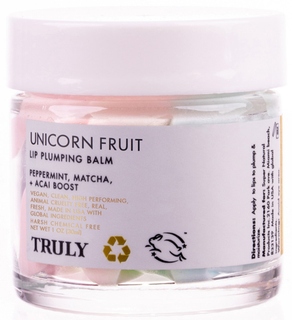
“Unicorn Fruit Lip Plumping Balm”
This product can help improve hydration of the skin with the two types of ingredients.
The first type is called “humectants”:
these ingredients help attract water.
When humectants are on the surface of the skin, they “pull in” the moisture from the outside environment, or from
within deeper layers of the skin. The following ingredients in this product do the job:
betaine, glycerin.
This product also contains ingredients called “occlusives”. They help reduce the speed with which our skin loses moisture to the outside environment. These ingredients also help soften the upper layer of the skin, so it feels less tight and nicer to the touch. The following ingredients in this product do the job: butyrospermum parkii butter, cocos nucifera oil.
Can it cause trouble?
Irritancy7 strong irritants: Ocimum sanctum leaf extract, Ocimum basilicum flower/leaf extract + 5 more — patch-test recommendedHigh risk
Comedogenic6 ingredients rated 2 or more on the 0–5 pore-clogging scale6 flagged
User reviews
Be the first — your take helps the next person decide.
Ingredients
Filter by role to see what each ingredient is doing.
Butyrospermum parkii butter~23–34%
- Irritation risk
- Low
- Comedogenicity
- 3/5
A great moisturising ingredient that softens the skin and reduces water loss from its upper layer. It also can be helpful in protecting skin from free radicals
More about Butyrospermum parkii butterCocos nucifera oil~3.6–5.5%
- Irritation risk
- Low
- Comedogenicity
- 3/5
An emollient. Found to be as effective as a moisturizer for dry skin as mineral oil. Could be comedogenic
More about Cocos nucifera oilButter~4.7–7%
- Irritation risk
- Low
Mangifera indica seed butter~3.8–5.7%
- Irritation risk
- Low
Helps to soften the upper layer of the skin and might have some anti-oxidant effect
More about Mangifera indica seed butterPrunus amygdalus dulcis oil~3–4.4%
- Irritation risk
- Low
An emollient that softens the skin
More about Prunus amygdalus dulcis oilSimmondsia chinensis seed oil~2.3–3.5%
- Irritation risk
- Medium
Softens the upper layer of skin and helps restore the healthy skin barrier. Has shown to help calm down inflammation in skin. It is a stable oil, meaning that it retains its properties even when exposed to air.
More about Simmondsia chinensis seed oilTheobroma cacao seed butter~1.7–2.5%
- Irritation risk
- Low
- Comedogenicity
- 3/5
Helps soften the upper layer of the skin and can be helpful in restoring the skin barrier function. Might have some anti-oxidant effect
More about Theobroma cacao seed butterTheobroma cacao extract~1.3–1.9%
- Irritation risk
- Low
- Comedogenicity
- 3/5
Tocopherol~1.1–1.7%
- Irritation risk
- Low
Pure form of vitamin E. Can help moisturise and protect the skin from free radicals. Often used to help stabilise other ingredients or the formula itself
More about TocopherolMelia azadirachta leaf extract~0.9–1.35%
- Irritation risk
- High
A plant extract that has anti-bacterial properties. Can be used to preserve the product. Can be irritating
More about Melia azadirachta leaf extractMelia azadirachta flower extract~0.55–1.35%
- Irritation risk
- Medium
A plant extract that might be helpful to neutralize free radicals in skin
More about Melia azadirachta flower extractCorallina officinalis extract~0.5–1.15%
- Irritation risk
- Low
- Comedogenicity
- 3/5
Red algae extract that helps attract water to the upper layer of the skin and might contain antioxidants
More about Corallina officinalis extractBetaine~0.45–1.05%
- Irritation risk
- Low
Helps attract water to the upper layer of the skin and improves the product texture
More about BetaineCoccinia indica fruit extract~0.4–0.95%
- Irritation risk
- Medium
A plant extract that might have some anti-oxidant effect helping neutralize free radicals in skin
More about Coccinia indica fruit extractSolanum melongena fruit extract~0.4–0.9%
- Irritation risk
- Medium
Eggplant fruit extract. Might have some anti-oxidant effect
More about Solanum melongena fruit extractAloe barbadensis flower extract~0.45–1.05%
- Irritation risk
- High
A plant extract that might have some anti-oxidant effect
More about Aloe barbadensis flower extractOcimum sanctum leaf extract~0.4–0.9%
- Irritation risk
- High
A plant extract that is rich in a fragrance compound eugenol that is a frequent allergen and can be irritating. It might also contain anti-oxidants to help neutralize free radicals
More about Ocimum sanctum leaf extractOcimum basilicum flower/leaf extract~0.35–0.8%
- Irritation risk
- High
Used as a fragrance. Canbe irritating
More about Ocimum basilicum flower/leaf extractCurcuma longa root extract~0.3–0.75%
- Irritation risk
- High
A plant extract that can contain an active compound curcumin, that may have some anti-inflammatory properties when applied to the skin, but solid research is lacking and the typical concentration used in skincare products is too low. Can be an irritant
More about Curcuma longa root extractMentha piperita oil~0.2–0.75%
Leuconostoc/radish root ferment filtrate~0.3–0.7%
- Irritation risk
- Medium
A preservative that comes from radishes fermented by a bacteria. New research suggests that the preservation properties in the ingredient come from an ammonium salt that is not present naturally in radish root but used in its cultivation. Is problematic because the exact amount of the preservative agents is difficult to determine
More about Leuconostoc/radish root ferment filtrateLonicera japonica flower extract~0.2–0.8%
- Irritation risk
- High
A plant extract that might help neutralize free radicals in skin. Can contain volalite oils and be irritating
More about Lonicera japonica flower extractLonicera caprifolium flower extract~0.2–0.7%
- Irritation risk
- High
A plant extract that might help neutralize free radicals in skin. Can contain volalite oils and be irritating
More about Lonicera caprifolium flower extractRosa damascena extract~0.2–0.75%
- Irritation risk
- High
Oil of a very fragrant pink rose used as fragrance in cosmetics. Extensive research has shown it has mixed benefits. In the pro column, inhaling this flower’s scent seems to have relaxing properties and the plant’s petals contain skin-soothing and antioxidant compounds that can benefit skin. On the flipside, the numerous chemicals that create this rose’s distinctive fragrance pose a risk of causing skin aggravation.
More about Rosa damascena extractGluconolactone~0.2–0.75%
- Irritation risk
- Medium
A polyhydroxy acid (PHA) that helps shed the dead cells from the skin surface revealing smoother skin. Is believed to be genter than AHAs. It helps attract water to the upper layer of the skin and can stimulate production of skin's own hyaluronic acid resulting in improved hydration levels. It has been shown to be helpful against acne and clogged pores if used consistently (e.g over a period of 12 weeks) in high enough concentration. It can help reduce fine lines and wrinkles and improve skin tone with long-term application. Can help neutralize free radicals
More about GluconolactoneHydrogenated soybean oil~0.35–0.75%
- Irritation risk
- Low
- Comedogenicity
- 2/5
Phenoxyethanol~0.2–0.8%
- Irritation risk
- Low
A preservative. It helps prevent bacterial growth in cosmetic products
More about PhenoxyethanolTetrasodium glutamate diacetate~0.2–0.75%
- Irritation risk
- Low
Helps stabilize the product formulation
More about Tetrasodium glutamate diacetateRosa damascena extract~0.2–0.75%
- Irritation risk
- High
Oil of a very fragrant pink rose used as fragrance in cosmetics. Extensive research has shown it has mixed benefits. In the pro column, inhaling this flower’s scent seems to have relaxing properties and the plant’s petals contain skin-soothing and antioxidant compounds that can benefit skin. On the flipside, the numerous chemicals that create this rose’s distinctive fragrance pose a risk of causing skin aggravation.
More about Rosa damascena extractBeta vulgaris root extract~0.2–0.75%
- Irritation risk
- Medium
A plant extract that might have some antioxidant properties, but mostly used in cosmetics for its color
More about Beta vulgaris root extractWater~0.2–0.75%
Glycerin~0.3–0.75%
- Irritation risk
- Low
One of the best moisturizing ingredients. Naturally present in skin. It attracts water to the upper layer of the skin working as a humectant
More about GlycerinEuterpe oleracea fruit extract~0.2–0.75%
- Irritation risk
- Medium
A plant extract that can have some anti-oxidant effect in skin
More about Euterpe oleracea fruit extractSodium benzoate~0.25–0.5%
Potassium sorbate~0.3–0.6%
Camellia sinensis leaf extract~0.35–0.75%
- Irritation risk
- Low
Can contain potent anti-oxidant compounds (abbreviated ECG, GCG, EGC, and EGCG) that might help protect the skin from free radicals. Can help calm down inflammation and has some anti-bacterial properties. Unfortunately, these antioxidants are unstable and lose their effectiveness very quickly in products. The concentration of the antioxidant compounds in the extract also tends to be low to be effective in topical formulation
More about Camellia sinensis leaf extractSalvia hispanica seed extract~0.4–0.9%
- Irritation risk
- Medium
A plant extract that typically contains linolenic and linoleic acids that help soften the upper layer of the skin and can support skin barrier function
More about Salvia hispanica seed extractRosmarinus officinalis leaf extract~0.3–0.7%
- Irritation risk
- High
Can be helpful in reducing inflammation in skin, including inflamed acne. It can be irritating
More about Rosmarinus officinalis leaf extractRosa damascena extract~0.3–0.75%
- Irritation risk
- High
Oil of a very fragrant pink rose used as fragrance in cosmetics. Extensive research has shown it has mixed benefits. In the pro column, inhaling this flower’s scent seems to have relaxing properties and the plant’s petals contain skin-soothing and antioxidant compounds that can benefit skin. On the flipside, the numerous chemicals that create this rose’s distinctive fragrance pose a risk of causing skin aggravation.
More about Rosa damascena extractCollagen~0.2–0.75%
- Irritation risk
- Low
Cannot penetrate the skin barrier so is not particularly useful in skincare products
More about CollagenCapsicum frutescens fruit extract~0.2–0.7%
- Irritation risk
- High
Chilli pepper extract that is very likely to be irritating. Might be added to lip product to create a temporary burst of color. Is likely to have a negative effect on the skin and dry it out
More about Capsicum frutescens fruit extractParfum~0.1–0.5%
- Irritation risk
- High
An aromatic blend of unspecified and possibly irritating ingredients
More about ParfumMica~0.2–0.7%
- Irritation risk
- Low
Creates an illusion of smoother and more radiant skin tone. Adds shimmer to the skin by reflecting light
More about MicaTitanium dioxide~0.15–0.5%
- Irritation risk
- Low
Works as a UV filter when used in high concentrations. It is photostable and is effective mostly against the UVB light, with some protection in the UVA range. In small concentrations, used for its ability to improve the color of cosmetic products. Is usually well tolerated by the skin
More about Titanium dioxideTin oxide~0.2–0.7%
- Irritation risk
- Low
A colorant that can add a pearl-like appearance to the formulation
More about Tin oxideCi 77742~0.1–0.45%
Ingredient list view
Butyrospermum parkii butter, Cocos nucifera oil, Butter, Mangifera indica seed butter, Prunus amygdalus dulcis oil, Simmondsia chinensis seed oil, Theobroma cacao seed butter, Theobroma cacao extract, Tocopherol, Unknown, Melia azadirachta leaf extract, Melia azadirachta flower extract, Corallina officinalis extract, Betaine, Coccinia indica fruit extract, Solanum melongena fruit extract, Aloe barbadensis flower extract, Ocimum sanctum leaf extract, Ocimum basilicum flower/leaf extract, Curcuma longa root extract, Mentha piperita oil, Leuconostoc/radish root ferment filtrate, Lonicera japonica flower extract, Lonicera caprifolium flower extract, Rosa damascena extract, Gluconolactone, Hydrogenated soybean oil, Phenoxyethanol, Tetrasodium glutamate diacetate, Rosa damascena extract, Beta vulgaris root extract, Water, Glycerin, Euterpe oleracea fruit extract, Sodium benzoate, Potassium sorbate, Camellia sinensis leaf extract, Salvia hispanica seed extract, Rosmarinus officinalis leaf extract, Rosa damascena extract, Unknown, Collagen, Capsicum frutescens fruit extract, Parfum, Mica, Titanium dioxide, Tin oxide, Ci 77742
Compare prices
Retailers ranked by price — lowest first.

Affiliate links · prices updated regularly
Sources cited in this review
Every concentration estimate and effectiveness label is anchored to one of these 32 studies and safety reviews.
- 1Extraction and Characteristics of Seed Kernel Oil from Mangopdfs.semanticscholar.org
- 2
- 3
- 4
- 5
- 6Vitamin E in dermatologyncbi.nlm.nih.gov

Affiliate links · As an Amazon Associate, WIMJ earns from qualifying purchases.