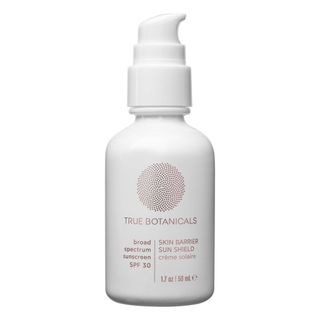
True Botanicals Skin Barrier Sun Shield SPF 30
Works for
3 of 4 advertised claims delivered
Sun protectionSPF 30 · 1 UV filterBroad spectrum
This product offers a good level of protection against both UVB and UVA rays.
It is a mineral sunscreen. In other words, it contains non-organic UV filters. It will probably not sting your eyes but might leave a white cast.
This product can be considered "reef safe" because it does not contain the UV filters (oxybenzone and octinoxate) that can be harmful to coral reefs when present in the water in high concentrations.
Anti-aging5 ingredients credited for this claimStrong support
“Good for All Skin Types Why we love it A clean sunscreen and skincare product in one This first of its kind non-nano zinc formula provides broad spectrum protection from both harmful UVA and UVB rays, while antioxidant-rich and hydrating anti-aging ingredients nourish your skin for a youthful-looking glow.”
This product can help prevent early signs of skin aging because it offers a good level of broad spectrum sun protection. Sun damage is the main cause of premature skin aging, and protecting your skin from the sun is the best anti-aging strategy.
These ingredients in the product might also be helpful for reducing and preventing fine lines, wrinkles, and skin elasticity, even though there is no conclusive evidence for their effectiveness: pisum sativum peptide.
Moisturizing16 ingredients credited for this claimStrong support
“That means no more skin congestion, breakouts, dryness or irritation.”
This product can help improve hydration of the skin with the two types of ingredients.
The first type is called “humectants”:
these ingredients help attract water.
When humectants are on the surface of the skin, they “pull in” the moisture from the outside environment, or from
within deeper layers of the skin. The following ingredients in this product do the job:
glycerin.
This product also contains ingredients called “occlusives”. They help reduce the speed with which our skin loses moisture to the outside environment. These ingredients also help soften the upper layer of the skin, so it feels less tight and nicer to the touch. The following ingredients in this product do the job: caprylic/capric triglyceride, squalane.
The following ingredients in this product are especially good for supporting the skin barrier and helping with the hydration level: pisum sativum peptide
Anti-blemish3 ingredients credited for this claimWeak support
“That means no more skin congestion, breakouts, dryness or irritation.”
Effective ingredients missing or their concentration is too low.
Evens skin toneNot advertised by the brand · 3 ingredients credited for this claimStrong support
This product offers broad spectrum sun protection. It means that it can prevent hyperpigmentation and help keep the skin tone even (sun damage is the main factor causing age spots, darkening of post-acne marks and other discolorations).
Can it cause trouble?
Irritancy1 strong irritant: Citrus aurantium dulcis flowerMedium risk
ComedogenicClean of flagged comedogenic ingredientsNone flagged
User reviews
Be the first — your take helps the next person decide.
Ingredients
Filter by role to see what each ingredient is doing.
Zinc oxide19%
- Irritation risk
- Low
A broad spectrum sunblock (protects from both UVA and UVB rays). Is suitable for most sensitive skins. In small concentrations, can be used as a colorant
More about Zinc oxideCamellia sinensis leaf water~23–34%
- Irritation risk
- Low
Green tea leaf water. Might have some minimal anti-oxidant effect
More about Camellia sinensis leaf waterCaprylic/capric triglyceride~5.6–8.4%
- Irritation risk
- Medium
A good mix of fatty acids that forms a protective layer on the skin. Improves the shelf life of products. Derived from coconut and glycerin
More about Caprylic/capric triglycerideCoco-caprylate~4–6%
- Irritation risk
- Medium
An emollient that softens skin and creates a nice product texture
More about Coco-caprylateGlycerin~2.9–4.3%
- Irritation risk
- Low
One of the best moisturizing ingredients. Naturally present in skin. It attracts water to the upper layer of the skin working as a humectant
More about GlycerinPolyglyceryl-6 stearate~2.3–3.4%
- Irritation risk
- Low
Helps soften the upper layer of the skin
More about Polyglyceryl-6 stearateCapryloyl glycerin/sebacic acid copolymer~1.9–2.8%
- Irritation risk
- Low
Helps soften the upper layer of the skin
More about Capryloyl glycerin/sebacic acid copolymerWater~1.6–2.4%
Oryza sativa bran extract~1.3–2%
Squalane~1.2–1.8%
- Irritation risk
- Low
An oil naturally present in skin. Works as an emollient to soften the skin and form a protective layer on its surface without a greasy feeling.
More about SqualanePolyhydroxystearic acid~0.9–1.35%
- Irritation risk
- Medium
Used to create a thicker product consistency and stabilize the formulation
More about Polyhydroxystearic acidHippophae rhamnoides seed oil~0.55–1.25%
- Irritation risk
- Low
Silybum marianum ethyl ester~0.45–1.05%
- Irritation risk
- Medium
Helps to create a nice product texture. Used to substitute silicones
More about Silybum marianum ethyl esterPisum sativum peptide~0.4–0.95%
Terminalia chebula fruit extract~0.35–0.85%
- Irritation risk
- Low
Haematococcus pluvialis powder~0.35–0.85%
- Irritation risk
- Low
Simmondsia chinensis seed oil~0.4–0.9%
- Irritation risk
- Medium
Softens the upper layer of skin and helps restore the healthy skin barrier. Has shown to help calm down inflammation in skin. It is a stable oil, meaning that it retains its properties even when exposed to air.
More about Simmondsia chinensis seed oilAloe barbadensis leaf juice~0.35–0.8%
- Irritation risk
- Medium
Traditionally used to treat sunburns, dermatitis and inflammation, but evidence for its effectiveness is lacking. The extract can contain humectants that help attract water into the skin
More about Aloe barbadensis leaf juiceCamellia sinensis leaf extract~0.35–0.75%
- Irritation risk
- Low
Can contain potent anti-oxidant compounds (abbreviated ECG, GCG, EGC, and EGCG) that might help protect the skin from free radicals. Can help calm down inflammation and has some anti-bacterial properties. Unfortunately, these antioxidants are unstable and lose their effectiveness very quickly in products. The concentration of the antioxidant compounds in the extract also tends to be low to be effective in topical formulation
More about Camellia sinensis leaf extractCitrus aurantium dulcis flower~0.2–0.75%
- Irritation risk
- High
Isopropyl jojobate~0.2–0.8%
- Irritation risk
- Low
Jojoba alcohol~0.2–0.75%
Jojoba esters~0.2–0.7%
- Irritation risk
- Medium
An emollient made of jojoba oil. Helps soften the skin and support its barrier function
More about Jojoba estersXanthan gum~0.15–0.65%
- Irritation risk
- Low
Used to create a thicker product consistency
More about Xanthan gumPolyglyceryl-6 behenate~0.15–0.6%
Lactic acid~0.15–0.55%
- Irritation risk
- Medium
An exfoliating and moisturizing alpha-hydroxy acid (AHA). Typically causes less irritation than other AHAs, for example, glycolic acid. At high concentrations (about 15%), lactic acid can help reduce lines and wrinkles. Recent studies show that lactic acid can support the "good" bacteria living on skin's surface (healthy skin microbiome)
More about Lactic acidAcacia senegal gum~0.15–0.6%
- Irritation risk
- Medium
Helps mask the small of other ingredients and improve the product texture
More about Acacia senegal gumDipotassium glycyrrhizate~0.1–0.5%
- Irritation risk
- Low
A salt derived from licorice. Works as an emollient to soften the upper layer of the skin and can help calm down inflammation. Might be helpful for skin lightening
More about Dipotassium glycyrrhizateAllantoin~0.1–0.4%
- Irritation risk
- Low
Helps calm down inflammation in skin and can help reduce itching. Helps to repair the skin barrier and keep skin hydrated
More about AllantoinPhenethyl alcohol~0.1–0.45%
Ethylhexylglycerin~0.1–0.35%
Sodium phytate~0.1–0.35%
Glycerin~0.1–0.35%
- Irritation risk
- Low
One of the best moisturizing ingredients. Naturally present in skin. It attracts water to the upper layer of the skin working as a humectant
More about GlycerinLeuconostoc/radish root ferment filtrate~0.05–0.2%
- Irritation risk
- Medium
A preservative that comes from radishes fermented by a bacteria. New research suggests that the preservation properties in the ingredient come from an ammonium salt that is not present naturally in radish root but used in its cultivation. Is problematic because the exact amount of the preservative agents is difficult to determine
More about Leuconostoc/radish root ferment filtrateTocopherol~0.05–0.2%
- Irritation risk
- Low
Pure form of vitamin E. Can help moisturise and protect the skin from free radicals. Often used to help stabilise other ingredients or the formula itself
More about TocopherolIngredient list view
Zinc oxide, Camellia sinensis leaf water, Caprylic/capric triglyceride, Coco-caprylate, Glycerin, Polyglyceryl-6 stearate, Capryloyl glycerin/sebacic acid copolymer, Water, Oryza sativa bran extract, Squalane, Polyhydroxystearic acid, Hippophae rhamnoides seed oil, Silybum marianum ethyl ester, Pisum sativum peptide, Terminalia chebula fruit extract, Haematococcus pluvialis powder, Simmondsia chinensis seed oil, Aloe barbadensis leaf juice, Camellia sinensis leaf extract, Unknown, Citrus aurantium dulcis flower, Unknown, Isopropyl jojobate, Jojoba alcohol, Jojoba esters, Xanthan gum, Polyglyceryl-6 behenate, Lactic acid, Acacia senegal gum, Dipotassium glycyrrhizate, Allantoin, Phenethyl alcohol, Ethylhexylglycerin, Sodium phytate, Glycerin, Leuconostoc/radish root ferment filtrate, Tocopherol
Compare prices
Retailers ranked by price — lowest first.

Product summary
We assess that "True Botanicals - Skin Barrier Sun Shield SPF 30" can provide reliable sun protection based on the ingredient list. It can protect from both UVA and UVB rays. This is great news because not all sunscreens with SPF ratings give UVA protection. (UVA rays do not cause sunburn, but still damage our skin and lead to early aging).
It also works as a moisturizer, so you do not have to use an additional hydrating product. This product prevents early signs of aging by protecting against sun damage (all broad spectrum sunscreens do that).
Sunscreen filters
This product is a mineral sunscreen. It uses zinc oxide for sun protection. Zinc oxide almost never irritates the skin or stings eyes, but it can leave a white cast.
Irritation risk
This sunscreen contains some common irritants, including those without a benefit for the skin. We assess the overall irritancy of it to be medium. For a detailed overview of all potential irritants: click here
You can see the detailed formula review with the breakdown of all actives in the product and the full ingredient list with estimated concentrations in the tables below.
Price
The product retails for 65.00$ in the United States.
For a detailed price comparison: click here.
Sources cited in this review
Every concentration estimate and effectiveness label is anchored to one of these 15 studies and safety reviews.
- 1A review of inorganic UV filters zinc oxide and titanium dioxideonlinelibrary.wiley.com
- 2
- 3
- 4
- 5
- 6

Affiliate links · As an Amazon Associate, WIMJ earns from qualifying purchases.