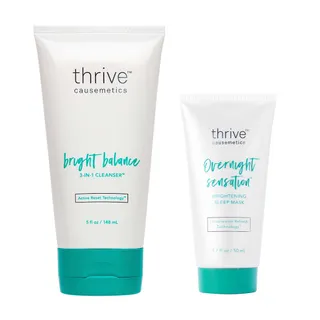
Thrive Causemetics Overnight Sensation Mask + Bright Balance Cleanser
Works for
CleansingCocamidopropyl betaine, Glyceryl stearate + 9 moreCleanses gently
“Overnight Sensation Mask™ + Bright Balance Cleanser™”
This product works by removing dirt and oil from the surface of the skin. It uses a combination of mild cleansing agents (cocamidopropyl betaine, glyceryl stearate, hydroxyproline, peg-100 stearate, polyglyceryl-4 caprate, polyglyceryl-6 caprylate, sodium cocoyl isethionate, sodium lauroyl methyl isethionate, sodium methyl oleoyl taurate, xanthan gum) and should be able to cleanse the skin gently. Still keep in mind that any cleansing can disrupt the skin barrier, and most people do not need to cleanse their skin more than once per day.
Even though this formulation is mild, the following cleansing agents could trigger an irritation or allergy for some people: cocamidopropyl betaine
ExfoliationSide benefit · Glycolic acid, Tartaric acid + 1 moreWorks well
This product can help exfoliate the skin. In other words, it helps break down the bonds between dead cells on the surface of the skin and speed up the skin turnover. Skin often appears softer and brighter after exfoliation, but overdoing it can result in disrupted skin barrier. The following ingredient is doing the exfoliating job in this product: glycolic acid.
Can it cause trouble?
Irritancy9 strong irritants: Lavandula angustifolia oil, Limonene + 7 more — patch-test recommendedHigh risk
Comedogenic1 ingredient rated 2 or more on the 0–5 pore-clogging scale1 flagged
User reviews
Be the first — your take helps the next person decide.
Ingredients
Filter by role to see what each ingredient is doing.
Titanium dioxide~29–36%
- Irritation risk
- Low
Works as a UV filter when used in high concentrations. It is photostable and is effective mostly against the UVB light, with some protection in the UVA range. In small concentrations, used for its ability to improve the color of cosmetic products. Is usually well tolerated by the skin
More about Titanium dioxideCi 77891~11–13%
- Irritation risk
- Low
Mica~5.7–7%
- Irritation risk
- Low
Creates an illusion of smoother and more radiant skin tone. Adds shimmer to the skin by reflecting light
More about MicaWater~3.9–4.7%
Glycerin~2.9–3.5%
- Irritation risk
- Low
One of the best moisturizing ingredients. Naturally present in skin. It attracts water to the upper layer of the skin working as a humectant
More about GlycerinPropanediol~2.4–3%
- Irritation risk
- Low
Acts as a solvent for other ingredients. Speeds up the absorption of other ingredients into the skin
More about PropanediolButylene glycol~2–2.5%
- Irritation risk
- Low
Used to create a nice product texture and help delivery of other ingredients. Might be somewhat helpful in attracting water to the upper layer of the skin
More about Butylene glycolSqualane~2–2.4%
- Irritation risk
- Low
An oil naturally present in skin. Works as an emollient to soften the skin and form a protective layer on its surface without a greasy feeling.
More about SqualaneDimethicone~1.5–1.8%
- Irritation risk
- Low
A silicone that helps to reduce water loss from the surface of the skin. Can temporarily "fill in" lines and wrinkles, absorb oil, and create a nice product finish
More about DimethiconeHydrogenated polydecene~0.75–1.15%
- Irritation risk
- Low
Helps to soften the upper layer of the skin and create a nice product texture
More about Hydrogenated polydeceneSodium acrylates copolymer~0.75–1.1%
- Irritation risk
- Medium
Used to create a thicker product consistency
More about Sodium acrylates copolymerGlyceryl stearate~0.65–0.95%
- Irritation risk
- Low
An emollient that softens the skin and forms a protective layer on its surface. Helps water and oil mix together
More about Glyceryl stearatePhenoxyethanol~0.5–0.8%
- Irritation risk
- Low
A preservative. It helps prevent bacterial growth in cosmetic products
More about PhenoxyethanolPeg-100 stearate~0.6–0.9%
- Irritation risk
- Low
Helps oil and water mix togehter and creates a nice product texture
More about Peg-100 stearateLecithin~0.5–0.75%
- Irritation risk
- Low
Used mostly for creating emulsions - helping oil and water mix together. Helps soften the upper layer of the skin
More about LecithinRosa canina seed extract~0.5–0.8%
- Irritation risk
- Low
Hydroxyacetophenone~0.45–0.65%
Panthenol~0.45–0.65%
- Irritation risk
- Low
Helps attract water to the upper layer of the skin and can help improve skin barrier function
More about PanthenolPolyacrylate crosspolymer-6~0.45–0.65%
- Irritation risk
- Low
Evodia rutaecarpa fruit extract~0.3–0.55%
- Irritation risk
- Low
Lactic acid~0.3–0.55%
- Irritation risk
- Medium
An exfoliating and moisturizing alpha-hydroxy acid (AHA). Typically causes less irritation than other AHAs, for example, glycolic acid. At high concentrations (about 15%), lactic acid can help reduce lines and wrinkles. Recent studies show that lactic acid can support the "good" bacteria living on skin's surface (healthy skin microbiome)
More about Lactic acidMenthone glycerin acetal~0.3–0.55%
- Irritation risk
- Low
Aloe barbadensis leaf extract~0.4–0.65%
- Irritation risk
- Medium
Traditionally used to treat sunburns, dermatitis and inflammation, but evidence for its effectiveness is lacking. The extract can contain humectants that help attract water into the skin
More about Aloe barbadensis leaf extractEthylhexylglycerin~0.3–0.55%
Lavandula angustifolia oil~0.3–0.55%
- Irritation risk
- High
An essential oil. Potential allergen and can be irritating. It has some anti-bacterial properties
More about Lavandula angustifolia oilMelatonin~0.3–0.55%
- Irritation risk
- Low
A compound that can regulate sleep cycles in humans and animals. When used in cosmetics, comes from plant sources. It can work as anti-oxidant in skin when applied topically in skincare
More about MelatoninSodium hyaluronate~0.3–0.6%
- Irritation risk
- Low
One of the best moisturizing ingredients. Attracts water into the upper layer of the skin
More about Sodium hyaluronateTetrahexyldecyl ascorbate~0.3–0.6%
- Irritation risk
- Medium
Being a lipid soluble form of vitamin C, it is more stable than ascorbic acid, but still degrades quickly and needs to be stabilized in a formulation with another ingredient. It is claimed to penetrate skin better than pure vitamin C and have the the similar benefits, but solid studies of its effectiveness are lacking. Is likely to require a higher concentration in a product than pure vitamin C to be effective. It might be able to help reduce pore clogging.
More about Tetrahexyldecyl ascorbateTocopheryl acetate~0.35–0.6%
- Irritation risk
- Medium
A more stable but less bio-available form of vitamin E compared to Tocopherol. Might help moisturize and protect the skin from free radicals, but mostly used in low concentrations to stabilize other ingredients.
More about Tocopheryl acetateLimonene~0.25–0.45%
- Irritation risk
- High
A common frangrance that can easily irritate skin, especially if exposed to air, light or heat
More about LimoneneGlycolic acid~0.3–0.55%
- Irritation risk
- High
An alpha-hydroxy acid (AHA) that helps to remove the dead skin cells on the surface of the skin reveling a more even, smoother complexation. It is also able to stimulate collagen production with long-term use. Could help to reduce pore congestion. It can be irritating to the skin. Apply sunscreen daily if using products with glycolic acid
More about Glycolic acidGlabridin~0.3–0.55%
- Irritation risk
- Low
Vaccinium myrtillus fruit extract~0.3–0.55%
- Irritation risk
- Medium
A plant extract that might help neutralize free radicals in skin, but research on its efficacy in skin is lacking
More about Vaccinium myrtillus fruit extractAcer saccharum extract~0.25–0.5%
- Irritation risk
- Medium
A plant extract that contains small percentage of AHAs. Is unlikely to have any skin benefit due the small concentration of the active compounds
More about Acer saccharum extractCitrus aurantium dulcis fruit extract~0.3–0.5%
- Irritation risk
- High
A plant extract that is used as a fragrance. Can be irritating and lead to photosensitivity
More about Citrus aurantium dulcis fruit extractPeg-12 dimethicone~0.3–0.6%
- Irritation risk
- Low
Helps soften the upper layer of the skin and create a nice product texture
More about Peg-12 dimethiconeCitric acid~0.3–0.55%
- Irritation risk
- Medium
Can work as an exfoliant but is typically used to adjust the product pH
More about Citric acidCitrus aurantium dulcis peel oil~0.3–0.5%
- Irritation risk
- High
An essentil oil from orange peel. Potential allergen and can be irritating
More about Citrus aurantium dulcis peel oilT-butyl alcohol~0.3–0.5%
- Irritation risk
- Medium
Used to dissolve other ingredients and to improve smell of products. It could be irritating
More about T-butyl alcoholGlycyrrhiza glabra root extract~0.3–0.5%
- Irritation risk
- Medium
A plant extract that can help lighten the skin and calm down inflammation. Might be helpful in neutralizing free radicals
More about Glycyrrhiza glabra root extractMalic acid~0.3–0.55%
Tartaric acid~0.3–0.6%
- Irritation risk
- Medium
An AHA (alpha-hydroxy acid). It oxidizes quickly which makes it less effective in skincare formulations. It can support skin's barrier and moisture levels
More about Tartaric acidLinalool~0.25–0.45%
Citronellol~0.25–0.45%
Citral~0.25–0.45%
Water~0.3–0.6%
Cocamidopropyl betaine~0.95–1.15%
- Irritation risk
- High
Helps water and oil mix together. Used as a cleansing ingredient. Could be an allergen
More about Cocamidopropyl betaineSodium lauroyl methyl isethionate~0.45–0.65%
- Irritation risk
- Medium
Works as a cleansing agent
More about Sodium lauroyl methyl isethionateGlycerin~0.3–0.6%
- Irritation risk
- Low
One of the best moisturizing ingredients. Naturally present in skin. It attracts water to the upper layer of the skin working as a humectant
More about GlycerinAcrylates copolymer~0.3–0.55%
- Irritation risk
- Medium
Used to stabilize product formulation, help create an even product layer over skin (for example, in sunscreen) and create a thicker product consistency
More about Acrylates copolymerSodium acrylates copolymer~0.3–0.55%
- Irritation risk
- Medium
Used to create a thicker product consistency
More about Sodium acrylates copolymerSodium methyl oleoyl taurate~0.65–1%
- Irritation risk
- Medium
Helps oil and water mix together
More about Sodium methyl oleoyl tauratePolyglyceryl-4 caprate~0.35–0.65%
Polyglyceryl-6 caprylate~0.35–0.65%
- Irritation risk
- Medium
Helps oil and water mix together
More about Polyglyceryl-6 caprylateSodium cocoyl isethionate~0.45–0.65%
- Irritation risk
- Medium
Helps water and oil mix together. Can be used as a cleansing agent
More about Sodium cocoyl isethionatePanthenol~0.3–0.6%
- Irritation risk
- Low
Helps attract water to the upper layer of the skin and can help improve skin barrier function
More about PanthenolTocopherol~0.3–0.6%
- Irritation risk
- Low
Pure form of vitamin E. Can help moisturise and protect the skin from free radicals. Often used to help stabilise other ingredients or the formula itself
More about TocopherolSodium hyaluronate~0.3–0.6%
- Irritation risk
- Low
One of the best moisturizing ingredients. Attracts water into the upper layer of the skin
More about Sodium hyaluronateCitrus aurantium dulcis peel oil~0.3–0.5%
- Irritation risk
- High
An essentil oil from orange peel. Potential allergen and can be irritating
More about Citrus aurantium dulcis peel oilLimnanthes alba seed oil~0.4–0.6%
- Irritation risk
- Low
This oil's cmposition is closest to rapeseed oil. It is a very stable oil and serves as an emoillient
More about Limnanthes alba seed oilHedychium coronarium root extract~0.25–0.5%
- Irritation risk
- Low
Yeast extract~0.3–0.6%
- Irritation risk
- Low
Helps attract water to the upper layer of the skin and might have some anti-oxidant and skin lightening properties. It can help calm down inflammation in skin
More about Yeast extractCamellia sinensis leaf extract~0.35–0.6%
- Irritation risk
- Low
Can contain potent anti-oxidant compounds (abbreviated ECG, GCG, EGC, and EGCG) that might help protect the skin from free radicals. Can help calm down inflammation and has some anti-bacterial properties. Unfortunately, these antioxidants are unstable and lose their effectiveness very quickly in products. The concentration of the antioxidant compounds in the extract also tends to be low to be effective in topical formulation
More about Camellia sinensis leaf extractSodium pca~0.3–0.6%
- Irritation risk
- Low
Naturally present in skin and helps to attract water to its upper layer
More about Sodium pcaProline~0.35–0.6%
Citrus limon peel oil~0.25–0.45%
Citrus paradisi peel oil~0.25–0.45%
Xanthan gum~0.4–0.6%
- Irritation risk
- Low
Used to create a thicker product consistency
More about Xanthan gumLecithin~0.4–0.6%
- Irritation risk
- Low
Used mostly for creating emulsions - helping oil and water mix together. Helps soften the upper layer of the skin
More about LecithinAspalathus linearis leaf extract~0.3–0.5%
- Irritation risk
- Low
Plant extract that might have help to neutralize free radicals in skin, but evidence of effectiveness is skin is lacking
More about Aspalathus linearis leaf extractHydroxyproline~0.3–0.5%
- Irritation risk
- Low
Is helpful in restoring skin barrier function supporting its moisture levels. Is claimed to stimulte collagen production in skin but evidence is lacking
More about HydroxyprolineHippophae rhamnoides fruit oil~0.25–0.5%
- Irritation risk
- High
A plant oil that might somewhat help to neutralize free radicals. It could be irritating
More about Hippophae rhamnoides fruit oilHydrolyzed hyaluronic acid~0.25–0.45%
- Irritation risk
- Low
One of the best moisturizing ingredients. Attracts water into the upper layer of the skin. A version of it is naturally present in skin
More about Hydrolyzed hyaluronic acidBromelain~0.25–0.45%
- Irritation risk
- Low
Haematococcus pluvialis extract~0.25–0.5%
- Irritation risk
- Medium
Green algae extract that might contain antioxidant astaxanthin
More about Haematococcus pluvialis extractChondrus crispus extract~0.3–0.55%
- Irritation risk
- Low
- Comedogenicity
- 3/5
Red algae extract that helps attract water to the upper layer of the skin and create a nicer product consistency
More about Chondrus crispus extractTannic acid~0.3–0.55%
- Irritation risk
- Low
Tetrasodium glutamate diacetate~0.3–0.5%
- Irritation risk
- Low
Helps stabilize the product formulation
More about Tetrasodium glutamate diacetateSodium hydroxide~0.25–0.5%
Hydroxyacetophenone~0.15–0.3%
Sodium benzoate~0.15–0.3%
Ethylhexylglycerin~0.15–0.3%
Phenoxyethanol~0.2–0.35%
- Irritation risk
- Low
A preservative. It helps prevent bacterial growth in cosmetic products
More about PhenoxyethanolChlorphenesin~0.15–0.25%
Limonene~0.1–0.2%
- Irritation risk
- High
A common frangrance that can easily irritate skin, especially if exposed to air, light or heat
More about LimoneneIngredient list view
Titanium dioxide, Ci 77891, Mica, Unknown, Water, Glycerin, Propanediol, Butylene glycol, Squalane, Dimethicone, Hydrogenated polydecene, Sodium acrylates copolymer, Glyceryl stearate, Phenoxyethanol, Peg-100 stearate, Lecithin, Rosa canina seed extract, Hydroxyacetophenone, Panthenol, Polyacrylate crosspolymer-6, Evodia rutaecarpa fruit extract, Lactic acid, Menthone glycerin acetal, Aloe barbadensis leaf extract, Ethylhexylglycerin, Lavandula angustifolia oil, Melatonin, Sodium hyaluronate, Tetrahexyldecyl ascorbate, Tocopheryl acetate, Limonene, Glycolic acid, Glabridin, Vaccinium myrtillus fruit extract, Acer saccharum extract, Citrus aurantium dulcis fruit extract, Peg-12 dimethicone, Citric acid, Citrus aurantium dulcis peel oil, T-butyl alcohol, Glycyrrhiza glabra root extract, Malic acid, Tartaric acid, Linalool, Citronellol, Citral, Water, Cocamidopropyl betaine, Sodium lauroyl methyl isethionate, Glycerin, Acrylates copolymer, Sodium acrylates copolymer, Sodium methyl oleoyl taurate, Polyglyceryl-4 caprate, Polyglyceryl-6 caprylate, Sodium cocoyl isethionate, Panthenol, Tocopherol, Sodium hyaluronate, Citrus aurantium dulcis peel oil, Limnanthes alba seed oil, Hedychium coronarium root extract, Yeast extract, Camellia sinensis leaf extract, Sodium pca, Proline, Citrus limon peel oil, Citrus paradisi peel oil, Xanthan gum, Lecithin, Aspalathus linearis leaf extract, Hydroxyproline, Hippophae rhamnoides fruit oil, Hydrolyzed hyaluronic acid, Bromelain, Haematococcus pluvialis extract, Chondrus crispus extract, Tannic acid, Tetrasodium glutamate diacetate, Sodium hydroxide, Hydroxyacetophenone, Sodium benzoate, Ethylhexylglycerin, Phenoxyethanol, Chlorphenesin, Limonene
Compare prices
Retailers ranked by price — lowest first.
Worth comparing, line by line.
Match % combines shared ingredients, the first five ingredients, shared actives and hero ingredients, irritancy (lower counts in the alternative's favour), texture and body area. Only products in the same routine step are compared.
| Thrive CausemeticsOvernight Sensation Mask + Bright Balance CleanserYOUR PRODUCT | CeraVeGel Moussant Anti-Imperfections | YEOUTHVitamin C Facial Cleanser Day/Night Cream | SkinCeuticalsGentle Cleanser Cream | |
|---|---|---|---|---|
| Match | — | 47% | 38% | 38% |
| Price | — | — | $41.90 | $53.54 |
| Shared key ingredients | — | 5 of 29 | 8 of 29 | 5 of 29 |
| Key difference | — | Salicylic Acid | Sodium Ascorbyl Phosphate | Allantoin |
| Irritancy | High | Low | Medium | Medium |
| Drying alcohol | — | — | — | — |
| View product | Shop | Shop | Shop |



More alternatives: Uriage Hyséac 3-Régul Global Skin Care + Cleansing GelAcnecide Purifide Ph Control Face Wash
Sources cited in this review
Every concentration estimate and effectiveness label is anchored to one of these 38 studies and safety reviews.
- 1
- 2
- 3Final Report on the Safety Assessment of Dimethicone Copolyoljournals.sagepub.com
- 4Safety Assessment of Polyene Group as Used in Cosmeticscir-safety.org
- 5
- 6Skin moisturizing effects of panthenol-based formulationspdfs.semanticscholar.org

Affiliate links · As an Amazon Associate, WIMJ earns from qualifying purchases.