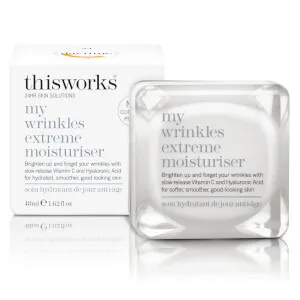
this works My Wrinkles Extreme Moisturiser

this works My Wrinkles Extreme Moisturiser

Efficacy91/100IrritancyHigh

Works for

Anti-aging
Ascorbyl glucoside, Bakuchiol + 2 more
Works well
What the product description says
“My Wrinkles Extreme Moisturiser”
From product name

This product can help reduce and prevent fine lines and wrinkles, improve skin elasticity and firmness because it contains bakuchiol.

These ingredients in the product can also be helpful, even though there is less evidence for their effectiveness: ascorbyl glucoside, serine.

Keep in mind that it typically takes at least 6 weeks to notice any results because the changes that are needed to improve fine lines and elasticity happen in the deeper layers of the skin. No topical anti-aging product can “erase” wrinkles or fully reverse signs of aging.

Ascorbyl glucosideKey activeEffect: MediumA vitamin C derivative that is more stable but less potent than pure form of vitamin C. Has a potential to boost collagen production, nutralise free radicals and reduce hyperpigmentation, but the required concentration is likely to be much higher than for the pure form of vitamin C, limiting the ingredient's effectiveness in products~1.6–1.9%
BakuchiolKey activeEffect: HighA plant extract that is, though different in chemical structure, acts similar to retinoids. First studies show that it can help reduce fine lines and wrinkles, improve skin tone, reduce clogged pores and blemishes, and reduce inflammation. There is no conclusive evidence that bakuchiol is as effective as retinol however. The study that directly compared retinol with bakuchiol used bakuchiol applied twice daily compared to once per day for the retinol. According to this study, bakuchiol is less irritating than retinol. Bakuchiol is extracted from seeds of Babchi plant. Other parts of the plant contain coumarins that could cause allergic and irritant reactions. These compounds should be removed in the extraction process when bakuchiol is produced, but it is a good idea to be cautious and stay away from products that include the Babchi plant extracts other than purified bakuchiol to avoid irritation~0.45–0.65%
SerineKey activeEffect: MediumAn amino-acid that helps to attract water to the upper layer of the skin. In combination with other amino-acids, might help to reduce fine lines and wrinkles~0.2–0.35%
Butyrospermum parkii butterEffect: LowA great moisturising ingredient that softens the skin and reduces water loss from its upper layer. It also can be helpful in protecting skin from free radicals~4.4–5.3%
Evens skin tone
Ascorbyl glucoside, Bakuchiol + 1 more
Works well
What the product description says
“Plant-based Bakuchiol helps reduce the appearance of lines and wrinkles, even skin tone and fade hyperpigmentation.”
Source: Feelunique

This product can help reduce hypepigmentation and even out the skin tone because it contains the following effective ingredients: bakuchiol

The following ingredient (ingredients) in this product might be helpful, but there is no evidence to confirm that it actually can help even out the skin tone: alanine, ascorbyl glucoside.

Keep in mind that you would need to apply any topical skincare targetted at hypigmentation consistently for a couple of months to get a result. No topical skincare product can help get rid of hyperpigmentation (including post-acne marks and age spots) instantly.

Ascorbyl glucosideKey activeEffect: MediumA vitamin C derivative that is more stable but less potent than pure form of vitamin C. Has a potential to boost collagen production, nutralise free radicals and reduce hyperpigmentation, but the required concentration is likely to be much higher than for the pure form of vitamin C, limiting the ingredient's effectiveness in products~1.6–1.9%
BakuchiolKey activeEffect: HighA plant extract that is, though different in chemical structure, acts similar to retinoids. First studies show that it can help reduce fine lines and wrinkles, improve skin tone, reduce clogged pores and blemishes, and reduce inflammation. There is no conclusive evidence that bakuchiol is as effective as retinol however. The study that directly compared retinol with bakuchiol used bakuchiol applied twice daily compared to once per day for the retinol. According to this study, bakuchiol is less irritating than retinol. Bakuchiol is extracted from seeds of Babchi plant. Other parts of the plant contain coumarins that could cause allergic and irritant reactions. These compounds should be removed in the extraction process when bakuchiol is produced, but it is a good idea to be cautious and stay away from products that include the Babchi plant extracts other than purified bakuchiol to avoid irritation~0.45–0.65%
AlanineEffect: LowAn amino-acid that helps to attract water to the upper layer of the skin and might help to lighten the skin, but solid evidence is lacking~0.25–0.45%
Moisturizing
Butyrospermum parkii butter, Coconut alkanes + 28 more
Works
What the product description says
“My Wrinkles Extreme Moisturiser”
From product name

This product can help improve hydration of the skin with the two types of ingredients.

The first type is called “humectants”:
these ingredients help attract water. When humectants are on the surface of the skin, they “pull in” the moisture from the outside environment, or from within deeper layers of the skin. The following ingredients in this product do the job: alanine, anhydroxylitol.

This product also contains ingredients called “occlusives”. They help reduce the speed with which our skin loses moisture to the outside environment. These ingredients also help soften the upper layer of the skin, so it feels less tight and nicer to the touch. The following ingredients in this product do the job: arginine, beeswax.

Butyrospermum parkii butterKey active· Emollient, OcclusiveEffect: HighA great moisturising ingredient that softens the skin and reduces water loss from its upper layer. It also can be helpful in protecting skin from free radicals~4.4–5.3%
Coconut alkanesKey active· EmollientEffect: MediumAn emollient that helps soften the skin~3.1–3.7%
Ricinus communis seed oilKey active· Emollient, OcclusiveEffect: HighA plant oil that can help soften the skin. It might be helpful in calming down inflammation, but solid research is lacking. Is often used in lip products to create the needed product consistency~2.3–2.9%
GlycerinKey active· HumectantEffect: HighOne of the best moisturizing ingredients. Naturally present in skin. It attracts water to the upper layer of the skin working as a humectant~1.9–2.3%
Crambe abyssinica seed oilKey activeEffect: MediumHelps soften the upper layer of the skin~1.2–1.5%
Glyceryl stearate seKey activeEffect: MediumUsed to stabilize the product formulations and works as an emollient~1–1.3%
Theobroma cacao seed butterKey active· EmollientEffect: HighHelps soften the upper layer of the skin and can be helpful in restoring the skin barrier function. Might have some anti-oxidant effect~0.6–0.9%
Cetearyl alcoholKey active· EmollientEffect: MediumA non-drying alcohol. Works as an emollient. Helps water and oil mix together and creates a nice product texture~0.4–0.6%
Cera albaKey active· Emollient, OcclusiveEffect: HighForms a protective barrier that holds water and keeps dry skin hydrated. Keeps an emulsion from separating into its oil and liquid components, and increases the thickness of a product. Can be an allergen~0.35–0.65%
BeeswaxKey active· Emollient, OcclusiveEffect: HighForms a protective barrier that holds water and keeps dry skin hydrated. Keeps an emulsion from separating into its oil and liquid components, and increases the thickness of a product. Can be an allergen~0.3–0.55%
Copernicia cerifera waxKey active· Emollient, OcclusiveEffect: HighHelps to soften the upper layer of the skin and create a nice product consistency~0.3–0.55%
Sodium hyaluronateKey active· HumectantEffect: HighOne of the best moisturizing ingredients. Attracts water into the upper layer of the skin~0.25–0.4%
AlanineKey active· HumectantEffect: HighAn amino-acid that helps to attract water to the upper layer of the skin and might help to lighten the skin, but solid evidence is lacking~0.25–0.45%
CitrullineKey active· HumectantEffect: HighAn amino-acid that helps attract water to the upper layer of the skin~0.25–0.4%
Glutamic acidKey active· HumectantEffect: HighAn amino-acid that helps attract water to the upper layer of the skin~0.25–0.4%
GlycogenKey active· HumectantEffect: HighHelps attract water to the upper layer of the skin~0.25–0.4%
Histidine hclKey activeEffect: HighA salt of an amino-acid that helps attract water to the upper layer of the skin. Might be helpful in restoring the skin barrier function~0.25–0.4%
Lysine hclKey activeEffect: High~0.25–0.45%
Hydrogenated castor oilKey active· EmollientEffect: MediumA plant oil that can help soften the skin. It might be helpful in calming down inflammation, but solid research is lacking. Is often used in lip products to create the needed product consistency~0.25–0.45%
Coco-caprylate/caprateKey active· EmollientEffect: MediumHelps to soften the upper layer of the skin without creating a greasy texture~0.25–0.45%
SerineKey activeEffect: HighAn amino-acid that helps to attract water to the upper layer of the skin. In combination with other amino-acids, might help to reduce fine lines and wrinkles~0.2–0.35%
XylitylglucosideKey active· HumectantEffect: HighHelps attract water to the upper layer of the skin and repair the skin barrier function~0.2–0.35%
AnhydroxylitolKey active· HumectantEffect: HighHelps attract water to the upper layer of the skin and repair the skin barrir function~0.2–0.4%
MannitolKey active· HumectantEffect: HighHelps to attract water to the upper layer of the skin~0.2–0.35%
SucroseKey active· HumectantEffect: HighCan help attract water to the upper layer of the skin. In crystal form, it can work as a gentle exfoliant, gentler than the salt scrub. Helps stabilize the emulsion~0.15–0.3%
ArginineKey active· Humectant, OcclusiveEffect: HighAn amino acid that is naturally present in skin and helps keep it hydrated. When used together with AHAs, it can reduce their irritating effect on the skin~0.15–0.3%
Butylene glycol· HumectantEffect: LowUsed to create a nice product texture and help delivery of other ingredients. Might be somewhat helpful in attracting water to the upper layer of the skin~5.4–6.6%
Moringa oleifera seed oil· EmollientEffect: LowA plant oil that helps soften the upper layer of the skin. Is unlikely to be helpful in restoring skin barrier function due to the low content of linoleic acid~0.75–1.15%
Glyceryl stearate· EmollientEffect: LowAn emollient that softens the skin and forms a protective layer on its surface. Helps water and oil mix together~0.55–0.8%
Caprylic/capric triglycerideUnder-dosedA good mix of fatty acids that forms a protective layer on the skin. Improves the shelf life of products. Derived from coconut and glycerin~0.45–0.65%
Anti-oxidation
Side benefit · Ascorbyl glucoside, Bakuchiol + 2 more
Works well

This product contains antioxidants (bakuchiol) that can help neutralize free radicals in skin. By doing so, they can lessen the damage the skin gets from the UV light (sun).

The following ingredients - ascorbyl glucoside also can have an antioxidant effect, but there is less evidence to confirm their effectiveness in skin.

Ascorbyl glucosideKey activeEffect: MediumA vitamin C derivative that is more stable but less potent than pure form of vitamin C. Has a potential to boost collagen production, nutralise free radicals and reduce hyperpigmentation, but the required concentration is likely to be much higher than for the pure form of vitamin C, limiting the ingredient's effectiveness in products~1.6–1.9%
BakuchiolKey activeEffect: HighA plant extract that is, though different in chemical structure, acts similar to retinoids. First studies show that it can help reduce fine lines and wrinkles, improve skin tone, reduce clogged pores and blemishes, and reduce inflammation. There is no conclusive evidence that bakuchiol is as effective as retinol however. The study that directly compared retinol with bakuchiol used bakuchiol applied twice daily compared to once per day for the retinol. According to this study, bakuchiol is less irritating than retinol. Bakuchiol is extracted from seeds of Babchi plant. Other parts of the plant contain coumarins that could cause allergic and irritant reactions. These compounds should be removed in the extraction process when bakuchiol is produced, but it is a good idea to be cautious and stay away from products that include the Babchi plant extracts other than purified bakuchiol to avoid irritation~0.45–0.65%
Butyrospermum parkii butterEffect: LowA great moisturising ingredient that softens the skin and reduces water loss from its upper layer. It also can be helpful in protecting skin from free radicals~4.4–5.3%
Theobroma cacao seed butterEffect: LowHelps soften the upper layer of the skin and can be helpful in restoring the skin barrier function. Might have some anti-oxidant effect~0.6–0.9%
Anti-blemish
Side benefit · Bakuchiol
May help

This product might be able to help reduce blemishes and clogged pores because it contains bakuchiol.

BakuchiolKey activeEffect: HighA plant extract that is, though different in chemical structure, acts similar to retinoids. First studies show that it can help reduce fine lines and wrinkles, improve skin tone, reduce clogged pores and blemishes, and reduce inflammation. There is no conclusive evidence that bakuchiol is as effective as retinol however. The study that directly compared retinol with bakuchiol used bakuchiol applied twice daily compared to once per day for the retinol. According to this study, bakuchiol is less irritating than retinol. Bakuchiol is extracted from seeds of Babchi plant. Other parts of the plant contain coumarins that could cause allergic and irritant reactions. These compounds should be removed in the extraction process when bakuchiol is produced, but it is a good idea to be cautious and stay away from products that include the Babchi plant extracts other than purified bakuchiol to avoid irritation~0.45–0.65%

Can it cause trouble?

Irritancy
8 strong irritants: Parfum, Limonene + 6 more — patch-test recommended
High risk
We flagged 26 ingredients with irritancy potential. Severity depends on your sensitivity threshold; the table lists the worst offenders first.
IngredientFunctionIrritationEst. amount
ParfumAn aromatic blend of unspecified and possibly irritating ingredientsHigh~0.2–0.35%est.
Benzyl alcoholA preservative. Can be used to mask unpleasant smell. Can be irritatingHigh~0.2–0.4%est.
LimoneneA common frangrance that can easily irritate skin, especially if exposed to air, light or heatHigh~0.2–0.4%est.
LinaloolA fragrance. Can be irritatingHigh~0.2–0.4%est.
Citrus aurantium amara peel oil—High~0.2–0.35%est.
Citrus limon peel oilA highly irritating fragranceHigh~0.15–0.3%est.
CitralA fragrance with a lemon scent. A likely irritantHigh~0.1–0.2%est.
GeraniolA fragrance. Can be irritatingHigh~0.15–0.25%est.
Coconut alkanesAn emollient that helps soften the skinMedium~3.1–3.7%est.
Ricinus communis seed oilA plant oil that can help soften the skin. It might be helpful in calming down inflammation, but solid research is lacking. Is often used in lip products to create the needed product consistencyMedium~2.3–2.9%est.
Ascorbyl glucosideA vitamin C derivative that is more stable but less potent than pure form of vitamin C. Has a potential to boost collagen production, nutralise free radicals and reduce hyperpigmentation, but the required concentration is likely to be much higher than for the pure form of vitamin C, limiting the ingredient's effectiveness in productsMedium~1.6–1.9%est.
Crambe abyssinica seed oilHelps soften the upper layer of the skinMedium~1.2–1.5%est.
Moringa oleifera seed oilA plant oil that helps soften the upper layer of the skin. Is unlikely to be helpful in restoring skin barrier function due to the low content of linoleic acidMedium~0.75–1.15%est.
BakuchiolA plant extract that is, though different in chemical structure, acts similar to retinoids. First studies show that it can help reduce fine lines and wrinkles, improve skin tone, reduce clogged pores and blemishes, and reduce inflammation. There is no conclusive evidence that bakuchiol is as effective as retinol however. The study that directly compared retinol with bakuchiol used bakuchiol applied twice daily compared to once per day for the retinol. According to this study, bakuchiol is less irritating than retinol. Bakuchiol is extracted from seeds of Babchi plant. Other parts of the plant contain coumarins that could cause allergic and irritant reactions. These compounds should be removed in the extraction process when bakuchiol is produced, but it is a good idea to be cautious and stay away from products that include the Babchi plant extracts other than purified bakuchiol to avoid irritationMedium~0.45–0.65%est.
Caprylic/capric triglycerideA good mix of fatty acids that forms a protective layer on the skin. Improves the shelf life of products. Derived from coconut and glycerinMedium~0.45–0.65%est.
Candelilla/jojoba/rice bran polyglyceryl-3 estersHelp oil and water mix togetherMedium~0.3–0.6%est.
Sodium stearoyl lactylateHelps oil and water mix togetherMedium~0.3–0.55%est.
Acrylates/c10-30 alkyl acrylate crosspolymerMaintains the texture of skincare products. Allows the product to spread evenly. Helps oil and water mix togetherMedium~0.3–0.55%est.
Hydrogenated castor oilA plant oil that can help soften the skin. It might be helpful in calming down inflammation, but solid research is lacking. Is often used in lip products to create the needed product consistencyMedium~0.25–0.45%est.
Sodium stearoyl glutamateHelps oil and water mix togetherMedium~0.3–0.5%est.
Cera albaForms a protective barrier that holds water and keeps dry skin hydrated. Keeps an emulsion from separating into its oil and liquid components, and increases the thickness of a product. Can be an allergenMedium~0.35–0.65%est.
Disodium edtaStabilizes the product formulationMedium~0.25–0.45%est.
EthylhexylglycerinA preservativeMedium~0.25–0.45%est.
Dehydroacetic acidA preservativeMedium~0.2–0.4%est.
Citric acidCan work as an exfoliant but is typically used to adjust the product pHMedium~0.15–0.25%est.
Comedogenic
5 ingredients rated 2 or more on the 0–5 pore-clogging scale
5 flagged
These ingredients have a comedogenic rating of 2 or more on a 0–5 scale; the table shows each one's rating. In leave-on products they can clog pores in acne-prone skin.
IngredientFunctionRatingEst. amount
Butyrospermum parkii butterA great moisturising ingredient that softens the skin and reduces water loss from its upper layer. It also can be helpful in protecting skin from free radicals3/5~4.4–5.3%est.
Theobroma cacao seed butterHelps soften the upper layer of the skin and can be helpful in restoring the skin barrier function. Might have some anti-oxidant effect3/5~0.6–0.9%est.
Coconut alkanesAn emollient that helps soften the skin2/5~3.1–3.7%est.
Glyceryl stearate seUsed to stabilize the product formulations and works as an emollient2/5~1–1.3%est.
Cetearyl alcoholA non-drying alcohol. Works as an emollient. Helps water and oil mix together and creates a nice product texture2/5~0.4–0.6%est.
Did this help you decide?

User reviews

Would you recommend?
No community reviews yet.

Be the first — your take helps the next person decide.

Ingredients

Filter by role to see what each ingredient is doing.

Water~45–55%
Formula
Irritation risk
Low

Plain old water

More about Water
Butylene glycol~5.4–6.6%
Formula
Irritation risk
Low
Works for
Moisturizing

Used to create a nice product texture and help delivery of other ingredients. Might be somewhat helpful in attracting water to the upper layer of the skin

More about Butylene glycol
Butyrospermum parkii butter~4.4–5.3%
Key activeComedogenic 3/5
Irritation risk
Low
Comedogenicity
3/5
Works for
MoisturizingAnti-agingAnti-oxidation

A great moisturising ingredient that softens the skin and reduces water loss from its upper layer. It also can be helpful in protecting skin from free radicals

More about Butyrospermum parkii butter
Coconut alkanes~3.1–3.7%
Key activeComedogenic 2/5Irritant · medium
Irritation risk
Medium
Comedogenicity
2/5
Works for
Moisturizing

An emollient that helps soften the skin

More about Coconut alkanes
Ricinus communis seed oil~2.3–2.9%
Key activeIrritant · medium
Irritation risk
Medium
Works for
MoisturizingAnti-inflammatory

A plant oil that can help soften the skin. It might be helpful in calming down inflammation, but solid research is lacking. Is often used in lip products to create the needed product consistency

More about Ricinus communis seed oil
Glycerin~1.9–2.3%
Key active
Irritation risk
Low
Works for
Moisturizing

One of the best moisturizing ingredients. Naturally present in skin. It attracts water to the upper layer of the skin working as a humectant

More about Glycerin
Ascorbyl glucoside~1.6–1.9%
Key activeIrritant · medium
Irritation risk
Medium
Works for
Evens skin toneAnti-oxidationAnti-aging

A vitamin C derivative that is more stable but less potent than pure form of vitamin C. Has a potential to boost collagen production, nutralise free radicals and reduce hyperpigmentation, but the required concentration is likely to be much higher than for the pure form of vitamin C, limiting the ingredient's effectiveness in products

More about Ascorbyl glucoside
Crambe abyssinica seed oil~1.2–1.5%
Key activeIrritant · medium
Irritation risk
Medium
Works for
Moisturizing

Helps soften the upper layer of the skin

More about Crambe abyssinica seed oil
Glyceryl stearate se~1–1.3%
Key activeComedogenic 2/5
Irritation risk
Low
Comedogenicity
2/5
Works for
CleansingMoisturizing

Used to stabilize the product formulations and works as an emollient

More about Glyceryl stearate se
Moringa oleifera seed oil~0.75–1.15%
Irritant · medium
Irritation risk
Medium
Works for
Moisturizing

A plant oil that helps soften the upper layer of the skin. Is unlikely to be helpful in restoring skin barrier function due to the low content of linoleic acid

More about Moringa oleifera seed oil
Theobroma cacao seed butter~0.6–0.9%
Key activeComedogenic 3/5
Irritation risk
Low
Comedogenicity
3/5
Works for
MoisturizingAnti-oxidationAnti-dandruff

Helps soften the upper layer of the skin and can be helpful in restoring the skin barrier function. Might have some anti-oxidant effect

More about Theobroma cacao seed butter
Glyceryl stearate~0.55–0.8%
Formula
Irritation risk
Low
Works for
CleansingMoisturizing

An emollient that softens the skin and forms a protective layer on its surface. Helps water and oil mix together

More about Glyceryl stearate
Bakuchiol~0.45–0.65%
Key activeIrritant · medium
Irritation risk
Medium
Works for
Anti-blemishEvens skin toneAnti-oxidationAnti-inflammatoryAnti-aging

A plant extract that is, though different in chemical structure, acts similar to retinoids. First studies show that it can help reduce fine lines and wrinkles, improve skin tone, reduce clogged pores and blemishes, and reduce inflammation. There is no conclusive evidence that bakuchiol is as effective as retinol however. The study that directly compared retinol with bakuchiol used bakuchiol applied twice daily compared to once per day for the retinol. According to this study, bakuchiol is less irritating than retinol. Bakuchiol is extracted from seeds of Babchi plant. Other parts of the plant contain coumarins that could cause allergic and irritant reactions. These compounds should be removed in the extraction process when bakuchiol is produced, but it is a good idea to be cautious and stay away from products that include the Babchi plant extracts other than purified bakuchiol to avoid irritation

More about Bakuchiol
Caprylic/capric triglyceride~0.45–0.65%
Under-dosedIrritant · medium
Irritation risk
Medium
Works for
Moisturizing

A good mix of fatty acids that forms a protective layer on the skin. Improves the shelf life of products. Derived from coconut and glycerin

More about Caprylic/capric triglyceride
Candelilla/jojoba/rice bran polyglyceryl-3 esters~0.3–0.6%
Irritant · medium
Irritation risk
Medium
Works for
Cleansing

Help oil and water mix together

More about Candelilla/jojoba/rice bran polyglyceryl-3 esters
Phenoxyethanol~0.35–0.6%
Formula
Irritation risk
Low

A preservative. It helps prevent bacterial growth in cosmetic products

More about Phenoxyethanol
Cetearyl alcohol~0.4–0.6%
Key activeComedogenic 2/5
Irritation risk
Low
Comedogenicity
2/5
Works for
CleansingMoisturizing

A non-drying alcohol. Works as an emollient. Helps water and oil mix together and creates a nice product texture

More about Cetearyl alcohol
Sodium stearoyl lactylate~0.3–0.55%
Irritant · medium
Irritation risk
Medium
Works for
Cleansing

Helps oil and water mix together

More about Sodium stearoyl lactylate
Acrylates/c10-30 alkyl acrylate crosspolymer~0.3–0.55%
Irritant · medium
Irritation risk
Medium

Maintains the texture of skincare products. Allows the product to spread evenly. Helps oil and water mix together

More about Acrylates/c10-30 alkyl acrylate crosspolymer
Sodium hydroxide~0.25–0.45%
Formula
Irritation risk
Low

Used to adjust the product's pH

More about Sodium hydroxide
Coco-caprylate/caprate~0.25–0.45%
Key active
Irritation risk
Low
Works for
Moisturizing

Helps to soften the upper layer of the skin without creating a greasy texture

More about Coco-caprylate/caprate
Xylitylglucoside~0.2–0.35%
Key active
Irritation risk
Low
Works for
Moisturizing

Helps attract water to the upper layer of the skin and repair the skin barrier function

More about Xylitylglucoside
Arginine~0.15–0.3%
Key active
Irritation risk
Low
Works for
Moisturizing

An amino acid that is naturally present in skin and helps keep it hydrated. When used together with AHAs, it can reduce their irritating effect on the skin

More about Arginine
Mannitol~0.2–0.35%
Key active
Irritation risk
Low
Works for
Moisturizing

Helps to attract water to the upper layer of the skin

More about Mannitol
Serine~0.2–0.35%
Key active
Irritation risk
Low
Works for
MoisturizingAnti-aging

An amino-acid that helps to attract water to the upper layer of the skin. In combination with other amino-acids, might help to reduce fine lines and wrinkles

More about Serine
Sucrose~0.15–0.3%
Key active
Irritation risk
Low
Works for
Moisturizing

Can help attract water to the upper layer of the skin. In crystal form, it can work as a gentle exfoliant, gentler than the salt scrub. Helps stabilize the emulsion

More about Sucrose
Hydrogenated castor oil~0.25–0.45%
Key activeIrritant · medium
Irritation risk
Medium
Works for
CleansingMoisturizingAnti-inflammatory

A plant oil that can help soften the skin. It might be helpful in calming down inflammation, but solid research is lacking. Is often used in lip products to create the needed product consistency

More about Hydrogenated castor oil
Mica~0.25–0.45%
Formula
Irritation risk
Low

Creates an illusion of smoother and more radiant skin tone. Adds shimmer to the skin by reflecting light

More about Mica
Anhydroxylitol~0.2–0.4%
Key active
Irritation risk
Low
Works for
Moisturizing

Helps attract water to the upper layer of the skin and repair the skin barrir function

More about Anhydroxylitol
Parfum~0.2–0.35%
Irritant · high
Irritation risk
High

An aromatic blend of unspecified and possibly irritating ingredients

More about Parfum
Sodium hyaluronate~0.25–0.4%
Key active
Irritation risk
Low
Works for
Moisturizing

One of the best moisturizing ingredients. Attracts water into the upper layer of the skin

More about Sodium hyaluronate
Sodium stearoyl glutamate~0.3–0.5%
Irritant · medium
Irritation risk
Medium
Works for
Cleansing

Helps oil and water mix together

More about Sodium stearoyl glutamate
Benzyl alcohol~0.2–0.4%
Irritant · high
Irritation risk
High

A preservative. Can be used to mask unpleasant smell. Can be irritating

More about Benzyl alcohol
Limonene~0.2–0.4%
Irritant · high
Irritation risk
High

A common frangrance that can easily irritate skin, especially if exposed to air, light or heat

More about Limonene
Citrulline~0.25–0.4%
Key active
Irritation risk
Low
Works for
Moisturizing

An amino-acid that helps attract water to the upper layer of the skin

More about Citrulline
Glycogen~0.25–0.4%
Key active
Irritation risk
Low
Works for
Moisturizing

Helps attract water to the upper layer of the skin

More about Glycogen
Histidine hcl~0.25–0.4%
Key active
Irritation risk
Low
Works for
Moisturizing

A salt of an amino-acid that helps attract water to the upper layer of the skin. Might be helpful in restoring the skin barrier function

More about Histidine hcl
Cera alba~0.35–0.65%
Key activeIrritant · medium
Irritation risk
Medium
Works for
CleansingMoisturizing

Forms a protective barrier that holds water and keeps dry skin hydrated. Keeps an emulsion from separating into its oil and liquid components, and increases the thickness of a product. Can be an allergen

More about Cera alba
Beeswax~0.3–0.55%
Key active
Irritation risk
Low
Works for
Moisturizing

Forms a protective barrier that holds water and keeps dry skin hydrated. Keeps an emulsion from separating into its oil and liquid components, and increases the thickness of a product. Can be an allergen

More about Beeswax
Xylitol~0.2–0.4%
Formula
Irritation risk
Low

Helps attract water to the upper layer of the skin and repair the skin barrier function

More about Xylitol
Disodium edta~0.25–0.45%
Irritant · medium
Irritation risk
Medium

Stabilizes the product formulation

More about Disodium edta
Ethylhexylglycerin~0.25–0.45%
Irritant · medium
Irritation risk
Medium

A preservative

More about Ethylhexylglycerin
Linalool~0.2–0.4%
Irritant · high
Irritation risk
High

A fragrance. Can be irritating

More about Linalool
Copernicia cerifera wax~0.3–0.55%
Key active
Irritation risk
Low
Works for
Moisturizing

Helps to soften the upper layer of the skin and create a nice product consistency

More about Copernicia cerifera wax
Alanine~0.25–0.45%
Key active
Irritation risk
Low
Works for
MoisturizingEvens skin tone

An amino-acid that helps to attract water to the upper layer of the skin and might help to lighten the skin, but solid evidence is lacking

More about Alanine
Glutamic acid~0.25–0.4%
Key active
Irritation risk
Low
Works for
Moisturizing

An amino-acid that helps attract water to the upper layer of the skin

More about Glutamic acid
Lysine hcl~0.25–0.45%
Key active
Irritation risk
Low
Works for
Moisturizing
More about Lysine hcl
Dehydroacetic acid~0.2–0.4%
Irritant · medium
Irritation risk
Medium

A preservative

More about Dehydroacetic acid
Citrus aurantium amara leaf/twig oil~0.2–0.4%
Irritant · high
Citrus aurantium amara peel oil~0.2–0.35%
Irritant · high
Citrus limon peel oil~0.15–0.3%
Irritant · high
Irritation risk
High

A highly irritating fragrance

More about Citrus limon peel oil
Juniperus virginiana wood oil~0.15–0.25%
Formula
Citral~0.1–0.2%
Irritant · high
Irritation risk
High

A fragrance with a lemon scent. A likely irritant

More about Citral
Geraniol~0.15–0.25%
Irritant · high
Irritation risk
High

A fragrance. Can be irritating

More about Geraniol
Citric acid~0.15–0.25%
Irritant · medium
Irritation risk
Medium

Can work as an exfoliant but is typically used to adjust the product pH

More about Citric acid
Ci 77891~0.1–0.15%
Formula
Irritation risk
Low
More about Ci 77891
Titanium dioxide~0.1–0.15%
Formula
Irritation risk
Low
Works for
Sun protection

Works as a UV filter when used in high concentrations. It is photostable and is effective mostly against the UVB light, with some protection in the UVA range. In small concentrations, used for its ability to improve the color of cosmetic products. Is usually well tolerated by the skin

More about Titanium dioxide
Ingredient list view

Water, Butylene glycol, Butyrospermum parkii butter, Coconut alkanes, Ricinus communis seed oil, Glycerin, Ascorbyl glucoside, Crambe abyssinica seed oil, Glyceryl stearate se, Moringa oleifera seed oil, Theobroma cacao seed butter, Glyceryl stearate, Bakuchiol, Caprylic/capric triglyceride, Candelilla/jojoba/rice bran polyglyceryl-3 esters, Phenoxyethanol, Cetearyl alcohol, Sodium stearoyl lactylate, Acrylates/c10-30 alkyl acrylate crosspolymer, Sodium hydroxide, Coco-caprylate/caprate, Xylitylglucoside, Arginine, Mannitol, Serine, Sucrose, Hydrogenated castor oil, Mica, Anhydroxylitol, Parfum, Sodium hyaluronate, Sodium stearoyl glutamate, Benzyl alcohol, Limonene, Citrulline, Glycogen, Histidine hcl, Cera alba, Beeswax, Xylitol, Disodium edta, Ethylhexylglycerin, Linalool, Copernicia cerifera wax, Alanine, Glutamic acid, Lysine hcl, Dehydroacetic acid, Citrus aurantium amara leaf/twig oil, Citrus aurantium amara peel oil, Citrus limon peel oil, Juniperus virginiana wood oil, Citral, Geraniol, Citric acid, Ci 77891, Titanium dioxide

Compare prices

Retailers ranked by price — lowest first.

SpaceNK US
$65.00 Out of stock
Check

Affiliate links

Worth comparing, line by line.

Match % combines shared ingredients, the first five ingredients, shared actives and hero ingredients, irritancy (lower counts in the alternative's favour), texture and body area. Only products in the same routine step are compared.

Side-by-side comparison of this product against its closest alternatives
this worksMy Wrinkles Extreme MoisturiserYOUR PRODUCTVotaryNatural Glow Day CreamNoble PanaceaThe Brilliant Overnight Recharge CreamEveline CosmeticsBio Hyaluron Expert
Match—82%79%77%
Price—$110.50$183.20—
Shared key ingredients—7 of 239 of 2310 of 23
Key difference—Prunus Amygdalus Dulcis SeedNiacinamideLactic Acid
Irritancy High High High Medium
Drying alcohol————
View product Shop Shop Shop

More alternatives: Nivea Cellular Expert lift night cream with BakuchiolMIGUHARA Cica Bakuchiol Erasing Cream

Cheaper alternatives? See how this stacks up against similar formulas.
We compare ingredient profiles across our catalog — pick the closest match for your budget.
Open dupe finder

Sources cited in this review

Every concentration estimate and effectiveness label is anchored to one of these 23 studies and safety reviews.

  1. 1
  2. 2
  3. 3
  4. 4
  5. 5
  6. 6
this works My Wrinkles Extreme Moisturiser
this worksMy Wrinkles Extreme Moisturiser

Affiliate links · As an Amazon Associate, WIMJ earns from qualifying purchases.

As an Amazon Associate, WIMJ earns from qualifying purchases.