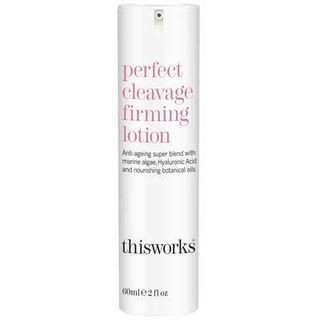
this works Body Perfect Cleavage Firming Lotion
Works for
2 of 3 advertised claims delivered
Moisturizing21 ingredients credited for this claimStrong support
“Comfrey Root helps boost cell renewal and provides long-lasting, calming hydration.”
This product can help improve hydration of the skin with the two types of ingredients.
The first type is called “humectants”:
these ingredients help attract water.
When humectants are on the surface of the skin, they “pull in” the moisture from the outside environment, or from
within deeper layers of the skin. The following ingredients in this product do the job:
galactoarabinan, glycerin.
This product also contains ingredients called “occlusives”. They help reduce the speed with which our skin loses moisture to the outside environment. These ingredients also help soften the upper layer of the skin, so it feels less tight and nicer to the touch. The following ingredients in this product do the job: caprylic/capric triglyceride, ribes nigrum seed oil.
The following ingredients in this product are especially good for supporting the skin barrier and helping with the hydration level: urea
Anti-aging3 ingredients credited for this claimModerate support
“Vitamin C works to diminish damage and promote increased clarity and collagen production; for plumper, more glowing skin.”
This product contains serine. This ingredient might be able to help reduce and prevent fine lines and wrinkles, improve skin elasticity and firmness, but there is not enough evidence that it actually works.
Evens skin tone1 ingredient credited for this claimWeak support
“Vitamin C works to diminish damage and promote increased clarity and collagen production; for plumper, more glowing skin.”
Effective ingredients missing or their concentration is too low
Can it cause trouble?
Irritancy9 strong irritants: Parfum, Linalool + 7 more — patch-test recommendedHigh risk
Comedogenic5 ingredients rated 2 or more on the 0–5 pore-clogging scale5 flagged
User reviews
Be the first — your take helps the next person decide.
Ingredients
Filter by role to see what each ingredient is doing.
Water~45–55%
Caprylic/capric triglyceride~6.2–7.6%
- Irritation risk
- Medium
A good mix of fatty acids that forms a protective layer on the skin. Improves the shelf life of products. Derived from coconut and glycerin
More about Caprylic/capric triglycerideGlycerin~4.2–5.2%
- Irritation risk
- Low
One of the best moisturizing ingredients. Naturally present in skin. It attracts water to the upper layer of the skin working as a humectant
More about GlycerinLinum usitatissimum seed oil~3–3.7%
Glyceryl stearate se~2.3–2.9%
- Irritation risk
- Low
- Comedogenicity
- 2/5
Used to stabilize the product formulations and works as an emollient
More about Glyceryl stearate sePrunus amygdalus dulcis oil~2–2.5%
- Irritation risk
- Low
An emollient that softens the skin
More about Prunus amygdalus dulcis oilVitis vinifera seed oil~1.7–2.1%
- Irritation risk
- Medium
A great emollient that can also have anti-oxidant properties
More about Vitis vinifera seed oilRibes nigrum seed oil~1.5–1.8%
- Irritation risk
- Medium
An emollient. Can be helpful for restoring skin barrier function.
More about Ribes nigrum seed oilGlyceryl stearate~1.2–1.5%
- Irritation risk
- Low
An emollient that softens the skin and forms a protective layer on its surface. Helps water and oil mix together
More about Glyceryl stearateCandelilla/jojoba/rice bran polyglyceryl-3 esters~0.95–1.15%
- Irritation risk
- Medium
Help oil and water mix together
More about Candelilla/jojoba/rice bran polyglyceryl-3 estersGalactoarabinan~0.7–1.05%
- Irritation risk
- Medium
Helps attract water to the upper layer of the skin
More about GalactoarabinanTheobroma cacao seed butter~0.6–0.85%
- Irritation risk
- Low
- Comedogenicity
- 3/5
Helps soften the upper layer of the skin and can be helpful in restoring the skin barrier function. Might have some anti-oxidant effect
More about Theobroma cacao seed butterBenzyl alcohol~0.45–0.65%
- Irritation risk
- High
A preservative. Can be used to mask unpleasant smell. Can be irritating
More about Benzyl alcoholCarbomer~0.45–0.7%
- Irritation risk
- Low
Helps create a thicker or gel-like product texture. It is not a surfactant but can be used in gentle cleansing formulations
More about CarbomerCetearyl alcohol~0.5–0.7%
- Irritation risk
- Low
- Comedogenicity
- 2/5
A non-drying alcohol. Works as an emollient. Helps water and oil mix together and creates a nice product texture
More about Cetearyl alcoholSodium stearoyl lactylate~0.45–0.65%
- Irritation risk
- Medium
Helps oil and water mix together
More about Sodium stearoyl lactylateButylene glycol~0.4–0.6%
- Irritation risk
- Low
Used to create a nice product texture and help delivery of other ingredients. Might be somewhat helpful in attracting water to the upper layer of the skin
More about Butylene glycolPhenoxyethanol~0.4–0.6%
- Irritation risk
- Low
A preservative. It helps prevent bacterial growth in cosmetic products
More about PhenoxyethanolPullulan~0.35–0.6%
- Irritation risk
- High
Creates a thin drying film on the skin resulting in a short-term tightening effect
More about PullulanAllantoin~0.25–0.5%
- Irritation risk
- Low
Helps calm down inflammation in skin and can help reduce itching. Helps to repair the skin barrier and keep skin hydrated
More about AllantoinTocopheryl acetate~0.3–0.55%
- Irritation risk
- Medium
A more stable but less bio-available form of vitamin E compared to Tocopherol. Might help moisturize and protect the skin from free radicals, but mostly used in low concentrations to stabilize other ingredients.
More about Tocopheryl acetateSodium hydroxide~0.25–0.5%
Parfum~0.25–0.45%
- Irritation risk
- High
An aromatic blend of unspecified and possibly irritating ingredients
More about ParfumSodium stearoyl glutamate~0.3–0.55%
- Irritation risk
- Medium
Helps oil and water mix together
More about Sodium stearoyl glutamateXanthan gum~0.25–0.5%
- Irritation risk
- Low
Used to create a thicker product consistency
More about Xanthan gumHordeum vulgare seed extract~0.25–0.45%
- Irritation risk
- Low
A grain extract. It might contain compounds that help neutralize free radicals in skin
More about Hordeum vulgare seed extractPentylene glycol~0.3–0.55%
- Irritation risk
- Medium
Used to preserve products, dissolve other ingredients and create a nice product texture
More about Pentylene glycolPrunus persica juice~0.25–0.45%
- Irritation risk
- Low
Pyrus malus juice~0.25–0.45%
- Irritation risk
- High
Apple juice. Might help attract water to the skin. Can be irritating
More about Pyrus malus juiceTriticum vulgare seed extract~0.25–0.45%
- Irritation risk
- Low
- Comedogenicity
- 2/5
Macrocystis pyrifera extract~0.25–0.45%
- Irritation risk
- Low
- Comedogenicity
- 3/5
Disodium edta~0.25–0.45%
Sodium hyaluronate~0.25–0.45%
- Irritation risk
- Low
One of the best moisturizing ingredients. Attracts water into the upper layer of the skin
More about Sodium hyaluronateNannochloropsis oculata extract~0.25–0.45%
- Irritation risk
- Low
A microalgae extract that helps to attact water to the upper layer of the skin
More about Nannochloropsis oculata extractDehydroacetic acid~0.25–0.45%
Lactic acid~0.25–0.45%
- Irritation risk
- Medium
An exfoliating and moisturizing alpha-hydroxy acid (AHA). Typically causes less irritation than other AHAs, for example, glycolic acid. At high concentrations (about 15%), lactic acid can help reduce lines and wrinkles. Recent studies show that lactic acid can support the "good" bacteria living on skin's surface (healthy skin microbiome)
More about Lactic acidPanax ginseng root extract~0.3–0.5%
- Irritation risk
- High
A plant extract that might have some anti-inflammatory properties, but solid evidence is lacking. It can be irritating
More about Panax ginseng root extractPvp~0.25–0.5%
- Irritation risk
- Medium
Helps evenly disperse other ingredients in a formulation and create an even layer on the surface of the skin
More about PvpSerine~0.25–0.45%
- Irritation risk
- Low
An amino-acid that helps to attract water to the upper layer of the skin. In combination with other amino-acids, might help to reduce fine lines and wrinkles
More about SerineSodium lactate~0.25–0.45%
- Irritation risk
- Medium
Helps attract water to the upper layer of the skin. Is often used to adjust the pH level of the product
More about Sodium lactateSorbitol~0.25–0.45%
- Irritation risk
- Low
Helps attract water to the upper layer of the skin and improves the product texture
More about SorbitolUrea~0.25–0.45%
- Irritation risk
- Low
Naturally present in skin (urea makes up about 7% of natural moisturizing factors in skin). Attracts water to the upper layer of the skin. Also has a positive effect on the skin barrier beyond the humectant action. Can enhance penetration of other ingredients. Is an exfoliating ingredient when used in high concentrations
More about UreaLinalool~0.25–0.45%
Limonene~0.25–0.45%
- Irritation risk
- High
A common frangrance that can easily irritate skin, especially if exposed to air, light or heat
More about LimoneneGeranium maculatum oil~0.25–0.45%
Hydrolyzed vegetable protein~0.25–0.45%
Potassium sorbate~0.25–0.45%
Cymbopogon nardus oil~0.25–0.45%
- Irritation risk
- High
Sodium benzoate~0.25–0.45%
Benzyl benzoate~0.2–0.35%
- Irritation risk
- High
Fragrance with sweet balsamic smell. Help to preserve products and dissolve other ingredients. Could trigger allergic reactions and be irritating
More about Benzyl benzoateSodium chloride~0.25–0.45%
- Irritation risk
- Low
Used to stabilize mixtures of oil and water, and create thicker, gel-like product textures
More about Sodium chlorideFarnesol~0.15–0.3%
Benzyl salicylate~0.15–0.25%
Benzoic acid~0.15–0.3%
Citral~0.1–0.15%
Ingredient list view
Water, Caprylic/capric triglyceride, Glycerin, Linum usitatissimum seed oil, Glyceryl stearate se, Prunus amygdalus dulcis oil, Vitis vinifera seed oil, Ribes nigrum seed oil, Glyceryl stearate, Candelilla/jojoba/rice bran polyglyceryl-3 esters, Galactoarabinan, Theobroma cacao seed butter, Benzyl alcohol, Carbomer, Cetearyl alcohol, Sodium stearoyl lactylate, Butylene glycol, Phenoxyethanol, Pullulan, Allantoin, Tocopheryl acetate, Sodium hydroxide, Parfum, Sodium stearoyl glutamate, Xanthan gum, Hordeum vulgare seed extract, Pentylene glycol, Prunus persica juice, Pyrus malus juice, Triticum vulgare seed extract, Macrocystis pyrifera extract, Disodium edta, Sodium hyaluronate, Nannochloropsis oculata extract, Dehydroacetic acid, Lactic acid, Panax ginseng root extract, Pvp, Serine, Sodium lactate, Sorbitol, Urea, Linalool, Limonene, Geranium maculatum oil, Hydrolyzed vegetable protein, Potassium sorbate, Cymbopogon nardus oil, Sodium benzoate, Benzyl benzoate, Sodium chloride, Farnesol, Benzyl salicylate, Benzoic acid, Citral, Unknown
Compare prices
Retailers ranked by price — lowest first.
Affiliate links · prices updated regularly · As an Amazon Associate, WIMJ earns from qualifying purchases.
Product summary
Judging from the ingredient list, "this works - Body Perfect Cleavage Firming Lotion" works well for improving skin hydration To work well, any moisturizer needs to include a combination of water-binding and emollient ingredients. This works - Body Perfect Cleavage Firming Lotion ticks this box. Urea, galactoarabinan, glycerin, sodium hyaluronate and sodium lactate in this product (humectants) attract water molecules to the upper layer of the skin (the water comes from the outside air or from the deeper layers of the skin if the air is dry). Ribes nigrum seed oil, theobroma cacao seed butter, vitis vinifera seed oil, caprylic/capric triglyceride and cetearyl alcohol in this product help decrease the water evoporation from the skin, so that it stays hydrated for longer. These ingredients also soften the skin and take away the feeling of tightness and dryness.
Irritation risk
There are quite a few common irritants in this product, including ingredients without particular skin benefits. We would not recommend it for sensitive skin. We assess the overall irritancy of this moisturizer to be high. For a detailed overview of all potential irritants: click here
You can see the detailed formula review with the breakdown of all actives in the product and the full ingredient list with estimated concentrations in the tables below.
Price
The product retails for 109.97$ in the United States.
For a detailed price comparison: click here.
Sources cited in this review
Every concentration estimate and effectiveness label is anchored to one of these 14 studies and safety reviews.
- 1
- 2
- 3
- 4
- 5Hyaluronic acid: A key molecule in skin agingncbi.nlm.nih.gov
- 6

Affiliate links · As an Amazon Associate, WIMJ earns from qualifying purchases.