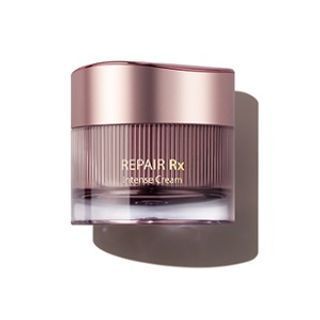
The Saem Repair Rx Intense Cream
Works for
2 of 2 advertised claims delivered
Anti-aging13 ingredients credited for this claimStrong evidence
“This brightening, anti-wrinkle cream provides deep moisture to skin with a mild formula which is suitable even for sensitive skin.”
This product can help reduce and prevent fine lines and wrinkles, improve skin elasticity and firmness because it contains adenosine, bakuchiol, niacinamide.
These ingredients in the product can also be helpful, even though there is less evidence for their effectiveness: acetyl hexapeptide-8, centella asiatica extract, copper tripeptide-1, palmitoyl pentapeptide-4, sh-decapeptide-7, sh-octapeptide-4, sh-oligopeptide-9, sh-pentapeptide-19.
Keep in mind that it typically takes at least 6 weeks to notice any results because the changes that are needed to improve fine lines and elasticity happen in the deeper layers of the skin. No topical anti-aging product can “erase” wrinkles or fully reverse signs of aging.
Moisturizing40 ingredients credited for this claimStrong evidence
“30% of Centella Asiatica Extract that helps the skin for better absorption of moisture and nutritents Bakuchiol helps strengthen skin energy and improves skin texture.”
This product can help improve hydration of the skin with the two types of ingredients.
The first type is called “humectants”:
these ingredients help attract water.
When humectants are on the surface of the skin, they “pull in” the moisture from the outside environment, or from
within deeper layers of the skin. The following ingredients in this product do the job:
diglycerin, fructooligosaccharides.
This product also contains ingredients called “occlusives”. They help reduce the speed with which our skin loses moisture to the outside environment. These ingredients also help soften the upper layer of the skin, so it feels less tight and nicer to the touch. The following ingredients in this product do the job: bis-diglyceryl polyacyladipate-2, butyrospermum parkii butter.
The following ingredients in this product are especially good for supporting the skin barrier and helping with the hydration level: acetyl hexapeptide-8, ceramide np, copper tripeptide-1, niacinamide, palmitoyl pentapeptide-4, sh-decapeptide-7, sh-octapeptide-4, sh-pentapeptide-19
Anti-oxidationNot advertised by the brand · 9 ingredients credited for this claimStrong evidence
This product contains antioxidants (bakuchiol) that can help neutralize free radicals in skin. By doing so, they can lessen the damage the skin gets from the UV light (sun).
The following ingredients - centella asiatica extract also can have an antioxidant effect, but there is less evidence to confirm their effectiveness in skin.
Evens skin toneNot advertised by the brand · 3 ingredients credited for this claimStrong evidence
This product can help reduce hypepigmentation and even out the skin tone because it contains the following effective ingredients: bakuchiol, niacinamide
Keep in mind that you would need to apply any topical skincare targetted at hypigmentation consistently for a couple of months to get a result. No topical skincare product can help get rid of hyperpigmentation (including post-acne marks and age spots) instantly.
Anti-blemishNot advertised by the brand · 5 ingredients credited for this claimStrong evidence
This product can help reduce breakouts and clogged pores because it contains the following ingredient: niacinamide. This ingredient is used for treating acne and can have a noticeable effect.
In addition, this product contains bakuchiol. It can help in reducing blemishes, even though it is less effective.
Can it cause trouble?
Irritancy2 strong irritants: Ocimum sanctum leaf extract, ParfumMedium risk
Comedogenic5 ingredients rated 2 or more on the 0–5 pore-clogging scale5 flagged

User reviews
Be the first — your take helps the next person decide.
Ingredients
Filter by role to see what each ingredient is doing.
Centella asiatica extract~22–33%
- Irritation risk
- Medium
A plant extract that has been shown to be able to reduce inflammation in skin, support restoration of skin barrier function, as well as support collagen production. Contains active compounds called centelloids: asiaticoside, madecasosside, asiatic acid and madecassic acid. Might be helpful in preventing stretch marks. It can be itself be irritating though.
More about Centella asiatica extractGlycerin~3.4–5.1%
- Irritation risk
- Low
One of the best moisturizing ingredients. Naturally present in skin. It attracts water to the upper layer of the skin working as a humectant
More about GlycerinCaprylyl methicone~4.4–6.7%
- Irritation risk
- Low
A type of silicone that helps to soften the upper layer of the skin and create a nice product finish on the skin
More about Caprylyl methiconeOctyldodecanol~3.6–5.4%
- Irritation risk
- Low
An emollient that helps to soften the skin and create a pleasant product texture and stabilize the formulation
More about OctyldodecanolOctyldodecyl myristate~2.8–4.2%
- Irritation risk
- Low
Helps soften the upper layer of the skin
More about Octyldodecyl myristateButyrospermum parkii butter~2.2–3.4%
- Irritation risk
- Low
- Comedogenicity
- 3/5
A great moisturising ingredient that softens the skin and reduces water loss from its upper layer. It also can be helpful in protecting skin from free radicals
More about Butyrospermum parkii butterBehenyl alcohol~1.8–2.6%
- Irritation risk
- Low
Non-drying alcohol that helps water and oil mix together. Also serves as an emollient
More about Behenyl alcoholDiglycerin~1.3–1.9%
- Irritation risk
- Low
Helps attract water to the upper layer of the skin
More about DiglycerinNiacinamide~1.1–1.6%
- Irritation risk
- Low
Is proven to be effective in reducing blemishes, evening out skin tone and helping to improve lines and wrinkles. It helps the skin to repair sun damage, calm down inflammation and keep maintain good levels of moisture. The concentration of about 2% is effective for supporting the skin barrier and evening out the skin tone. Concentration of 4-6% is better for helping with acne and balancing the sebum production
More about NiacinamidePentaerythrityl tetraethylhexanoate~0.95–1.45%
- Irritation risk
- Low
Used to create a nice product consistency while softening the upper layer of the skin
More about Pentaerythrityl tetraethylhexanoatePolyglyceryl-3 methylglucose distearate~0.55–1.3%
- Irritation risk
- Medium
Helps water and oil mix together
More about Polyglyceryl-3 methylglucose distearatePentylene glycol~0.55–1.25%
- Irritation risk
- Medium
Used to preserve products, dissolve other ingredients and create a nice product texture
More about Pentylene glycol1,2-hexanediol~0.4–0.95%
Macadamia integrifolia seed oil~0.45–1.05%
- Irritation risk
- Low
A plant oil that helps soften the upper layer of the skin
More about Macadamia integrifolia seed oilChlorella vulgaris extract~0.35–0.85%
- Irritation risk
- Medium
- Comedogenicity
- 3/5
A plant extract that can help to attract water to the upper layer of the skin and might have some anti-oxidant and anti-inflammatory properties
More about Chlorella vulgaris extractMelia azadirachta flower extract~0.35–0.85%
- Irritation risk
- Medium
A plant extract that might be helpful to neutralize free radicals in skin
More about Melia azadirachta flower extractMelia azadirachta leaf extract~0.35–0.8%
- Irritation risk
- High
A plant extract that has anti-bacterial properties. Can be used to preserve the product. Can be irritating
More about Melia azadirachta leaf extractTheobroma cacao seed extract~0.35–0.8%
- Irritation risk
- Low
- Comedogenicity
- 3/5
Curcuma longa root extract~0.2–0.75%
- Irritation risk
- High
A plant extract that can contain an active compound curcumin, that may have some anti-inflammatory properties when applied to the skin, but solid research is lacking and the typical concentration used in skincare products is too low. Can be an irritant
More about Curcuma longa root extractOcimum sanctum leaf extract~0.2–0.75%
- Irritation risk
- High
A plant extract that is rich in a fragrance compound eugenol that is a frequent allergen and can be irritating. It might also contain anti-oxidants to help neutralize free radicals
More about Ocimum sanctum leaf extractCorallina officinalis extract~0.2–0.75%
- Irritation risk
- Low
- Comedogenicity
- 3/5
Red algae extract that helps attract water to the upper layer of the skin and might contain antioxidants
More about Corallina officinalis extractBis-diglyceryl polyacyladipate-2~0.35–0.8%
- Irritation risk
- Low
Helps soften the upper layer of the skin and reduce water loss from its surface
More about Bis-diglyceryl polyacyladipate-2Water~0.15–0.7%
Polymethylsilsesquioxane~0.2–0.75%
- Irritation risk
- Low
A silicone that improves product texture and helps dissolve other ingredients. Can form a non-greasy film on the skin to prevent moisture loss
More about PolymethylsilsesquioxaneCetearyl olivate~0.2–0.7%
Sorbitan olivate~0.2–0.7%
Glyceryl stearate~0.3–0.75%
- Irritation risk
- Low
An emollient that softens the skin and forms a protective layer on its surface. Helps water and oil mix together
More about Glyceryl stearateAmmonium acryloyldimethyltaurate/vp copolymer~0.15–0.7%
- Irritation risk
- Low
Increases thickness of a product. Texture enhancer for oil-in-water emulsions
More about Ammonium acryloyldimethyltaurate/vp copolymerDiisostearyl malate~0.3–0.7%
- Irritation risk
- Medium
Helps to soften the upper layer of the skin
More about Diisostearyl malatePanthenol~0.15–0.65%
- Irritation risk
- Low
Helps attract water to the upper layer of the skin and can help improve skin barrier function
More about PanthenolGlucose~0.15–0.65%
- Irritation risk
- Low
Helps attract water to the upper layer of the skin. Could be helpful in restoring the skin barrier function
More about GlucoseHydroxyethyl acrylate/sodium acryloyldimethyl taurate copolymer~0.15–0.7%
- Irritation risk
- Medium
A gelling agent that thickens the product consistency and leaves the skin with a velvety finish
More about Hydroxyethyl acrylate/sodium acryloyldimethyl taurate copolymerButylene glycol~0.15–0.65%
- Irritation risk
- Low
Used to create a nice product texture and help delivery of other ingredients. Might be somewhat helpful in attracting water to the upper layer of the skin
More about Butylene glycolFructooligosaccharides~0.15–0.65%
- Irritation risk
- Low
Help attract water to the upper layer of the skin
More about FructooligosaccharidesFructose~0.15–0.65%
- Irritation risk
- Low
Helps attract water to the upper layer of the skin
More about FructoseCetearyl glucoside~0.2–0.7%
- Irritation risk
- Medium
Helps water and oil in the product mix well together and improves product texture
More about Cetearyl glucosideOctanediol~0.15–0.7%
- Irritation risk
- Low
Ethylhexylglycerin~0.15–0.7%
Allantoin~0.15–0.6%
- Irritation risk
- Low
Helps calm down inflammation in skin and can help reduce itching. Helps to repair the skin barrier and keep skin hydrated
More about AllantoinCaprylyl glycol~0.2–0.8%
- Irritation risk
- Medium
Helps preserve products and creates a nice product texture
More about Caprylyl glycolDipotassium glycyrrhizate~0.15–0.65%
- Irritation risk
- Low
A salt derived from licorice. Works as an emollient to soften the upper layer of the skin and can help calm down inflammation. Might be helpful for skin lightening
More about Dipotassium glycyrrhizateAdenosine~0.15–0.65%
- Irritation risk
- Low
Might help improve cell turnover and reduce inflammation in skin. One study shows that the ingredients might be able to help reduce dynamic wrinkles (for example, in the corners of the eyes or on the forehead)
More about AdenosineTrisodium ethylenediamine disuccinate~0.15–0.65%
- Irritation risk
- Medium
Used to improve stability of the formulation
More about Trisodium ethylenediamine disuccinateSorbitan isostearate~0.2–0.7%
- Irritation risk
- Low
Helps oil and water mix together
More about Sorbitan isostearateDipropylene glycol~0.15–0.65%
- Irritation risk
- Low
Helps to dissolve other ingredients in a formulation. Slows down the rate of product drying
More about Dipropylene glycolEctoin~0.15–0.65%
- Irritation risk
- Low
Softens the upper layer of the skin and can support skin barrier function
More about EctoinSaccharide isomerate~0.15–0.65%
- Irritation risk
- Low
Helps attract water to the upper layer of the skin
More about Saccharide isomerateDextrin~0.2–0.7%
- Irritation risk
- Low
A sugar that is used to stabilize the product formulation. Can help attract water to the upper layer of the skin
More about DextrinTocopherol~0.15–0.7%
- Irritation risk
- Low
Pure form of vitamin E. Can help moisturise and protect the skin from free radicals. Often used to help stabilise other ingredients or the formula itself
More about TocopherolBakuchiol~0.3–0.7%
- Irritation risk
- Medium
A plant extract that is, though different in chemical structure, acts similar to retinoids. First studies show that it can help reduce fine lines and wrinkles, improve skin tone, reduce clogged pores and blemishes, and reduce inflammation. There is no conclusive evidence that bakuchiol is as effective as retinol however. The study that directly compared retinol with bakuchiol used bakuchiol applied twice daily compared to once per day for the retinol. According to this study, bakuchiol is less irritating than retinol. Bakuchiol is extracted from seeds of Babchi plant. Other parts of the plant contain coumarins that could cause allergic and irritant reactions. These compounds should be removed in the extraction process when bakuchiol is produced, but it is a good idea to be cautious and stay away from products that include the Babchi plant extracts other than purified bakuchiol to avoid irritation
More about BakuchiolCaprylyl/capryl glucoside~0.35–0.75%
- Irritation risk
- Medium
Helps oil and water mix together. Can be used as a cleansing agent
More about Caprylyl/capryl glucosideCitric acid~0.15–0.65%
- Irritation risk
- Medium
Can work as an exfoliant but is typically used to adjust the product pH
More about Citric acidSodium citrate~0.15–0.65%
- Irritation risk
- Medium
Helps to control the skin's pH level. Maintains the skin's natural film of amino-lactic acids and oils. Helps to preserve products
More about Sodium citrateHydrogenated lecithin~0.15–0.7%
- Irritation risk
- Low
Helps to retain moisture by creating a protective barrier on the skin. Rich in fatty acids. Improves product texture and helps with the penetration of other ingredients.
More about Hydrogenated lecithinCeramide np~0.2–0.8%
- Irritation risk
- Low
A type of lipid similar to ceramides naturally present in skin. Helps to soften the upper layer of the skin and supports the skin barrier function to keep it hydrated. Can help to prevent inflammation in skin
More about Ceramide npPalmitoyl pentapeptide-4~0.15–0.65%
- Irritation risk
- Low
A type of peptide. Peptides are excellent moisturizers and might be able support collagen production reducing fine lines and wrinkles
More about Palmitoyl pentapeptide-4Sh-decapeptide-7~0.15–0.65%
- Irritation risk
- Low
A type of peptide. Peptides are excellent moisturizers and might be able support collagen production reducing fine lines and wrinkles
More about Sh-decapeptide-7Sh-octapeptide-4~0.15–0.65%
- Irritation risk
- Low
A type of peptide. Peptides are excellent moisturizers and might be able support collagen production reducing fine lines and wrinkles
More about Sh-octapeptide-4Sh-oligopeptide-9~0.15–0.6%
- Irritation risk
- Low
A type of peptide. Peptides are excellent moisturizers and might be able support collagen production reducing fine lines and wrinkles
More about Sh-oligopeptide-9Sh-pentapeptide-19~0.15–0.55%
Copper tripeptide-1~0.15–0.5%
- Irritation risk
- Low
A naturally occurring peptide. One of the most studied peptides in dermatology. It is sometimes abbreviated GHK-Cu. Belongs to the class of carrier peptides. It stimulates both synthesis and breakdown of collagen in skin. It is released in skin wounds and inflammation to support healing. It accelerates wound-healing of the skin and can stimulate hair growth. There are preliminary studies that confirm that copper tripeptide can help support collagen production reducing fine lines and wrinkles and decrease inflammation in skin.
More about Copper tripeptide-1Acetyl hexapeptide-8~0.15–0.5%
- Irritation risk
- Low
A type of peptide. Peptides are excellent moisturizers and might be able support collagen production reducing fine lines and wrinkles
More about Acetyl hexapeptide-8Cetearyl alcohol~0.2–0.75%
- Irritation risk
- Low
- Comedogenicity
- 2/5
A non-drying alcohol. Works as an emollient. Helps water and oil mix together and creates a nice product texture
More about Cetearyl alcoholXanthan gum~0.1–0.4%
- Irritation risk
- Low
Used to create a thicker product consistency
More about Xanthan gumParfum~0.1–0.35%
- Irritation risk
- High
An aromatic blend of unspecified and possibly irritating ingredients
More about ParfumIngredient list view
Centella asiatica extract, Glycerin, Caprylyl methicone, Octyldodecanol, Octyldodecyl myristate, Butyrospermum parkii butter, Behenyl alcohol, Diglycerin, Niacinamide, Pentaerythrityl tetraethylhexanoate, Polyglyceryl-3 methylglucose distearate, Pentylene glycol, 1,2-hexanediol, Macadamia integrifolia seed oil, Chlorella vulgaris extract, Melia azadirachta flower extract, Melia azadirachta leaf extract, Theobroma cacao seed extract, Curcuma longa root extract, Ocimum sanctum leaf extract, Corallina officinalis extract, Bis-diglyceryl polyacyladipate-2, Water, Polymethylsilsesquioxane, Cetearyl olivate, Sorbitan olivate, Glyceryl stearate, Ammonium acryloyldimethyltaurate/vp copolymer, Diisostearyl malate, Panthenol, Glucose, Hydroxyethyl acrylate/sodium acryloyldimethyl taurate copolymer, Butylene glycol, Fructooligosaccharides, Fructose, Cetearyl glucoside, Octanediol, Ethylhexylglycerin, Allantoin, Caprylyl glycol, Dipotassium glycyrrhizate, Adenosine, Trisodium ethylenediamine disuccinate, Sorbitan isostearate, Dipropylene glycol, Ectoin, Saccharide isomerate, Dextrin, Tocopherol, Bakuchiol, Caprylyl/capryl glucoside, Citric acid, Sodium citrate, Hydrogenated lecithin, Ceramide np, Palmitoyl pentapeptide-4, Sh-decapeptide-7, Sh-octapeptide-4, Sh-oligopeptide-9, Sh-pentapeptide-19, Copper tripeptide-1, Acetyl hexapeptide-8, Cetearyl alcohol, Xanthan gum, Parfum
Compare prices
Retailers ranked by price — lowest first.

Affiliate links · prices updated regularly
Worth comparing, line by line.
Match % combines shared ingredients, the first five ingredients, shared actives and hero ingredients, irritancy (lower counts in the alternative's favour), texture and body area. Only products in the same routine step are compared.
| The SaemRepair Rx Intense CreamYOUR PRODUCT | Some By MiRetinol Bakuchiol Dual Cream 50ml | 23 years oldBakuchiol A Cream | Key SoulcareSKIN TRANSFORMATION CREAM FRAGRANCE FREE | |
|---|---|---|---|---|
| Match | — | 70% | 68% | 67% |
| Price | $36.50 | $25.47−$11.03 | $18.00−$18.50 | $34.00−$2.50 |
| Shared key ingredients | — | 8 of 26 | 8 of 26 | 6 of 26 |
| Key difference | — | Palmitoyl Hexapeptide-12 | Cyclopentasiloxane | Phytosphingosine |
| Irritancy | Medium | Medium | Medium | Low |
| Drying alcohol | — | — | — | — |
| View product | Shop | Shop | Shop |


Product summary
"The Saem - Repair Rx Intense Cream" has a good moisturizing formula. As we expect from a proper moisturizer, the formula includes a combo of effective humectants and emollients. These are the two different types of ingredients that are essential for improving the skin hydration and supporting a healthy skin barrier. Acetyl hexapeptide-8, diglycerin, fructooligosaccharides, fructose and glycerin in this product (humectants) attract water molecules to the upper layer of the skin (the water comes from the outside air or from the deeper layers of the skin if the air is dry). Ceramide np, bis-diglyceryl polyacyladipate-2, butyrospermum parkii butter, cetearyl alcohol and diisostearyl malate in this product help decrease the water evoporation from the skin, so that it stays hydrated for longer. These ingredients also soften the skin and take away the feeling of tightness and dryness.
Ingredient callouts
- this moisturizer contains Bakuchiol (0.30% - 0.70%). It is a plant extract that is has a similar effect to that of Retinoids but with less irritation. Bakuchiol can help reduce fine lines and wrinkles, improve skin tone, reduce clogged pores and blemishes, and reduce inflammation.
- Another benefit is that this moisturizer contain ceramides (ceramide np 0.20% - 0.80%). Ceramides are an important part of our natural skin barrier. The Ceramides used in skincare are synthetic or come from plants. They help soften the skin and can help "fill the gaps" in the skin barrier, keeping the skin hydrated and resilient for longer.
- We like that this moisturizer contains peptides (acetyl hexapeptide-8 0.15% - 0.50%, copper tripeptide-1 0.15% - 0.50%, sh-pentapeptide-19 0.15% - 0.55%, sh-octapeptide-4 0.15% - 0.65%, sh-decapeptide-7 0.15% - 0.65% and palmitoyl pentapeptide-4 0.15% - 0.65%). There are many different kind of Peptides and they are naturally present in our skin. They all are a combination of aminoacids. Some of them work as natural antibiotics, promote wound-healing and production of collagen. The science is still not settled on how effective Peptides are in skincare, but it is very likely that they have a benefit. Peptides might help restore the skin barrier and fight the signs of aging. At the very least, Peptides work as humectants: they attract water to the upper layer of the skin and improve its hydration.
- Adenosine 0.15% - 0.65%. It is a compound that in involved in many biological processes inside the skin cells. According one high-quality clinical trial, topical Adenosine in low concentrations can somewhat help improve "deep wrinkles" - the wrinkles that appear with age in places where our faces are most dynamic (for example, on the forehead or in the corners of the eyes).
Irritation risk
This formulation includes some common irritants, including ingredients that do not provide a benefit for the skin. We assess the overall irritancy of this moisturizer to be medium. For a detailed overview of all potential irritants: click here
You can see the detailed formula review with the breakdown of all actives in the product and the full ingredient list with estimated concentrations in the tables below.
Price
The product retails for 36.50$ in the United States.
For a detailed price comparison: click here.
Sources cited in this review
Every concentration estimate and effectiveness label is anchored to one of these 35 studies and safety reviews.
- 1
- 2Centella asiatica in cosmetologyncbi.nlm.nih.gov
- 3
- 4
- 5
- 6Contact dermatitis due to Madecassolonlinelibrary.wiley.com

Affiliate links · As an Amazon Associate, WIMJ earns from qualifying purchases.