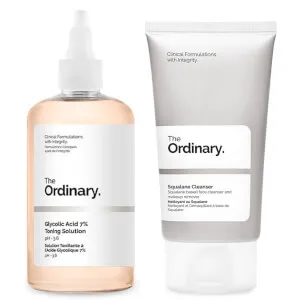
The Ordinary Glycolic Acid and Squalane Cleanser
Works for
ExfoliationGlycolic acid, UreaWorks well
“A concentrated formula that boasts a 7% solution of Glycolic Acid, an alpha hydroxyl acid that gently exfoliates the surface layer to restore clarity and visibly improve uneven textures with a balanced pH for maximum efficacy.”
This product can help exfoliate the skin. In other words, it helps break down the bonds between dead cells on the surface of the skin and speed up the skin turnover. Skin often appears softer and brighter after exfoliation, but overdoing it can result in disrupted skin barrier. The following ingredient is doing the exfoliating job in this product: glycolic acid.
CleansingTriethanolamine, Sucrose stearate + 6 moreCleanses gently
“Glycolic Acid and Squalane Cleanser”
This product works by removing dirt and oil from the surface of the skin. It uses a combination of mild cleansing agents (hexylene glycol, isoceteth-20, polysorbate 20, sucrose dilaurate, sucrose laurate, sucrose stearate, sucrose trilaurate, triethanolamine) and should be able to cleanse the skin gently. Still keep in mind that any cleansing can disrupt the skin barrier, and most people do not need to cleanse their skin more than once per day.
Can it cause trouble?
Irritancy2 strong irritants: Rosa damascena flower water, Hexyl nicotinateMedium risk
ComedogenicClean of flagged comedogenic ingredientsNone flagged

User reviews
Be the first — your take helps the next person decide.
Ingredients
Filter by role to see what each ingredient is doing.
Water~45–55%
Glycolic acid~4.2–5.1%
- Irritation risk
- High
An alpha-hydroxy acid (AHA) that helps to remove the dead skin cells on the surface of the skin reveling a more even, smoother complexation. It is also able to stimulate collagen production with long-term use. Could help to reduce pore congestion. It can be irritating to the skin. Apply sunscreen daily if using products with glycolic acid
More about Glycolic acidRosa damascena flower water~3.6–4.4%
- Irritation risk
- High
Used to add a nice rose smell to the product. Might help attract water to the upper layer of the skin and have some anti-oxidant effect. Can be irritating
More about Rosa damascena flower waterCentaurea cyanus flower water~2.9–3.5%
- Irritation risk
- High
Cornflower water. Might have an anti-oxidant effect and can help reduce inflammation in skin. However, it can be irritating on its own
More about Centaurea cyanus flower waterAloe barbadensis leaf water~2.2–2.7%
- Irritation risk
- Medium
Traditionally used to treat sunburns, dermatitis and inflammation, but data on its effectiveness is lacking. While the majority of the content is plain water, it can contain some goodies like vitamins, enzymes, minerals, and humectants that help attract water into the skin
More about Aloe barbadensis leaf waterPropanediol~1.8–2.2%
- Irritation risk
- Low
Acts as a solvent for other ingredients. Speeds up the absorption of other ingredients into the skin
More about PropanediolGlycerin~1.6–1.9%
- Irritation risk
- Low
One of the best moisturizing ingredients. Naturally present in skin. It attracts water to the upper layer of the skin working as a humectant
More about GlycerinTriethanolamine~1.3–1.6%
- Irritation risk
- Medium
Used to adjust pH of the product and can help improve the product's smell
More about TriethanolamineAminomethyl propanol~1.1–1.3%
Panax ginseng root extract~0.75–1.1%
- Irritation risk
- High
A plant extract that might have some anti-inflammatory properties, but solid evidence is lacking. It can be irritating
More about Panax ginseng root extractTasmannia lanceolata fruit/leaf extract~0.55–0.8%
- Irritation risk
- High
Aspartic acid~0.4–0.65%
- Irritation risk
- Low
An amino-acid that helps increase skin hydration and might help to slightly improve skin firmness, potentially reducing lines and wrinkles
More about Aspartic acidAlanine~0.25–0.5%
- Irritation risk
- Low
An amino-acid that helps to attract water to the upper layer of the skin and might help to lighten the skin, but solid evidence is lacking
More about AlanineGlycine~0.2–0.4%
- Irritation risk
- Low
Helps to attract water to the upper layer of the skin and can help restore the skin barrier function
More about GlycineSerine~0.2–0.35%
- Irritation risk
- Low
An amino-acid that helps to attract water to the upper layer of the skin. In combination with other amino-acids, might help to reduce fine lines and wrinkles
More about SerineValine~0.2–0.35%
- Irritation risk
- Low
Isoleucine~0.2–0.35%
- Irritation risk
- Low
An amino acid that can help attract water to the upper layer of the skin and support skin's barrier function
More about IsoleucineProline~0.2–0.4%
Threonine~0.2–0.4%
- Irritation risk
- Low
An amino-acid that helps to attract water to the upper layer of the skin. In combination with other amino-acids, might help to reduce fine lines and wrinkles
More about ThreonineHistidine~0.15–0.3%
Phenylalanine~0.15–0.3%
- Irritation risk
- Low
Glutamic acid~0.15–0.3%
- Irritation risk
- Low
An amino-acid that helps attract water to the upper layer of the skin
More about Glutamic acidArginine~0.1–0.2%
- Irritation risk
- Low
An amino acid that is naturally present in skin and helps keep it hydrated. When used together with AHAs, it can reduce their irritating effect on the skin
More about ArgininePca~0.1–0.25%
- Irritation risk
- Low
Naturally present in skin and helps to attract water to its upper layer
More about PcaSodium pca~0.1–0.2%
- Irritation risk
- Low
Naturally present in skin and helps to attract water to its upper layer
More about Sodium pcaSodium lactate~0.1–0.2%
- Irritation risk
- Medium
Helps attract water to the upper layer of the skin. Is often used to adjust the pH level of the product
More about Sodium lactateFructose~0.1–0.2%
- Irritation risk
- Low
Helps attract water to the upper layer of the skin
More about FructoseGlucose~0.1–0.2%
- Irritation risk
- Low
Helps attract water to the upper layer of the skin. Could be helpful in restoring the skin barrier function
More about GlucoseSucrose~0.1–0.2%
- Irritation risk
- Low
Can help attract water to the upper layer of the skin. In crystal form, it can work as a gentle exfoliant, gentler than the salt scrub. Helps stabilize the emulsion
More about SucroseUrea~0.15–0.25%
- Irritation risk
- Low
Naturally present in skin (urea makes up about 7% of natural moisturizing factors in skin). Attracts water to the upper layer of the skin. Also has a positive effect on the skin barrier beyond the humectant action. Can enhance penetration of other ingredients. Is an exfoliating ingredient when used in high concentrations
More about UreaHexyl nicotinate~0.2–0.35%
- Irritation risk
- High
Might be able to enhance blood flow in the skin. Can be irritating and result in skin redness
More about Hexyl nicotinateDextrin~0.15–0.3%
- Irritation risk
- Low
A sugar that is used to stabilize the product formulation. Can help attract water to the upper layer of the skin
More about DextrinCitric acid~0.15–0.25%
- Irritation risk
- Medium
Can work as an exfoliant but is typically used to adjust the product pH
More about Citric acidPolysorbate 20~0.15–0.3%
Gellan gum~0.15–0.3%
Trisodium ethylenediamine disuccinate~0.15–0.25%
- Irritation risk
- Medium
Used to improve stability of the formulation
More about Trisodium ethylenediamine disuccinateSodium chloride~0.15–0.3%
- Irritation risk
- Low
Used to stabilize mixtures of oil and water, and create thicker, gel-like product textures
More about Sodium chlorideHexylene glycol~0.15–0.25%
- Irritation risk
- Medium
Helps create a more spreadable product texture
More about Hexylene glycolPotassium sorbate~0.15–0.3%
Sodium benzoate~0.15–0.25%
1,2-hexanediol~0.15–0.25%
Caprylyl glycol~0.15–0.3%
- Irritation risk
- Medium
Helps preserve products and creates a nice product texture
More about Caprylyl glycolSqualane~0.2–0.35%
- Irritation risk
- Low
An oil naturally present in skin. Works as an emollient to soften the skin and form a protective layer on its surface without a greasy feeling.
More about SqualaneWater~0.15–0.25%
Coco-caprylate/caprate~0.15–0.3%
- Irritation risk
- Low
Helps to soften the upper layer of the skin without creating a greasy texture
More about Coco-caprylate/caprateGlycerin~0.15–0.3%
- Irritation risk
- Low
One of the best moisturizing ingredients. Naturally present in skin. It attracts water to the upper layer of the skin working as a humectant
More about GlycerinSucrose stearate~0.2–0.35%
Ethyl macadamiate~0.15–0.3%
Malic acid~0.15–0.25%
Tocopherol~0.15–0.25%
- Irritation risk
- Low
Pure form of vitamin E. Can help moisturise and protect the skin from free radicals. Often used to help stabilise other ingredients or the formula itself
More about TocopherolHydroxymethoxyphenyl decanone~0.1–0.25%
- Irritation risk
- Low
An anti-oxidant. Is also called 6-paradol. It might be able to neutralize free radicals in skin. The manufacturer claims that it is able to stimulate synthesis of hyaluronic acid in skin, but there is no evidence of effectiveness of this ingredient so far. The only evidence of efficacy for this ingredient so far come from small lab tests. This ingredient comes together with Caprylic/Capric Triglyceride as part of the complex called SymDecanox HA produced by a cosmetic ingredient supplier Symrise.
More about Hydroxymethoxyphenyl decanoneSucrose laurate~0.2–0.35%
- Irritation risk
- Low
Helps oil and water mix together. Can be used as a cleansing agent
More about Sucrose laurateSucrose dilaurate~0.2–0.35%
- Irritation risk
- Medium
Helps oil and water mix together. Can be used as a cleansing agent
More about Sucrose dilaurateSucrose trilaurate~0.15–0.3%
- Irritation risk
- Medium
Helps oil and water mix together. Can be used as a cleansing agent
More about Sucrose trilaurateHydrogenated starch hydrolysate~0.15–0.3%
- Irritation risk
- Low
Helps to attract water to the upper layer of the skin. Can add sweet taste to lip products
More about Hydrogenated starch hydrolysatePolyacrylate crosspolymer-6~0.15–0.3%
- Irritation risk
- Low
Isoceteth-20~0.15–0.25%
Sodium polyacrylate~0.2–0.35%
- Irritation risk
- Low
Used to create a gel-like product texture, as well as to stabilize emulsions
More about Sodium polyacrylateTrisodium ethylenediamine disuccinate~0.1–0.25%
- Irritation risk
- Medium
Used to improve stability of the formulation
More about Trisodium ethylenediamine disuccinateEthylhexylglycerin~0.05–0.15%
Chlorphenesin~0.1–0.2%
Ingredient list view
Water, Glycolic acid, Rosa damascena flower water, Centaurea cyanus flower water, Aloe barbadensis leaf water, Propanediol, Glycerin, Triethanolamine, Aminomethyl propanol, Panax ginseng root extract, Tasmannia lanceolata fruit/leaf extract, Aspartic acid, Alanine, Glycine, Serine, Valine, Isoleucine, Proline, Threonine, Histidine, Phenylalanine, Glutamic acid, Arginine, Pca, Sodium pca, Sodium lactate, Fructose, Glucose, Sucrose, Urea, Hexyl nicotinate, Dextrin, Citric acid, Polysorbate 20, Gellan gum, Trisodium ethylenediamine disuccinate, Sodium chloride, Hexylene glycol, Potassium sorbate, Sodium benzoate, 1,2-hexanediol, Caprylyl glycol, Squalane, Water, Coco-caprylate/caprate, Glycerin, Sucrose stearate, Ethyl macadamiate, Malic acid, Tocopherol, Hydroxymethoxyphenyl decanone, Sucrose laurate, Sucrose dilaurate, Sucrose trilaurate, Hydrogenated starch hydrolysate, Polyacrylate crosspolymer-6, Isoceteth-20, Sodium polyacrylate, Trisodium ethylenediamine disuccinate, Ethylhexylglycerin, Chlorphenesin
Compare prices
Retailers ranked by price — lowest first.
Affiliate links · As an Amazon Associate, WIMJ earns from qualifying purchases.
Worth comparing, line by line.
Match % combines shared ingredients, the first five ingredients, shared actives and hero ingredients, irritancy (lower counts in the alternative's favour), texture and body area. Only products in the same routine step are compared.
| The OrdinaryGlycolic Acid and Squalane CleanserYOUR PRODUCT | Synergy Therm CosmeticsAHA/PHA Exfoliating Toner | FacetheoryGlycolacsal Solution T4 with Glycolic Acid, Salicylic Acid and Lactic Acid | Derma EDeluxe Mini Vitamin C Micellar Cleansing Water | |
|---|---|---|---|---|
| Match | — | 53% | 52% | 51% |
| Price | $23.80 | — | — | $5.00−$18.80 |
| Shared key ingredients | — | 4 of 28 | 2 of 28 | 2 of 28 |
| Key difference | — | Gluconolactone | Salicylic Acid | Panthenol |
| Irritancy | Medium | Low | Low | Low |
| Drying alcohol | — | — | — | — |
| View product | Shop | Shop | Shop |


More alternatives: endota spa Glycolic Exfoliating CleanserSkinfix Acne+ 2% BHA Cleanser
Sources cited in this review
Every concentration estimate and effectiveness label is anchored to one of these 30 studies and safety reviews.
- 1
- 2Glycolic acid peel therapy – a current reviewncbi.nlm.nih.gov
- 3
- 4
- 5
- 6

Affiliate links · As an Amazon Associate, WIMJ earns from qualifying purchases.