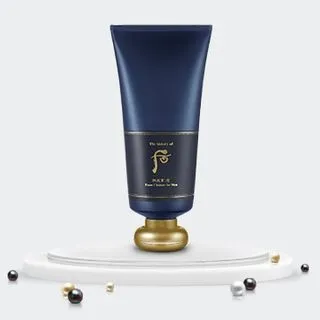
The History of Whoo Gongjinhyang Gun Ja Yang Foam Cleanser
Works for
CleansingMyristic acid, Stearic acid + 12 moreCan be harsh
“Gongjinhyang Gun Ja Yang Foam Cleanser”
This product works by removing dirt and oil from the surface of the skin.
The following cleansing agents are typically mild, but still can cause an irritation or allergy for some people cocamidopropyl betaine, sodium methyl cocoyl taurate.
Keep in mind that cleansing can disrupt the skin barrier, and most people do not need to cleanse their skin more than once per day.
Can it cause trouble?
Irritancy8 strong irritants: Zingiber officinale root extract, Eugenia caryophyllus flower extract + 6 more — patch-test recommendedHigh risk
Comedogenic4 ingredients rated 2 or more on the 0–5 pore-clogging scale4 flagged
User reviews
Be the first — your take helps the next person decide.
Ingredients
Filter by role to see what each ingredient is doing.
Water~45–55%
Glycerin~5–6.1%
- Irritation risk
- Low
One of the best moisturizing ingredients. Naturally present in skin. It attracts water to the upper layer of the skin working as a humectant
More about GlycerinMyristic acid~4.1–5%
- Irritation risk
- Medium
- Comedogenicity
- 3/5
Helps oil and water mix together. Could be comedogenic
More about Myristic acidButylene glycol~3–3.6%
- Irritation risk
- Low
Used to create a nice product texture and help delivery of other ingredients. Might be somewhat helpful in attracting water to the upper layer of the skin
More about Butylene glycolPotassium hydroxide~2.3–2.8%
Stearic acid~2–2.4%
- Irritation risk
- Low
Helps oil and water mix together and works as an emollient
More about Stearic acidLauric acid~1.6–2%
- Irritation risk
- Medium
- Comedogenicity
- 3/5
Helps water and oil mix together. Has anti-bacterial properties that might be helpful in preventing blemishes
More about Lauric acidPotassium cocoyl glycinate~1.4–1.7%
Glycol stearate~1.2–1.5%
Cocamidopropyl betaine~1.5–1.8%
- Irritation risk
- High
Helps water and oil mix together. Used as a cleansing ingredient. Could be an allergen
More about Cocamidopropyl betaineGlyceryl stearate~0.7–1.05%
- Irritation risk
- Low
An emollient that softens the skin and forms a protective layer on its surface. Helps water and oil mix together
More about Glyceryl stearatePeg-100 stearate~0.6–0.9%
- Irritation risk
- Low
Helps oil and water mix togehter and creates a nice product texture
More about Peg-100 stearateSodium methyl cocoyl taurate~0.75–1.1%
- Irritation risk
- High
Helps oil and water mix together. Can be used as cleansing agent
More about Sodium methyl cocoyl tauratePanthenol~0.4–0.65%
- Irritation risk
- Low
Helps attract water to the upper layer of the skin and can help improve skin barrier function
More about PanthenolSasa quelpaertensis extract~0.35–0.6%
- Irritation risk
- Low
Zingiber officinale root extract~0.3–0.6%
- Irritation risk
- High
A plant extract that can contain an irritating essential oil. Might have some anti-oxidant effect, but evidence is lacking
More about Zingiber officinale root extractZiziphus jujuba fruit extract~0.4–0.6%
- Irritation risk
- Low
Glycyrrhiza glabra root extract~0.25–0.5%
- Irritation risk
- Medium
A plant extract that can help lighten the skin and calm down inflammation. Might be helpful in neutralizing free radicals
More about Glycyrrhiza glabra root extractEugenia caryophyllus flower extract~0.3–0.55%
- Irritation risk
- High
A plant extract that is used as a fragrance. Can be irritating
More about Eugenia caryophyllus flower extractCnidium officinale rhizome extract~0.25–0.45%
- Irritation risk
- Low
Cnidium officinale rhizome extract~0.2–0.4%
- Irritation risk
- Low
Eugenia caryophyllus bud extract~0.2–0.35%
- Irritation risk
- Low
Santalum album extract~0.25–0.4%
Nardostachys chinensis root extract~0.25–0.45%
- Irritation risk
- Low
Citrus reticulata peel extract~0.25–0.45%
- Irritation risk
- High
A likely irritant. Might have some anti-oxidant activity, but is mostly used as a fragrance in cosmetic products
More about Citrus reticulata peel extractFoeniculum vulgare fruit extract~0.25–0.45%
- Irritation risk
- Low
Agastache rugosa extract~0.25–0.45%
- Irritation risk
- Low
Poria cocos extract~0.25–0.45%
- Irritation risk
- Low
Morus alba bark extract~0.25–0.45%
- Irritation risk
- High
A plant extract that might have anti-oxidant properties and help even out skin tone, but solid evidence is lacking
More about Morus alba bark extractPaeonia lactiflora extract~0.25–0.45%
- Irritation risk
- Low
Ginkgo biloba nut extract~0.25–0.45%
- Irritation risk
- Low
Atractylodes macrocephala root extract~0.25–0.45%
- Irritation risk
- Low
Tribulus terrestris fruit extract~0.25–0.4%
- Irritation risk
- Low
Ampelopsis japonica root extract~0.25–0.45%
- Irritation risk
- Low
Cordyceps sinensis extract~0.25–0.45%
- Irritation risk
- Low
Panax ginseng root extract~0.25–0.5%
- Irritation risk
- High
A plant extract that might have some anti-inflammatory properties, but solid evidence is lacking. It can be irritating
More about Panax ginseng root extractAngelica acutiloba root extract~0.25–0.45%
- Irritation risk
- Low
Cornus officinalis fruit extract~0.25–0.45%
- Irritation risk
- High
A plant extract that contains anti-oxidants. It might help to neutralize free radicals in skin. Can be used to help preserve the product formulation
More about Cornus officinalis fruit extractVelvet extract~0.2–0.4%
- Irritation risk
- Low
Thymus vulgaris extract~0.2–0.4%
- Irritation risk
- High
Gold~0.25–0.45%
Pearl powder~0.25–0.45%
- Irritation risk
- Low
Consists of 95% calcium carbonate that does not have any effect on the skin. The remaining 5% can include compounds that can help neutralize free radicals and support skin barrier function
More about Pearl powderCucurbita pepo powder~0.25–0.45%
- Irritation risk
- Low
Tuber melanosporum extract~0.2–0.4%
- Irritation risk
- Low
Camellia sinensis leaf extract~0.25–0.45%
- Irritation risk
- Low
Can contain potent anti-oxidant compounds (abbreviated ECG, GCG, EGC, and EGCG) that might help protect the skin from free radicals. Can help calm down inflammation and has some anti-bacterial properties. Unfortunately, these antioxidants are unstable and lose their effectiveness very quickly in products. The concentration of the antioxidant compounds in the extract also tends to be low to be effective in topical formulation
More about Camellia sinensis leaf extractC14-22 alcohols~0.25–0.45%
- Irritation risk
- Low
A non-drying alcohol that helps stabilize product formulations
More about C14-22 alcoholsSqualane~0.3–0.55%
- Irritation risk
- Low
An oil naturally present in skin. Works as an emollient to soften the skin and form a protective layer on its surface without a greasy feeling.
More about SqualaneMacadamia ternifolia seed oil~0.25–0.5%
- Irritation risk
- Medium
Plant oil from nuts that helps soften the upper layer of the skin. Contains a high concentration of oleic acid that can weaken skin's barrier function and increase water-loss while enhancing penetration of other ingredients
More about Macadamia ternifolia seed oilTriethylhexanoin~0.2–0.4%
- Irritation risk
- Medium
Helps soften the upper layer of the skin
More about TriethylhexanoinArachidyl glucoside~0.25–0.45%
Butyrospermum parkii butter~0.3–0.5%
- Irritation risk
- Low
- Comedogenicity
- 3/5
A great moisturising ingredient that softens the skin and reduces water loss from its upper layer. It also can be helpful in protecting skin from free radicals
More about Butyrospermum parkii butterCeramide np~0.25–0.5%
- Irritation risk
- Low
A type of lipid similar to ceramides naturally present in skin. Helps to soften the upper layer of the skin and supports the skin barrier function to keep it hydrated. Can help to prevent inflammation in skin
More about Ceramide npCholesterol~0.3–0.55%
- Irritation risk
- Low
An emollient that is naturally found in skin
More about CholesterolDimethicone~0.3–0.55%
- Irritation risk
- Low
A silicone that helps to reduce water loss from the surface of the skin. Can temporarily "fill in" lines and wrinkles, absorb oil, and create a nice product finish
More about DimethiconeCarbomer~0.25–0.45%
- Irritation risk
- Low
Helps create a thicker or gel-like product texture. It is not a surfactant but can be used in gentle cleansing formulations
More about CarbomerSorbitan olivate~0.25–0.45%
Zea mays starch~0.25–0.45%
- Irritation risk
- Medium
- Comedogenicity
- 3/5
Used to thicken the product's consistency
More about Zea mays starchMannitol~0.25–0.4%
- Irritation risk
- Low
Helps to attract water to the upper layer of the skin
More about MannitolMicrocrystalline cellulose~0.25–0.5%
Hydroxypropyl starch phosphate~0.25–0.5%
- Irritation risk
- Medium
Helps oil and water mix together and used to stabilize product formulations
More about Hydroxypropyl starch phosphateCi 77492~0.25–0.45%
Titanium dioxide~0.3–0.55%
- Irritation risk
- Low
Works as a UV filter when used in high concentrations. It is photostable and is effective mostly against the UVB light, with some protection in the UVA range. In small concentrations, used for its ability to improve the color of cosmetic products. Is usually well tolerated by the skin
More about Titanium dioxideTocopheryl acetate~0.25–0.45%
- Irritation risk
- Medium
A more stable but less bio-available form of vitamin E compared to Tocopherol. Might help moisturize and protect the skin from free radicals, but mostly used in low concentrations to stabilize other ingredients.
More about Tocopheryl acetate1,2-hexanediol~0.2–0.4%
Sucrose~0.2–0.35%
- Irritation risk
- Low
Can help attract water to the upper layer of the skin. In crystal form, it can work as a gentle exfoliant, gentler than the salt scrub. Helps stabilize the emulsion
More about SucroseHydrogenated lecithin~0.2–0.4%
- Irritation risk
- Low
Helps to retain moisture by creating a protective barrier on the skin. Rich in fatty acids. Improves product texture and helps with the penetration of other ingredients.
More about Hydrogenated lecithinShellac~0.25–0.45%
- Irritation risk
- Low
Silica~0.3–0.55%
Mica~0.2–0.35%
- Irritation risk
- Low
Creates an illusion of smoother and more radiant skin tone. Adds shimmer to the skin by reflecting light
More about MicaTromethamine~0.15–0.25%
Trisodium edta~0.15–0.25%
Parfum~0.1–0.2%
- Irritation risk
- High
An aromatic blend of unspecified and possibly irritating ingredients
More about ParfumLimonene~0.05–0.15%
- Irritation risk
- High
A common frangrance that can easily irritate skin, especially if exposed to air, light or heat
More about LimoneneLinalool~0.05–0.1%
Ingredient list view
Water, Glycerin, Myristic acid, Butylene glycol, Potassium hydroxide, Stearic acid, Lauric acid, Potassium cocoyl glycinate, Glycol stearate, Cocamidopropyl betaine, Glyceryl stearate, Peg-100 stearate, Sodium methyl cocoyl taurate, Panthenol, Sasa quelpaertensis extract, Zingiber officinale root extract, Ziziphus jujuba fruit extract, Glycyrrhiza glabra root extract, Eugenia caryophyllus flower extract, Cnidium officinale rhizome extract, Cnidium officinale rhizome extract, Eugenia caryophyllus bud extract, Santalum album extract, Nardostachys chinensis root extract, Citrus reticulata peel extract, Foeniculum vulgare fruit extract, Agastache rugosa extract, Poria cocos extract, Morus alba bark extract, Paeonia lactiflora extract, Ginkgo biloba nut extract, Atractylodes macrocephala root extract, Tribulus terrestris fruit extract, Ampelopsis japonica root extract, Cordyceps sinensis extract, Panax ginseng root extract, Angelica acutiloba root extract, Cornus officinalis fruit extract, Velvet extract, Thymus vulgaris extract, Gold, Pearl powder, Cucurbita pepo powder, Tuber melanosporum extract, Camellia sinensis leaf extract, C14-22 alcohols, Squalane, Macadamia ternifolia seed oil, Triethylhexanoin, Arachidyl glucoside, Butyrospermum parkii butter, Ceramide np, Cholesterol, Dimethicone, Carbomer, Sorbitan olivate, Zea mays starch, Mannitol, Microcrystalline cellulose, Hydroxypropyl starch phosphate, Ci 77492, Titanium dioxide, Tocopheryl acetate, 1,2-hexanediol, Sucrose, Hydrogenated lecithin, Shellac, Silica, Mica, Tromethamine, Trisodium edta, Parfum, Limonene, Linalool
Compare prices
Retailers ranked by price — lowest first.
Affiliate links · As an Amazon Associate, WIMJ earns from qualifying purchases.
Worth comparing, line by line.
Match % combines shared ingredients, the first five ingredients, shared actives and hero ingredients, irritancy (lower counts in the alternative's favour), texture and body area. Only products in the same routine step are compared.
| The History of WhooGongjinhyang Gun Ja Yang Foam CleanserYOUR PRODUCT | THE FACE SHOPYehwadam Deep Moisturizing Foaming Cleanser | KLAVUUPure Pearlsation Revitalizing Facial Cleansing Foam | Banila CoClean It Zero Calming Foam Cleanser | |
|---|---|---|---|---|
| Match | — | 43% | 41% | 40% |
| Price | — | $16.16 | $21.00 | $3.60 |
| Shared key ingredients | — | 21 of 26 | 14 of 26 | 11 of 26 |
| Key difference | — | Glycol Distearate | Agran Oil | Madecassoside |
| Irritancy | High | High | Medium | Medium |
| Drying alcohol | — | — | Contains drying alcohol | — |
| View product | Shop | Shop | Shop |


More alternatives: VILLAGE 11 FACTORY Moisture Cleansing FoamThe Saem Snail Essential EX Deep Cleansing Foam
Sources cited in this review
Every concentration estimate and effectiveness label is anchored to one of these 21 studies and safety reviews.
- 1
- 2
- 3
- 4Skin moisturizing effects of panthenol-based formulationspdfs.semanticscholar.org
- 5
- 6

Affiliate links · As an Amazon Associate, WIMJ earns from qualifying purchases.