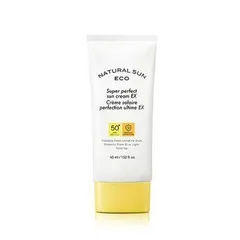
Works for:
based on ingredients and %- Sun protection
- Anti-oxidation
- Anti-aging
- Evens skin tone
Can it cause trouble?
- Irritation risk: high
- Comedogenic risk ingredients: 0
Key actives


Product Summary
We assess that "THE FACE SHOP - Natural Sun Eco Super Perfect Sun Cream EX" can provide reliable sun protection based on the ingredient list. We love that it can protect from both UVA and UVB rays (not all sunscreens with SPF ratings give UVA protection. UVA rays do not cause sunburn, but still damage our skin and lead to early aging).
This moisturizer should also be hydrating enough to use without an additional moisturizer during the day. Like all broad-spectrum sunscreens, this product has an anti-aging benefit.
Sunscreen filters
This is a so-called "chemical" sunscreen. It means that it uses organic UV filters. They typically offer good sun protection and rarely leave a white cast, but they can be irritating for some people with sensitive skin. Here are the exact UV filters in this sunscreen: tinosorb s 0.35% - 0.80%, uvinul a plus 2.20% - 3.30%, octinoxate 1.90% - 2.80% and octisalate 2.80% - 4.20%.
Irritation risk
There are quite a few common irritants in this product, including ingredients without particular skin benefits. We would not recommend it for sensitive skin. We assess the overall irritancy of this moisturizer to be high. For a detailed overview of all potential irritants: click here
You can see the detailed formula review with the breakdown of all actives in the product and the full ingredient list with estimated concentrations in the tables below.
Price
The product retails for 15.40$ in the United States.
For a detailed price comparison: click here.
Anti-aging
This product can help reduce and prevent fine lines and wrinkles, improve skin elasticity and firmness because it contains adenosine.
Keep in mind that it typically takes at least 6 weeks to notice any results because the changes that are needed to improve fine lines and elasticity happen in the deeper layers of the skin. No topical anti-aging product can “erase” wrinkles or fully reverse signs of aging.
This product can also help prevent early signs of skin aging because it offers a good level of broad spectrum sun protection. Sun damage is the main cause of premature skin aging, and protecting your skin from the sun is the best anti-aging strategy.
Might help improve cell turnover and reduce inflammation in skin. One study shows that the ingredients might be able to help reduce dynamic wrinkles (for example, in the corners of the eyes or on the forehead)
An amino acid that helps attract water to the upper layer of the skin. Might be helpful against lines and wrinkles, but evidence of effectiveness is lacking
Is proven to be effective in reducing blemishes, evening out skin tone and helping to improve lines and wrinkles. It helps the skin to repair sun damage, calm down inflammation and keep maintain good levels of moisture. The concentration of about 2% is effective for supporting the skin barrier and evening out the skin tone. Concentration of 4-6% is better for helping with acne and balancing the sebum production
A plant extract that has been shown to be able to reduce inflammation in skin, support restoration of skin barrier function, as well as support collagen production. Contains active compounds called centelloids: asiaticoside, madecasosside, asiatic acid and madecassic acid. Might be helpful in preventing stretch marks. It can be itself be irritating though.
A vitamin C derivative. Studies show that is might be effective in reducing hyperpigmentation, but there are no studies confirming that it is effectively converted into the bioavailable form of Vitamin C in skin. It is not clear how this derivative compares in effectiveness to the topical application of bioavailable form of vitamin C (L-ascorbic acid)
Can contain potent anti-oxidant compounds (abbreviated ECG, GCG, EGC, and EGCG) that might help protect the skin from free radicals. Can help calm down inflammation and has some anti-bacterial properties. Unfortunately, these antioxidants are unstable and lose their effectiveness very quickly in products. The concentration of the antioxidant compounds in the extract also tends to be low to be effective in topical formulation
Pure form of vitamin E. Can help moisturise and protect the skin from free radicals. Often used to help stabilise other ingredients or the formula itself
A plant extract that might be helpful in neutralizing free radicals and have a skin lightening effect if used in high enough concentrations
Anti-oxidation
This product contains antioxidants (glutathione) that can help neutralize free radicals in skin. By doing so, they can lessen the damage the skin gets from the UV light (sun).
The following ingredients - ficus carica fruit extract, saccharomyces/barley seed ferment filtrate also can have an antioxidant effect, but there is less evidence to confirm their effectiveness in skin.
A peptide that can help neutralize free radicals in skin and reduce melanin production resulting in skin lightening effect and reduction in hyperpigmentation. It can also help attract moisture to the upper layer of the skin
A plant extract that can help neutralize free radicals. The concentrations typically used in cosmetics are too small to have an effect
A yeast extract that can help neutralize free radicals in skin and can help attract water to its upper layers
A plant extract (perforate St John's-wort) that might have some anti-oxidant effect. Can be used as a fragrance and be irritating
A plant extract that might help neutralize free radicals in skin. Can contain volalite oils and be irritating
Used as a fragrance for its mint-like smell
Plant extract that might be somewhat helpful in neutralizing free radicals in skin
A plant extract that can have some anti-oxidant effect in skin
A plant extract that can help lighten the skin and calm down inflammation. Might be helpful in neutralizing free radicals
A plant extract that has some anti-oxidant activity, but solid research is lacking. Can help attract water to the upper layer of the skin
A plant extract that might have some anti-oxidant properties
Might help improve cell turnover and reduce inflammation in skin. One study shows that the ingredients might be able to help reduce dynamic wrinkles (for example, in the corners of the eyes or on the forehead)
A seaweed extract that helps attract water to the upper layer of the skin and might have an anti-oxidant effect
A plant extract tha can have anti-oxidant properties, but evidence of effectiveness in skin is lacking
A plant extract that might have some anti-oxidant properties
Plant extract that might help calm down inflammation and have some anti-oxidant properties
A plant extract that might help neutralize free radicals in skin
Carrot extract. Might have anti-oxidant properties and be used to add orange color
A fruit extact. Might have some anti-oxidant properties
A plant extract that can contain an irritating essential oil. Might have some anti-oxidant effect, but evidence is lacking
An essential oil. Can be irritating. Can become an allergen with oxidation
A fruit extract that might have some anti-oxidant properties but evidence of effectiveness in skin is lacking
A vitamin C derivative. Studies show that is might be effective in reducing hyperpigmentation, but there are no studies confirming that it is effectively converted into the bioavailable form of Vitamin C in skin. It is not clear how this derivative compares in effectiveness to the topical application of bioavailable form of vitamin C (L-ascorbic acid)
Pure form of vitamin E. Can help moisturise and protect the skin from free radicals. Often used to help stabilise other ingredients or the formula itself
A plant extract that might be helpful in neutralizing free radicals and have a skin lightening effect if used in high enough concentrations
Can contain potent anti-oxidant compounds (abbreviated ECG, GCG, EGC, and EGCG) that might help protect the skin from free radicals. Can help calm down inflammation and has some anti-bacterial properties. Unfortunately, these antioxidants are unstable and lose their effectiveness very quickly in products. The concentration of the antioxidant compounds in the extract also tends to be low to be effective in topical formulation
A plant extract that has been shown to be able to reduce inflammation in skin, support restoration of skin barrier function, as well as support collagen production. Contains active compounds called centelloids: asiaticoside, madecasosside, asiatic acid and madecassic acid. Might be helpful in preventing stretch marks. It can be itself be irritating though.
Can have some moisturizing properties due to its sugar content
Can be helpful in reducing inflammation in skin, including inflamed acne. It can be irritating
A plant extract that can contain an antioxidant compound
Might be somewhat helpful in reducing hyperpigmentation and neutralizing free radicals but its typical concentration in a product is too low for having an effect
A plant extract that might have some antioxidant properties, but mostly used in cosmetics for its color
Evens skin tone
This product offers broad spectrum sun protection. It means that it can prevent hyperpigmentation and help keep the skin tone even (sun damage is the main factor causing age spots, darkening of post-acne marks and other discolorations).
A peptide that can help neutralize free radicals in skin and reduce melanin production resulting in skin lightening effect and reduction in hyperpigmentation. It can also help attract moisture to the upper layer of the skin
A plant extract that can help lighten the skin and calm down inflammation. Might be helpful in neutralizing free radicals
An enzyme-based exfoliant
Is proven to be effective in reducing blemishes, evening out skin tone and helping to improve lines and wrinkles. It helps the skin to repair sun damage, calm down inflammation and keep maintain good levels of moisture. The concentration of about 2% is effective for supporting the skin barrier and evening out the skin tone. Concentration of 4-6% is better for helping with acne and balancing the sebum production
A vitamin C derivative. Studies show that is might be effective in reducing hyperpigmentation, but there are no studies confirming that it is effectively converted into the bioavailable form of Vitamin C in skin. It is not clear how this derivative compares in effectiveness to the topical application of bioavailable form of vitamin C (L-ascorbic acid)
A plant extract that might be helpful in neutralizing free radicals and have a skin lightening effect if used in high enough concentrations
Can contain potent anti-oxidant compounds (abbreviated ECG, GCG, EGC, and EGCG) that might help protect the skin from free radicals. Can help calm down inflammation and has some anti-bacterial properties. Unfortunately, these antioxidants are unstable and lose their effectiveness very quickly in products. The concentration of the antioxidant compounds in the extract also tends to be low to be effective in topical formulation
Sun protection
This product offers a good level of protection against both UVB and UVA rays.
This sunscreen uses organic (so-called "chemical") sunscreen filters. Organic, or "chemical" filters usually provide reliable sun protection and rarely leave a white cast. Sunscreens with organic filters can sting eyes.
Uvinul A Plus. A new generation broad spectrum sunscreen that offers an effective protection especially in the UVA range. It is stable in formulations. Unfortunately, is not approved by the FDA (US) yet
Tinosorb S. One of the most effective broad spectrum sunscreen ingredients. Protects from both UVA and UVB rays. It is photostable. Unfortunately, not approved by FDA (US) yet.
Octinoxate. When used in higher concentrations, works as a sunscreen protecting the skin from UVB rays. When used in lower concentration, helps to preserve the product formulation. Is shown to be harmful to coral reefs - consider avoiding bathing in coral reef areas when wearing a product with this ingredient. It can be irritating
Octisalate. A UV filter. It offers some protection against the sun rays that cause sunburn (UVB), but does not protect against the most aging sun rays (UVA). It loses its effectiveness quickly when exposed to sunlight. It is an organic, or so called "chemical" sunscreen
A broad spectrum sunblock (protects from both UVA and UVB rays). Is suitable for most sensitive skins. In small concentrations, can be used as a colorant
Works as a UV filter when used in high concentrations. It is photostable and is effective mostly against the UVB light, with some protection in the UVA range. In small concentrations, used for its ability to improve the color of cosmetic products. Is usually well tolerated by the skin
Moisturizing
What does the product description say?
Natural Sun Eco Super Perfect Sun Cream EX
Source: From product name
This product can help improve hydration of the skin with the two types of ingredients.
The first type is called “humectants”:
these ingredients help attract water.
When humectants are on the surface of the skin, they “pull in” the moisture from the outside environment, or from
within deeper layers of the skin. The following ingredients in this product do the job:
glycerin, honey extract.
This product also contains ingredients called “occlusives”. They help reduce the speed with which our skin loses moisture to the outside environment. These ingredients also help soften the upper layer of the skin, so it feels less tight and nicer to the touch. The following ingredients in this product do the job: grifola frondosa fruiting body extract, isododecane.
Mushroom extract that helps attract water to the upper layer of the skin and might be able to stimulate sebum production in skin
Can support skin barrier function and reduce inflammation in skin
A seaweed extract that helps attract water to the upper layer of the skin and might have an anti-oxidant effect
One of the best moisturizing ingredients. Naturally present in skin. It attracts water to the upper layer of the skin working as a humectant
A peptide that can help neutralize free radicals in skin and reduce melanin production resulting in skin lightening effect and reduction in hyperpigmentation. It can also help attract moisture to the upper layer of the skin
A fermented sweet black tea. There is no studies on particular benefits of this ingredient in skin. It can help attract water to the upper layer of the skin, and might have some anti-oxidant effect. It is used in skincare for mostly marketing purposes because of the popularity of kombucha drinks
Plant oil that due to its high content of linoleic acid can help support skin's barrier function improving its hydration
An amino acid that helps attract water to the upper layer of the skin. Might be helpful against lines and wrinkles, but evidence of effectiveness is lacking
Helps attract water to the upper layer of the skin
Might help improve cell turnover and reduce inflammation in skin. One study shows that the ingredients might be able to help reduce dynamic wrinkles (for example, in the corners of the eyes or on the forehead)
Enhances the product texture and makes it more spreadable. Helps reduce water loss from the outer layer of skin. Extands the shelf life by preventing bacteria growth
Help soften the upper layer of the skin
A silicone that helps improve the product texture and spreadability. Can absorb oil creating a short-term mattifying effect on the skin
An emollient that helps soften the skin and can decrease moisture loss. Helps create a nice product texture
A fermentation product created by bacteria Lactobacillus out of soybean. The fermented product helps to attract water to the upper layer of the skin and has anti-bacterial properties. It might be helpful in calming down inflammation and could be helpful in evening out skin tone, but studies are lacking
A plant extract that helps soften the upper layer of the skin
A yeast extract that can help neutralize free radicals in skin and can help attract water to its upper layers
Help improve the product's texture
An emollient that helps soften the skin. It also forms a protective on its surface to reduce water loss.
An emollient that can also help water and oil mix together, as well as prevent bacteria growth in products
Improves the texture of the product and helps soften the skin. Helps oil and water mix together and can be used as a cleansing agent
Used to create a nice product texture and help delivery of other ingredients. Might be somewhat helpful in attracting water to the upper layer of the skin
Helps products spread more easily and works as an emollient to soften skin
An emollient that is naturally present in skin and helps soften it
A plant extract that has some anti-oxidant activity, but solid research is lacking. Can help attract water to the upper layer of the skin
A fruit extract that might have some antioxidant properties and might help attract water to the skin, but evidence of effectiveness is lacking
A plant extract that has been shown to be able to reduce inflammation in skin, support restoration of skin barrier function, as well as support collagen production. Contains active compounds called centelloids: asiaticoside, madecasosside, asiatic acid and madecassic acid. Might be helpful in preventing stretch marks. It can be itself be irritating though.
Is proven to be effective in reducing blemishes, evening out skin tone and helping to improve lines and wrinkles. It helps the skin to repair sun damage, calm down inflammation and keep maintain good levels of moisture. The concentration of about 2% is effective for supporting the skin barrier and evening out the skin tone. Concentration of 4-6% is better for helping with acne and balancing the sebum production
Helps attract water to the upper layer of the skin and can help improve skin barrier function
Can have some moisturizing properties due to its sugar content
A vitamin C derivative. Studies show that is might be effective in reducing hyperpigmentation, but there are no studies confirming that it is effectively converted into the bioavailable form of Vitamin C in skin. It is not clear how this derivative compares in effectiveness to the topical application of bioavailable form of vitamin C (L-ascorbic acid)
Pure form of vitamin E. Can help moisturise and protect the skin from free radicals. Often used to help stabilise other ingredients or the formula itself
Might be somewhat helpful in reducing hyperpigmentation and neutralizing free radicals but its typical concentration in a product is too low for having an effect
Can contain potent anti-oxidant compounds (abbreviated ECG, GCG, EGC, and EGCG) that might help protect the skin from free radicals. Can help calm down inflammation and has some anti-bacterial properties. Unfortunately, these antioxidants are unstable and lose their effectiveness very quickly in products. The concentration of the antioxidant compounds in the extract also tends to be low to be effective in topical formulation
How honest is this product?
| Promise | Can it deliver? |
|---|---|
| Sun protection |
Total Promises Fulfilled score: 90/100.
We receive a small commission for purchases made through these links at no cost for you. Thank you for your support! Learn more
Potential irritants
Comedogenic ingredients
No comedogenic ingredients detected
User reviews (0)
Averages from community submissions.
No reviews yet for this product.
Be the first to share your experience!
Tried this product?
Help capture what the ingredient list can't—texture, finish, pilling, scent, and more. Answer what you can, skip the rest.
Takes ~30 seconds.
Reviews are shown in aggregate. No personal details.
| Product | Similarity | Price | Irritancy |
|---|---|---|---|
 THE FACE SHOP Natural Sun Eco Super Perfect Sun Cream EX | Current | $15.40 | |
Nella Honey 1 Snail White Moist Sun Cream | 81% | $14.40 | |
 Chasin' Rabbits G'day Mate Sunscreen | 79% | $28.10 | |
Cetaphil Daily Oil-Free Facial Moisturizer With Sunscreen Spf 35 For Sensitive, Combination Skin, 3 Ounces | 78% | $14.92 | |
 Ekel Aqua Sun Block AHA BHA PHA SPF 50PA+++ | 77% | RUB 256.00 | |
 NEEDLY Mild non-nano sun milk SPF 50+ PA++++ | 77% | - |
Key Actives
Is proven to be effective in reducing blemishes, evening out skin tone and helping to improve lines and wrinkles. It helps the skin to repair sun damage, calm down inflammation and keep maintain good levels of moisture. The concentration of about 2% is effective for supporting the skin barrier and evening out the skin tone. Concentration of 4-6% is better for helping with acne and balancing the sebum production
A plant extract that has been shown to be able to reduce inflammation in skin, support restoration of skin barrier function, as well as support collagen production. Contains active compounds called centelloids: asiaticoside, madecasosside, asiatic acid and madecassic acid. Might be helpful in preventing stretch marks. It can be itself be irritating though.
Can contain potent anti-oxidant compounds (abbreviated ECG, GCG, EGC, and EGCG) that might help protect the skin from free radicals. Can help calm down inflammation and has some anti-bacterial properties. Unfortunately, these antioxidants are unstable and lose their effectiveness very quickly in products. The concentration of the antioxidant compounds in the extract also tends to be low to be effective in topical formulation
Helps attract water to the upper layer of the skin and can help improve skin barrier function
A peptide that can help neutralize free radicals in skin and reduce melanin production resulting in skin lightening effect and reduction in hyperpigmentation. It can also help attract moisture to the upper layer of the skin
A plant extract that might be helpful in neutralizing free radicals and have a skin lightening effect if used in high enough concentrations
Can be helpful in reducing inflammation in skin, including inflamed acne. It can be irritating
Might help improve cell turnover and reduce inflammation in skin. One study shows that the ingredients might be able to help reduce dynamic wrinkles (for example, in the corners of the eyes or on the forehead)
A silicone that helps improve the product texture and spreadability. Can absorb oil creating a short-term mattifying effect on the skin
Can support skin barrier function and reduce inflammation in skin
A yeast extract that can help neutralize free radicals in skin and can help attract water to its upper layers
A seaweed extract that helps attract water to the upper layer of the skin and might have an anti-oxidant effect
An amino acid that helps attract water to the upper layer of the skin. Might be helpful against lines and wrinkles, but evidence of effectiveness is lacking
Uvinul A Plus. A new generation broad spectrum sunscreen that offers an effective protection especially in the UVA range. It is stable in formulations. Unfortunately, is not approved by the FDA (US) yet
Octinoxate. When used in higher concentrations, works as a sunscreen protecting the skin from UVB rays. When used in lower concentration, helps to preserve the product formulation. Is shown to be harmful to coral reefs - consider avoiding bathing in coral reef areas when wearing a product with this ingredient. It can be irritating
One of the best moisturizing ingredients. Naturally present in skin. It attracts water to the upper layer of the skin working as a humectant
A broad spectrum sunblock (protects from both UVA and UVB rays). Is suitable for most sensitive skins. In small concentrations, can be used as a colorant
Helps thicken the product consistency
Anti-bacterial compound that works as a preservative
A fermented sweet black tea. There is no studies on particular benefits of this ingredient in skin. It can help attract water to the upper layer of the skin, and might have some anti-oxidant effect. It is used in skincare for mostly marketing purposes because of the popularity of kombucha drinks
Plant oil that due to its high content of linoleic acid can help support skin's barrier function improving its hydration
A plant extract that can help neutralize free radicals. The concentrations typically used in cosmetics are too small to have an effect
Mushroom extract that helps attract water to the upper layer of the skin and might be able to stimulate sebum production in skin
Works as a UV filter when used in high concentrations. It is photostable and is effective mostly against the UVB light, with some protection in the UVA range. In small concentrations, used for its ability to improve the color of cosmetic products. Is usually well tolerated by the skin
Tinosorb S. One of the most effective broad spectrum sunscreen ingredients. Protects from both UVA and UVB rays. It is photostable. Unfortunately, not approved by FDA (US) yet.
Potential irritants
Octinoxate. When used in higher concentrations, works as a sunscreen protecting the skin from UVB rays. When used in lower concentration, helps to preserve the product formulation. Is shown to be harmful to coral reefs - consider avoiding bathing in coral reef areas when wearing a product with this ingredient. It can be irritating
Anti-bacterial compound that works as a preservative
An enzyme-based exfoliant
A plant extract that can contain an irritating essential oil. Might have some anti-oxidant effect, but evidence is lacking
A plant extract that is used as a fragrance. Can be irritating
A plant extract (perforate St John's-wort) that might have some anti-oxidant effect. Can be used as a fragrance and be irritating
Anise fruit extract. Used as a fragrance. Can be irritating
Essential oil that can be irritating
Contains essential oil. Can be irritating and lead to photosensitivity
A plant extract that can contain an active compound curcumin, that may have some anti-inflammatory properties when applied to the skin, but solid research is lacking and the typical concentration used in skincare products is too low. Can be an irritant
A plant extract that might have anti-oxidant properties. Can be irritating
A plant extract that might help neutralize free radicals in skin. Can contain volalite oils and be irritating
Used as a frangrance. Can be irritating. Might have some anti-bacterial properties
Used as a fragrance for its mint-like smell
A fruit extact. Might have some anti-oxidant properties
Can be helpful in reducing inflammation in skin, including inflamed acne. It can be irritating
Plant extract that has some anti-bacterial properties. Can be used as a fragrance. Can be irritating
Plant extract that can have healing and anti-inflammatory properties. It is a potential allergen and can be irritating
A plant oil with high content of volatile compounds that, especially when exposed to air, can cause allergic reactions and irritate the skin
An essential oil. Can be irritating. Can become an allergen with oxidation
Plant extract that can be irritating and is a known allergen
A plant oil with a high content of volatile compounds that can irritate the skin and lead to allergic reactions. Can lead to photosensitivity
A common frangrance that can easily irritate skin, especially if exposed to air, light or heat
Uvinul A Plus. A new generation broad spectrum sunscreen that offers an effective protection especially in the UVA range. It is stable in formulations. Unfortunately, is not approved by the FDA (US) yet
A peptide that can help neutralize free radicals in skin and reduce melanin production resulting in skin lightening effect and reduction in hyperpigmentation. It can also help attract moisture to the upper layer of the skin
A vitamin C derivative. Studies show that is might be effective in reducing hyperpigmentation, but there are no studies confirming that it is effectively converted into the bioavailable form of Vitamin C in skin. It is not clear how this derivative compares in effectiveness to the topical application of bioavailable form of vitamin C (L-ascorbic acid)
Helps to control the skin's pH level. Maintains the skin's natural film of amino-lactic acids and oils. Helps to preserve products
Can work as an exfoliant but is typically used to adjust the product pH
A plant extract that can contain an antioxidant compound
A preservative that comes from radishes fermented by a bacteria. New research suggests that the preservation properties in the ingredient come from an ammonium salt that is not present naturally in radish root but used in its cultivation. Is problematic because the exact amount of the preservative agents is difficult to determine
A plant extract that can have some anti-oxidant effect in skin
A plant extract that helps soften the upper layer of the skin
A plant extract that might be helpful in neutralizing free radicals and have a skin lightening effect if used in high enough concentrations
A plant extract tha can have anti-oxidant properties, but evidence of effectiveness in skin is lacking
A plant extract that might have some antioxidant properties, but mostly used in cosmetics for its color
Plant extract that might help calm down inflammation and have some anti-oxidant properties
A plant extract that might help neutralize free radicals in skin
A plant extract that has been shown to be able to reduce inflammation in skin, support restoration of skin barrier function, as well as support collagen production. Contains active compounds called centelloids: asiaticoside, madecasosside, asiatic acid and madecassic acid. Might be helpful in preventing stretch marks. It can be itself be irritating though.
Might be somewhat helpful in reducing hyperpigmentation and neutralizing free radicals but its typical concentration in a product is too low for having an effect
Plant extract that might be somewhat helpful in neutralizing free radicals in skin
A plant extract that can help neutralize free radicals. The concentrations typically used in cosmetics are too small to have an effect
A plant extract that can help lighten the skin and calm down inflammation. Might be helpful in neutralizing free radicals
Mushroom extract that helps attract water to the upper layer of the skin and might be able to stimulate sebum production in skin
A plant extract that has some anti-oxidant activity, but solid research is lacking. Can help attract water to the upper layer of the skin
A fruit extract that might have some antioxidant properties and might help attract water to the skin, but evidence of effectiveness is lacking
A plant extract. Might have some antioxidant properties
Can have some moisturizing properties due to its sugar content
A fruit extract that might have some anti-oxidant properties but evidence of effectiveness in skin is lacking
A plant extract that might have some anti-oxidant properties
Tinosorb S. One of the most effective broad spectrum sunscreen ingredients. Protects from both UVA and UVB rays. It is photostable. Unfortunately, not approved by FDA (US) yet.
Cedarwood oil. Used as a fragrance. Can be irritating
Comedogenic ingredients
We couldn't find any comedogenic ingredients in this product
All ingredients
An emollient that helps soften the skin and can decrease moisture loss. Helps create a nice product texture
Helps to dissolve other ingredients in a formulation. Slows down the rate of product drying
Helps products spread more easily and works as an emollient to soften skin
Octisalate. A UV filter. It offers some protection against the sun rays that cause sunburn (UVB), but does not protect against the most aging sun rays (UVA). It loses its effectiveness quickly when exposed to sunlight. It is an organic, or so called "chemical" sunscreen
Uvinul A Plus. A new generation broad spectrum sunscreen that offers an effective protection especially in the UVA range. It is stable in formulations. Unfortunately, is not approved by the FDA (US) yet
Octinoxate. When used in higher concentrations, works as a sunscreen protecting the skin from UVB rays. When used in lower concentration, helps to preserve the product formulation. Is shown to be harmful to coral reefs - consider avoiding bathing in coral reef areas when wearing a product with this ingredient. It can be irritating
An emollient that helps soften the skin. It also forms a protective on its surface to reduce water loss.
One of the best moisturizing ingredients. Naturally present in skin. It attracts water to the upper layer of the skin working as a humectant
A broad spectrum sunblock (protects from both UVA and UVB rays). Is suitable for most sensitive skins. In small concentrations, can be used as a colorant
A silicone that helps improve the product texture and spreadability. Can absorb oil creating a short-term mattifying effect on the skin
Improves the texture of the product and helps soften the skin. Helps oil and water mix together and can be used as a cleansing agent
Is proven to be effective in reducing blemishes, evening out skin tone and helping to improve lines and wrinkles. It helps the skin to repair sun damage, calm down inflammation and keep maintain good levels of moisture. The concentration of about 2% is effective for supporting the skin barrier and evening out the skin tone. Concentration of 4-6% is better for helping with acne and balancing the sebum production
Enhances the product texture and makes it more spreadable. Helps reduce water loss from the outer layer of skin. Extands the shelf life by preventing bacteria growth
A type of clay that is used to thicken the product consistency
Helps attract water to the upper layer of the skin and can help improve skin barrier function
A peptide that can help neutralize free radicals in skin and reduce melanin production resulting in skin lightening effect and reduction in hyperpigmentation. It can also help attract moisture to the upper layer of the skin
A vitamin C derivative. Studies show that is might be effective in reducing hyperpigmentation, but there are no studies confirming that it is effectively converted into the bioavailable form of Vitamin C in skin. It is not clear how this derivative compares in effectiveness to the topical application of bioavailable form of vitamin C (L-ascorbic acid)
Can support skin barrier function and reduce inflammation in skin
Anti-bacterial compound that works as a preservative
An enzyme-based exfoliant
A yeast extract that can help neutralize free radicals in skin and can help attract water to its upper layers
A fermentation product created by bacteria Lactobacillus out of soybean. The fermented product helps to attract water to the upper layer of the skin and has anti-bacterial properties. It might be helpful in calming down inflammation and could be helpful in evening out skin tone, but studies are lacking
A fermented sweet black tea. There is no studies on particular benefits of this ingredient in skin. It can help attract water to the upper layer of the skin, and might have some anti-oxidant effect. It is used in skincare for mostly marketing purposes because of the popularity of kombucha drinks
Can contain potent anti-oxidant compounds (abbreviated ECG, GCG, EGC, and EGCG) that might help protect the skin from free radicals. Can help calm down inflammation and has some anti-bacterial properties. Unfortunately, these antioxidants are unstable and lose their effectiveness very quickly in products. The concentration of the antioxidant compounds in the extract also tends to be low to be effective in topical formulation
Helps to control the skin's pH level. Maintains the skin's natural film of amino-lactic acids and oils. Helps to preserve products
Plant oil that due to its high content of linoleic acid can help support skin's barrier function improving its hydration
Can work as an exfoliant but is typically used to adjust the product pH
A plant extract that can contain an irritating essential oil. Might have some anti-oxidant effect, but evidence is lacking
A plant extract that is used as a fragrance. Can be irritating
A plant extract (perforate St John's-wort) that might have some anti-oxidant effect. Can be used as a fragrance and be irritating
Anise fruit extract. Used as a fragrance. Can be irritating
Essential oil that can be irritating
A plant extract that can contain an antioxidant compound
A preservative that comes from radishes fermented by a bacteria. New research suggests that the preservation properties in the ingredient come from an ammonium salt that is not present naturally in radish root but used in its cultivation. Is problematic because the exact amount of the preservative agents is difficult to determine
A plant extract that can have some anti-oxidant effect in skin
A plant extract that helps soften the upper layer of the skin
A plant extract that might be helpful in neutralizing free radicals and have a skin lightening effect if used in high enough concentrations
A plant extract tha can have anti-oxidant properties, but evidence of effectiveness in skin is lacking
A plant extract that might have some anti-oxidant properties
A plant extract that might have some antioxidant properties, but mostly used in cosmetics for its color
Plant extract that might help calm down inflammation and have some anti-oxidant properties
A plant extract that might help neutralize free radicals in skin
A plant extract that has been shown to be able to reduce inflammation in skin, support restoration of skin barrier function, as well as support collagen production. Contains active compounds called centelloids: asiaticoside, madecasosside, asiatic acid and madecassic acid. Might be helpful in preventing stretch marks. It can be itself be irritating though.
Contains essential oil. Can be irritating and lead to photosensitivity
Might be somewhat helpful in reducing hyperpigmentation and neutralizing free radicals but its typical concentration in a product is too low for having an effect
A plant extract that can contain an active compound curcumin, that may have some anti-inflammatory properties when applied to the skin, but solid research is lacking and the typical concentration used in skincare products is too low. Can be an irritant
Carrot extract. Might have anti-oxidant properties and be used to add orange color
A plant extract that might have anti-oxidant properties. Can be irritating
Plant extract that might be somewhat helpful in neutralizing free radicals in skin
A plant extract that can help neutralize free radicals. The concentrations typically used in cosmetics are too small to have an effect
A plant extract that can help lighten the skin and calm down inflammation. Might be helpful in neutralizing free radicals
Mushroom extract that helps attract water to the upper layer of the skin and might be able to stimulate sebum production in skin
A plant extract that might help neutralize free radicals in skin. Can contain volalite oils and be irritating
Used as a frangrance. Can be irritating. Might have some anti-bacterial properties
Used as a fragrance for its mint-like smell
A plant extract that has some anti-oxidant activity, but solid research is lacking. Can help attract water to the upper layer of the skin
A fruit extract that might have some antioxidant properties and might help attract water to the skin, but evidence of effectiveness is lacking
A fruit extact. Might have some anti-oxidant properties
A plant extract. Might have some antioxidant properties
Can have some moisturizing properties due to its sugar content
Can be helpful in reducing inflammation in skin, including inflamed acne. It can be irritating
A fruit extract that might have some anti-oxidant properties but evidence of effectiveness in skin is lacking
A plant extract that might have some anti-oxidant properties
Plant extract that has some anti-bacterial properties. Can be used as a fragrance. Can be irritating
A seaweed extract that helps attract water to the upper layer of the skin and might have an anti-oxidant effect
Plant extract that can have healing and anti-inflammatory properties. It is a potential allergen and can be irritating
Works as a UV filter when used in high concentrations. It is photostable and is effective mostly against the UVB light, with some protection in the UVA range. In small concentrations, used for its ability to improve the color of cosmetic products. Is usually well tolerated by the skin
An emollient that can also help water and oil mix together, as well as prevent bacteria growth in products
Tinosorb S. One of the most effective broad spectrum sunscreen ingredients. Protects from both UVA and UVB rays. It is photostable. Unfortunately, not approved by FDA (US) yet.
A type of silicone that helps oil and water mix well together. Helps to disperse other ingredients, e.g. pigments, evenly in a formulation
Might help improve cell turnover and reduce inflammation in skin. One study shows that the ingredients might be able to help reduce dynamic wrinkles (for example, in the corners of the eyes or on the forehead)
Used to create a nice product texture and help delivery of other ingredients. Might be somewhat helpful in attracting water to the upper layer of the skin
Is used to add opaque (non-transparent) appearance to formulations. Can be used to coat other ingredients for even dispersion. This is a different ingredient compared to the ones used in antipersperants (aluminium chloride and aluminium chlorohydrate)
Creates an illusion of smoother and more radiant skin tone. Adds shimmer to the skin by reflecting light
An emollient that is naturally present in skin and helps soften it
Used to stabilize the product formulation and can help absorb oil
Pure form of vitamin E. Can help moisturise and protect the skin from free radicals. Often used to help stabilise other ingredients or the formula itself
An amino acid that helps attract water to the upper layer of the skin. Might be helpful against lines and wrinkles, but evidence of effectiveness is lacking
A plant oil with high content of volatile compounds that, especially when exposed to air, can cause allergic reactions and irritate the skin
An essential oil. Can be irritating. Can become an allergen with oxidation
Cedarwood oil. Used as a fragrance. Can be irritating
Plant extract that can be irritating and is a known allergen
A plant oil with a high content of volatile compounds that can irritate the skin and lead to allergic reactions. Can lead to photosensitivity
A common frangrance that can easily irritate skin, especially if exposed to air, light or heat
Ingredient list view
Water, Isododecane, Dipropylene glycol, Dicaprylyl carbonate, Ethylhexyl salicylate, Diethylamino hydroxybenzoyl hexyl benzoate, Ethylhexyl methoxycinnamate, Isodecyl neopentanoate, Sorbitan olivate, Glycerin, Zinc oxide, Cyclopentasiloxane, Isohexadecane, Niacinamide, C12-15 alkyl benzoate, Disteardimonium hectorite, Methyl methacrylate crosspolymer, Panthenol, Glutathione, Ascorbyl tetraisopalmitate, Cyanocobalamin, Saccharomyces/grape ferment extract, Lactobacillus/wasabia japonica root ferment extract, Lactobacillus/punica granatum fruit ferment extract, Aureobasidium pullulans ferment extract, Lactobacillus/pear juice ferment filtrate, Saccharomyces/barley seed ferment filtrate, Lactobacillus/panax ginseng root ferment filtrate, Lactobacillus/soybean ferment extract, Lactobacillus/water hyacinth ferment, Monascus/rice ferment, Saccharomyces/potato extract ferment filtrate, Lactobacillus/rye flour ferment, Saccharomyces/xylinum/black tea ferment, Artemisia annua extract, Azadirachta indica leaf extract, Camellia sinensis leaf extract, Boswellia serrata resin extract, Jasminum officinale flower/leaf extract, Sodium citrate, Sesamum indicum seed extract, Glycine max seed extract, Oryza sativa bran extract, Citric acid, Wine extract, Larrea divaricata extract, Salvia officinalis leaf extract, Zingiber officinale root extract, Adenophora stricta root extract, Carum petroselinum extract, Cinnamomum zeylanicum bark extract, Coriandrum sativum fruit/leaf extract, Cymbopogon citratus extract, Eugenia caryophyllus flower extract, Foeniculum vulgare fruit extract, Fraxinus excelsior leaf extract, Honey extract, Hypericum perforatum flower/leaf/stem extract, Illicium verum fruit extract, Lavandula angustifolia flower extract, Marrubium vulgare extract, Nigella sativa seed extract, Valeriana officinalis rhizome/root extract, Citrullus lanatus fruit extract, Leuconostoc/radish root ferment filtrate, Unknown, Euterpe oleracea fruit extract, Lupinus albus seed extract, Phyllanthus emblica fruit extract, Vaccinium angustifolium fruit extract, Acer palmatum leaf extract, Acorus calamus root extract, Actinidia polygama fruit extract, Akebia quinata extract, Allium cepa bulb extract, Allium sativum bulb extract, Anemarrhena asphodeloides root extract, Artemisia princeps leaf extract, Beta vulgaris root extract, Brassica oleracea capitata leaf extract, Brassica rapa leaf extract, Camellia japonica leaf extract, Carica papaya fruit extract, Carthamus tinctorius flower extract, Cassia obtusifolia seed extract, Centella asiatica extract, Chaenomeles sinensis fruit extract, Cichorium intybus root extract, Citrus aurantium bergamia leaf extract, Citrus junos fruit extract, Citrus unshiu peel extract, Codonopsis lanceolata root extract, Crataegus cuneata fruit extract, Cucumis sativus fruit extract, Curcuma longa root extract, Daucus carota sativa root extract, Diospyros kaki fruit extract, Equisetum arvense extract, Eriobotrya japonica leaf extract, Ficus carica fruit extract, Geranium robertianum extract, Glechoma hederacea extract, Glycyrrhiza glabra root extract, Grifola frondosa fruiting body extract, Helianthus annuus seed extract, Hemerocallis fulva flower extract, Ipomoea batatas root extract, Lentinus edodes extract, Lippia citriodora leaf extract, Lonicera japonica flower extract, Lycium chinense fruit extract, Melissa officinalis extract, Mentha piperita flower/leaf/stem extract, Morus bombycis leaf extract, Musa sapientum fruit extract, Nelumbo nucifera root extract, Ocimum basilicum leaf extract, Panicum miliaceum seed extract, Perilla frutescens leaf extract, Phaseolus angularis seed extract, Plantago major seed extract, Platycodon grandiflorus root extract, Portulaca oleracea extract, Prunus armeniaca fruit extract, Prunus persica fruit extract, Prunus domestica fruit extract, Pyrus malus fruit extract, Rehmannia chinensis root extract, Rosmarinus officinalis leaf extract, Rubus idaeus fruit extract, Sasa veitchii leaf extract, Schizonepeta tenuifolia extract, Spinacia oleracea leaf extract, Taraxacum officinale leaf extract, Thymus vulgaris leaf extract, Trichosanthes kirilowii root extract, Undaria pinnatifida extract, Chamomilla recutita flower extract, Ginkgo biloba nut extract, Houttuynia cordata extract, Vinegar, Titanium dioxide, Ci 77891, Glyceryl caprylate, Peg-30 dipolyhydroxystearate, Bis-ethylhexyloxyphenol methoxyphenyl triazine, Ethylhexylglycerin, Triethoxycaprylylsilane, Magnesium sulfate, Adenosine, Butylene glycol, Aluminum hydroxide, Mica, 1,2-hexanediol, Sodium palmitoyl proline, Caprylic/capric glycerides, Ci 77492, Ci 77491, Sodium palmitoyl sarcosinate, Palmitic acid, Maltodextrin, Tocopherol, Triethoxysilylethyl polydimethylsiloxyethyl hexyl dimethicone, Magnesium palmitoyl glutamate, Diphenylsiloxy phenyl trimethicone, Citrus grandis peel oil, Citrus aurantium dulcis flower oil, Elettaria cardamomum seed oil, Pelargonium graveolens flower oil, Juniperus virginiana oil, Lavandula hybrida oil, Citrus aurantium bergamia fruit oil, Limonene, Citronellol, Geraniol, Linalool, Citral
- Glycerol and the skin: holistic approach to its origin and functions
- A review of inorganic UV filters zinc oxide and titanium dioxide
- Risk assessment of zinc oxide, a cosmetic ingredient used as a UV filter of sunscreens
- Characterization of the UVA protection provided by avobenzone, zinc oxide, and titanium dioxide in broad-spectrum sunscreen products
- Ultraviolet Protection Properties of Commercial Sunscreens and Sunscreens Containing Zno Nanorods
- ZnO nanoparticles and organic chemical UV-filters are equally well tolerated by human immune cells
- Niacinamide - mechanisms of action and its topical use in dermatology
- Gehring, W. (2004). Nicotinic acid/niacinamide and the skin. Journal of Cosmetic Dermatology, 3(2), 88–93. doi:10.1111/j.1473-2130.2004.00115.x
- Skin moisturizing effects of panthenol-based formulations
- Safety Assessment of Panthenol, Pantothenic Acid, and Derivatives as Used in Cosmetics
- Glutathione as a skin whitening agent: Facts, myths, evidence and controversies
- Glutathione for skin lightening: a regnant myth or evidence-based verity?
- Glutathione for skin lightening for dermatologists and cosmetologists
- Assessment of penetration of Ascorbyl Tetraisopalmitate into biological membranes by molecular dynamics
- Stability evaluation of tocopheryl acetate and ascorbyl tetraisopalmitate in isolation and incorporated in cosmetic formulations using thermal analysis
- A new lipophilic pro-vitamin C, tetra-isopalmitoyl ascorbic acid (VC-IP), prevents UV-induced skin pigmentation through its anti-oxidative properties
- New lipophilic pro-vitamin C, tetra-isopalmitoyl ascorbic acid (VC-IP), suppresses senile lentigo through controlling of melanocytes-keratinocytes interaction
- Topical vitamin B12--a new therapeutic approach in atopic dermatitis-evaluation of efficacy and tolerability in a randomized placebo-controlled multicentre clinical trial
- Superiority of a vitamin B12-containing emollient compared to a standard emollient in the maintenance treatment of mild-to-moderate plaque psoriasis
- Inhibition of inflammatory nitric oxide production and epidermis damages by Saccharomycopsis Ferment Filtrate
- Seed oil content and fatty acid composition in East African sesame (Sesamum indicum L.) accessions evaluated over 3 years
- Allergic contact dermatitis caused by Salvia officinalis extract
- Some phytochemical, pharmacological and toxicological properties of ginger (Zingiber officinale Roscoe): A review of recent research
- Medical Attributes of St. John’s Wort (Hypericum perforatum)
- Evaluation of Skin Irritation and Acute and Subacute Oral Toxicity of Lavandula angustifolia Essential Oils in Rabbit and Mice
- Assessment report on Lavandula angustifolia Mill., aetheroleum and Lavandula angustifolia Mill., flos
- Analyzing Lycopene Content in Fruits
- Total Oxidant Scavenging Capacity of Euterpe oleracea Mart. (Açaí) Seeds and Identification of Their Polyphenolic Compounds
- Euterpe oleracea, Matricaria chamomilla, and Camellia sinensis as promising ingredients for development of skin care formulations
- Emblica
- Amla (Emblica officinalis Gaertn.) extract promotes procollagen production and inhibits matrix metalloproteinase-1 in human skin fibroblasts
- Emblica Cascading Antioxidant: A Novel Natural Skin Care Ingredient
- Anti-Inflammatory and Neuroactive Properties of Selected Fruit Extracts
- Anti-inflammatory Effects of Brassica oleracea Var. capitata L. (Cabbage) Methanol Extract in Mice with Contact Dermatitis
- Effect of Brassica oleracea in rats skin wound healing
- Anti-photoaging capability of antioxidant extract from Camellia japonica leaf
- Anti-Inflammatory Effect of Titrated Extract of Centella asiatica in Phthalic Anhydride-Induced Allergic Dermatitis Animal Model
- Centella asiatica in cosmetology
- Triterpene Composition and Bioactivities of Centella asiatica
- Asiaticoside induction for cell-cycle progression, proliferation and collagen synthesis in human dermal fibroblasts
- Assessment report on Centella asiatica (L.) Urban, herba
- Contact dermatitis due to Madecassol
- The Effects of a Standardized Extract of Centella asiatica on Postlaser Resurfacing Wound Healing on the Face: A Split-Face, Double-Blind, Randomized, Placebo-Controlled Trial
- Safety Assessment of Citrus Fruit-Derived Ingredients as Used in Cosmetics
- Vaughn, A. R., Branum, A., & Sivamani, R. K. (2016). Effects of Turmeric (Curcuma longa) on Skin Health: A Systematic Review of the Clinical Evidence. Phytotherapy Research, 30(8), 1243–1264. doi:10.1002/ptr.5640
- VOLATILE CONSTITUENTS FROM THE FLOWERS OF TWO SPECIES OF HONEYSUCKLE ( LONICERA JAPONICA AND LONICERA CAPRIFOLIUM )
- Chemical composition of the essential oils from the flower, leaf and stem of Lonicera japonica
- Portulaca oleracea (purslane)
- Allergic contact dermatitis induced by rosemary leaf extract in a cleansing gel
- Safety Assessment of Rosmarinus officinalis (Rosemary)-Derived Ingredients as Used in Cosmetics
- Rosmarinus officinalis Extract Suppresses Propionibacterium acnes–Induced Inflammatory Responses
- Safety Assessment of Magnesium Sulfate as Used in Cosmetics
- Evaluation of anti-wrinkle efficacy of adenosine-containing products using the FOITS technique
- Safety Assessment of Alumina and Aluminum Hydroxide as Used in Cosmetics
- The influence of alkane chain length on the skin irritation potential of 1,2-alkanediols
- Vitamin E in dermatology
- Vitamin E and Skin Health
- Safety Assessment of Amino Acid Alkyl Amides as Used in Cosmetics
- Fragrance Compound Geraniol Forms Contact Allergens on Air Exposure. Identification and Quantification of Oxidation Products and Effect on Skin Sensitization
- Safety Assessment of Citrus-Derived Peel Oils as Used in Cosmetics
- Oxidized citrus oil (R-limonene): A frequent skin sensitizer in Europe
- Air oxidation increases skin irritation from fragrance terpenes
- Annex I: Clinical evidence regarding sensitisation to individual fragrance chemicals and to natural extracts