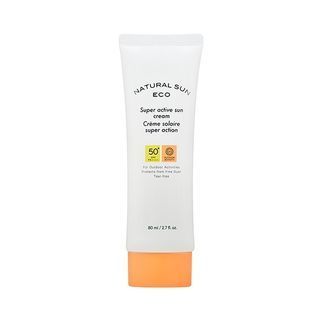
THE FACE SHOP Natural Sun Eco Super Active Sun Cream Jumbo
Works for
1 of 2 advertised claims delivered
Moisturizing27 ingredients credited for this claimGood support
“Natural Sun Eco Super Active Sun Cream Jumbo”
This product can help improve hydration of the skin with the two types of ingredients.
The first type is called “humectants”:
these ingredients help attract water.
When humectants are on the surface of the skin, they “pull in” the moisture from the outside environment, or from
within deeper layers of the skin. The following ingredients in this product do the job:
glycerin, saccharomyces/barley seed ferment filtrate.
This product also contains ingredients called “occlusives”. They help reduce the speed with which our skin loses moisture to the outside environment. These ingredients also help soften the upper layer of the skin, so it feels less tight and nicer to the touch. The following ingredients in this product do the job: glycine soja oil, grifola frondosa fruiting body extract.
Evens skin tone5 ingredients credited for this claimLimited support
“Helps to improve wrinkle appearance and brightening up skin tone.”
This product contains ingredients (glycyrrhiza glabra root extract, morus alba bark extract, paeonia lactiflora root extract) that could help reduce hyperpigmentation (for example, post-acne marks or age spots) in theory, but there is not enough evidence that they actually work.
Anti-agingNot advertised by the brand · 5 ingredients credited for this claimStrong support
This product can help reduce and prevent fine lines and wrinkles, improve skin elasticity and firmness because it contains adenosine.
Keep in mind that it typically takes at least 6 weeks to notice any results because the changes that are needed to improve fine lines and elasticity happen in the deeper layers of the skin. No topical anti-aging product can “erase” wrinkles or fully reverse signs of aging.
Anti-oxidationNot advertised by the brand · 34 ingredients credited for this claimModerate support
This product contains antioxidants (camellia japonica flower extract, ficus carica fruit extract, saccharomyces/barley seed ferment filtrate) that might be able to help neutralize free radicals in skin to lessen the damage it gets from the UV light (sun). There is not enough evidence to confirm their effectiveness in skin though.
Can it cause trouble?
Irritancy21 strong irritants: Allium cepa bulb extract, Carica papaya fruit extract + 19 more — patch-test recommendedHigh risk
Comedogenic1 ingredient rated 2 or more on the 0–5 pore-clogging scale1 flagged


User reviews
Be the first — your take helps the next person decide.
Ingredients
Filter by role to see what each ingredient is doing.
Water~40–60%
Ethylhexyl methoxycinnamate~5.5–8.3%
- Irritation risk
- High
Octinoxate. When used in higher concentrations, works as a sunscreen protecting the skin from UVB rays. When used in lower concentration, helps to preserve the product formulation. Is shown to be harmful to coral reefs - consider avoiding bathing in coral reef areas when wearing a product with this ingredient. It can be irritating
More about Ethylhexyl methoxycinnamateIsododecane~4.5–6.8%
- Irritation risk
- Low
An emollient that helps soften the skin and can decrease moisture loss. Helps create a nice product texture
More about IsododecaneDipropylene glycol~2.9–4.3%
- Irritation risk
- Low
Helps to dissolve other ingredients in a formulation. Slows down the rate of product drying
More about Dipropylene glycolZinc oxide~3.5–5.2%
- Irritation risk
- Low
A broad spectrum sunblock (protects from both UVA and UVB rays). Is suitable for most sensitive skins. In small concentrations, can be used as a colorant
More about Zinc oxideEthylhexyl salicylate~2.6–3.9%
- Irritation risk
- Low
Octisalate. A UV filter. It offers some protection against the sun rays that cause sunburn (UVB), but does not protect against the most aging sun rays (UVA). It loses its effectiveness quickly when exposed to sunlight. It is an organic, or so called "chemical" sunscreen
More about Ethylhexyl salicylateSorbitan olivate~1.8–2.8%
Diethylamino hydroxybenzoyl hexyl benzoate~2.1–3.1%
- Irritation risk
- Medium
Uvinul A Plus. A new generation broad spectrum sunscreen that offers an effective protection especially in the UVA range. It is stable in formulations. Unfortunately, is not approved by the FDA (US) yet
More about Diethylamino hydroxybenzoyl hexyl benzoateDicaprylyl carbonate~1.4–2.1%
- Irritation risk
- Low
Helps products spread more easily and works as an emollient to soften skin
More about Dicaprylyl carbonateGlycerin~1.3–1.9%
- Irritation risk
- Low
One of the best moisturizing ingredients. Naturally present in skin. It attracts water to the upper layer of the skin working as a humectant
More about GlycerinCyclopentasiloxane~0.6–1.35%
- Irritation risk
- Low
A silicone that helps improve the product texture and spreadability. Can absorb oil creating a short-term mattifying effect on the skin
More about CyclopentasiloxaneIsohexadecane~0.55–1.25%
- Irritation risk
- Low
Improves the texture of the product and helps soften the skin. Helps oil and water mix together and can be used as a cleansing agent
More about IsohexadecaneNiacinamide~0.35–0.85%
- Irritation risk
- Low
Is proven to be effective in reducing blemishes, evening out skin tone and helping to improve lines and wrinkles. It helps the skin to repair sun damage, calm down inflammation and keep maintain good levels of moisture. The concentration of about 2% is effective for supporting the skin barrier and evening out the skin tone. Concentration of 4-6% is better for helping with acne and balancing the sebum production
More about NiacinamideTitanium dioxide~0.5–1.1%
- Irritation risk
- Low
Works as a UV filter when used in high concentrations. It is photostable and is effective mostly against the UVB light, with some protection in the UVA range. In small concentrations, used for its ability to improve the color of cosmetic products. Is usually well tolerated by the skin
More about Titanium dioxideDisteardimonium hectorite~0.3–0.75%
- Irritation risk
- Low
A type of clay that is used to thicken the product consistency
More about Disteardimonium hectoriteBis-ethylhexyloxyphenol methoxyphenyl triazine~0.4–1%
- Irritation risk
- Medium
Tinosorb S. One of the most effective broad spectrum sunscreen ingredients. Protects from both UVA and UVB rays. It is photostable. Unfortunately, not approved by FDA (US) yet.
More about Bis-ethylhexyloxyphenol methoxyphenyl triazinePanthenol~0.2–0.8%
- Irritation risk
- Low
Helps attract water to the upper layer of the skin and can help improve skin barrier function
More about PanthenolPhenethyl benzoate~0.2–0.75%
Ascorbyl glucoside~0.15–0.65%
- Irritation risk
- Medium
A vitamin C derivative that is more stable but less potent than pure form of vitamin C. Has a potential to boost collagen production, nutralise free radicals and reduce hyperpigmentation, but the required concentration is likely to be much higher than for the pure form of vitamin C, limiting the ingredient's effectiveness in products
More about Ascorbyl glucosideCamellia japonica flower extract~0.15–0.65%
- Irritation risk
- High
A plant extract that might help neutralize free radicals in skin
More about Camellia japonica flower extractTocopherol~0.15–0.6%
- Irritation risk
- Low
Pure form of vitamin E. Can help moisturise and protect the skin from free radicals. Often used to help stabilise other ingredients or the formula itself
More about TocopherolGlycine soja oil~0.15–0.6%
- Irritation risk
- Medium
- Comedogenicity
- 2/5
A good emollient that helps soften the skin and helps repair its barrier function. It can clog pores if used in high concentrations.
More about Glycine soja oilAspalathus linearis leaf extract~0.15–0.5%
- Irritation risk
- Low
Plant extract that might have help to neutralize free radicals in skin, but evidence of effectiveness is skin is lacking
More about Aspalathus linearis leaf extractMorus alba bark extract~0.15–0.5%
- Irritation risk
- High
A plant extract that might have anti-oxidant properties and help even out skin tone, but solid evidence is lacking
More about Morus alba bark extractOphiopogon japonicus root extract~0.1–0.45%
- Irritation risk
- Medium
Plant extract that might help neutralize free radicals and support skin barrier function, but research on its effectiveness in skin is lacking
More about Ophiopogon japonicus root extractPanax ginseng root extract~0.15–0.6%
- Irritation risk
- High
A plant extract that might have some anti-inflammatory properties, but solid evidence is lacking. It can be irritating
More about Panax ginseng root extractSchisandra chinensis fruit extract~0.1–0.5%
- Irritation risk
- Medium
A berry extract that might help neutralize free radicals on the surface of the skin
More about Schisandra chinensis fruit extractGlycyrrhiza glabra root extract~0.1–0.45%
- Irritation risk
- Medium
A plant extract that can help lighten the skin and calm down inflammation. Might be helpful in neutralizing free radicals
More about Glycyrrhiza glabra root extractAngelica acutiloba root extract~0.15–0.5%
- Irritation risk
- Low
Atractylodes japonica rhizome extract~0.15–0.5%
- Irritation risk
- Low
Paeonia lactiflora root extract~0.15–0.5%
- Irritation risk
- Medium
A plant extract that might help neutralize free radicals and reduce hyperpigmentation, but the research on its effectiveness in skin is lacking
More about Paeonia lactiflora root extractPaeonia suffruticosa root extract~0.15–0.55%
Plantago asiatica extract~0.15–0.5%
- Irritation risk
- Low
Prunus persica kernel extract~0.1–0.5%
- Irritation risk
- Low
Scutellaria baicalensis root extract~0.1–0.45%
- Irritation risk
- High
A plant extract that might contain a compound baicalin that could be helpful in neutralizing free radicals and reducing inflammation in skin. The baicalin concentration in skincare products is often too low for an effective action. Can be used for its fragrant properties
More about Scutellaria baicalensis root extractLactobacillus/pear juice ferment filtrate~0.15–0.5%
- Irritation risk
- Low
Saccharomyces/barley seed ferment filtrate~0.15–0.5%
- Irritation risk
- Low
A yeast extract that can help neutralize free radicals in skin and can help attract water to its upper layers
More about Saccharomyces/barley seed ferment filtrateLactobacillus/panax ginseng root ferment filtrate~0.15–0.5%
- Irritation risk
- Low
Lactobacillus/rye flour ferment~0.15–0.5%
- Irritation risk
- Low
Lactobacillus/soybean ferment extract~0.15–0.5%
- Irritation risk
- Low
A fermentation product created by bacteria Lactobacillus out of soybean. The fermented product helps to attract water to the upper layer of the skin and has anti-bacterial properties. It might be helpful in calming down inflammation and could be helpful in evening out skin tone, but studies are lacking
More about Lactobacillus/soybean ferment extractLactobacillus/wasabia japonica root ferment extract~0.15–0.55%
- Irritation risk
- High
Anti-bacterial compound that works as a preservative
More about Lactobacillus/wasabia japonica root ferment extractLactobacillus/water hyacinth ferment~0.15–0.55%
- Irritation risk
- Low
Monascus/rice ferment~0.15–0.55%
- Irritation risk
- Low
Saccharomyces/grape ferment extract~0.1–0.5%
- Irritation risk
- Low
Saccharomyces/potato extract ferment filtrate~0.15–0.5%
- Irritation risk
- Low
Saccharomyces/xylinum/black tea ferment~0.1–0.5%
- Irritation risk
- Low
A fermented sweet black tea. There is no studies on particular benefits of this ingredient in skin. It can help attract water to the upper layer of the skin, and might have some anti-oxidant effect. It is used in skincare for mostly marketing purposes because of the popularity of kombucha drinks
More about Saccharomyces/xylinum/black tea fermentAcer palmatum leaf extract~0.15–0.55%
- Irritation risk
- Low
Acorus calamus root extract~0.1–0.45%
- Irritation risk
- Low
Actinidia polygama fruit extract~0.15–0.5%
- Irritation risk
- Low
Akebia quinata extract~0.15–0.5%
- Irritation risk
- Low
Allium cepa bulb extract~0.15–0.5%
- Irritation risk
- High
Allium sativum bulb extract~0.15–0.5%
- Irritation risk
- Low
Anemarrhena asphodeloides root extract~0.15–0.5%
- Irritation risk
- Low
A plant extract that might have some anti-oxidant properties
More about Anemarrhena asphodeloides root extractArtemisia princeps leaf extract~0.15–0.5%
- Irritation risk
- Low
Beta vulgaris root extract~0.15–0.5%
- Irritation risk
- Medium
A plant extract that might have some antioxidant properties, but mostly used in cosmetics for its color
More about Beta vulgaris root extractBrassica oleracea capitata leaf extract~0.15–0.5%
- Irritation risk
- Medium
Plant extract that might help calm down inflammation and have some anti-oxidant properties
More about Brassica oleracea capitata leaf extractBrassica rapa leaf extract~0.15–0.5%
- Irritation risk
- Low
Camellia japonica leaf extract~0.15–0.5%
- Irritation risk
- Medium
A plant extract that might help neutralize free radicals in skin
More about Camellia japonica leaf extractCarica papaya fruit extract~0.15–0.5%
- Irritation risk
- High
Carthamus tinctorius flower extract~0.15–0.5%
- Irritation risk
- Low
Cassia obtusifolia seed extract~0.15–0.5%
- Irritation risk
- High
Centella asiatica extract~0.15–0.6%
- Irritation risk
- Medium
A plant extract that has been shown to be able to reduce inflammation in skin, support restoration of skin barrier function, as well as support collagen production. Contains active compounds called centelloids: asiaticoside, madecasosside, asiatic acid and madecassic acid. Might be helpful in preventing stretch marks. It can be itself be irritating though.
More about Centella asiatica extractChaenomeles sinensis fruit extract~0.15–0.55%
- Irritation risk
- Low
Chamomilla recutita flower extract~0.15–0.5%
- Irritation risk
- High
Plant extract that can have healing and anti-inflammatory properties. It is a potential allergen and can be irritating
More about Chamomilla recutita flower extractCichorium intybus root extract~0.15–0.5%
- Irritation risk
- Low
Citrullus lanatus fruit extract~0.15–0.5%
- Irritation risk
- Medium
A plant extract that can contain an antioxidant compound
More about Citrullus lanatus fruit extractCitrus aurantium bergamia leaf extract~0.15–0.55%
- Irritation risk
- High
Citrus junos fruit extract~0.15–0.5%
- Irritation risk
- High
Contains essential oil. Can be irritating and lead to photosensitivity
More about Citrus junos fruit extractCitrus unshiu peel extract~0.15–0.55%
- Irritation risk
- High
Codonopsis lanceolata root extract~0.15–0.5%
- Irritation risk
- Low
Crataegus cuneata fruit extract~0.15–0.5%
- Irritation risk
- Low
Cucumis sativus fruit extract~0.15–0.5%
- Irritation risk
- Medium
Might be somewhat helpful in reducing hyperpigmentation and neutralizing free radicals but its typical concentration in a product is too low for having an effect
More about Cucumis sativus fruit extractCurcuma longa root extract~0.1–0.45%
- Irritation risk
- High
A plant extract that can contain an active compound curcumin, that may have some anti-inflammatory properties when applied to the skin, but solid research is lacking and the typical concentration used in skincare products is too low. Can be an irritant
More about Curcuma longa root extractDaucus carota sativa root extract~0.15–0.5%
- Irritation risk
- Low
Carrot extract. Might have anti-oxidant properties and be used to add orange color
More about Daucus carota sativa root extractDiospyros kaki fruit extract~0.15–0.5%
- Irritation risk
- Low
Equisetum arvense extract~0.15–0.55%
- Irritation risk
- High
A plant extract that might have anti-oxidant properties. Can be irritating
More about Equisetum arvense extractEriobotrya japonica leaf extract~0.1–0.45%
- Irritation risk
- Medium
Plant extract that might be somewhat helpful in neutralizing free radicals in skin
More about Eriobotrya japonica leaf extractFicus carica fruit extract~0.15–0.5%
- Irritation risk
- Medium
A plant extract that can help neutralize free radicals. The concentrations typically used in cosmetics are too small to have an effect
More about Ficus carica fruit extractGeranium robertianum extract~0.1–0.5%
- Irritation risk
- Low
Ginkgo biloba nut extract~0.15–0.5%
- Irritation risk
- Low
Glechoma hederacea extract~0.1–0.45%
- Irritation risk
- Low
Grifola frondosa fruiting body extract~0.15–0.55%
- Irritation risk
- Medium
Mushroom extract that helps attract water to the upper layer of the skin and might be able to stimulate sebum production in skin
More about Grifola frondosa fruiting body extractHelianthus annuus seed extract~0.15–0.5%
- Irritation risk
- Low
Hemerocallis fulva flower extract~0.15–0.5%
- Irritation risk
- Low
Houttuynia cordata extract~0.15–0.5%
- Irritation risk
- Low
Ipomoea batatas root extract~0.15–0.5%
- Irritation risk
- Low
Lentinus edodes extract~0.15–0.5%
- Irritation risk
- Low
Lippia citriodora leaf extract~0.1–0.45%
- Irritation risk
- Low
Lonicera japonica flower extract~0.15–0.5%
- Irritation risk
- High
A plant extract that might help neutralize free radicals in skin. Can contain volalite oils and be irritating
More about Lonicera japonica flower extractLycium chinense fruit extract~0.15–0.6%
- Irritation risk
- Low
Melissa officinalis extract~0.15–0.6%
- Irritation risk
- Low
Mentha piperita flower/leaf/stem extract~0.15–0.5%
- Irritation risk
- High
Morus bombycis leaf extract~0.15–0.6%
- Irritation risk
- Low
Musa sapientum fruit extract~0.15–0.6%
- Irritation risk
- Low
Nelumbo nucifera root extract~0.15–0.6%
- Irritation risk
- Low
Ocimum basilicum leaf extract~0.15–0.6%
- Irritation risk
- High
Used as a frangrance. Can be irritating. Might have some anti-bacterial properties
More about Ocimum basilicum leaf extractPanicum miliaceum seed extract~0.15–0.6%
- Irritation risk
- Low
Perilla frutescens leaf extract~0.15–0.65%
- Irritation risk
- High
Used as a fragrance for its mint-like smell
More about Perilla frutescens leaf extractVigna angularis seed extract~0.15–0.65%
- Irritation risk
- Low
Plantago major seed extract~0.15–0.65%
- Irritation risk
- Low
Platycodon grandiflorus root extract~0.15–0.7%
- Irritation risk
- Low
Portulaca oleracea extract~0.15–0.6%
- Irritation risk
- Medium
A plant extract that has some anti-oxidant activity, but solid research is lacking. Can help attract water to the upper layer of the skin
More about Portulaca oleracea extractPrunus armeniaca fruit extract~0.15–0.6%
- Irritation risk
- Medium
A fruit extract that might have some antioxidant properties and might help attract water to the skin, but evidence of effectiveness is lacking
More about Prunus armeniaca fruit extractPrunus persica fruit extract~0.3–0.7%
- Irritation risk
- High
A fruit extact. Might have some anti-oxidant properties
More about Prunus persica fruit extractPrunus salicina fruit extract~0.15–0.65%
- Irritation risk
- Low
Malus domestica fruit extract~0.15–0.65%
- Irritation risk
- Medium
Helps attract water to the upper layer of the skin
More about Malus domestica fruit extractRaphanus sativus root extract~0.15–0.6%
- Irritation risk
- Low
Rehmannia chinensis root extract~0.15–0.55%
- Irritation risk
- Low
Rosmarinus officinalis leaf extract~0.15–0.6%
- Irritation risk
- High
Can be helpful in reducing inflammation in skin, including inflamed acne. It can be irritating
More about Rosmarinus officinalis leaf extractRubus idaeus fruit extract~0.15–0.55%
- Irritation risk
- Medium
A fruit extract that might have some anti-oxidant properties but evidence of effectiveness in skin is lacking
More about Rubus idaeus fruit extractSalvia officinalis leaf extract~0.15–0.7%
- Irritation risk
- High
Sage leaf extract. It can be irritating
More about Salvia officinalis leaf extractSasa veitchii leaf extract~0.15–0.6%
- Irritation risk
- Low
Schizonepeta tenuifolia extract~0.15–0.6%
- Irritation risk
- Low
Sesamum indicum seed extract~0.15–0.55%
- Irritation risk
- Low
Plant oil that due to its high content of linoleic acid can help support skin's barrier function improving its hydration
More about Sesamum indicum seed extractSpinacia oleracea leaf extract~0.15–0.6%
- Irritation risk
- Medium
A plant extract that might have some anti-oxidant properties
More about Spinacia oleracea leaf extractTaraxacum officinale leaf extract~0.15–0.6%
- Irritation risk
- Low
Thymus vulgaris leaf extract~0.15–0.65%
- Irritation risk
- High
Plant extract that has some anti-bacterial properties. Can be used as a fragrance. Can be irritating
More about Thymus vulgaris leaf extractTrichosanthes kirilowii root extract~0.15–0.65%
- Irritation risk
- Low
Undaria pinnatifida extract~0.15–0.6%
- Irritation risk
- Low
A seaweed extract that helps attract water to the upper layer of the skin and might have an anti-oxidant effect
More about Undaria pinnatifida extractZingiber officinale root extract~0.1–0.5%
- Irritation risk
- High
A plant extract that can contain an irritating essential oil. Might have some anti-oxidant effect, but evidence is lacking
More about Zingiber officinale root extractMethyl methacrylate crosspolymer~0.15–0.7%
- Irritation risk
- Low
Helps thicken the product consistency
More about Methyl methacrylate crosspolymerGlyceryl caprylate~0.2–0.75%
- Irritation risk
- Low
An emollient that can also help water and oil mix together, as well as prevent bacteria growth in products
More about Glyceryl caprylatePeg-30 dipolyhydroxystearate~0.15–0.7%
- Irritation risk
- Medium
Helps oil and water mix together
More about Peg-30 dipolyhydroxystearateAluminum hydroxide~0.2–0.7%
- Irritation risk
- Low
Is used to add opaque (non-transparent) appearance to formulations. Can be used to coat other ingredients for even dispersion. This is a different ingredient compared to the ones used in antipersperants (aluminium chloride and aluminium chlorohydrate)
More about Aluminum hydroxideStearic acid~0.3–0.75%
- Irritation risk
- Low
Helps oil and water mix together and works as an emollient
More about Stearic acidTriethoxycaprylylsilane~0.15–0.65%
- Irritation risk
- Low
A type of silicone that helps oil and water mix well together. Helps to disperse other ingredients, e.g. pigments, evenly in a formulation
More about TriethoxycaprylylsilaneMethylpropanediol~0.15–0.65%
Ethylhexylglycerin~0.15–0.65%
Isodecyl neopentanoate~0.15–0.7%
- Irritation risk
- Low
An emollient that helps soften the skin. It also forms a protective on its surface to reduce water loss.
More about Isodecyl neopentanoateButylene glycol~0.15–0.6%
- Irritation risk
- Low
Used to create a nice product texture and help delivery of other ingredients. Might be somewhat helpful in attracting water to the upper layer of the skin
More about Butylene glycolMagnesium sulfate~0.15–0.7%
Adenosine~0.15–0.6%
- Irritation risk
- Low
Might help improve cell turnover and reduce inflammation in skin. One study shows that the ingredients might be able to help reduce dynamic wrinkles (for example, in the corners of the eyes or on the forehead)
More about Adenosine1,2-hexanediol~0.15–0.5%
Parfum~0.1–0.45%
- Irritation risk
- High
An aromatic blend of unspecified and possibly irritating ingredients
More about ParfumLinalool~0.1–0.4%
Hexyl cinnamal~0.1–0.4%
Limonene~0.1–0.45%
- Irritation risk
- High
A common frangrance that can easily irritate skin, especially if exposed to air, light or heat
More about LimoneneCitronellol~0.1–0.4%
Hydroxycitronellal~0.05–0.25%
- Irritation risk
- High
A fragrance. A likely allergen and can be irritating
More about HydroxycitronellalGeraniol~0.05–0.3%
Ingredient list view
Water, Ethylhexyl methoxycinnamate, Isododecane, Dipropylene glycol, Zinc oxide, Ethylhexyl salicylate, Sorbitan olivate, Diethylamino hydroxybenzoyl hexyl benzoate, Dicaprylyl carbonate, Glycerin, Cyclopentasiloxane, Isohexadecane, Niacinamide, Titanium dioxide, Disteardimonium hectorite, Bis-ethylhexyloxyphenol methoxyphenyl triazine, Panthenol, Phenethyl benzoate, Ascorbyl glucoside, Camellia japonica flower extract, Tocopherol, Glycine soja oil, Aspalathus linearis leaf extract, Morus alba bark extract, Ophiopogon japonicus root extract, Panax ginseng root extract, Schisandra chinensis fruit extract, Glycyrrhiza glabra root extract, Angelica acutiloba root extract, Atractylodes japonica rhizome extract, Paeonia lactiflora root extract, Paeonia suffruticosa root extract, Plantago asiatica extract, Prunus persica kernel extract, Scutellaria baicalensis root extract, Lactobacillus/pear juice ferment filtrate, Saccharomyces/barley seed ferment filtrate, Lactobacillus/panax ginseng root ferment filtrate, Lactobacillus/rye flour ferment, Lactobacillus/soybean ferment extract, Lactobacillus/wasabia japonica root ferment extract, Lactobacillus/water hyacinth ferment, Monascus/rice ferment, Saccharomyces/grape ferment extract, Saccharomyces/potato extract ferment filtrate, Saccharomyces/xylinum/black tea ferment, Acer palmatum leaf extract, Acorus calamus root extract, Actinidia polygama fruit extract, Akebia quinata extract, Allium cepa bulb extract, Allium sativum bulb extract, Anemarrhena asphodeloides root extract, Artemisia princeps leaf extract, Beta vulgaris root extract, Brassica oleracea capitata leaf extract, Brassica rapa leaf extract, Camellia japonica leaf extract, Carica papaya fruit extract, Carthamus tinctorius flower extract, Cassia obtusifolia seed extract, Centella asiatica extract, Chaenomeles sinensis fruit extract, Chamomilla recutita flower extract, Cichorium intybus root extract, Citrullus lanatus fruit extract, Citrus aurantium bergamia leaf extract, Citrus junos fruit extract, Citrus unshiu peel extract, Codonopsis lanceolata root extract, Crataegus cuneata fruit extract, Cucumis sativus fruit extract, Curcuma longa root extract, Daucus carota sativa root extract, Diospyros kaki fruit extract, Equisetum arvense extract, Eriobotrya japonica leaf extract, Ficus carica fruit extract, Geranium robertianum extract, Ginkgo biloba nut extract, Glechoma hederacea extract, Grifola frondosa fruiting body extract, Helianthus annuus seed extract, Hemerocallis fulva flower extract, Houttuynia cordata extract, Ipomoea batatas root extract, Lentinus edodes extract, Lippia citriodora leaf extract, Lonicera japonica flower extract, Lycium chinense fruit extract, Melissa officinalis extract, Mentha piperita flower/leaf/stem extract, Morus bombycis leaf extract, Musa sapientum fruit extract, Nelumbo nucifera root extract, Ocimum basilicum leaf extract, Panicum miliaceum seed extract, Perilla frutescens leaf extract, Vigna angularis seed extract, Plantago major seed extract, Platycodon grandiflorus root extract, Portulaca oleracea extract, Prunus armeniaca fruit extract, Prunus persica fruit extract, Prunus salicina fruit extract, Malus domestica fruit extract, Raphanus sativus root extract, Rehmannia chinensis root extract, Rosmarinus officinalis leaf extract, Rubus idaeus fruit extract, Salvia officinalis leaf extract, Sasa veitchii leaf extract, Schizonepeta tenuifolia extract, Sesamum indicum seed extract, Spinacia oleracea leaf extract, Taraxacum officinale leaf extract, Thymus vulgaris leaf extract, Trichosanthes kirilowii root extract, Undaria pinnatifida extract, Zingiber officinale root extract, Methyl methacrylate crosspolymer, Glyceryl caprylate, Peg-30 dipolyhydroxystearate, Aluminum hydroxide, Stearic acid, Triethoxycaprylylsilane, Methylpropanediol, Ethylhexylglycerin, Isodecyl neopentanoate, Butylene glycol, Magnesium sulfate, Adenosine, 1,2-hexanediol, Parfum, Linalool, Hexyl cinnamal, Limonene, Citronellol, Hydroxycitronellal, Geraniol
Compare prices
Retailers ranked by price — lowest first.

Affiliate links · prices updated regularly
Worth comparing, line by line.
Match % combines shared ingredients, the first five ingredients, shared actives and hero ingredients, irritancy (lower counts in the alternative's favour), texture and body area. Only products in the same routine step are compared.
| THE FACE SHOPNatural Sun Eco Super Active Sun Cream JumboYOUR PRODUCT | Dr.wantRed Soothing Gel | TOSOWOONGDexpanthenol Cream | SNPPeptaronic Cream | |
|---|---|---|---|---|
| Match | — | 78% | 78% | 78% |
| Price | $21.50 | $18.20−$3.30 | $19.10−$2.40 | $12.00−$9.50 |
| Shared key ingredients | — | 5 of 24 | 5 of 24 | 4 of 24 |
| Key difference | — | Madecassoside | Madecassoside | Hexapeptide-11 |
| Irritancy | High | Medium | Medium | Medium |
| Drying alcohol | — | Contains drying alcohol | Contains drying alcohol | — |
| View product | Shop | Shop | Shop |

Sources cited in this review
Every concentration estimate and effectiveness label is anchored to one of these 54 studies and safety reviews.
- 1A review of inorganic UV filters zinc oxide and titanium dioxideonlinelibrary.wiley.com
- 2
- 3
- 4
- 5
- 6

Affiliate links · As an Amazon Associate, WIMJ earns from qualifying purchases.