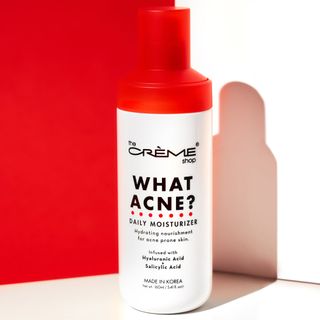
The Crème Shop What Acne? - Daily Moisturizer

The Crème Shop What Acne? - Daily Moisturizer

Efficacy37/100IrritancyHigh
Edit

Works for

1 of 2 advertised claims delivered

Moisturizing
Sodium hyaluronate, Laminaria japonica extract + 14 more
Good evidence
What the product description says
“What Acne? , Daily Moisturizer , Daily Moisturizer”
From product name

This product contains good ingredients to attract water to the upper layer of the skin. These ingredients are called "humectants": glycerin, sodium hyaluronate.

When humectants are on the surface of the skin, they “pull in” the moisture from the outside environment, or from within deeper layers of the skin. If the air is dry, humectants can speed up the moisture loss from the skin. This is why it is a good idea to use another product on top of this one to help "seal in" the moisture (look for ingredients like dimethicone, squalane, oils and butters).

Sodium hyaluronateKey active· HumectantEffect: HighOne of the best moisturizing ingredients. Attracts water into the upper layer of the skin~0.1–0.3%
Laminaria japonica extractKey activeEffect: HighSeaweed extract that might help to attract water to the upper layer of the skin and have some anti-oxidant properties~0.1–0.35%
GlycerinKey active· HumectantEffect: HighOne of the best moisturizing ingredients. Naturally present in skin. It attracts water to the upper layer of the skin working as a humectant~3.3–4.9%
Undaria pinnatifida extractKey activeEffect: HighA seaweed extract that helps attract water to the upper layer of the skin and might have an anti-oxidant effect~0.1–0.3%
Sesamum indicum seed extractKey activeEffect: HighPlant oil that due to its high content of linoleic acid can help support skin's barrier function improving its hydration~0.1–0.3%
GlucoseKey active· HumectantEffect: MediumHelps attract water to the upper layer of the skin. Could be helpful in restoring the skin barrier function~1–1.6%
Cetyl alcoholKey active· EmollientEffect: MediumA non-drying alcohol that works to soften the skin and stabilize product formulations helping oil and water mix together~0.2–0.75%
CyclopentasiloxaneKey active· EmollientEffect: MediumA silicone that helps improve the product texture and spreadability. Can absorb oil creating a short-term mattifying effect on the skin~0.5–1.2%
Butylene glycol· HumectantEffect: LowUsed to create a nice product texture and help delivery of other ingredients. Might be somewhat helpful in attracting water to the upper layer of the skin~0.1–0.35%
Dicaprylyl carbonate· EmollientEffect: LowHelps products spread more easily and works as an emollient to soften skin~4.3–6.5%
Scutellaria baicalensis root extract· HumectantEffect: LowA plant extract that might contain a compound baicalin that could be helpful in neutralizing free radicals and reducing inflammation in skin. The baicalin concentration in skincare products is often too low for an effective action. Can be used for its fragrant properties~0.1–0.35%
Caprylyl glycol· Humectant, EmollientEffect: LowHelps preserve products and creates a nice product texture~0.2–0.7%
Hydrogenated polyisobutene· Emollient, OcclusiveEffect: LowUsed to improve the product consistency and soften the upper layer of the skin~3.7–5.5%
Camellia sinensis leaf extractEffect: LowCan contain potent anti-oxidant compounds (abbreviated ECG, GCG, EGC, and EGCG) that might help protect the skin from free radicals. Can help calm down inflammation and has some anti-bacterial properties. Unfortunately, these antioxidants are unstable and lose their effectiveness very quickly in products. The concentration of the antioxidant compounds in the extract also tends to be low to be effective in topical formulation~22–34%
GluconolactoneUnder-dosedEffect: HighA polyhydroxy acid (PHA) that helps shed the dead cells from the skin surface revealing smoother skin. Is believed to be genter than AHAs. It helps attract water to the upper layer of the skin and can stimulate production of skin's own hyaluronic acid resulting in improved hydration levels. It has been shown to be helpful against acne and clogged pores if used consistently (e.g over a period of 12 weeks) in high enough concentration. It can help reduce fine lines and wrinkles and improve skin tone with long-term application. Can help neutralize free radicals~0.15–0.5%
CyclohexasiloxaneEffect: Low, below effective doseA silicone that serves as an emollient. Helps create a nice non-greasy feels~0.4–0.95%
Anti-blemish
Camellia sinensis leaf extract, Salicylic acid + 1 more
Weak evidence
What the product description says
“What Acne? , Daily Moisturizer , Daily Moisturizer”
From product name

Effective ingredients missing or their concentration is too low.

Camellia sinensis leaf extractEffect: LowCan contain potent anti-oxidant compounds (abbreviated ECG, GCG, EGC, and EGCG) that might help protect the skin from free radicals. Can help calm down inflammation and has some anti-bacterial properties. Unfortunately, these antioxidants are unstable and lose their effectiveness very quickly in products. The concentration of the antioxidant compounds in the extract also tends to be low to be effective in topical formulation~22–34%
Salicylic acidUnder-dosedEffect: HighUsed for skin exfoliation. It has an anti-inflammatory and anti-bacterial effect, helps to unclog pores, prevent blemishes and speed up healing of the existing ones. Sometimes referred to as a BHA (beta-hydroxy acid)~0.15–0.6%
GluconolactoneUnder-dosedEffect: MediumA polyhydroxy acid (PHA) that helps shed the dead cells from the skin surface revealing smoother skin. Is believed to be genter than AHAs. It helps attract water to the upper layer of the skin and can stimulate production of skin's own hyaluronic acid resulting in improved hydration levels. It has been shown to be helpful against acne and clogged pores if used consistently (e.g over a period of 12 weeks) in high enough concentration. It can help reduce fine lines and wrinkles and improve skin tone with long-term application. Can help neutralize free radicals~0.15–0.5%
Anti-oxidation
Not advertised by the brand · Camellia sinensis leaf extract, Camellia japonica leaf extract + 7 more
Moderate evidence

This product contains antioxidants (camellia sinensis leaf extract) that might be able to help neutralize free radicals in skin to lessen the damage it gets from the UV light (sun). There is not enough evidence to confirm their effectiveness in skin though.

Camellia sinensis leaf extractKey activeEffect: MediumCan contain potent anti-oxidant compounds (abbreviated ECG, GCG, EGC, and EGCG) that might help protect the skin from free radicals. Can help calm down inflammation and has some anti-bacterial properties. Unfortunately, these antioxidants are unstable and lose their effectiveness very quickly in products. The concentration of the antioxidant compounds in the extract also tends to be low to be effective in topical formulation~22–34%
Camellia japonica leaf extractEffect: LowA plant extract that might help neutralize free radicals in skin~0.1–0.35%
Undaria pinnatifida extractEffect: LowA seaweed extract that helps attract water to the upper layer of the skin and might have an anti-oxidant effect~0.1–0.3%
Glycyrrhiza glabra root extractEffect: LowA plant extract that can help lighten the skin and calm down inflammation. Might be helpful in neutralizing free radicals~0.1–0.45%
Morus alba bark extractEffect: LowA plant extract that might have anti-oxidant properties and help even out skin tone, but solid evidence is lacking~0.1–0.5%
Scutellaria baicalensis root extractEffect: LowA plant extract that might contain a compound baicalin that could be helpful in neutralizing free radicals and reducing inflammation in skin. The baicalin concentration in skincare products is often too low for an effective action. Can be used for its fragrant properties~0.1–0.35%
GluconolactoneUnder-dosedEffect: MediumA polyhydroxy acid (PHA) that helps shed the dead cells from the skin surface revealing smoother skin. Is believed to be genter than AHAs. It helps attract water to the upper layer of the skin and can stimulate production of skin's own hyaluronic acid resulting in improved hydration levels. It has been shown to be helpful against acne and clogged pores if used consistently (e.g over a period of 12 weeks) in high enough concentration. It can help reduce fine lines and wrinkles and improve skin tone with long-term application. Can help neutralize free radicals~0.15–0.5%
3-o-ethyl ascorbic acidUnder-dosedEffect: MediumA vitamin C derivative that is more stable but less potent than pure form of vitamin C. Can help neutralize free radicals and help reduce hyperpigmentation, but the required concentration is likely to be much higher than for the pure form of vitamin C, limiting the ingredient's effectiveness in products~0.1–0.35%
Tocopheryl acetateEffect: Low, below effective doseA more stable but less bio-available form of vitamin E compared to Tocopherol. Might help moisturize and protect the skin from free radicals, but mostly used in low concentrations to stabilize other ingredients.~0.1–0.35%

Can it cause trouble?

Irritancy
7 strong irritants: Alcohol, Citrus aurantium bergamia fruit oil + 5 more — patch-test recommended
High risk
We flagged 22 ingredients with irritancy potential. Severity depends on your sensitivity threshold; the table lists the worst offenders first.
IngredientFunctionIrritationEst. amount
AlcoholCan be drying and contribute to skin irritation. Used in formulars to dissolve other ingredients, create a thinner product consistency or for its antibacterial propertiesHigh~2.6–3.9%est.
Salicylic acidUsed for skin exfoliation. It has an anti-inflammatory and anti-bacterial effect, helps to unclog pores, prevent blemishes and speed up healing of the existing ones. Sometimes referred to as a BHA (beta-hydroxy acid)High~0.15–0.6%est.
Citrus aurantium bergamia fruit oilA plant oil with a high content of volatile compounds that can irritate the skin and lead to allergic reactions. Can lead to photosensitivityHigh~0.1–0.35%est.
Lavandula angustifolia oilAn essential oil. Potential allergen and can be irritating. It has some anti-bacterial propertiesHigh~0.1–0.3%est.
3-o-ethyl ascorbic acidA vitamin C derivative that is more stable but less potent than pure form of vitamin C. Can help neutralize free radicals and help reduce hyperpigmentation, but the required concentration is likely to be much higher than for the pure form of vitamin C, limiting the ingredient's effectiveness in productsHigh~0.1–0.35%est.
Morus alba bark extractA plant extract that might have anti-oxidant properties and help even out skin tone, but solid evidence is lackingHigh~0.1–0.5%est.
Sophora angustifolia root extract—High~0.1–0.45%est.
Scutellaria baicalensis root extractA plant extract that might contain a compound baicalin that could be helpful in neutralizing free radicals and reducing inflammation in skin. The baicalin concentration in skincare products is often too low for an effective action. Can be used for its fragrant propertiesHigh~0.1–0.35%est.
Lavandula angustifolia extractUsed for fragrance and contains volatile compounds that can irritate the skinHigh~0.1–0.45%est.
Rosmarinus officinalis extract—High~0.1–0.35%est.
Thymus vulgaris extract—High~0.1–0.3%est.
C12-20 alkyl glucosideHelps water and oil mix togetherMedium~1.5–2.2%est.
Hydroxyethyl acrylate/sodium acryloyldimethyl taurate copolymerA gelling agent that thickens the product consistency and leaves the skin with a velvety finishMedium~0.15–0.6%est.
1,2-hexanediolA preservativeMedium~0.15–0.55%est.
Caprylyl glycolHelps preserve products and creates a nice product textureMedium~0.2–0.7%est.
GluconolactoneA polyhydroxy acid (PHA) that helps shed the dead cells from the skin surface revealing smoother skin. Is believed to be genter than AHAs. It helps attract water to the upper layer of the skin and can stimulate production of skin's own hyaluronic acid resulting in improved hydration levels. It has been shown to be helpful against acne and clogged pores if used consistently (e.g over a period of 12 weeks) in high enough concentration. It can help reduce fine lines and wrinkles and improve skin tone with long-term application. Can help neutralize free radicalsMedium~0.15–0.5%est.
EthylhexylglycerinA preservativeMedium~0.1–0.4%est.
Disodium edtaStabilizes the product formulationMedium~0.1–0.35%est.
Camellia japonica leaf extractA plant extract that might help neutralize free radicals in skinMedium~0.1–0.35%est.
Tocopheryl acetateA more stable but less bio-available form of vitamin E compared to Tocopherol. Might help moisturize and protect the skin from free radicals, but mostly used in low concentrations to stabilize other ingredients.Medium~0.1–0.35%est.
Glycyrrhiza glabra root extractA plant extract that can help lighten the skin and calm down inflammation. Might be helpful in neutralizing free radicalsMedium~0.1–0.45%est.
Comedogenic
1 ingredient rated 2 or more on the 0–5 pore-clogging scale
1 flagged
These ingredients have a comedogenic rating of 2 or more on a 0–5 scale; the table shows each one's rating. In leave-on products they can clog pores in acne-prone skin.
IngredientFunctionRatingEst. amount
Laminaria japonica extractSeaweed extract that might help to attract water to the upper layer of the skin and have some anti-oxidant properties3/5~0.1–0.35%est.
Edit

User reviews

Would you recommend?
No community reviews yet.

Be the first — your take helps the next person decide.

Write a review · ~30s

Ingredients

Filter by role to see what each ingredient is doing.

Camellia sinensis leaf extract~22–34%
Key active
Irritation risk
Low
Works for
Anti-oxidationAntibacterialAnti-agingAnti-blemishEvens skin toneMoisturizing

Can contain potent anti-oxidant compounds (abbreviated ECG, GCG, EGC, and EGCG) that might help protect the skin from free radicals. Can help calm down inflammation and has some anti-bacterial properties. Unfortunately, these antioxidants are unstable and lose their effectiveness very quickly in products. The concentration of the antioxidant compounds in the extract also tends to be low to be effective in topical formulation

More about Camellia sinensis leaf extract
Glycerin~3.3–4.9%
Key active
Irritation risk
Low
Works for
Moisturizing

One of the best moisturizing ingredients. Naturally present in skin. It attracts water to the upper layer of the skin working as a humectant

More about Glycerin
Dicaprylyl carbonate~4.3–6.5%
Formula
Irritation risk
Low
Works for
Moisturizing

Helps products spread more easily and works as an emollient to soften skin

More about Dicaprylyl carbonate
Hydrogenated polyisobutene~3.7–5.5%
Formula
Irritation risk
Low
Works for
Moisturizing

Used to improve the product consistency and soften the upper layer of the skin

More about Hydrogenated polyisobutene
Alcohol~2.6–3.9%
Irritant · high
Irritation risk
High
Works for
Antibacterial

Can be drying and contribute to skin irritation. Used in formulars to dissolve other ingredients, create a thinner product consistency or for its antibacterial properties

More about Alcohol
C14-22 alcohols~1.9–2.9%
Formula
Irritation risk
Low

A non-drying alcohol that helps stabilize product formulations

More about C14-22 alcohols
C12-20 alkyl glucoside~1.5–2.2%
Irritant · medium
Irritation risk
Medium
Works for
Cleansing

Helps water and oil mix together

More about C12-20 alkyl glucoside
Water~1.3–1.9%
Formula
Irritation risk
Low

Plain old water

More about Water
Glucose~1–1.6%
Key active
Irritation risk
Low
Works for
Moisturizing

Helps attract water to the upper layer of the skin. Could be helpful in restoring the skin barrier function

More about Glucose
Propanediol~0.8–1.2%
Formula
Irritation risk
Low

Acts as a solvent for other ingredients. Speeds up the absorption of other ingredients into the skin

More about Propanediol
Cyclopentasiloxane~0.5–1.2%
Key active
Irritation risk
Low
Works for
MattifyingMoisturizing

A silicone that helps improve the product texture and spreadability. Can absorb oil creating a short-term mattifying effect on the skin

More about Cyclopentasiloxane
Cyclohexasiloxane~0.4–0.95%
Formula
Irritation risk
Low
Works for
Moisturizing

A silicone that serves as an emollient. Helps create a nice non-greasy feels

More about Cyclohexasiloxane
Sea water~0.15–0.65%
Formula
Irritation risk
Low

Dissolves other ingredients. It does not have additional skin benefits compared to plain water

More about Sea water
Hydroxyethyl acrylate/sodium acryloyldimethyl taurate copolymer~0.15–0.6%
Irritant · medium
Irritation risk
Medium

A gelling agent that thickens the product consistency and leaves the skin with a velvety finish

More about Hydroxyethyl acrylate/sodium acryloyldimethyl taurate copolymer
Cetyl alcohol~0.2–0.75%
Key active
Irritation risk
Low
Works for
CleansingMoisturizing

A non-drying alcohol that works to soften the skin and stabilize product formulations helping oil and water mix together

More about Cetyl alcohol
1,2-hexanediol~0.15–0.55%
Irritant · medium
Irritation risk
Medium

A preservative

More about 1,2-hexanediol
Caprylyl glycol~0.2–0.7%
Irritant · medium
Irritation risk
Medium
Works for
Moisturizing

Helps preserve products and creates a nice product texture

More about Caprylyl glycol
Salicylic acid~0.15–0.6%
Under-dosedIrritant · high
Irritation risk
High
Works for
ExfoliationAnti-blemishAnti-inflammatoryAntibacterialEvens skin tone

Used for skin exfoliation. It has an anti-inflammatory and anti-bacterial effect, helps to unclog pores, prevent blemishes and speed up healing of the existing ones. Sometimes referred to as a BHA (beta-hydroxy acid)

More about Salicylic acid
Gluconolactone~0.15–0.5%
Under-dosedIrritant · medium
Irritation risk
Medium
Works for
ExfoliationAnti-agingMoisturizingEvens skin toneAnti-oxidationAnti-blemish

A polyhydroxy acid (PHA) that helps shed the dead cells from the skin surface revealing smoother skin. Is believed to be genter than AHAs. It helps attract water to the upper layer of the skin and can stimulate production of skin's own hyaluronic acid resulting in improved hydration levels. It has been shown to be helpful against acne and clogged pores if used consistently (e.g over a period of 12 weeks) in high enough concentration. It can help reduce fine lines and wrinkles and improve skin tone with long-term application. Can help neutralize free radicals

More about Gluconolactone
Ammonium acryloyldimethyltaurate/vp copolymer~0.1–0.45%
Formula
Irritation risk
Low

Increases thickness of a product. Texture enhancer for oil-in-water emulsions

More about Ammonium acryloyldimethyltaurate/vp copolymer
Citrus aurantium bergamia fruit oil~0.1–0.35%
Irritant · high
Irritation risk
High

A plant oil with a high content of volatile compounds that can irritate the skin and lead to allergic reactions. Can lead to photosensitivity

More about Citrus aurantium bergamia fruit oil
Ethylhexylglycerin~0.1–0.4%
Irritant · medium
Irritation risk
Medium

A preservative

More about Ethylhexylglycerin
Disodium edta~0.1–0.35%
Irritant · medium
Irritation risk
Medium

Stabilizes the product formulation

More about Disodium edta
Lavandula angustifolia oil~0.1–0.3%
Irritant · high
Irritation risk
High

An essential oil. Potential allergen and can be irritating. It has some anti-bacterial properties

More about Lavandula angustifolia oil
3-o-ethyl ascorbic acid~0.1–0.35%
Under-dosedIrritant · high
Irritation risk
High
Works for
Evens skin toneAnti-oxidationAnti-aging

A vitamin C derivative that is more stable but less potent than pure form of vitamin C. Can help neutralize free radicals and help reduce hyperpigmentation, but the required concentration is likely to be much higher than for the pure form of vitamin C, limiting the ingredient's effectiveness in products

More about 3-o-ethyl ascorbic acid
Sophora flavescens extract~0.1–0.35%
Formula
Terminalia chebula fruit extract~0.1–0.3%
Formula
Camellia japonica leaf extract~0.1–0.35%
Irritant · medium
Irritation risk
Medium
Works for
Anti-oxidation

A plant extract that might help neutralize free radicals in skin

More about Camellia japonica leaf extract
Sodium hyaluronate~0.1–0.3%
Key active
Irritation risk
Low
Works for
Moisturizing

One of the best moisturizing ingredients. Attracts water into the upper layer of the skin

More about Sodium hyaluronate
Tocopheryl acetate~0.1–0.35%
Irritant · medium
Irritation risk
Medium
Works for
Anti-oxidation

A more stable but less bio-available form of vitamin E compared to Tocopherol. Might help moisturize and protect the skin from free radicals, but mostly used in low concentrations to stabilize other ingredients.

More about Tocopheryl acetate
Undaria pinnatifida extract~0.1–0.3%
Key active
Irritation risk
Low
Works for
MoisturizingAnti-oxidation

A seaweed extract that helps attract water to the upper layer of the skin and might have an anti-oxidant effect

More about Undaria pinnatifida extract
Laminaria japonica extract~0.1–0.35%
Key activeComedogenic 3/5
Irritation risk
Low
Comedogenicity
3/5
Works for
Moisturizing

Seaweed extract that might help to attract water to the upper layer of the skin and have some anti-oxidant properties

More about Laminaria japonica extract
Hizikia fusiforme extract~0.1–0.3%
Formula
Butylene glycol~0.1–0.35%
Formula
Irritation risk
Low
Works for
Moisturizing

Used to create a nice product texture and help delivery of other ingredients. Might be somewhat helpful in attracting water to the upper layer of the skin

More about Butylene glycol
Glycyrrhiza glabra root extract~0.1–0.45%
Irritant · medium
Irritation risk
Medium
Works for
Anti-oxidationEvens skin toneReduces rednessAnti-inflammatoryAntibacterial

A plant extract that can help lighten the skin and calm down inflammation. Might be helpful in neutralizing free radicals

More about Glycyrrhiza glabra root extract
Cimicifuga racemosa root extract~0.1–0.45%
Formula
Polygonum multiflorum root extract~0.1–0.4%
Formula
Sesamum indicum seed extract~0.1–0.3%
Key active
Irritation risk
Low
Works for
Moisturizing

Plant oil that due to its high content of linoleic acid can help support skin's barrier function improving its hydration

More about Sesamum indicum seed extract
Phellinus linteus extract~0.1–0.4%
Formula
Angelica gigas root extract~0.1–0.45%
Formula
Morus alba bark extract~0.1–0.5%
Irritant · high
Irritation risk
High
Works for
Anti-oxidationEvens skin tone

A plant extract that might have anti-oxidant properties and help even out skin tone, but solid evidence is lacking

More about Morus alba bark extract
Paeonia albiflora root extract~0.1–0.45%
Formula
Sophora angustifolia root extract~0.1–0.45%
Irritant · high
Scutellaria baicalensis root extract~0.1–0.35%
Irritant · high
Irritation risk
High
Works for
MoisturizingAnti-oxidationReduces irritationAnti-inflammatoryAntibacterial

A plant extract that might contain a compound baicalin that could be helpful in neutralizing free radicals and reducing inflammation in skin. The baicalin concentration in skincare products is often too low for an effective action. Can be used for its fragrant properties

More about Scutellaria baicalensis root extract
Lavandula angustifolia extract~0.1–0.45%
Irritant · high
Irritation risk
High

Used for fragrance and contains volatile compounds that can irritate the skin

More about Lavandula angustifolia extract
Rosmarinus officinalis extract~0.1–0.35%
Irritant · high
Origanum vulgare flower/leaf/stem extract~0.1–0.35%
Irritant · high
Thymus vulgaris extract~0.1–0.3%
Irritant · high
Ingredient list view

Camellia sinensis leaf extract, Glycerin, Dicaprylyl carbonate, Hydrogenated polyisobutene, Alcohol, C14-22 alcohols, C12-20 alkyl glucoside, Water, Glucose, Propanediol, Cyclopentasiloxane, Cyclohexasiloxane, Sea water, Hydroxyethyl acrylate/sodium acryloyldimethyl taurate copolymer, Cetyl alcohol, 1,2-hexanediol, Caprylyl glycol, Salicylic acid, Gluconolactone, Ammonium acryloyldimethyltaurate/vp copolymer, Citrus aurantium bergamia fruit oil, Ethylhexylglycerin, Disodium edta, Lavandula angustifolia oil, 3-o-ethyl ascorbic acid, Sophora flavescens extract, Terminalia chebula fruit extract, Camellia japonica leaf extract, Sodium hyaluronate, Tocopheryl acetate, Undaria pinnatifida extract, Laminaria japonica extract, Hizikia fusiforme extract, Butylene glycol, Glycyrrhiza glabra root extract, Cimicifuga racemosa root extract, Polygonum multiflorum root extract, Sesamum indicum seed extract, Phellinus linteus extract, Angelica gigas root extract, Morus alba bark extract, Paeonia albiflora root extract, Sophora angustifolia root extract, Scutellaria baicalensis root extract, Lavandula angustifolia extract, Rosmarinus officinalis extract, Origanum vulgare flower/leaf/stem extract, Thymus vulgaris extract

Compare prices

Retailers ranked by price — lowest first.

Amazon USPrice as of 10/20/2026 09:13 GMT
$5.09
Buy

Affiliate links · prices updated regularly · As an Amazon Associate, WIMJ earns from qualifying purchases.

Worth comparing, line by line.

Match % combines shared ingredients, the first five ingredients, shared actives and hero ingredients, irritancy (lower counts in the alternative's favour), texture and body area. Only products in the same routine step are compared.

Side-by-side comparison of this product against its closest alternatives
The Crème ShopWhat Acne? - Daily MoisturizerYOUR PRODUCTSVRSEBIACLEAR CicapeelIt'S SKINTiger Cica Green Chill Down Calming Soothing PadDECLEORHydra Floral White Petal Skin Perfecting Concentrate
Match—74%71%68%
Price$5.09$30.70+$25.61$23.43+$18.34$69.40+$64.31
Shared key ingredients—3 of 104 of 104 of 10
Key difference—SarcosineCapryloyl Salicylic AcidArginine
Irritancy High Medium High High
Drying alcohol Contains drying alcohol Contains drying alcohol Contains drying alcohol Contains drying alcohol
View product Shop Shop Shop
Cheaper alternatives? See how this stacks up against similar formulas.
We compare ingredient profiles across our catalog — pick the closest match for your budget.
Open dupe finder

Sources cited in this review

Every concentration estimate and effectiveness label is anchored to one of these 35 studies and safety reviews.

  1. 1
  2. 2
  3. 3
  4. 4
  5. 5
  6. 6
The Crème Shop What Acne? - Daily Moisturizer
The Crème ShopWhat Acne? - Daily Moisturizer

Affiliate links · As an Amazon Associate, WIMJ earns from qualifying purchases.

As an Amazon Associate, WIMJ earns from qualifying purchases.