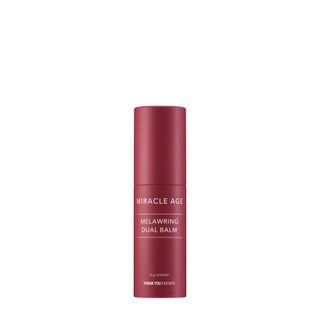
Thank You Farmer Miracle Age Melawring Dual Balm
Works for
3 of 3 advertised claims delivered
Evens skin tone1 ingredient credited for this claimModerate support
“This high-performance dual balm is specifically designed to combat wrinkles and reduce melanin production, effectively diminishing hyperpigmentation.”
The following ingredient (ingredients) in this product might be helpful, but there is no evidence to confirm that it actually works: pancratium maritimum extract.
Moisturizing23 ingredients credited for this claimGood support
“This smooth and non-sticky formula is infused with target-oriented ingredients that work harmoniously to provide you with anti-aging, moisturizing, and soothing benefits.”
This product can help improve hydration of the skin with the two types of ingredients.
The first type is called “humectants”:
these ingredients help attract water.
When humectants are on the surface of the skin, they “pull in” the moisture from the outside environment, or from
within deeper layers of the skin. The following ingredients in this product do the job:
allantoin, glycerin.
This product also contains ingredients called “occlusives”. They help reduce the speed with which our skin loses moisture to the outside environment. These ingredients also help soften the upper layer of the skin, so it feels less tight and nicer to the touch. The following ingredients in this product do the job: caprylic/capric triglyceride, helianthus annuus seed oil.
Anti-aging4 ingredients credited for this claimModerate support
“This high-performance dual balm is specifically designed to combat wrinkles and reduce melanin production, effectively diminishing hyperpigmentation.”
This product contains centella asiatica extract. This ingredient might be able to help reduce and prevent fine lines and wrinkles, improve skin elasticity and firmness, but there is not enough evidence that it actually works.
Anti-oxidationNot advertised by the brand · 10 ingredients credited for this claimModerate support
This product contains antioxidants (centella asiatica extract) that might be able to help neutralize free radicals in skin to lessen the damage it gets from the UV light (sun). There is not enough evidence to confirm their effectiveness in skin though.
Can it cause trouble?
Irritancy1 strong irritant: Citrus aurantium bergamia fruit oilMedium risk
Comedogenic1 ingredient rated 2 or more on the 0–5 pore-clogging scale1 flagged
User reviews
Be the first — your take helps the next person decide.
Ingredients
Filter by role to see what each ingredient is doing.
Lactobacillus ferment~22–33%
- Irritation risk
- Low
A fermentation product created by bacteria Lactobacillus. The fermented product has anti-bacterial properties and might be helpful in calming down inflammation, but studies are lacking. Helps attract water to the upper layer of the skin. Can be used as a preservative
More about Lactobacillus fermentPancratium maritimum extract~3.4–5.2%
- Irritation risk
- High
A plant extract that might help neutralize free radicals in skin. It might help reduce hyperpigmentation
More about Pancratium maritimum extractArgania spinosa kernel oil~4.4–6.7%
- Irritation risk
- Medium
An emollient that helps soften the upper layer of the skin. Might have some weak anti-oxidant properties
More about Argania spinosa kernel oilLespedeza capitata leaf/stem extract~3.6–5.4%
- Irritation risk
- Low
Allantoin~2.5–3.8%
- Irritation risk
- Low
Helps calm down inflammation in skin and can help reduce itching. Helps to repair the skin barrier and keep skin hydrated
More about AllantoinCentella asiatica extract~1.9–2.9%
- Irritation risk
- Medium
A plant extract that has been shown to be able to reduce inflammation in skin, support restoration of skin barrier function, as well as support collagen production. Contains active compounds called centelloids: asiaticoside, madecasosside, asiatic acid and madecassic acid. Might be helpful in preventing stretch marks. It can be itself be irritating though.
More about Centella asiatica extractCaprylic/capric triglyceride~1.8–2.6%
- Irritation risk
- Medium
A good mix of fatty acids that forms a protective layer on the skin. Improves the shelf life of products. Derived from coconut and glycerin
More about Caprylic/capric triglyceridePolyglyceryl-2 triisostearate~1.3–1.9%
- Irritation risk
- Low
Helps to soften the upper layer of the skin and create a nice product texture
More about Polyglyceryl-2 triisostearateTridecyl trimellitate~1.1–1.7%
- Irritation risk
- Medium
Used to create a thicker product consistency and soften the upper layer of the skin
More about Tridecyl trimellitateOctyldodecanol~0.9–1.35%
- Irritation risk
- Low
An emollient that helps to soften the skin and create a pleasant product texture and stabilize the formulation
More about OctyldodecanolMacadamia seed oil polyglyceryl-6 esters behenate~0.55–1.3%
Synthetic wax~0.45–1.05%
- Irritation risk
- Low
Used to stabilize product formulations and thicken product consistency
More about Synthetic waxButyrospermum parkii butter~0.4–0.9%
- Irritation risk
- Low
- Comedogenicity
- 3/5
A great moisturising ingredient that softens the skin and reduces water loss from its upper layer. It also can be helpful in protecting skin from free radicals
More about Butyrospermum parkii butterMicrocrystalline wax~0.35–0.8%
Tocopheryl acetate~0.2–0.7%
- Irritation risk
- Medium
A more stable but less bio-available form of vitamin E compared to Tocopherol. Might help moisturize and protect the skin from free radicals, but mostly used in low concentrations to stabilize other ingredients.
More about Tocopheryl acetatePolymethylsilsesquioxane~0.3–0.75%
- Irritation risk
- Low
A silicone that improves product texture and helps dissolve other ingredients. Can form a non-greasy film on the skin to prevent moisture loss
More about PolymethylsilsesquioxaneVinyl dimethicone/methicone silsesquioxane crosspolymer~0.2–0.75%
- Irritation risk
- Low
A type of silicone that create a smooth product finish and can create an optical soft-focus effect on the skin. Helps to thicken the product consistency
More about Vinyl dimethicone/methicone silsesquioxane crosspolymerPolyethylene~0.5–1.1%
Silica~0.4–0.9%
Euphorbia cerifera wax~0.4–0.95%
- Irritation risk
- Low
Tocopherol~0.15–0.65%
- Irritation risk
- Low
Pure form of vitamin E. Can help moisturise and protect the skin from free radicals. Often used to help stabilise other ingredients or the formula itself
More about TocopherolPhytosteryl/isostearyl/cetyl/stearyl/behenyl dimer dilinoleate~0.3–0.7%
- Irritation risk
- Low
Helps soften the upper layer of the skin and create a nice product consistency
More about Phytosteryl/isostearyl/cetyl/stearyl/behenyl dimer dilinoleateBisabolol~0.1–0.5%
- Irritation risk
- Low
An active component of chamomile plant that historically has been used to calm down irritated skin. A recent study shows that bisabolol indeed can have some anti-inflammatory effect on skin, even though conclusive data is lacking. Bisabolol has a sweet floral scent and can be added to products for its aromatic properties
More about BisabololSorbitan olivate~0.15–0.65%
Glyceryl caprylate~0.2–0.8%
- Irritation risk
- Low
An emollient that can also help water and oil mix together, as well as prevent bacteria growth in products
More about Glyceryl caprylateStearalkonium hectorite~0.15–0.6%
Hippophae rhamnoides fruit oil~0.15–0.6%
- Irritation risk
- High
A plant oil that might somewhat help to neutralize free radicals. It could be irritating
More about Hippophae rhamnoides fruit oilCitrus aurantium bergamia fruit oil~0.15–0.55%
- Irritation risk
- High
A plant oil with a high content of volatile compounds that can irritate the skin and lead to allergic reactions. Can lead to photosensitivity
More about Citrus aurantium bergamia fruit oilSimmondsia chinensis seed oil~0.2–0.8%
- Irritation risk
- Medium
Softens the upper layer of skin and helps restore the healthy skin barrier. Has shown to help calm down inflammation in skin. It is a stable oil, meaning that it retains its properties even when exposed to air.
More about Simmondsia chinensis seed oilArgania spinosa kernel oil~0.2–0.75%
- Irritation risk
- Medium
An emollient that helps soften the upper layer of the skin. Might have some weak anti-oxidant properties
More about Argania spinosa kernel oilHelianthus annuus seed oil~0.2–0.75%
- Irritation risk
- Low
A great emollient due to its high linoleic acid content. One of the most effective plant oils in helping skin hydration and repairing skin barrier function
More about Helianthus annuus seed oilMacadamia integrifolia seed oil~0.2–0.75%
- Irritation risk
- Low
A plant oil that helps soften the upper layer of the skin
More about Macadamia integrifolia seed oilOlea europaea fruit oil~0.15–0.7%
- Irritation risk
- Medium
An emollient that helps soften the skin but is not effective for restoring its barrier function. Might be helpful to calm down inflammation
More about Olea europaea fruit oilCamellia sinensis seed oil~0.2–0.7%
- Irritation risk
- Low
A plant oil that helps to soften the upper layer of the skin and can help restore the skin barrier. Might have some anti-oxidant effect
More about Camellia sinensis seed oilCamellia japonica seed oil~0.2–0.75%
- Irritation risk
- Low
A plant oil that helps to soften the upper layer of the skin and can help restore skin's barrier function. Might have an anti-oxidant effect
More about Camellia japonica seed oilPropylene carbonate~0.15–0.7%
- Irritation risk
- Low
Is used to dissolve other ingredients and create nice product texture
More about Propylene carbonateGlyceryl behenate/eicosadioate~0.2–0.75%
Dehydroacetic acid~0.15–0.55%
Monascus extract~0.15–0.55%
- Irritation risk
- Low
A yeast extract that might help to attract water to the upper layer of the skin
More about Monascus extractWater~0.15–0.55%
Glycerin~0.15–0.65%
- Irritation risk
- Low
One of the best moisturizing ingredients. Naturally present in skin. It attracts water to the upper layer of the skin working as a humectant
More about GlycerinButylene glycol~0.1–0.4%
- Irritation risk
- Low
Used to create a nice product texture and help delivery of other ingredients. Might be somewhat helpful in attracting water to the upper layer of the skin
More about Butylene glycolPropanediol~0.1–0.4%
- Irritation risk
- Low
Acts as a solvent for other ingredients. Speeds up the absorption of other ingredients into the skin
More about PropanediolLactobacillus ferment~0.1–0.3%
- Irritation risk
- Low
A fermentation product created by bacteria Lactobacillus. The fermented product has anti-bacterial properties and might be helpful in calming down inflammation, but studies are lacking. Helps attract water to the upper layer of the skin. Can be used as a preservative
More about Lactobacillus fermentAllantoin~0.05–0.25%
- Irritation risk
- Low
Helps calm down inflammation in skin and can help reduce itching. Helps to repair the skin barrier and keep skin hydrated
More about Allantoin1,2-hexanediol~0.05–0.3%
Lespedeza capitata leaf/stem extract~0.1–0.3%
- Irritation risk
- Low
Pancratium maritimum extract~0.05–0.15%
- Irritation risk
- High
A plant extract that might help neutralize free radicals in skin. It might help reduce hyperpigmentation
More about Pancratium maritimum extractCentella asiatica extract~0.1–0.4%
- Irritation risk
- Medium
A plant extract that has been shown to be able to reduce inflammation in skin, support restoration of skin barrier function, as well as support collagen production. Contains active compounds called centelloids: asiaticoside, madecasosside, asiatic acid and madecassic acid. Might be helpful in preventing stretch marks. It can be itself be irritating though.
More about Centella asiatica extractIngredient list view
Lactobacillus ferment, Pancratium maritimum extract, Argania spinosa kernel oil, Lespedeza capitata leaf/stem extract, Allantoin, Centella asiatica extract, Caprylic/capric triglyceride, Polyglyceryl-2 triisostearate, Tridecyl trimellitate, Octyldodecanol, Macadamia seed oil polyglyceryl-6 esters behenate, Synthetic wax, Butyrospermum parkii butter, Microcrystalline wax, Tocopheryl acetate, Polymethylsilsesquioxane, Vinyl dimethicone/methicone silsesquioxane crosspolymer, Polyethylene, Silica, Euphorbia cerifera wax, Tocopherol, Phytosteryl/isostearyl/cetyl/stearyl/behenyl dimer dilinoleate, Bisabolol, Sorbitan olivate, Glyceryl caprylate, Stearalkonium hectorite, Hippophae rhamnoides fruit oil, Citrus aurantium bergamia fruit oil, Simmondsia chinensis seed oil, Argania spinosa kernel oil, Helianthus annuus seed oil, Macadamia integrifolia seed oil, Olea europaea fruit oil, Camellia sinensis seed oil, Camellia japonica seed oil, Propylene carbonate, Glyceryl behenate/eicosadioate, Dehydroacetic acid, Monascus extract, Water, Glycerin, Butylene glycol, Propanediol, Lactobacillus ferment, Allantoin, 1,2-hexanediol, Lespedeza capitata leaf/stem extract, Pancratium maritimum extract, Centella asiatica extract
Compare prices
Retailers ranked by price — lowest first.


Sources cited in this review
Every concentration estimate and effectiveness label is anchored to one of these 30 studies and safety reviews.
- 1
- 2
- 3Use of Probiotics for Dermal Applicationsresearchgate.net
- 4
- 5
- 6

Affiliate links · As an Amazon Associate, WIMJ earns from qualifying purchases.