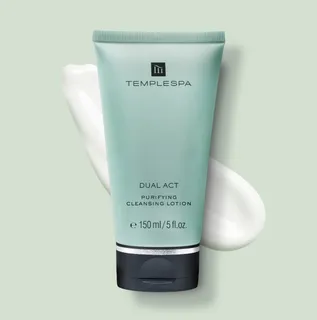
Works for
CleansingGlyceryl stearate, Peg-100 stearate + 2 moreCleanses gently
“Prebiotic willowherb flower, willow bark and seaweed extracts work to efficiently remove make-up and daily grime, purify pores and deeply cleanse, lifting away impurities and excess sebum.”
This product works by removing dirt and oil from the surface of the skin. It uses a combination of mild cleansing agents (glyceryl stearate, peg-100 stearate, peg-40 hydrogenated castor oil, stearic acid) and should be able to cleanse the skin gently. Still keep in mind that any cleansing can disrupt the skin barrier, and most people do not need to cleanse their skin more than once per day.
Can it cause trouble?
Irritancy6 strong irritants: Parfum, Retinyl palmitate + 4 more — patch-test recommendedHigh risk
Comedogenic1 ingredient rated 2 or more on the 0–5 pore-clogging scale1 flagged
User reviews
Be the first — your take helps the next person decide.
Ingredients
Filter by role to see what each ingredient is doing.
Water~45–55%
Caprylic/capric triglyceride~6.9–8.5%
- Irritation risk
- Medium
A good mix of fatty acids that forms a protective layer on the skin. Improves the shelf life of products. Derived from coconut and glycerin
More about Caprylic/capric triglycerideGlycerin~4.2–5.2%
- Irritation risk
- Low
One of the best moisturizing ingredients. Naturally present in skin. It attracts water to the upper layer of the skin working as a humectant
More about GlycerinButylene glycol~3.2–3.9%
- Irritation risk
- Low
Used to create a nice product texture and help delivery of other ingredients. Might be somewhat helpful in attracting water to the upper layer of the skin
More about Butylene glycolGlyceryl stearate~2.4–3%
- Irritation risk
- Low
An emollient that softens the skin and forms a protective layer on its surface. Helps water and oil mix together
More about Glyceryl stearatePeg-100 stearate~2.1–2.6%
- Irritation risk
- Low
Helps oil and water mix togehter and creates a nice product texture
More about Peg-100 stearatePrunus armeniaca kernel oil~1.7–2.1%
- Irritation risk
- Medium
An emollient that helps soften the skin
More about Prunus armeniaca kernel oilVitis vinifera seed oil~1.5–1.9%
- Irritation risk
- Medium
A great emollient that can also have anti-oxidant properties
More about Vitis vinifera seed oilPhenoxyethanol~0.5–1%
- Irritation risk
- Low
A preservative. It helps prevent bacterial growth in cosmetic products
More about PhenoxyethanolStearic acid~1.1–1.3%
- Irritation risk
- Low
Helps oil and water mix together and works as an emollient
More about Stearic acidAcrylates/c10-30 alkyl acrylate crosspolymer~0.75–1.15%
- Irritation risk
- Medium
Maintains the texture of skincare products. Allows the product to spread evenly. Helps oil and water mix together
More about Acrylates/c10-30 alkyl acrylate crosspolymerPeg-40 hydrogenated castor oil~0.6–0.9%
- Irritation risk
- Medium
Helps oil and water mix together
More about Peg-40 hydrogenated castor oilSodium hydroxide~0.55–0.8%
Parfum~0.45–0.7%
- Irritation risk
- High
An aromatic blend of unspecified and possibly irritating ingredients
More about ParfumEthylhexylglycerin~0.45–0.7%
Salix alba bark extract~0.4–0.6%
- Irritation risk
- High
A plant extract that can help neutralize free radicals in skin. It contains a compound salicin that can theoretically be converted into salicylic acid that, in turn, helps reduce inflammation in skin, but the evidence of effectiveness in skin is lacking and the extract is usually not used in a concentration that would enable an exfoliating effect
More about Salix alba bark extractSodium gluconate~0.4–0.6%
Tocopheryl acetate~0.4–0.6%
- Irritation risk
- Medium
A more stable but less bio-available form of vitamin E compared to Tocopherol. Might help moisturize and protect the skin from free radicals, but mostly used in low concentrations to stabilize other ingredients.
More about Tocopheryl acetateRetinyl palmitate~0.3–0.6%
- Irritation risk
- High
Three steps removed from the active form of vitamin A - retinoic acid. To have an effect in the skin, it first needs to be converted twice to become the retinoic acid. This means it is less potent than retinol, but could also be less irritating. Once converted to the retinoic acid in the skin, it helps against all signs of aging, improves skin cell turnover and helps fight blemishes and clogged pores. However, in many cosmetic formulations, it is used in a concentration that is too low to have the full effect
More about Retinyl palmitateAscorbyl tetraisopalmitate~0.3–0.6%
- Irritation risk
- Medium
A vitamin C derivative. Studies show that is might be effective in reducing hyperpigmentation, but there are no studies confirming that it is effectively converted into the bioavailable form of Vitamin C in skin. It is not clear how this derivative compares in effectiveness to the topical application of bioavailable form of vitamin C (L-ascorbic acid)
More about Ascorbyl tetraisopalmitateEpilobium fleischeri flower/leaf/stem extract~0.3–0.5%
- Irritation risk
- Low
Sodium benzoate~0.25–0.5%
Ficus carica fruit extract~0.25–0.45%
- Irritation risk
- Medium
A plant extract that can help neutralize free radicals. The concentrations typically used in cosmetics are too small to have an effect
More about Ficus carica fruit extractFucus vesiculosus extract~0.25–0.45%
- Irritation risk
- Low
- Comedogenicity
- 3/5
Olea europaea leaf extract~0.2–0.4%
- Irritation risk
- Medium
A plant extract that might have some anti-oxidant and anti-inflammatory properties but evidence for effectiveness in skin is missing
More about Olea europaea leaf extractPunica granatum seed extract~0.25–0.4%
Potassium sorbate~0.2–0.4%
Citric acid~0.2–0.35%
- Irritation risk
- Medium
Can work as an exfoliant but is typically used to adjust the product pH
More about Citric acidTocopherol~0.2–0.35%
- Irritation risk
- Low
Pure form of vitamin E. Can help moisturise and protect the skin from free radicals. Often used to help stabilise other ingredients or the formula itself
More about TocopherolCoumarin~0.15–0.25%
Geraniol~0.1–0.25%
Limonene~0.1–0.2%
- Irritation risk
- High
A common frangrance that can easily irritate skin, especially if exposed to air, light or heat
More about LimoneneLinalool~0.1–0.15%
Ci 42090~0.1–0.15%
Ingredient list view
Water, Caprylic/capric triglyceride, Glycerin, Butylene glycol, Glyceryl stearate, Peg-100 stearate, Prunus armeniaca kernel oil, Vitis vinifera seed oil, Phenoxyethanol, Stearic acid, Acrylates/c10-30 alkyl acrylate crosspolymer, Peg-40 hydrogenated castor oil, Sodium hydroxide, Parfum, Ethylhexylglycerin, Salix alba bark extract, Sodium gluconate, Tocopheryl acetate, Retinyl palmitate, Ascorbyl tetraisopalmitate, Epilobium fleischeri flower/leaf/stem extract, Sodium benzoate, Ficus carica fruit extract, Fucus vesiculosus extract, Olea europaea leaf extract, Punica granatum seed extract, Potassium sorbate, Citric acid, Tocopherol, Coumarin, Geraniol, Limonene, Linalool, Ci 42090
Compare prices
Retailers ranked by price — lowest first.

Worth comparing, line by line.
Match % combines shared ingredients, the first five ingredients, shared actives and hero ingredients, irritancy (lower counts in the alternative's favour), texture and body area. Only products in the same routine step are compared.
| Temple SpaDUAL ACTYOUR PRODUCT | SEPHORA COLLECTIONCleansing Wipes - Pomegranate - Energizing | Perricone MDCold Plasma Plus+ Daily Detox Clay Cleanser | endota spaDeep Cleansing Cream | |
|---|---|---|---|---|
| Match | — | 36% | 35% | 34% |
| Price | — | — | $29.00 | $35.11 |
| Shared key ingredients | — | 4 of 12 | 3 of 12 | 6 of 12 |
| Key difference | — | Lauryl Glucoside | Copper Tripeptide-1 | Wheat Germ Oil |
| Irritancy | High | Medium | Medium | Low |
| Drying alcohol | — | — | — | — |
| View product | Shop | Shop | Shop |


More alternatives: SkinCode Exclusive Cellular Cleansing MilkIOMA Gentle Cleansing Cream
Sources cited in this review
Every concentration estimate and effectiveness label is anchored to one of these 12 studies and safety reviews.
- 1
- 2
- 3Efficacy and Safety of White Willow Bark (Salix alba) Extractonlinelibrary.wiley.com
- 4
- 5
- 6

Affiliate links · As an Amazon Associate, WIMJ earns from qualifying purchases.