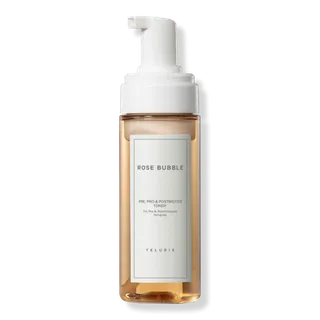
Works for
MoisturizingGlycerin, Allantoin + 18 moreWorks
“A gentle, microbiome-friendly toner that hydrates, calms, and rebalances skin with rose water and postbiotics.”
This product contains good ingredients to attract water to the upper layer of the skin. These ingredients are called "humectants": allantoin, glycerin.
When humectants are on the surface of the skin, they “pull in” the moisture from the outside environment, or from within deeper layers of the skin. If the air is dry, humectants can speed up the moisture loss from the skin. This is why it is a good idea to use another product on top of this one to help "seal in" the moisture (look for ingredients like dimethicone, squalane, oils and butters).
ExfoliationAllantoin, Lactobacillus/punica granatum fruit ferment extractNot delivered
“Gently exfoliates and smooths skin without disrupting the microbiome”
This product might help exfoliate the skin with lactobacillus/punica granatum fruit ferment extract, but This ingredient is not the most effective.
Anti-agingSide benefit · Bakuchiol, Lactococcus ferment lysate + 2 moreWorks well
This product can help reduce and prevent fine lines and wrinkles, improve skin elasticity and firmness because it contains bakuchiol.
Keep in mind that it typically takes at least 6 weeks to notice any results because the changes that are needed to improve fine lines and elasticity happen in the deeper layers of the skin. No topical anti-aging product can “erase” wrinkles or fully reverse signs of aging.
Anti-oxidationSide benefit · Bakuchiol, Eclipta prostrata extract + 3 moreWorks well
This product contains antioxidants (bakuchiol) that can help neutralize free radicals in skin. By doing so, they can lessen the damage the skin gets from the UV light (sun).
Evens skin toneSide benefit · Bakuchiol, Lactobacillus/punica granatum fruit ferment extract + 1 moreWorks well
This product can help reduce hypepigmentation and even out the skin tone because it contains the following effective ingredients: bakuchiol
Keep in mind that you would need to apply any topical skincare targetted at hypigmentation consistently for a couple of months to get a result. No topical skincare product can help get rid of hyperpigmentation (including post-acne marks and age spots) instantly.
Anti-blemishSide benefit · Bakuchiol, Allantoin + 1 moreMay help
This product might be able to help reduce blemishes and clogged pores because it contains bakuchiol.
Can it cause trouble?
Irritancy1 strong irritant: Rosa hybrid flower waterMedium risk
Comedogenic1 ingredient rated 2 or more on the 0–5 pore-clogging scale1 flagged

User reviews
Be the first — your take helps the next person decide.
Ingredients
Filter by role to see what each ingredient is doing.
Water~40–60%
Glycerin~4–6.1%
- Irritation risk
- Low
One of the best moisturizing ingredients. Naturally present in skin. It attracts water to the upper layer of the skin working as a humectant
More about GlycerinPropanediol~3.4–5.1%
- Irritation risk
- Low
Acts as a solvent for other ingredients. Speeds up the absorption of other ingredients into the skin
More about Propanediol1,2-hexanediol~2–3%
Dipropylene glycol~1.9–2.9%
- Irritation risk
- Low
Helps to dissolve other ingredients in a formulation. Slows down the rate of product drying
More about Dipropylene glycolPolyglyceryl-10 laurate~1.6–2.4%
- Irritation risk
- Medium
Helps water and oil mix together
More about Polyglyceryl-10 lauratePolyglyceryl-4 laurate~1.4–2.1%
Caprylyl/capryl glucoside~1.3–1.9%
- Irritation risk
- Medium
Helps oil and water mix together. Can be used as a cleansing agent
More about Caprylyl/capryl glucosideSodium citrate~0.95–1.4%
- Irritation risk
- Medium
Helps to control the skin's pH level. Maintains the skin's natural film of amino-lactic acids and oils. Helps to preserve products
More about Sodium citrateAllantoin~0.45–1.1%
- Irritation risk
- Low
Helps calm down inflammation in skin and can help reduce itching. Helps to repair the skin barrier and keep skin hydrated
More about AllantoinEclipta prostrata extract~0.45–1%
- Irritation risk
- High
A plant extract that might help neutralize free radicals in skin. It can be irritating
More about Eclipta prostrata extractButylene glycol~0.35–0.85%
- Irritation risk
- Low
Used to create a nice product texture and help delivery of other ingredients. Might be somewhat helpful in attracting water to the upper layer of the skin
More about Butylene glycolCitric acid~0.3–0.75%
- Irritation risk
- Medium
Can work as an exfoliant but is typically used to adjust the product pH
More about Citric acidDisodium edta~0.2–0.8%
Lactobacillus/acerola cherry ferment~0.2–0.75%
- Irritation risk
- Low
Lactobacillus ferment lysate~0.15–0.7%
- Irritation risk
- Low
A "broth" with parts of dead cells of lactobacteria. Might be helpful supporting diverse microbiome in skin, but evidence is lacking
More about Lactobacillus ferment lysateBifida ferment filtrate~0.15–0.65%
- Irritation risk
- Low
Lactobacillus ferment~0.15–0.6%
- Irritation risk
- Low
A fermentation product created by bacteria Lactobacillus. The fermented product has anti-bacterial properties and might be helpful in calming down inflammation, but studies are lacking. Helps attract water to the upper layer of the skin. Can be used as a preservative
More about Lactobacillus fermentLactococcus ferment lysate~0.15–0.55%
- Irritation risk
- Low
Consists of remains of dead bacteria cells. Is likely helpful in attracting water to the upper layer of the skin. Might be helpful in reducing inflammation and neutralizing free radicals in skin
More about Lactococcus ferment lysateLactococcus ferment~0.15–0.5%
- Irritation risk
- Low
Lactobacillus/punica granatum fruit ferment extract~0.1–0.45%
- Irritation risk
- High
An enzyme-based exfoliant
More about Lactobacillus/punica granatum fruit ferment extractLeuconostoc/radish root ferment filtrate~0.1–0.5%
- Irritation risk
- Medium
A preservative that comes from radishes fermented by a bacteria. New research suggests that the preservation properties in the ingredient come from an ammonium salt that is not present naturally in radish root but used in its cultivation. Is problematic because the exact amount of the preservative agents is difficult to determine
More about Leuconostoc/radish root ferment filtrateLactobacillus/soybean ferment extract~0.1–0.4%
- Irritation risk
- Low
A fermentation product created by bacteria Lactobacillus out of soybean. The fermented product helps to attract water to the upper layer of the skin and has anti-bacterial properties. It might be helpful in calming down inflammation and could be helpful in evening out skin tone, but studies are lacking
More about Lactobacillus/soybean ferment extractNiacinamide~0.1–0.45%
- Irritation risk
- Low
Is proven to be effective in reducing blemishes, evening out skin tone and helping to improve lines and wrinkles. It helps the skin to repair sun damage, calm down inflammation and keep maintain good levels of moisture. The concentration of about 2% is effective for supporting the skin barrier and evening out the skin tone. Concentration of 4-6% is better for helping with acne and balancing the sebum production
More about NiacinamideEctoin~0.1–0.4%
- Irritation risk
- Low
Softens the upper layer of the skin and can support skin barrier function
More about EctoinRosa hybrid flower water~0.1–0.45%
- Irritation risk
- High
Sorbitol~0.1–0.45%
- Irritation risk
- Low
Helps attract water to the upper layer of the skin and improves the product texture
More about SorbitolBakuchiol~0.1–0.45%
- Irritation risk
- Medium
A plant extract that is, though different in chemical structure, acts similar to retinoids. First studies show that it can help reduce fine lines and wrinkles, improve skin tone, reduce clogged pores and blemishes, and reduce inflammation. There is no conclusive evidence that bakuchiol is as effective as retinol however. The study that directly compared retinol with bakuchiol used bakuchiol applied twice daily compared to once per day for the retinol. According to this study, bakuchiol is less irritating than retinol. Bakuchiol is extracted from seeds of Babchi plant. Other parts of the plant contain coumarins that could cause allergic and irritant reactions. These compounds should be removed in the extraction process when bakuchiol is produced, but it is a good idea to be cautious and stay away from products that include the Babchi plant extracts other than purified bakuchiol to avoid irritation
More about BakuchiolPolyglyceryl-4 oleate~0.1–0.5%
- Irritation risk
- Medium
Helps oil and water mix together
More about Polyglyceryl-4 oleateCaprylic/capric triglyceride~0.15–0.55%
- Irritation risk
- Medium
A good mix of fatty acids that forms a protective layer on the skin. Improves the shelf life of products. Derived from coconut and glycerin
More about Caprylic/capric triglycerideOctyldodecanol~0.1–0.4%
- Irritation risk
- Low
An emollient that helps to soften the skin and create a pleasant product texture and stabilize the formulation
More about OctyldodecanolSpirulina platensis extract~0.1–0.4%
- Irritation risk
- Low
- Comedogenicity
- 3/5
An algae extract. Might help to attract water to the upper layer of the skin and have an anti-oxidant effect
More about Spirulina platensis extractSolanum tuberosum pulp extract~0.1–0.35%
- Irritation risk
- Low
Saccharide isomerate~0.1–0.35%
- Irritation risk
- Low
Helps attract water to the upper layer of the skin
More about Saccharide isomerateSodium hyaluronate~0.1–0.3%
- Irritation risk
- Low
One of the best moisturizing ingredients. Attracts water into the upper layer of the skin
More about Sodium hyaluronateTremella fuciformis polysaccharide~0.1–0.35%
- Irritation risk
- Low
Hydroxypropyltrimonium hyaluronate~0.1–0.3%
- Irritation risk
- Low
Hydrolyzed hyaluronic acid~0.05–0.2%
- Irritation risk
- Low
One of the best moisturizing ingredients. Attracts water into the upper layer of the skin. A version of it is naturally present in skin
More about Hydrolyzed hyaluronic acidSodium acetylated hyaluronate~0.05–0.2%
- Irritation risk
- Low
A type of hyaluronic acid that works as an excellent moisturizer by attracting water into the upper layer of the skin. Is typically feels less sticky on the skin compared to the usual hyaluronic acid
More about Sodium acetylated hyaluronateHyaluronic acid~0.05–0.25%
- Irritation risk
- Low
One of the best moisturizing ingredients. Attracts water into the upper layer of the skin. Naturally present in skin. Typically has large molecule size unless advertised otherwise on the product label. Helps support skin's barrier function and may help to reduce inflammation
More about Hyaluronic acidHydrolyzed sodium hyaluronate~0.05–0.25%
- Irritation risk
- Low
Attracts water into the upper layer of the skin
More about Hydrolyzed sodium hyaluronateSodium hyaluronate crosspolymer~0.05–0.15%
- Irritation risk
- Medium
Attracts water into the upper layer of the skin
More about Sodium hyaluronate crosspolymerPotassium hyaluronate~0.05–0.15%
- Irritation risk
- Low
Ingredient list view
Water, Glycerin, Propanediol, 1,2-hexanediol, Dipropylene glycol, Polyglyceryl-10 laurate, Polyglyceryl-4 laurate, Caprylyl/capryl glucoside, Sodium citrate, Allantoin, Eclipta prostrata extract, Butylene glycol, Citric acid, Disodium edta, Lactobacillus/acerola cherry ferment, Lactobacillus ferment lysate, Bifida ferment filtrate, Lactobacillus ferment, Lactococcus ferment lysate, Lactococcus ferment, Lactobacillus/punica granatum fruit ferment extract, Leuconostoc/radish root ferment filtrate, Lactobacillus/soybean ferment extract, Niacinamide, Ectoin, Rosa hybrid flower water, Sorbitol, Bakuchiol, Polyglyceryl-4 oleate, Caprylic/capric triglyceride, Octyldodecanol, Spirulina platensis extract, Solanum tuberosum pulp extract, Saccharide isomerate, Sodium hyaluronate, Tremella fuciformis polysaccharide, Hydroxypropyltrimonium hyaluronate, Hydrolyzed hyaluronic acid, Sodium acetylated hyaluronate, Hyaluronic acid, Hydrolyzed sodium hyaluronate, Sodium hyaluronate crosspolymer, Potassium hyaluronate
Compare prices
Retailers ranked by price — lowest first.

Worth comparing, line by line.
Match % combines shared ingredients, the first five ingredients, shared actives and hero ingredients, irritancy (lower counts in the alternative's favour), texture and body area. Only products in the same routine step are compared.
| TelurisRose Bubble TonerYOUR PRODUCT | numbuzinNo.3 Bifida Bakuchiol 50 Zero Pore Milky Toner | DERMATORYRetinal Essence Toner | Dr Dennis GrossAdvanced Retinol + Ferulic Overnight Texture Renewal Peel | |
|---|---|---|---|---|
| Match | — | 84% | 82% | 73% |
| Price | $40.00 | $14.70−$25.30 | $23.40−$16.60 | — |
| Shared key ingredients | — | 5 of 14 | 4 of 14 | 5 of 14 |
| Key difference | — | Niacinamide | Niacinamide | Niacinamide |
| Irritancy | Medium | Medium | Medium | High |
| Drying alcohol | — | — | — | — |
| View product | Shop | Shop | Shop |

More alternatives: Miraculum Bakuchiol tonerSome By Mi Retinol Bakuchiol Bubble Toner
Sources cited in this review
Every concentration estimate and effectiveness label is anchored to one of these 19 studies and safety reviews.
- 1
- 2
- 3
- 4
- 5
- 6

Affiliate links · As an Amazon Associate, WIMJ earns from qualifying purchases.