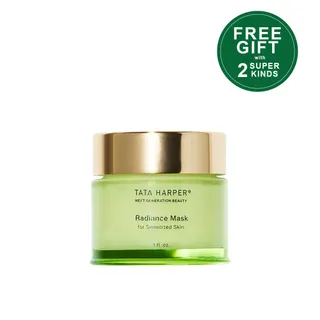
Works for
ExfoliationLactic acidWorks well
“A gentle exfoliating mask that restores radiance without irritating or drying out the skin.”
This product can help exfoliate the skin. In other words, it helps break down the bonds between dead cells on the surface of the skin and speed up the skin turnover. Skin often appears softer and brighter after exfoliation, but overdoing it can result in disrupted skin barrier. The following ingredient is doing the exfoliating job in this product: lactic acid.
MoisturizingDiglycerin, Lactic acid + 5 moreWorks
“Mild AHAs exfoliate and microbiome-balancing prebiotics support a healthy skin barrier.”
This product can help improve hydration of the skin with the two types of ingredients.
The first type is called “humectants”:
these ingredients help attract water.
When humectants are on the surface of the skin, they “pull in” the moisture from the outside environment, or from
within deeper layers of the skin. The following ingredients in this product do the job:
diglycerin, lactic acid.
This product also contains ingredients called “occlusives”. They help reduce the speed with which our skin loses moisture to the outside environment. These ingredients also help soften the upper layer of the skin, so it feels less tight and nicer to the touch. The following ingredients in this product do the job: helianthus annuus seed oil, passiflora edulis seed oil.
Evens skin toneSide benefit · Lactic acidWorks well
This product can help reduce hypepigmentation and even out the skin tone because it contains the following effective ingredients: lactic acid
Keep in mind that you would need to apply any topical skincare targetted at hypigmentation consistently for a couple of months to get a result. No topical skincare product can help get rid of hyperpigmentation (including post-acne marks and age spots) instantly.
Anti-agingSide benefit · Lactic acidMay help
This product contains lactic acid. There is some human evidence that this ingredient helps reduce and prevent fine lines and wrinkles and improve skin elasticity and firmness, though it is smaller or less consistent than the evidence for the best anti-aging ingredients.
Can it cause trouble?
Irritancy2 strong irritants: Lavandula angustifolia extract, Calendula officinalis flower extractMedium risk
ComedogenicClean of flagged comedogenic ingredientsNone flagged


User reviews
Be the first — your take helps the next person decide.
Ingredients
Filter by role to see what each ingredient is doing.
Diglycerin~22–33%
- Irritation risk
- Low
Helps attract water to the upper layer of the skin
More about DiglycerinCalendula officinalis flower/leaf/stem juice~5.6–8.4%
- Irritation risk
- Low
Propanediol~4.7–7%
- Irritation risk
- Low
Acts as a solvent for other ingredients. Speeds up the absorption of other ingredients into the skin
More about PropanediolCetearyl olivate~3.6–5.4%
Water~2.7–4%
Sorbitan olivate~2–3%
Lactic acid~1.6–2.4%
- Irritation risk
- Medium
An exfoliating and moisturizing alpha-hydroxy acid (AHA). Typically causes less irritation than other AHAs, for example, glycolic acid. At high concentrations (about 15%), lactic acid can help reduce lines and wrinkles. Recent studies show that lactic acid can support the "good" bacteria living on skin's surface (healthy skin microbiome)
More about Lactic acidLactobacillus ferment~1.3–2%
- Irritation risk
- Low
A fermentation product created by bacteria Lactobacillus. The fermented product has anti-bacterial properties and might be helpful in calming down inflammation, but studies are lacking. Helps attract water to the upper layer of the skin. Can be used as a preservative
More about Lactobacillus fermentLeuconostoc ferment filtrate~1.1–1.7%
Phytic acid~0.9–1.35%
- Irritation risk
- Medium
An alpha-hydroxy acid (AHA), but is mostly used to stabilize product formulations in cosmetics
More about Phytic acidSaccharide isomerate~0.55–1.25%
- Irritation risk
- Low
Helps attract water to the upper layer of the skin
More about Saccharide isomerateKaolin~0.9–1.35%
- Irritation risk
- Low
A type of clay that consists mainly of aluminum silicate. Helps absorb oil and creates a thicker product consistency. Can be used to add a white color
More about KaolinAlpha-glucan oligosaccharide~0.45–1.1%
- Irritation risk
- Low
Helps attract water to the upper layer of the skin
More about Alpha-glucan oligosaccharidePassiflora edulis seed oil~0.45–1.05%
- Irritation risk
- High
A good emollient helping to soften the skin. Might have some anti-oxidant properties. Adds a fragrance to the product
More about Passiflora edulis seed oilLavandula angustifolia extract~0.35–0.8%
- Irritation risk
- High
Used for fragrance and contains volatile compounds that can irritate the skin
More about Lavandula angustifolia extractChamomilla recutita flower extract~0.2–0.8%
- Irritation risk
- High
Plant extract that can have healing and anti-inflammatory properties. It is a potential allergen and can be irritating
More about Chamomilla recutita flower extractBorago officinalis leaf extract~0.2–0.7%
- Irritation risk
- Low
Calendula officinalis flower extract~0.15–0.6%
- Irritation risk
- High
A plant extract that has some anti-oxidant and anti-bacterial properties. Can be irritating
More about Calendula officinalis flower extractMedicago sativa extract~0.15–0.5%
- Irritation risk
- Medium
A plant extract that might help neutralize free radicals in skin
More about Medicago sativa extractHelianthus annuus seed oil~0.15–0.65%
- Irritation risk
- Low
A great emollient due to its high linoleic acid content. One of the most effective plant oils in helping skin hydration and repairing skin barrier function
More about Helianthus annuus seed oilCitric acid~0.1–0.45%
- Irritation risk
- Medium
Can work as an exfoliant but is typically used to adjust the product pH
More about Citric acidSodium hydroxide~0.1–0.4%
Sodium citrate~0.05–0.3%
- Irritation risk
- Medium
Helps to control the skin's pH level. Maintains the skin's natural film of amino-lactic acids and oils. Helps to preserve products
More about Sodium citrateIngredient list view
Diglycerin, Calendula officinalis flower/leaf/stem juice, Propanediol, Cetearyl olivate, Water, Sorbitan olivate, Lactic acid, Lactobacillus ferment, Leuconostoc ferment filtrate, Phytic acid, Saccharide isomerate, Kaolin, Alpha-glucan oligosaccharide, Passiflora edulis seed oil, Lavandula angustifolia extract, Chamomilla recutita flower extract, Borago officinalis leaf extract, Calendula officinalis flower extract, Medicago sativa extract, Helianthus annuus seed oil, Citric acid, Sodium hydroxide, Sodium citrate
Worth comparing, line by line.
Match % combines shared ingredients, the first five ingredients, shared actives and hero ingredients, irritancy (lower counts in the alternative's favour), texture and body area. Only products in the same routine step are compared.
| Tata HarperSUPERKIND Radiance MaskYOUR PRODUCT | Cultured SkincareBiome One Mask | Rosen SkincareSmooth Jelly Mask | SEPHORA COLLECTIONResurfacing Gel Mask - Exfoliate | |
|---|---|---|---|---|
| Match | — | 52% | 51% | 51% |
| Price | $49.97 | $63.49+$13.52 | — | $16.80−$33.17 |
| Shared key ingredients | — | 1 of 8 | 3 of 8 | 1 of 8 |
| Key difference | — | Potassium Azeloyl Diglycinate | — | 3-O-Ethyl Ascorbic Acid |
| Irritancy | Medium | Low | Low | Low |
| Drying alcohol | — | — | — | — |
| View product | Shop | Shop | Shop |


More alternatives: Dr. Idriss Major Fade Flash MaskTypology Mask Set for Enlarged Pores and Blackheads — 10% AHA + 10% PHA
Product summary
"Tata Harper - SUPERKIND Radiance Mask" could be helpful for: Moisturizing, but its actives are not the most effective or are not well-studied.
Ingredient callouts
- This product contains acids (lactic acid 1.60% - 2.40%). Their concentration is low, and they will not have a strong exfoliating effect. Instead, they work to support the skin natural acid mantle and to attract water (as humectants). Lactic acid is particularly good in attracting water to the upper layer of the skin and improving the skin barrier.
- Humectants (saccharide isomerate 0.55% - 1.25%, lactobacillus ferment 1.30% - 2.00% and diglycerin 22.00% - 33.00%). These ingredients help attract water to the upper layer of the skin and improve the skin hydration.
About the brand
According to Cruelty-Free Kitty "Tata Harper" is cruelty free, but its parent company is not.
Price
The product retails for 68.00$ in the United States, for 61.00£ in the United Kingdom and from 48.80£ up to 440.00£ in the United Kingdom.
For a detailed price comparison: click here.
Sources cited in this review
Every concentration estimate and effectiveness label is anchored to one of these 16 studies and safety reviews.
- 1Epidermal and dermal effects of topical lactic acidncbi.nlm.nih.gov
- 2Dual Effects of Alpha-Hydroxy Acids on the Skinpdfs.semanticscholar.org
- 3
- 4
- 5Use of Probiotics for Dermal Applicationsresearchgate.net
- 6Cosmetic and dermatologic use of alpha hydroxy acidsonlinelibrary.wiley.com
