Works for
MoisturizingPalmitoyl tripeptide-1, Diisostearyl malate + 21 moreWorks well
“Hydrates”
This product can help improve hydration of the skin with the two types of ingredients.
The first type is called “humectants”:
these ingredients help attract water.
When humectants are on the surface of the skin, they “pull in” the moisture from the outside environment, or from
within deeper layers of the skin. The following ingredients in this product do the job:
sodium hyaluronate.
This product also contains ingredients called “occlusives”. They help reduce the speed with which our skin loses moisture to the outside environment. These ingredients also help soften the upper layer of the skin, so it feels less tight and nicer to the touch. The following ingredients in this product do the job: bis-diglyceryl polyacyladipate-2, caprylic/capric triglyceride.
The following ingredients in this product are especially good for supporting the skin barrier and helping with the hydration level: palmitoyl tripeptide-1
Anti-agingSide benefit · Palmitoyl tripeptide-1, Tocopherol + 1 moreMay help
This product contains palmitoyl tripeptide-1. There is some human evidence that this ingredient helps reduce and prevent fine lines and wrinkles and improve skin elasticity and firmness, though it is smaller or less consistent than the evidence for the best anti-aging ingredients.
Can it cause trouble?
Irritancy4 strong irritants: Parfum, Limonene + 2 more — patch-test recommendedHigh risk
Comedogenic2 ingredients rated 2 or more on the 0–5 pore-clogging scale2 flagged
User reviews
Be the first — your take helps the next person decide.
Ingredients
Filter by role to see what each ingredient is doing.
Hydrogenated polyisobutene~23–34%
- Irritation risk
- Low
Used to improve the product consistency and soften the upper layer of the skin
More about Hydrogenated polyisobutenePhytosteryl/isostearyl/cetyl/stearyl/behenyl dimer dilinoleate~4.6–7%
- Irritation risk
- Low
Helps soften the upper layer of the skin and create a nice product consistency
More about Phytosteryl/isostearyl/cetyl/stearyl/behenyl dimer dilinoleatePolybutene~4.8–7.2%
Diisostearyl malate~3.8–5.7%
- Irritation risk
- Medium
Helps to soften the upper layer of the skin
More about Diisostearyl malateSynthetic beeswax~2.7–4.1%
- Irritation risk
- Low
Helps soften the upper layer of the skin
More about Synthetic beeswaxCaprylic/capric triglyceride~2.3–3.5%
- Irritation risk
- Medium
A good mix of fatty acids that forms a protective layer on the skin. Improves the shelf life of products. Derived from coconut and glycerin
More about Caprylic/capric triglycerideBis-diglyceryl polyacyladipate-2~1.8–2.7%
- Irritation risk
- Low
Helps soften the upper layer of the skin and reduce water loss from its surface
More about Bis-diglyceryl polyacyladipate-2Trihydroxystearin~1.3–2%
- Irritation risk
- Low
Helps soften the upper layer of the skin and improve the product texture
More about TrihydroxystearinEthylene/propylene/styrene copolymer~1.1–1.6%
- Irritation risk
- Low
Used to create a thicker product consistency
More about Ethylene/propylene/styrene copolymerSilica~1.2–1.8%
Vp/hexadecene copolymer~0.9–1.35%
- Irritation risk
- Low
Creates a nice product texture and can support water-resistance of sunscreens
More about Vp/hexadecene copolymerParfum~0.45–1.05%
- Irritation risk
- High
An aromatic blend of unspecified and possibly irritating ingredients
More about ParfumEthylhexyl palmitate~0.5–1.15%
- Irritation risk
- Low
- Comedogenicity
- 3/5
An emollient that helps soften the skin and create a nice product texture
More about Ethylhexyl palmitateRicinus communis seed oil~0.45–1.05%
- Irritation risk
- Medium
A plant oil that can help soften the skin. It might be helpful in calming down inflammation, but solid research is lacking. Is often used in lip products to create the needed product consistency
More about Ricinus communis seed oilTocopheryl acetate~0.4–0.9%
- Irritation risk
- Medium
A more stable but less bio-available form of vitamin E compared to Tocopherol. Might help moisturize and protect the skin from free radicals, but mostly used in low concentrations to stabilize other ingredients.
More about Tocopheryl acetateSodium hyaluronate~0.4–0.9%
- Irritation risk
- Low
One of the best moisturizing ingredients. Attracts water into the upper layer of the skin
More about Sodium hyaluronateTribehenin~0.45–1%
- Irritation risk
- Low
Used to create a thicker product consistency and soften the upper layer of the skin
More about TribeheninHelianthus annuus seed oil~0.4–0.95%
- Irritation risk
- Low
A great emollient due to its high linoleic acid content. One of the most effective plant oils in helping skin hydration and repairing skin barrier function
More about Helianthus annuus seed oilOpuntia ficus-indica seed oil~0.4–0.9%
- Irritation risk
- Medium
A plant oil that helps soften the upper layer of the skin and can support skin's barrier function due to its high content of linoleic acid. It also has anti-microbial properties
More about Opuntia ficus-indica seed oilPrunus armeniaca kernel oil~0.35–0.85%
- Irritation risk
- Medium
An emollient that helps soften the skin
More about Prunus armeniaca kernel oilSqualane~0.35–0.85%
- Irritation risk
- Low
An oil naturally present in skin. Works as an emollient to soften the skin and form a protective layer on its surface without a greasy feeling.
More about SqualaneSalvia hispanica seed oil~0.35–0.8%
- Irritation risk
- Low
Chia seed oil. Helps to soften the upper layer of the skin and might be helpful in repairing skin barrier
More about Salvia hispanica seed oilHydrogenated castor oil~0.35–0.8%
- Irritation risk
- Medium
A plant oil that can help soften the skin. It might be helpful in calming down inflammation, but solid research is lacking. Is often used in lip products to create the needed product consistency
More about Hydrogenated castor oilButylene/ethylene/styrene copolymer~0.2–0.75%
- Irritation risk
- Low
Used to create a gel-like product texture
More about Butylene/ethylene/styrene copolymerSorbitan isostearate~0.2–0.75%
- Irritation risk
- Low
Helps oil and water mix together
More about Sorbitan isostearateIsononyl isononanoate~0.35–0.75%
- Irritation risk
- Low
Forms a protective film on the surface of the skin to prevent moisture loss. Gives a velvety feel to products while reducing tackiness
More about Isononyl isononanoateTocopherol~0.2–0.75%
- Irritation risk
- Low
Pure form of vitamin E. Can help moisturise and protect the skin from free radicals. Often used to help stabilise other ingredients or the formula itself
More about TocopherolLactic acid~0.2–0.7%
- Irritation risk
- Medium
An exfoliating and moisturizing alpha-hydroxy acid (AHA). Typically causes less irritation than other AHAs, for example, glycolic acid. At high concentrations (about 15%), lactic acid can help reduce lines and wrinkles. Recent studies show that lactic acid can support the "good" bacteria living on skin's surface (healthy skin microbiome)
More about Lactic acidPentaerythrityl tetra-di-t-butyl hydroxyhydrocinnamate~0.2–0.75%
- Irritation risk
- Low
Used to increase stability of product formulations
More about Pentaerythrityl tetra-di-t-butyl hydroxyhydrocinnamateIsopropyl myristate~0.35–0.8%
- Irritation risk
- Low
- Comedogenicity
- 3/5
An emollient that helps soften the skin. Could be comedogenic
More about Isopropyl myristatePalmitoyl tripeptide-1~0.35–0.8%
- Irritation risk
- Low
A type of peptide. Peptides are excellent moisturizers and might be able support collagen production reducing fine lines and wrinkles
More about Palmitoyl tripeptide-1Isopropyl titanium triisostearate~0.35–0.8%
- Irritation risk
- Medium
Helps water and oil mix together
More about Isopropyl titanium triisostearateStearalkonium hectorite~0.2–0.7%
Polyhydroxystearic acid~0.2–0.75%
- Irritation risk
- Medium
Used to create a thicker product consistency and stabilize the formulation
More about Polyhydroxystearic acidPropylene carbonate~0.2–0.75%
- Irritation risk
- Low
Is used to dissolve other ingredients and create nice product texture
More about Propylene carbonateLimonene~0.15–0.6%
- Irritation risk
- High
A common frangrance that can easily irritate skin, especially if exposed to air, light or heat
More about LimoneneCitrus paradisi peel oil~0.15–0.55%
Linalool~0.1–0.5%
Citrus aurantium peel oil~0.1–0.4%
- Irritation risk
- Low
Terpineol~0.1–0.35%
- Irritation risk
- Low
Dimethyl phenethyl acetate~0.1–0.4%
- Irritation risk
- Low
Pinene~0.1–0.4%
- Irritation risk
- Low
Ci 77492~0.05–0.3%
Ci 77891~0.05–0.3%
- Irritation risk
- Low
Ingredient list view
Hydrogenated polyisobutene, Phytosteryl/isostearyl/cetyl/stearyl/behenyl dimer dilinoleate, Polybutene, Diisostearyl malate, Synthetic beeswax, Caprylic/capric triglyceride, Bis-diglyceryl polyacyladipate-2, Trihydroxystearin, Ethylene/propylene/styrene copolymer, Silica, Vp/hexadecene copolymer, Parfum, Ethylhexyl palmitate, Ricinus communis seed oil, Tocopheryl acetate, Sodium hyaluronate, Tribehenin, Helianthus annuus seed oil, Opuntia ficus-indica seed oil, Prunus armeniaca kernel oil, Squalane, Salvia hispanica seed oil, Hydrogenated castor oil, Butylene/ethylene/styrene copolymer, Sorbitan isostearate, Isononyl isononanoate, Tocopherol, Lactic acid, Pentaerythrityl tetra-di-t-butyl hydroxyhydrocinnamate, Isopropyl myristate, Palmitoyl tripeptide-1, Isopropyl titanium triisostearate, Stearalkonium hectorite, Polyhydroxystearic acid, Propylene carbonate, Limonene, Citrus paradisi peel oil, Linalool, Citrus aurantium peel oil, Terpineol, Dimethyl phenethyl acetate, Pinene, Ci 77492, Ci 77891
Compare prices
Retailers ranked by price — lowest first.

Worth comparing, line by line.
Match % combines shared ingredients, the first five ingredients, shared actives and hero ingredients, irritancy (lower counts in the alternative's favour), texture and body area. Only products in the same routine step are compared.
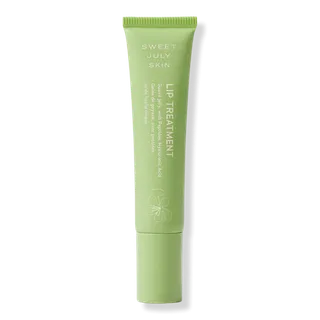
| Sweet July SkinLip TreatmentYOUR PRODUCT | Paula's choicePro-Collagen Peptide Gloss Balm Lip Treatment | Farmacy BeautyStrawberry Peptide Lip Smoothie | Burberry BeautyKisses Lip Lacquer | |
|---|---|---|---|---|
| Match | — | 46% | 46% | 45% |
| Price | $16.00 | $16.78+$0.78 | $22.00+$6.00 | $39.51+$23.51 |
| Shared key ingredients | — | 6 of 13 | 4 of 13 | 5 of 13 |
| Key difference | — | Palmitoyl Tripeptide-38 | Tetrahexyldecyl Ascorbate | Cera Microcristallina |
| Irritancy | High | Low | Medium | Medium |
| Drying alcohol | — | — | — | — |
| View product | Shop | Shop | Shop |


More alternatives: Urban Skin Rx Hydrating Lip TreatmentLANEIGE Lip Treatment Balm
Sources cited in this review
Every concentration estimate and effectiveness label is anchored to one of these 20 studies and safety reviews.
- 1
- 2
- 3
- 4
- 5
- 6

Affiliate links · As an Amazon Associate, WIMJ earns from qualifying purchases.