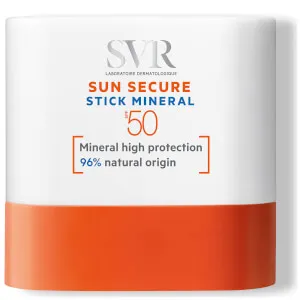
SVR Sun Secure Mineral Sunscreen SPF50
Works for
Sun protectionSPF 50 · 2 UV filtersBroad spectrum
This product offers a good level of protection against both UVB and UVA rays.
It is a mineral sunscreen. In other words, it contains non-organic UV filters. It will probably not sting your eyes but might leave a white cast.
This product can be considered "reef safe" because it does not contain the UV filters (oxybenzone and octinoxate) that can be harmful to coral reefs when present in the water in high concentrations.
Anti-agingTocopherol, Ascorbyl palmitate + 1 moreWorks well
“Preserve your complexion’s youthful appearance and elasticity by incorporating SPF-enriched skincare into your daily regime.”
This product can help prevent early signs of skin aging because it offers a good level of broad spectrum sun protection. Sun damage is the main cause of premature skin aging, and protecting your skin from the sun is the best anti-aging strategy.
Evens skin toneSide benefit · NiacinamideWorks well
This product offers broad spectrum sun protection. It means that it can prevent hyperpigmentation and help keep the skin tone even (sun damage is the main factor causing age spots, darkening of post-acne marks and other discolorations).
MoisturizingSide benefit the brand mentions · Caprylic/capric triglyceride, Cetyl palmitate + 12 moreWorks
“Moisturising vegetable oils and Glycerin reinforce the skin’s natural moisture barrier and ensures skin is plump with hydration.”
This product can help improve hydration of the skin with the two types of ingredients.
The first type is called “humectants”:
these ingredients help attract water.
When humectants are on the surface of the skin, they “pull in” the moisture from the outside environment, or from
within deeper layers of the skin. The following ingredients in this product do the job:
glycerin.
This product also contains ingredients called “occlusives”. They help reduce the speed with which our skin loses moisture to the outside environment. These ingredients also help soften the upper layer of the skin, so it feels less tight and nicer to the touch. The following ingredients in this product do the job: caprylic/capric triglyceride, glycine soja oil.
Can it cause trouble?
Irritancy1 strong irritant: ParfumMedium risk
Comedogenic1 ingredient rated 2 or more on the 0–5 pore-clogging scale1 flagged


User reviews
Be the first — your take helps the next person decide.
Ingredients
Filter by role to see what each ingredient is doing.
Zinc oxide~44–53%
- Irritation risk
- Low
A broad spectrum sunblock (protects from both UVA and UVB rays). Is suitable for most sensitive skins. In small concentrations, can be used as a colorant
More about Zinc oxideC9-12 alkane~7.3–8.9%
Titanium dioxide~5–6.1%
- Irritation risk
- Low
Works as a UV filter when used in high concentrations. It is photostable and is effective mostly against the UVB light, with some protection in the UVA range. In small concentrations, used for its ability to improve the color of cosmetic products. Is usually well tolerated by the skin
More about Titanium dioxideCaprylic/capric triglyceride~3.6–4.4%
- Irritation risk
- Medium
A good mix of fatty acids that forms a protective layer on the skin. Improves the shelf life of products. Derived from coconut and glycerin
More about Caprylic/capric triglycerideOctyldodecanol~2.7–3.3%
- Irritation risk
- Low
An emollient that helps to soften the skin and create a pleasant product texture and stabilize the formulation
More about OctyldodecanolCetyl palmitate~2.3–2.8%
- Irritation risk
- Low
An emollient that helps soften the skin and is used to improve product texture and stability
More about Cetyl palmitateWater~1.9–2.3%
Polyhydroxystearic acid~1.6–2%
- Irritation risk
- Medium
Used to create a thicker product consistency and stabilize the formulation
More about Polyhydroxystearic acidHydrogenated castor oil~1.4–1.7%
- Irritation risk
- Medium
A plant oil that can help soften the skin. It might be helpful in calming down inflammation, but solid research is lacking. Is often used in lip products to create the needed product consistency
More about Hydrogenated castor oilHelianthus annuus seed wax~1.2–1.5%
- Irritation risk
- Low
Helps soften the upper layer of the skin and support skin's barrier function while creating a thicker product consistency
More about Helianthus annuus seed waxPolyglyceryl-6 polyhydroxystearate~1–1.2%
- Irritation risk
- Medium
Helps oil and water mix together
More about Polyglyceryl-6 polyhydroxystearateC10-18 triglycerides~0.9–1.1%
- Irritation risk
- Low
Helps soften the skin and attract water to its upper layer. Helps create nice product texture
More about C10-18 triglyceridesMagnesium sulfate~0.75–1.1%
Polyglyceryl-6 polyricinoleate~0.6–0.95%
- Irritation risk
- Medium
Helps oil and water mix together
More about Polyglyceryl-6 polyricinoleateGlycerin~0.6–0.9%
- Irritation risk
- Low
One of the best moisturizing ingredients. Naturally present in skin. It attracts water to the upper layer of the skin working as a humectant
More about GlycerinNiacinamide~0.55–0.85%
- Irritation risk
- Low
Is proven to be effective in reducing blemishes, evening out skin tone and helping to improve lines and wrinkles. It helps the skin to repair sun damage, calm down inflammation and keep maintain good levels of moisture. The concentration of about 2% is effective for supporting the skin barrier and evening out the skin tone. Concentration of 4-6% is better for helping with acne and balancing the sebum production
More about NiacinamideCoco-caprylate/caprate~0.55–0.8%
- Irritation risk
- Low
Helps to soften the upper layer of the skin without creating a greasy texture
More about Coco-caprylate/caprateIrvingia gabonensis kernel butter~0.5–0.7%
- Irritation risk
- Low
Disteardimonium hectorite~0.45–0.65%
- Irritation risk
- Low
A type of clay that is used to thicken the product consistency
More about Disteardimonium hectoriteHydrogenated coco-glycerides~0.35–0.65%
- Irritation risk
- Medium
Helps oil and water mix together while creating a nice finish on the skin
More about Hydrogenated coco-glyceridesPropylene carbonate~0.3–0.6%
- Irritation risk
- Low
Is used to dissolve other ingredients and create nice product texture
More about Propylene carbonateGlycine soja oil~0.25–0.5%
- Irritation risk
- Medium
- Comedogenicity
- 2/5
A good emollient that helps soften the skin and helps repair its barrier function. It can clog pores if used in high concentrations.
More about Glycine soja oilLecithin~0.3–0.55%
- Irritation risk
- Low
Used mostly for creating emulsions - helping oil and water mix together. Helps soften the upper layer of the skin
More about LecithinLepidium sativum sprout extract~0.2–0.35%
- Irritation risk
- Low
Ascorbyl palmitate~0.15–0.3%
- Irritation risk
- Medium
Being a lipid soluble form of vitamin C, it is more stable and can penetrate the skin better than L-Ascorbic acid. It is effective in protecting the skin from free radicals, as well as evening the skin tone, but is less effective in stimulating collagen production compared to L-Ascorbic acid.
More about Ascorbyl palmitateTocopherol~0.15–0.3%
- Irritation risk
- Low
Pure form of vitamin E. Can help moisturise and protect the skin from free radicals. Often used to help stabilise other ingredients or the formula itself
More about TocopherolSilica~0.2–0.4%
Stearic acid~0.2–0.4%
- Irritation risk
- Low
Helps oil and water mix together and works as an emollient
More about Stearic acidParfum~0.05–0.15%
- Irritation risk
- High
An aromatic blend of unspecified and possibly irritating ingredients
More about ParfumIngredient list view
Zinc oxide, C9-12 alkane, Titanium dioxide, Caprylic/capric triglyceride, Octyldodecanol, Cetyl palmitate, Water, Polyhydroxystearic acid, Hydrogenated castor oil, Helianthus annuus seed wax, Polyglyceryl-6 polyhydroxystearate, C10-18 triglycerides, Magnesium sulfate, Polyglyceryl-6 polyricinoleate, Glycerin, Niacinamide, Coco-caprylate/caprate, Irvingia gabonensis kernel butter, Disteardimonium hectorite, Hydrogenated coco-glycerides, Propylene carbonate, Glycine soja oil, Lecithin, Lepidium sativum sprout extract, Ascorbyl palmitate, Tocopherol, Silica, Stearic acid, Parfum
Compare prices
Retailers ranked by price — lowest first.

Worth comparing, line by line.
Match % combines shared ingredients, the first five ingredients, shared actives and hero ingredients, irritancy (lower counts in the alternative's favour), texture and body area. Only products in the same routine step are compared.
| SVRSun Secure Mineral Sunscreen SPF50YOUR PRODUCT | SkinMedicaTotal Defense + Repair SPF 34 | CeraVeMineral Sunscreen Lotion, SPF 30 | TatchaThe Silk Sunscreen SPF 50 Weightless Mineral Sunscreen | |
|---|---|---|---|---|
| Match | — | 85% | 85% | 83% |
| Price | — | $43.69 | $19.99 | $64.00 |
| Shared key ingredients | — | 4 of 7 | 4 of 7 | 3 of 7 |
| Key difference | — | Knotgrass Extract | Panthenol | Bisabolol |
| Irritancy | Medium | Low | Low | Low |
| SPF | SPF 50 | SPF 34 | SPF 30 | SPF 50 |
| Drying alcohol | — | — | — | — |
| View product | Shop | Shop | Shop |


More alternatives: Tatcha US DEV The Silk Sunscreen SPF 50Dr Sam's Flawless Daily Sunscreen
Product summary
The ingredient list suggests that "SVR - Sun Secure Mineral Sunscreen SPF50" can provide reliable sun protection. We love that it can protect from both UVA and UVB rays (not all sunscreens with SPF ratings give UVA protection. UVA rays do not cause sunburn, but still damage our skin and lead to early aging).
Because it includes good moisturizing ingredients, it can also work as a hydrating day cream. Like all broad-spectrum sunscreens, this product has an anti-aging benefit.
Sunscreen filters
It is a mineral sunscreen. It uses titanium dioxide and zinc oxide for sun protection. Both titanium dioxide and zinc oxide almost never irritate even the most sensitive skin and eyes, but can leave a white cast.
Irritation risk
It contains some common irritants, including those without a benefit for the skin. We assess the overall irritancy of it to be medium. For a detailed overview of all potential irritants: click here
You can see the detailed formula review with the breakdown of all actives in the product and the full ingredient list with estimated concentrations in the tables below.
Price
The product retails for 90.41$ in the United States, for 28.90CA$ in Canada and for 16.50£ in the United Kingdom.
For a detailed price comparison: click here.
Sources cited in this review
Every concentration estimate and effectiveness label is anchored to one of these 16 studies and safety reviews.
- 1A review of inorganic UV filters zinc oxide and titanium dioxideonlinelibrary.wiley.com
- 2
- 3
- 4
- 5
- 6

Affiliate links · As an Amazon Associate, WIMJ earns from qualifying purchases.