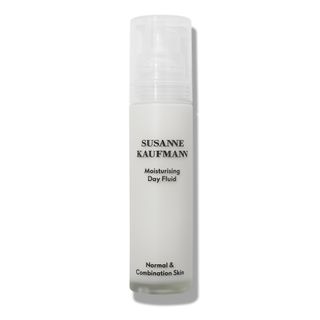
Susanne Kaufmann Moisturising Day Fluid
Works for
1 of 1 advertised claim delivered
MoisturizingSodium hyaluronate, Caprylic/capric triglyceride + 10 moreGood evidence
“Moisturising Day Fluid”
This product can help improve hydration of the skin with the two types of ingredients.
The first type is called “humectants”:
these ingredients help attract water.
When humectants are on the surface of the skin, they “pull in” the moisture from the outside environment, or from
within deeper layers of the skin. The following ingredients in this product do the job:
glycerin, sodium hyaluronate.
This product also contains ingredients called “occlusives”. They help reduce the speed with which our skin loses moisture to the outside environment. These ingredients also help soften the upper layer of the skin, so it feels less tight and nicer to the touch. The following ingredients in this product do the job: caprylic/capric triglyceride, helianthus annuus seed oil.
Can it cause trouble?
Irritancy3 strong irritants: Alcohol, Sodium anisate + 1 more — patch-test recommendedHigh risk
ComedogenicClean of flagged comedogenic ingredientsNone flagged
User reviews
Be the first — your take helps the next person decide.
Ingredients
Filter by role to see what each ingredient is doing.
Water~45–55%
Caprylic/capric triglyceride~7–8.6%
- Irritation risk
- Medium
A good mix of fatty acids that forms a protective layer on the skin. Improves the shelf life of products. Derived from coconut and glycerin
More about Caprylic/capric triglycerideDicaprylyl carbonate~4.4–5.4%
- Irritation risk
- Low
Helps products spread more easily and works as an emollient to soften skin
More about Dicaprylyl carbonatePentylene glycol~3.2–3.9%
- Irritation risk
- Medium
Used to preserve products, dissolve other ingredients and create a nice product texture
More about Pentylene glycolGlycerin~2.5–3%
- Irritation risk
- Low
One of the best moisturizing ingredients. Naturally present in skin. It attracts water to the upper layer of the skin working as a humectant
More about GlycerinPolyglyceryl-3 methylglucose distearate~2–2.4%
- Irritation risk
- Medium
Helps water and oil mix together
More about Polyglyceryl-3 methylglucose distearateGlyceryl stearate~1.7–2.1%
- Irritation risk
- Low
An emollient that softens the skin and forms a protective layer on its surface. Helps water and oil mix together
More about Glyceryl stearateHelianthus annuus hybrid oil~1.5–1.8%
- Irritation risk
- Low
Helps soften the upper layer of the skin
More about Helianthus annuus hybrid oilStearyl alcohol~1.3–1.5%
- Irritation risk
- Low
An emollient that helps soften the skin
More about Stearyl alcoholAlcohol~0.95–1.15%
- Irritation risk
- High
Can be drying and contribute to skin irritation. Used in formulars to dissolve other ingredients, create a thinner product consistency or for its antibacterial properties
More about AlcoholLecithin~0.7–1.05%
- Irritation risk
- Low
Used mostly for creating emulsions - helping oil and water mix together. Helps soften the upper layer of the skin
More about LecithinSimmondsia chinensis seed oil~0.65–0.95%
- Irritation risk
- Medium
Softens the upper layer of skin and helps restore the healthy skin barrier. Has shown to help calm down inflammation in skin. It is a stable oil, meaning that it retains its properties even when exposed to air.
More about Simmondsia chinensis seed oilSqualane~0.55–0.85%
- Irritation risk
- Low
An oil naturally present in skin. Works as an emollient to soften the skin and form a protective layer on its surface without a greasy feeling.
More about SqualaneBisabolol~0.45–0.65%
- Irritation risk
- Low
An active component of chamomile plant that historically has been used to calm down irritated skin. A recent study shows that bisabolol indeed can have some anti-inflammatory effect on skin, even though conclusive data is lacking. Bisabolol has a sweet floral scent and can be added to products for its aromatic properties
More about BisabololSolanum lycopersicum fruit extract~0.45–0.65%
- Irritation risk
- Low
Schisandra chinensis fruit extract~0.45–0.65%
- Irritation risk
- Medium
A berry extract that might help neutralize free radicals on the surface of the skin
More about Schisandra chinensis fruit extractSodium hyaluronate~0.4–0.6%
- Irritation risk
- Low
One of the best moisturizing ingredients. Attracts water into the upper layer of the skin
More about Sodium hyaluronateSempervivum tectorum extract~0.3–0.6%
- Irritation risk
- Low
Propanediol~0.3–0.55%
- Irritation risk
- Low
Acts as a solvent for other ingredients. Speeds up the absorption of other ingredients into the skin
More about PropanediolSodium stearoyl glutamate~0.3–0.55%
- Irritation risk
- Medium
Helps oil and water mix together
More about Sodium stearoyl glutamateTocopheryl acetate~0.25–0.45%
- Irritation risk
- Medium
A more stable but less bio-available form of vitamin E compared to Tocopherol. Might help moisturize and protect the skin from free radicals, but mostly used in low concentrations to stabilize other ingredients.
More about Tocopheryl acetateXanthan gum~0.25–0.4%
- Irritation risk
- Low
Used to create a thicker product consistency
More about Xanthan gumSodium hydroxide~0.2–0.4%
Sodium levulinate~0.2–0.35%
Tocopherol~0.15–0.3%
- Irritation risk
- Low
Pure form of vitamin E. Can help moisturise and protect the skin from free radicals. Often used to help stabilise other ingredients or the formula itself
More about TocopherolSodium anisate~0.15–0.25%
Potassium phosphate~0.1–0.25%
Helianthus annuus seed oil~0.1–0.25%
- Irritation risk
- Low
A great emollient due to its high linoleic acid content. One of the most effective plant oils in helping skin hydration and repairing skin barrier function
More about Helianthus annuus seed oilParfum~0.05–0.1%
- Irritation risk
- High
An aromatic blend of unspecified and possibly irritating ingredients
More about ParfumIngredient list view
Water, Caprylic/capric triglyceride, Dicaprylyl carbonate, Pentylene glycol, Glycerin, Polyglyceryl-3 methylglucose distearate, Glyceryl stearate, Helianthus annuus hybrid oil, Stearyl alcohol, Alcohol, Lecithin, Simmondsia chinensis seed oil, Squalane, Bisabolol, Solanum lycopersicum fruit extract, Schisandra chinensis fruit extract, Sodium hyaluronate, Sempervivum tectorum extract, Propanediol, Sodium stearoyl glutamate, Tocopheryl acetate, Xanthan gum, Sodium hydroxide, Sodium levulinate, Tocopherol, Sodium anisate, Potassium phosphate, Helianthus annuus seed oil, Parfum
Compare prices
Retailers ranked by price — lowest first.

Sources cited in this review
Every concentration estimate and effectiveness label is anchored to one of these 10 studies and safety reviews.
- 1
- 2
- 3Hyaluronic acid: A key molecule in skin agingncbi.nlm.nih.gov
- 4
- 5Vitamin E in dermatologyncbi.nlm.nih.gov
- 6Vitamin E and Skin Healthlpi.oregonstate.edu

Affiliate links · As an Amazon Associate, WIMJ earns from qualifying purchases.