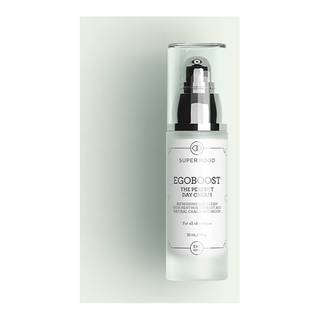
Supermood Egoboost The Perfect Day Cream
Works for
1 of 1 advertised claim delivered
MoisturizingGlycerin, Porphyridium cruentum extract + 6 moreGood evidence
“Luckily, Egoboost Perfect Day Cream is full of antioxidants from Chaga to nourish and hydrate your skin throughout the day.”
This product contains good ingredients to attract water to the upper layer of the skin. These ingredients are called "humectants": glycerin.
When humectants are on the surface of the skin, they “pull in” the moisture from the outside environment, or from within deeper layers of the skin. If the air is dry, humectants can speed up the moisture loss from the skin. This is why it is a good idea to use another product on top of this one to help "seal in" the moisture (look for ingredients like dimethicone, squalane, oils and butters).
Can it cause trouble?
Irritancy5 strong irritants: Parfum, Citronellol + 3 more — patch-test recommendedHigh risk
Comedogenic2 ingredients rated 2 or more on the 0–5 pore-clogging scale2 flagged
User reviews
Be the first — your take helps the next person decide.
Ingredients
Filter by role to see what each ingredient is doing.
Water~40–60%
Betula pendula sap~5.5–8.2%
- Irritation risk
- Low
Olea europaea fruit oil~3.6–5.5%
- Irritation risk
- Medium
An emollient that helps soften the skin but is not effective for restoring its barrier function. Might be helpful to calm down inflammation
More about Olea europaea fruit oilPrunus amygdalus dulcis oil~2.9–4.3%
- Irritation risk
- Low
An emollient that softens the skin
More about Prunus amygdalus dulcis oilC14-22 alcohols~2.1–3.1%
- Irritation risk
- Low
A non-drying alcohol that helps stabilize product formulations
More about C14-22 alcoholsC12-20 alkyl glucoside~1.7–2.6%
- Irritation risk
- Medium
Helps water and oil mix together
More about C12-20 alkyl glucosideHydroxypropyl methylcellulose~1.4–2.1%
- Irritation risk
- Medium
Used to create a thicker product consistency and stabilize the formulation
More about Hydroxypropyl methylcellulosePullulan~1.3–1.9%
- Irritation risk
- High
Creates a thin drying film on the skin resulting in a short-term tightening effect
More about PullulanPorphyridium cruentum extract~1–1.5%
- Irritation risk
- Low
- Comedogenicity
- 3/5
A red algae extract. Can help attract water to the upper layer of the skin and might have an antioxidant effect
More about Porphyridium cruentum extractGlycerin~0.85–1.3%
- Irritation risk
- Low
One of the best moisturizing ingredients. Naturally present in skin. It attracts water to the upper layer of the skin working as a humectant
More about GlycerinSimmondsia chinensis seed oil~0.55–1.25%
- Irritation risk
- Medium
Softens the upper layer of skin and helps restore the healthy skin barrier. Has shown to help calm down inflammation in skin. It is a stable oil, meaning that it retains its properties even when exposed to air.
More about Simmondsia chinensis seed oilButyrospermum parkii butter~0.45–1.05%
- Irritation risk
- Low
- Comedogenicity
- 3/5
A great moisturising ingredient that softens the skin and reduces water loss from its upper layer. It also can be helpful in protecting skin from free radicals
More about Butyrospermum parkii butterInonotus obliquus extract~0.35–0.85%
- Irritation risk
- Low
Maltodextrin~0.35–0.8%
- Irritation risk
- Low
Used to stabilize the product formulation and can help absorb oil
More about MaltodextrinTocopherol~0.2–0.75%
- Irritation risk
- Low
Pure form of vitamin E. Can help moisturise and protect the skin from free radicals. Often used to help stabilise other ingredients or the formula itself
More about TocopherolParfum~0.15–0.6%
- Irritation risk
- High
An aromatic blend of unspecified and possibly irritating ingredients
More about ParfumCitronellol~0.1–0.5%
Limonene~0.1–0.45%
- Irritation risk
- High
A common frangrance that can easily irritate skin, especially if exposed to air, light or heat
More about LimoneneLinalool~0.1–0.35%
Xanthan gum~0.1–0.35%
- Irritation risk
- Low
Used to create a thicker product consistency
More about Xanthan gumLactic acid~0.1–0.3%
- Irritation risk
- Medium
An exfoliating and moisturizing alpha-hydroxy acid (AHA). Typically causes less irritation than other AHAs, for example, glycolic acid. At high concentrations (about 15%), lactic acid can help reduce lines and wrinkles. Recent studies show that lactic acid can support the "good" bacteria living on skin's surface (healthy skin microbiome)
More about Lactic acidMenthol~0.1–0.4%
- Irritation risk
- High
Sodium benzoate~0.05–0.25%
Sodium dehydroacetate~0.05–0.2%
Ingredient list view
Water, Betula pendula sap, Olea europaea fruit oil, Prunus amygdalus dulcis oil, C14-22 alcohols, C12-20 alkyl glucoside, Hydroxypropyl methylcellulose, Pullulan, Porphyridium cruentum extract, Glycerin, Simmondsia chinensis seed oil, Butyrospermum parkii butter, Inonotus obliquus extract, Maltodextrin, Tocopherol, Parfum, Citronellol, Limonene, Linalool, Xanthan gum, Lactic acid, Menthol, Sodium benzoate, Sodium dehydroacetate
Compare prices
Retailers ranked by price — lowest first.
Affiliate links · prices updated regularly · As an Amazon Associate, WIMJ earns from qualifying purchases.
Sources cited in this review
Every concentration estimate and effectiveness label is anchored to one of these 10 studies and safety reviews.
- 1Use of “natural” oils for moisturization: Review of olive, coconut, and sunflower seed oilonlinelibrary.wiley.com
- 2
- 3
- 4Safety Assessment of Decyl Glucoside and Other Alkyl Glucosides as Used in Cosmeticsciteseerx.ist.psu.edu
- 5
- 6Vitamin E in dermatologyncbi.nlm.nih.gov

Affiliate links · As an Amazon Associate, WIMJ earns from qualifying purchases.