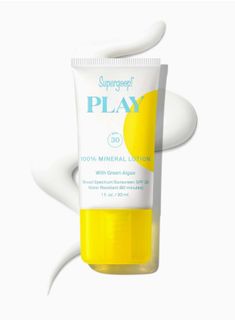
Supergoop! PLAY Mineral Lotion SPF 30
Works for
1 of 1 advertised claim delivered
Sun protectionSPF 30 · 2 UV filtersBroad spectrum
This product offers a good level of protection against both UVB and UVA rays.
This sunscreen uses organic (so-called "chemical") sunscreen filters. Organic, or "chemical" filters usually provide reliable sun protection and rarely leave a white cast. Sunscreens with organic filters can sting eyes.
This product can be considered "reef safe" because it does not contain the UV filters (oxybenzone and octinoxate) that can be harmful to coral reefs when present in the water in high concentrations.
Anti-agingNot advertised by the brand · TocopherolStrong evidence
This product can help prevent early signs of skin aging because it offers a good level of broad spectrum sun protection. Sun damage is the main cause of premature skin aging, and protecting your skin from the sun is the best anti-aging strategy.
Evens skin toneNot advertised by the brand · No ingredient credited for this claimStrong evidence
This product offers broad spectrum sun protection. It means that it can prevent hyperpigmentation and help keep the skin tone even (sun damage is the main factor causing age spots, darkening of post-acne marks and other discolorations).
Anti-oxidationNot advertised by the brand · Haematococcus pluvialis extract, Bisabolol + 1 moreModerate evidence
This product contains antioxidants (haematococcus pluvialis extract) that might be able to help neutralize free radicals in skin to lessen the damage it gets from the UV light (sun). There is not enough evidence to confirm their effectiveness in skin though.
MoisturizingNot advertised by the brand · Glycerin, Erythritol + 14 moreGood evidence
This product can help improve hydration of the skin with the two types of ingredients.
The first type is called “humectants”:
these ingredients help attract water.
When humectants are on the surface of the skin, they “pull in” the moisture from the outside environment, or from
within deeper layers of the skin. The following ingredients in this product do the job:
erythritol, glycerin.
This product also contains ingredients called “occlusives”. They help reduce the speed with which our skin loses moisture to the outside environment. These ingredients also help soften the upper layer of the skin, so it feels less tight and nicer to the touch. The following ingredients in this product do the job: jojoba esters, cetearyl alcohol.
Can it cause trouble?
Irritancy12 flagged ingredientsLow risk
Comedogenic1 ingredient rated 2 or more on the 0–5 pore-clogging scale1 flagged
User reviews
Be the first — your take helps the next person decide.
Ingredients
Filter by role to see what each ingredient is doing.
Zinc oxide16%
- Irritation risk
- Low
A broad spectrum sunblock (protects from both UVA and UVB rays). Is suitable for most sensitive skins. In small concentrations, can be used as a colorant
More about Zinc oxideArachidyl alcohol~23–35%
- Irritation risk
- Low
Used to soften the upper layer of the skin and create a thicker product consistency
More about Arachidyl alcoholArachidyl glucoside~5.5–8.3%
Astrocaryum vulgare kernel oil~3.6–5.5%
- Irritation risk
- Low
Behenyl alcohol~2.7–4%
- Irritation risk
- Low
Non-drying alcohol that helps water and oil mix together. Also serves as an emollient
More about Behenyl alcoholBisabolol~1.8–2.6%
- Irritation risk
- Low
An active component of chamomile plant that historically has been used to calm down irritated skin. A recent study shows that bisabolol indeed can have some anti-inflammatory effect on skin, even though conclusive data is lacking. Bisabolol has a sweet floral scent and can be added to products for its aromatic properties
More about BisabololButyloctyl salicylate~1.5–2.2%
- Irritation risk
- Medium
A synthetic ester of salicylic acid that is used to help disperse pigments and boost effectiveness of sunscreen ingredients. It is able to absorb UV light (working as an organic, or chemical filter), but is not approved as a sunscreen ingredient on its own
More about Butyloctyl salicylateC13-14 alkane~1.2–1.8%
- Irritation risk
- Low
Helps soften the upper layer of the skin
More about C13-14 alkaneCaprylhydroxamic acid~1–1.5%
Caprylic/capric triglyceride~0.95–1.4%
- Irritation risk
- Medium
A good mix of fatty acids that forms a protective layer on the skin. Improves the shelf life of products. Derived from coconut and glycerin
More about Caprylic/capric triglycerideCapryloyl glycerin/sebacic acid copolymer~0.8–1.2%
- Irritation risk
- Low
Helps soften the upper layer of the skin
More about Capryloyl glycerin/sebacic acid copolymerCaprylyl glycol~0.5–1.1%
- Irritation risk
- Medium
Helps preserve products and creates a nice product texture
More about Caprylyl glycolCellulose gum~0.4–0.95%
- Irritation risk
- Low
Used to create thicker product consistency and stabilize emulsions
More about Cellulose gumCetearyl alcohol~0.4–0.95%
- Irritation risk
- Low
- Comedogenicity
- 2/5
A non-drying alcohol. Works as an emollient. Helps water and oil mix together and creates a nice product texture
More about Cetearyl alcoholCetyl alcohol~0.35–0.85%
- Irritation risk
- Low
A non-drying alcohol that works to soften the skin and stabilize product formulations helping oil and water mix together
More about Cetyl alcoholCitric acid~0.2–0.7%
- Irritation risk
- Medium
Can work as an exfoliant but is typically used to adjust the product pH
More about Citric acidCoco-glucoside~0.35–0.8%
- Irritation risk
- High
Used as a cleansing agent (surfactant) in cleansers. Helps water and oil mix together in lotions. Can be irritating
More about Coco-glucosideDiheptyl succinate~0.2–0.7%
- Irritation risk
- Low
Helps to soften the upper layer of the skin and creates a nice product finish on the skin
More about Diheptyl succinateErythritol~0.15–0.6%
- Irritation risk
- Low
Helps to attract water to the upper layer of the skin
More about ErythritolEthyl ferulate~0.15–0.55%
- Irritation risk
- Low
Glycerin~0.15–0.55%
- Irritation risk
- Low
One of the best moisturizing ingredients. Naturally present in skin. It attracts water to the upper layer of the skin working as a humectant
More about GlycerinHaematococcus pluvialis extract~0.1–0.4%
- Irritation risk
- Medium
Green algae extract that might contain antioxidant astaxanthin
More about Haematococcus pluvialis extractJojoba esters~0.1–0.5%
- Irritation risk
- Medium
An emollient made of jojoba oil. Helps soften the skin and support its barrier function
More about Jojoba estersLauryl laurate~0.1–0.3%
- Irritation risk
- Medium
Helps soften the upper layer of the skin
More about Lauryl laurateMethyl dihydroabietate~0.1–0.35%
- Irritation risk
- Low
Helps soften the upper layer of the skin
More about Methyl dihydroabietateMicrocrystalline cellulose~0.1–0.4%
Neopentyl glycol diheptanoate~0.1–0.45%
- Irritation risk
- Low
Helps soften the upper layer of the skin and create a nice product consistency
More about Neopentyl glycol diheptanoatePolyester-7~0.1–0.4%
- Irritation risk
- Low
Polyester-8~0.1–0.4%
- Irritation risk
- Medium
Used to stabilize product formulations and individual ingredients (for example, sunscreens). Can be an allergen
More about Polyester-8Polyhydroxystearic acid~0.1–0.4%
- Irritation risk
- Medium
Used to create a thicker product consistency and stabilize the formulation
More about Polyhydroxystearic acidPropanediol~0.1–0.35%
- Irritation risk
- Low
Acts as a solvent for other ingredients. Speeds up the absorption of other ingredients into the skin
More about PropanediolSea water~0.05–0.3%
- Irritation risk
- Low
Dissolves other ingredients. It does not have additional skin benefits compared to plain water
More about Sea waterSodium gluconate~0.05–0.2%
Sodium stearoyl glutamate~0.15–0.55%
- Irritation risk
- Medium
Helps oil and water mix together
More about Sodium stearoyl glutamateTocopherol~0.05–0.15%
- Irritation risk
- Low
Pure form of vitamin E. Can help moisturise and protect the skin from free radicals. Often used to help stabilise other ingredients or the formula itself
More about TocopherolWater~0.01–0.1%
Ingredient list view
Zinc oxide, Arachidyl alcohol, Arachidyl glucoside, Astrocaryum vulgare kernel oil, Behenyl alcohol, Bisabolol, Butyloctyl salicylate, C13-14 alkane, Caprylhydroxamic acid, Caprylic/capric triglyceride, Capryloyl glycerin/sebacic acid copolymer, Caprylyl glycol, Cellulose gum, Cetearyl alcohol, Cetyl alcohol, Citric acid, Coco-glucoside, Diheptyl succinate, Erythritol, Ethyl ferulate, Glycerin, Haematococcus pluvialis extract, Jojoba esters, Lauryl laurate, Methyl dihydroabietate, Microcrystalline cellulose, Neopentyl glycol diheptanoate, Polyester-7, Polyester-8, Polyhydroxystearic acid, Propanediol, Sea water, Sodium gluconate, Sodium stearoyl glutamate, Tocopherol, Water
Compare prices
Retailers ranked by price — lowest first.

Sources cited in this review
Every concentration estimate and effectiveness label is anchored to one of these 16 studies and safety reviews.
- 1A review of inorganic UV filters zinc oxide and titanium dioxideonlinelibrary.wiley.com
- 2
- 3
- 4
- 5
- 6

Affiliate links · As an Amazon Associate, WIMJ earns from qualifying purchases.