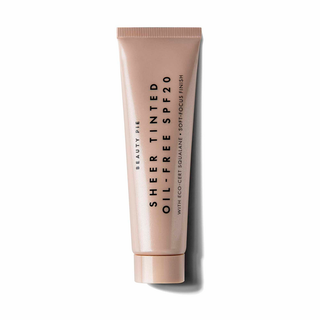
Super Healthy Skin™ Sheer Tinted Oil-Free SPF20
Works for
1 of 2 advertised claims delivered
Sun protectionSPF 20 · 3 UV filters · Partial spectrumWeak protectionSPF under 30
This product does not offer good protection against UVA rays.
Moisturizing12 ingredients credited for this claimGood support
“It’s probably the best oil-free sheer-tinted SPF, ever.+ Like a wearable, natural-skin luminizing, selfie filter.+ With SPF 20 protection and sheer, perfecting coverage.+ With Ecocert Squalane , naturally derived from Olive Oil to help limit skin dehydration.+ With smoothing Jojoba Esters and soothing Liquorice Extract.+ Instant visual fine line and wrinkle smoothing, for a soft-focused finish.”
This product can help improve hydration of the skin with the two types of ingredients.
The first type is called “humectants”:
these ingredients help attract water.
When humectants are on the surface of the skin, they “pull in” the moisture from the outside environment, or from
within deeper layers of the skin. The following ingredients in this product do the job:
glycerin, lauryl pca.
This product also contains ingredients called “occlusives”. They help reduce the speed with which our skin loses moisture to the outside environment. These ingredients also help soften the upper layer of the skin, so it feels less tight and nicer to the touch. The following ingredients in this product do the job: methicone, squalane.
Can it cause trouble?
Irritancy9 flagged ingredientsLow risk
Comedogenic1 ingredient rated 2 or more on the 0–5 pore-clogging scale1 flagged
User reviews
Ingredients
Filter by role to see what each ingredient is doing.
Water~45–55%
Ethylhexyl methoxycinnamate~6.2–7.6%
- Irritation risk
- High
Octinoxate. When used in higher concentrations, works as a sunscreen protecting the skin from UVB rays. When used in lower concentration, helps to preserve the product formulation. Is shown to be harmful to coral reefs - consider avoiding bathing in coral reef areas when wearing a product with this ingredient. It can be irritating
More about Ethylhexyl methoxycinnamateDisiloxane~4.4–5.4%
- Irritation risk
- Low
Peg-30 dipolyhydroxystearate~2.9–3.5%
- Irritation risk
- Medium
Helps oil and water mix together
More about Peg-30 dipolyhydroxystearateEthylhexyl salicylate~3.3–4%
- Irritation risk
- Low
Octisalate. A UV filter. It offers some protection against the sun rays that cause sunburn (UVB), but does not protect against the most aging sun rays (UVA). It loses its effectiveness quickly when exposed to sunlight. It is an organic, or so called "chemical" sunscreen
More about Ethylhexyl salicylateC12-15 alkyl benzoate~2–2.5%
- Irritation risk
- Low
Enhances the product texture and makes it more spreadable. Helps reduce water loss from the outer layer of skin. Extands the shelf life by preventing bacteria growth
More about C12-15 alkyl benzoateGlycerin~1.8–2.1%
- Irritation risk
- Low
One of the best moisturizing ingredients. Naturally present in skin. It attracts water to the upper layer of the skin working as a humectant
More about GlycerinEthylhexyl palmitate~1.5–1.8%
- Irritation risk
- Low
- Comedogenicity
- 3/5
An emollient that helps soften the skin and create a nice product texture
More about Ethylhexyl palmitateIsohexadecane~1.3–1.6%
- Irritation risk
- Low
Improves the texture of the product and helps soften the skin. Helps oil and water mix together and can be used as a cleansing agent
More about IsohexadecaneCyclopentasiloxane~1–1.2%
- Irritation risk
- Low
A silicone that helps improve the product texture and spreadability. Can absorb oil creating a short-term mattifying effect on the skin
More about CyclopentasiloxaneHydroxyacetophenone~0.7–1%
Sodium chloride~0.65–0.95%
- Irritation risk
- Low
Used to stabilize mixtures of oil and water, and create thicker, gel-like product textures
More about Sodium chlorideBoron nitride~0.55–0.85%
- Irritation risk
- Low
Helps to absord oil and evenly disperse other ingredients (for example, pigment) in product formulation
More about Boron nitrideJojoba esters~0.5–0.75%
- Irritation risk
- Medium
An emollient made of jojoba oil. Helps soften the skin and support its barrier function
More about Jojoba estersSqualane~0.5–0.75%
- Irritation risk
- Low
An oil naturally present in skin. Works as an emollient to soften the skin and form a protective layer on its surface without a greasy feeling.
More about SqualaneMagnesium stearate~0.45–0.7%
1,2-hexanediol~0.4–0.6%
Caprylyl glycol~0.4–0.65%
- Irritation risk
- Medium
Helps preserve products and creates a nice product texture
More about Caprylyl glycolMethicone~0.35–0.6%
- Irritation risk
- Low
A type of silicone that helps soften the upper layer of the skin and reduces the water loss from the skin surface
More about MethiconePentaerythrityl tetra-di-t-butyl hydroxyhydrocinnamate~0.3–0.55%
- Irritation risk
- Low
Used to increase stability of product formulations
More about Pentaerythrityl tetra-di-t-butyl hydroxyhydrocinnamateTrisodium ethylenediamine disuccinate~0.25–0.5%
- Irritation risk
- Medium
Used to improve stability of the formulation
More about Trisodium ethylenediamine disuccinateTocopheryl acetate~0.25–0.5%
- Irritation risk
- Medium
A more stable but less bio-available form of vitamin E compared to Tocopherol. Might help moisturize and protect the skin from free radicals, but mostly used in low concentrations to stabilize other ingredients.
More about Tocopheryl acetateLauryl pca~0.25–0.45%
- Irritation risk
- Low
Helps attract water to the upper layer of the skin
More about Lauryl pcaPpg-15 stearyl ether~0.3–0.5%
- Irritation risk
- Low
Help soften the upper layer of the skin and create a nice product consistency
More about Ppg-15 stearyl etherIsopropyl titanium triisostearate~0.3–0.5%
- Irritation risk
- Medium
Helps water and oil mix together
More about Isopropyl titanium triisostearateDipotassium glycyrrhizate~0.2–0.4%
- Irritation risk
- Low
A salt derived from licorice. Works as an emollient to soften the upper layer of the skin and can help calm down inflammation. Might be helpful for skin lightening
More about Dipotassium glycyrrhizateCi 77891~0.2–0.35%
- Irritation risk
- Low
Titanium dioxide~0.3–0.55%
- Irritation risk
- Low
Works as a UV filter when used in high concentrations. It is photostable and is effective mostly against the UVB light, with some protection in the UVA range. In small concentrations, used for its ability to improve the color of cosmetic products. Is usually well tolerated by the skin
More about Titanium dioxideCi 77492~0.15–0.3%
Iron oxides~0.15–0.25%
- Irritation risk
- Low
An umbrella term for the following three colorants: CI 77491, CI 77492, CI 77499. They might be able to offer some protection against visible light, but the degree of the protection is not clear
More about Iron oxidesCi 77491~0.15–0.25%
- Irritation risk
- Low
A red colorant made of iron oxide. Typically is not irritating
More about Ci 77491Iron oxides~0.1–0.2%
- Irritation risk
- Low
An umbrella term for the following three colorants: CI 77491, CI 77492, CI 77499. They might be able to offer some protection against visible light, but the degree of the protection is not clear
More about Iron oxidesCi 77499~0.1–0.15%
Iron oxides~0.05–0.1%
- Irritation risk
- Low
An umbrella term for the following three colorants: CI 77491, CI 77492, CI 77499. They might be able to offer some protection against visible light, but the degree of the protection is not clear
More about Iron oxidesIngredient list view
Water, Ethylhexyl methoxycinnamate, Disiloxane, Peg-30 dipolyhydroxystearate, Ethylhexyl salicylate, C12-15 alkyl benzoate, Glycerin, Ethylhexyl palmitate, Isohexadecane, Cyclopentasiloxane, Hydroxyacetophenone, Sodium chloride, Boron nitride, Jojoba esters, Squalane, Magnesium stearate, 1,2-hexanediol, Caprylyl glycol, Methicone, Pentaerythrityl tetra-di-t-butyl hydroxyhydrocinnamate, Trisodium ethylenediamine disuccinate, Tocopheryl acetate, Lauryl pca, Ppg-15 stearyl ether, Isopropyl titanium triisostearate, Dipotassium glycyrrhizate, Ci 77891, Titanium dioxide, Ci 77492, Iron oxides, Ci 77491, Iron oxides, Ci 77499, Iron oxides
Compare prices
Retailers ranked by price — lowest first.

Product summary
"Super Healthy Skin™ - Sheer Tinted Oil-Free SPF20" does not provide enough UVA protection. UVA rays do not cause sunburn, but still damage the skin, leading to early signs of aging and pigmentation issues.
Because it includes good moisturizing ingredients, it can also work as a hydrating day cream.
Sunscreen filters
This is a so-called "chemical" sunscreen. It means that it uses organic UV filters. They typically offer good sun protection and rarely leave a white cast, but they can be irritating for some people with sensitive skin. The UV filters in this sunscreen are: octinoxate 6.20% - 7.60% and octisalate 3.30% - 4.00%.
Irritation risk
This sunscreen contains actives that can be irritating. We assess the overall irritancy of this product to be low. For a detailed overview of all potential irritants: click here
You can see the detailed formula review with the breakdown of all actives in the product and the full ingredient list with estimated concentrations in the tables below.
What our users say
Based on 1 review 100% recommend this product- As for the white cast, the reviewer reported a noticeable whitish residue.
- When it comes to using this sunscreen under makeup, the user found that it pills under a foundation.
- As for using this sunscreen in the eye area, the reviewer reported that it stings eyes.
Price
The product retails from 9.00$ up to 22.00$ in the United Kingdom.
For a detailed price comparison: click here.
Sources cited in this review
Every concentration estimate and effectiveness label is anchored to one of these 7 studies and safety reviews.
- 1
- 2Safety Assessment of Boron Nitride as Used in Cosmetics cir-safety.org
- 3
- 4
- 5
- 6

Affiliate links · As an Amazon Associate, WIMJ earns from qualifying purchases.