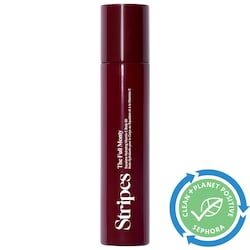
Stripes Full Monty Brightening Body Oil with Squalane + Vitamin C
Works for
1 of 2 advertised claims delivered
Moisturizing4 ingredients credited for this claimGood support
“What it is: A nongreasy moisturizing oil with squalane, açai oil, vitamins C and E, and Kakadu plum delivers deep hydration and an all-over glow.”
This product can help improve hydration of the skin with the two types of ingredients.
The first type is called “humectants”:
these ingredients help attract water.
When humectants are on the surface of the skin, they “pull in” the moisture from the outside environment, or from
within deeper layers of the skin. The following ingredients in this product do the job:
terminalia ferdinandiana seed oil.
This product also contains ingredients called “occlusives”. They help reduce the speed with which our skin loses moisture to the outside environment. These ingredients also help soften the upper layer of the skin, so it feels less tight and nicer to the touch. The following ingredients in this product do the job: squalane, terminalia ferdinandiana seed oil.
Evens skin tone1 ingredient credited for this claimWeak support
“- Vitamin C: An oil-soluble vitamin C visibly brightens and evens skin tone.”
Effective ingredients missing or their concentration is too low
Can it cause trouble?
Irritancy5 strong irritants: Parfum, Citral + 3 more — patch-test recommendedHigh risk
ComedogenicClean of flagged comedogenic ingredientsNone flagged
User reviews
Be the first — your take helps the next person decide.
Ingredients
Filter by role to see what each ingredient is doing.
Squalane~25–38%
- Irritation risk
- Low
An oil naturally present in skin. Works as an emollient to soften the skin and form a protective layer on its surface without a greasy feeling.
More about SqualaneEuterpe oleracea fruit oil~5.6–8.5%
- Irritation risk
- Medium
A plant oil that might help neutralize free radicals, but evidence of effectiveness in skin is lacking
More about Euterpe oleracea fruit oilPseudozyma epicola/argania spinosa kernel oil ferment filtrate~4.5–6.8%
- Irritation risk
- Low
Pseudozyma epicola/camellia japonica seed oil ferment extract filtrate~2.9–4.3%
Parfum~1.6–2.5%
- Irritation risk
- High
An aromatic blend of unspecified and possibly irritating ingredients
More about ParfumRosa canina seed oil~1.7–2.6%
- Irritation risk
- Medium
A plant oil that helps soften the upper layer of the skin. It might have anti-oxidant properties. Might help reduce inflammation in skin and help against blemishes
More about Rosa canina seed oilTerminalia ferdinandiana seed oil~1.5–2.2%
- Irritation risk
- Low
Helps soften the upper layer of the skin
More about Terminalia ferdinandiana seed oilCitrullus lanatus seed oil~1.3–1.9%
- Irritation risk
- Low
Tetrahexyldecyl ascorbate~0.45–1%
- Irritation risk
- Medium
Being a lipid soluble form of vitamin C, it is more stable than ascorbic acid, but still degrades quickly and needs to be stabilized in a formulation with another ingredient. It is claimed to penetrate skin better than pure vitamin C and have the the similar benefits, but solid studies of its effectiveness are lacking. Is likely to require a higher concentration in a product than pure vitamin C to be effective. It might be able to help reduce pore clogging.
More about Tetrahexyldecyl ascorbateTocopherol~0.35–0.75%
- Irritation risk
- Low
Pure form of vitamin E. Can help moisturise and protect the skin from free radicals. Often used to help stabilise other ingredients or the formula itself
More about TocopherolCitral~0.15–0.6%
Citronellol~0.05–0.25%
Limonene~0.05–0.1%
- Irritation risk
- High
A common frangrance that can easily irritate skin, especially if exposed to air, light or heat
More about LimoneneLinalool~0.01–0.05%
Ingredient list view
Squalane, Euterpe oleracea fruit oil, Pseudozyma epicola/argania spinosa kernel oil ferment filtrate, Pseudozyma epicola/camellia japonica seed oil ferment extract filtrate, Parfum, Rosa canina seed oil, Terminalia ferdinandiana seed oil, Citrullus lanatus seed oil, Tetrahexyldecyl ascorbate, Tocopherol, Citral, Citronellol, Limonene, Linalool
Compare prices
Retailers ranked by price — lowest first.

Sources cited in this review
Every concentration estimate and effectiveness label is anchored to one of these 9 studies and safety reviews.
- 1
- 2Nutrient composition of rose (Rosa canina L.) seed and oilsncbi.nlm.nih.gov
- 3
- 4
- 5
- 6

Affiliate links · As an Amazon Associate, WIMJ earns from qualifying purchases.