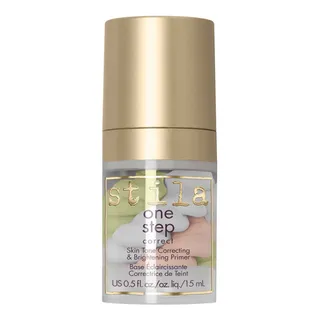
Stila One Step Correct Skin Tone Correcting & Brightening Primer
Works for
MoisturizingCyclopentasiloxane, Glycerin + 13 moreWorks
“Ideal for balancing-out the skin and correcting uneven skin tones, this revolutionary product primes, colour-corrects, brightens and nourishes skin for a flawless face with no fuss.”
This product can help improve hydration of the skin with the two types of ingredients.
The first type is called “humectants”:
these ingredients help attract water.
When humectants are on the surface of the skin, they “pull in” the moisture from the outside environment, or from
within deeper layers of the skin. The following ingredients in this product do the job:
glycerin, glyceryl acrylate/acrylic acid copolymer.
This product also contains ingredients called “occlusives”. They help reduce the speed with which our skin loses moisture to the outside environment. These ingredients also help soften the upper layer of the skin, so it feels less tight and nicer to the touch. The following ingredients in this product do the job: dimethicone, octyldodecyl neopentanoate.
Anti-oxidationSide benefit · Camellia oleifera leaf extract, Ginkgo biloba leaf extract + 5 moreWorks well
This product contains antioxidants (camellia oleifera leaf extract) that can help neutralize free radicals in skin. By doing so, they can lessen the damage the skin gets from the UV light (sun).
The following ingredients - ginkgo biloba leaf extract also can have an antioxidant effect, but there is less evidence to confirm their effectiveness in skin.
Anti-agingSide benefit · Lysine, Tocopherol + 3 moreMay help
This product contains lysine. There is some human evidence that this ingredient helps reduce and prevent fine lines and wrinkles and improve skin elasticity and firmness, though it is smaller or less consistent than the evidence for the best anti-aging ingredients.
Can it cause trouble?
Irritancy1 strong irritant: Retinyl palmitateMedium risk
ComedogenicClean of flagged comedogenic ingredientsNone flagged
User reviews
Be the first — your take helps the next person decide.
Ingredients
Filter by role to see what each ingredient is doing.
Water~45–55%
Cyclopentasiloxane~6.4–7.8%
- Irritation risk
- Low
A silicone that helps improve the product texture and spreadability. Can absorb oil creating a short-term mattifying effect on the skin
More about CyclopentasiloxaneGlycerin~4.2–5.1%
- Irritation risk
- Low
One of the best moisturizing ingredients. Naturally present in skin. It attracts water to the upper layer of the skin working as a humectant
More about GlycerinButylene glycol~3.1–3.8%
- Irritation risk
- Low
Used to create a nice product texture and help delivery of other ingredients. Might be somewhat helpful in attracting water to the upper layer of the skin
More about Butylene glycolPropylene glycol~2.3–2.9%
- Irritation risk
- High
Helps oil and water mix together and can enhance the penetration of other ingredients into the skin. It can be irritating
More about Propylene glycolTitanium dioxide~2.5–3%
- Irritation risk
- Low
Works as a UV filter when used in high concentrations. It is photostable and is effective mostly against the UVB light, with some protection in the UVA range. In small concentrations, used for its ability to improve the color of cosmetic products. Is usually well tolerated by the skin
More about Titanium dioxideZinc oxide~2.4–2.9%
- Irritation risk
- Low
A broad spectrum sunblock (protects from both UVA and UVB rays). Is suitable for most sensitive skins. In small concentrations, can be used as a colorant
More about Zinc oxideOctyldodecyl neopentanoate~1.5–1.8%
- Irritation risk
- Low
An emollient that helps soften the skin. Often used to stabilize other ingredients, for example, sunscreen
More about Octyldodecyl neopentanoateCarbomer~1.2–1.4%
- Irritation risk
- Low
Helps create a thicker or gel-like product texture. It is not a surfactant but can be used in gentle cleansing formulations
More about CarbomerPhenoxyethanol~0.5–1%
- Irritation risk
- Low
A preservative. It helps prevent bacterial growth in cosmetic products
More about PhenoxyethanolPeg/ppg-18/18 dimethicone~0.7–1.05%
- Irritation risk
- Low
A silicone that mixes with water creating nice light-weight product texture
More about Peg/ppg-18/18 dimethiconeSodium hydroxide~0.55–0.85%
Dimethicone~0.6–0.85%
- Irritation risk
- Low
A silicone that helps to reduce water loss from the surface of the skin. Can temporarily "fill in" lines and wrinkles, absorb oil, and create a nice product finish
More about DimethiconeCaprylyl glycol~0.5–0.75%
- Irritation risk
- Medium
Helps preserve products and creates a nice product texture
More about Caprylyl glycolAluminum hydroxide~0.5–0.75%
- Irritation risk
- Low
Is used to add opaque (non-transparent) appearance to formulations. Can be used to coat other ingredients for even dispersion. This is a different ingredient compared to the ones used in antipersperants (aluminium chloride and aluminium chlorohydrate)
More about Aluminum hydroxideStearic acid~0.55–0.85%
- Irritation risk
- Low
Helps oil and water mix together and works as an emollient
More about Stearic acidBoron nitride~0.45–0.65%
- Irritation risk
- Low
Helps to absord oil and evenly disperse other ingredients (for example, pigment) in product formulation
More about Boron nitrideChromium oxide greens~0.35–0.65%
- Irritation risk
- Low
Ultramarines~0.3–0.6%
- Irritation risk
- Low
Disodium edta~0.3–0.55%
Glyceryl acrylate/acrylic acid copolymer~0.3–0.5%
- Irritation risk
- Medium
Helps attract water to the upper layer of the skin and provide a longer-lasting hydration. Can create a thicker product consistency
More about Glyceryl acrylate/acrylic acid copolymerSodium dehydroacetate~0.25–0.5%
Iron oxides~0.25–0.45%
- Irritation risk
- Low
An umbrella term for the following three colorants: CI 77491, CI 77492, CI 77499. They might be able to offer some protection against visible light, but the degree of the protection is not clear
More about Iron oxidesMethylparaben~0.15–0.3%
Phytantriol~0.25–0.5%
- Irritation risk
- Low
Hexylene glycol~0.25–0.45%
- Irritation risk
- Medium
Helps create a more spreadable product texture
More about Hexylene glycolTriethoxycaprylylsilane~0.25–0.45%
- Irritation risk
- Low
A type of silicone that helps oil and water mix well together. Helps to disperse other ingredients, e.g. pigments, evenly in a formulation
More about TriethoxycaprylylsilaneDextrin palmitate~0.25–0.5%
- Irritation risk
- Medium
Helps water and oil mix together
More about Dextrin palmitatePalmitic acid~0.3–0.55%
- Irritation risk
- Low
An emollient that is naturally present in skin and helps soften it
More about Palmitic acidPropylparaben~0.25–0.4%
Iron oxides~0.25–0.45%
- Irritation risk
- Low
An umbrella term for the following three colorants: CI 77491, CI 77492, CI 77499. They might be able to offer some protection against visible light, but the degree of the protection is not clear
More about Iron oxidesOctyldodecanol~0.25–0.5%
- Irritation risk
- Low
An emollient that helps to soften the skin and create a pleasant product texture and stabilize the formulation
More about OctyldodecanolTetrahexyldecyl ascorbate~0.25–0.5%
- Irritation risk
- Medium
Being a lipid soluble form of vitamin C, it is more stable than ascorbic acid, but still degrades quickly and needs to be stabilized in a formulation with another ingredient. It is claimed to penetrate skin better than pure vitamin C and have the the similar benefits, but solid studies of its effectiveness are lacking. Is likely to require a higher concentration in a product than pure vitamin C to be effective. It might be able to help reduce pore clogging.
More about Tetrahexyldecyl ascorbateTocopherol~0.25–0.5%
- Irritation risk
- Low
Pure form of vitamin E. Can help moisturise and protect the skin from free radicals. Often used to help stabilise other ingredients or the formula itself
More about TocopherolTocopheryl acetate~0.25–0.5%
- Irritation risk
- Medium
A more stable but less bio-available form of vitamin E compared to Tocopherol. Might help moisturize and protect the skin from free radicals, but mostly used in low concentrations to stabilize other ingredients.
More about Tocopheryl acetateMagnesium ascorbyl phosphate~0.25–0.45%
- Irritation risk
- Medium
A derivative of vitamin C that is more stable, but less bioavailable than the pure form of vitamin C. It does not penetrate the skin well, but has been shown to convert to pure vitamin C once in skin. It can be helpful in stimulating collagen production and lightening the skin tone, but the required concentration is likely to be very high
More about Magnesium ascorbyl phosphateMica~0.3–0.5%
- Irritation risk
- Low
Creates an illusion of smoother and more radiant skin tone. Adds shimmer to the skin by reflecting light
More about MicaRetinyl palmitate~0.25–0.45%
- Irritation risk
- High
Three steps removed from the active form of vitamin A - retinoic acid. To have an effect in the skin, it first needs to be converted twice to become the retinoic acid. This means it is less potent than retinol, but could also be less irritating. Once converted to the retinoic acid in the skin, it helps against all signs of aging, improves skin cell turnover and helps fight blemishes and clogged pores. However, in many cosmetic formulations, it is used in a concentration that is too low to have the full effect
More about Retinyl palmitateIron oxides~0.25–0.45%
- Irritation risk
- Low
An umbrella term for the following three colorants: CI 77491, CI 77492, CI 77499. They might be able to offer some protection against visible light, but the degree of the protection is not clear
More about Iron oxidesLysine~0.25–0.45%
- Irritation risk
- Low
An amino-acid that helps to attract water to the upper layer of the skin. In combination with other amino-acids, might help to reduce fine lines and wrinkles
More about LysineAnthemis nobilis flower extract~0.2–0.35%
- Irritation risk
- High
A plant extract that one one hand, can contain compounds that can help calm down skin irritation, but, on the other hand, its other compounds (especially fragrant ones) can themselves be irritating
More about Anthemis nobilis flower extractCamellia oleifera leaf extract~0.25–0.45%
- Irritation risk
- Low
A plant extract that can help neutralize free radicals and reduce inflammation, even though it is not usually used in sufficient concentration in cosmetics
More about Camellia oleifera leaf extractGinkgo biloba leaf extract~0.2–0.4%
- Irritation risk
- High
A plant extract that might help neutralize free radicals and reduce inflammation in skin. It can be irritating
More about Ginkgo biloba leaf extractPanax ginseng root extract~0.25–0.45%
- Irritation risk
- High
A plant extract that might have some anti-inflammatory properties, but solid evidence is lacking. It can be irritating
More about Panax ginseng root extractSodium hyaluronate~0.2–0.4%
- Irritation risk
- Low
One of the best moisturizing ingredients. Attracts water into the upper layer of the skin
More about Sodium hyaluronateMagnesium chloride~0.2–0.35%
Potassium chloride~0.2–0.4%
- Irritation risk
- Low
Sodium chloride~0.2–0.35%
- Irritation risk
- Low
Used to stabilize mixtures of oil and water, and create thicker, gel-like product textures
More about Sodium chlorideZinc chloride~0.15–0.25%
- Irritation risk
- Low
Potassium sorbate~0.15–0.3%
Montmorillonite~0.15–0.25%
- Irritation risk
- Low
A clay mineral. Can absorb oil from the surface of the skin
More about MontmorilloniteIllite~0.2–0.35%
- Irritation risk
- Low
Kaolin~0.2–0.4%
- Irritation risk
- Low
A type of clay that consists mainly of aluminum silicate. Helps absorb oil and creates a thicker product consistency. Can be used to add a white color
More about KaolinIngredient list view
Water, Cyclopentasiloxane, Glycerin, Butylene glycol, Propylene glycol, Titanium dioxide, Zinc oxide, Octyldodecyl neopentanoate, Carbomer, Phenoxyethanol, Peg/ppg-18/18 dimethicone, Sodium hydroxide, Dimethicone, Caprylyl glycol, Aluminum hydroxide, Stearic acid, Boron nitride, Chromium oxide greens, Ultramarines, Disodium edta, Glyceryl acrylate/acrylic acid copolymer, Sodium dehydroacetate, Iron oxides, Methylparaben, Phytantriol, Hexylene glycol, Triethoxycaprylylsilane, Dextrin palmitate, Palmitic acid, Propylparaben, Iron oxides, Octyldodecanol, Tetrahexyldecyl ascorbate, Tocopherol, Tocopheryl acetate, Magnesium ascorbyl phosphate, Mica, Retinyl palmitate, Iron oxides, Lysine, Anthemis nobilis flower extract, Camellia oleifera leaf extract, Ginkgo biloba leaf extract, Panax ginseng root extract, Sodium hyaluronate, Magnesium chloride, Potassium chloride, Sodium chloride, Zinc chloride, Potassium sorbate, Montmorillonite, Illite, Kaolin
Compare prices
Retailers ranked by price — lowest first.
Affiliate links · As an Amazon Associate, WIMJ earns from qualifying purchases.
Worth comparing, line by line.
Match % combines shared ingredients, the first five ingredients, shared actives and hero ingredients, irritancy (lower counts in the alternative's favour), texture and body area. Only products in the same routine step are compared.
| StilaOne Step Correct Skin Tone Correcting & Brightening PrimerYOUR PRODUCT | CBM Colour by MayaBrightening Colour Corrector CC Cream | Jan MariniAge Intervention Peptide Extreme | CoverGirlMakeup Primer 100 | |
|---|---|---|---|---|
| Match | — | 33% | 33% | 33% |
| Price | $36.00 | $37.32+$1.32 | $135.00+$99.00 | $19.99−$16.01 |
| Shared key ingredients | — | 7 of 15 | 5 of 15 | 5 of 15 |
| Key difference | — | Caprylic/Capric Triglyceride | Myristoyl Pentapeptide-8 | Niacinamide |
| Irritancy | Medium | High | Low | Low |
| Drying alcohol | — | Contains drying alcohol | — | — |
| View product | Shop | Shop | Shop |



More alternatives: Institut Esthederm Intensive Vitamin E² SerumMax Factor Illuminating and Hydrating Primer
Sources cited in this review
Every concentration estimate and effectiveness label is anchored to one of these 29 studies and safety reviews.
- 1
- 2Surfactants and experimental irritant contact dermatitisncbi.nlm.nih.gov
- 3Propylene Glycolpubmed.ncbi.nlm.nih.gov
- 4Skin-sensitizing and irritant properties of propylene glycolonlinelibrary.wiley.com
- 5A review of inorganic UV filters zinc oxide and titanium dioxideonlinelibrary.wiley.com
- 6

Affiliate links · As an Amazon Associate, WIMJ earns from qualifying purchases.