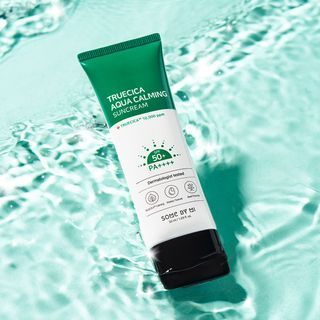
Some By Mi Truecica Aqua Calming Sun Cream
Works for
2 of 2 advertised claims delivered
Sun protectionSPF 50 · 5 UV filtersBroad spectrum
This product offers a good level of protection against both UVB and UVA rays.
This sunscreen uses organic (so-called "chemical") sunscreen filters. Organic, or "chemical" filters usually provide reliable sun protection and rarely leave a white cast. Sunscreens with organic filters can sting eyes.
This product can be considered "reef safe" because it does not contain the UV filters (oxybenzone and octinoxate) that can be harmful to coral reefs when present in the water in high concentrations.
MoisturizingMadecassoside, Niacinamide + 22 moreStrong evidence
“79% aqua based formula offers deep, long-lasting hydration.”
This product can help improve hydration of the skin with the two types of ingredients.
The first type is called “humectants”:
these ingredients help attract water.
When humectants are on the surface of the skin, they “pull in” the moisture from the outside environment, or from
within deeper layers of the skin. The following ingredients in this product do the job:
glycerin, hydrolyzed hyaluronic acid.
This product also contains ingredients called “occlusives”. They help reduce the speed with which our skin loses moisture to the outside environment. These ingredients also help soften the upper layer of the skin, so it feels less tight and nicer to the touch. The following ingredients in this product do the job: copernicia cerifera wax, c12-15 alkyl benzoate.
The following ingredients in this product are especially good for supporting the skin barrier and helping with the hydration level: madecassoside, niacinamide, panthenol
Anti-oxidationNot advertised by the brand · Asiaticoside, Madecassoside + 4 moreStrong evidence
This product contains antioxidants (asiaticoside, madecassoside) that can help neutralize free radicals in skin. By doing so, they can lessen the damage the skin gets from the UV light (sun).
The following ingredients - centella asiatica extract also can have an antioxidant effect, but there is less evidence to confirm their effectiveness in skin.
Anti-agingNot advertised by the brand · Adenosine, Niacinamide + 4 moreStrong evidence
This product can help reduce and prevent fine lines and wrinkles, improve skin elasticity and firmness because it contains adenosine, niacinamide.
These ingredients in the product can also be helpful, even though there is less evidence for their effectiveness: asiaticoside, centella asiatica extract, madecassoside.
Keep in mind that it typically takes at least 6 weeks to notice any results because the changes that are needed to improve fine lines and elasticity happen in the deeper layers of the skin. No topical anti-aging product can “erase” wrinkles or fully reverse signs of aging.
This product can also help prevent early signs of skin aging because it offers a good level of broad spectrum sun protection. Sun damage is the main cause of premature skin aging, and protecting your skin from the sun is the best anti-aging strategy.
Evens skin toneNot advertised by the brand · Niacinamide, MadecassosideStrong evidence
This product offers broad spectrum sun protection. It means that it can prevent hyperpigmentation and help keep the skin tone even (sun damage is the main factor causing age spots, darkening of post-acne marks and other discolorations).
Anti-blemishNot advertised by the brand · Niacinamide, Centella asiatica extractStrong evidence
This product can help reduce breakouts and clogged pores because it contains the following ingredient: niacinamide. This ingredient is used for treating acne and can have a noticeable effect.
Can it cause trouble?
Irritancy5 strong irritants: Melaleuca alternifolia leaf extract, Lavandula angustifolia oil + 3 more — patch-test recommendedHigh risk
Comedogenic1 ingredient rated 2 or more on the 0–5 pore-clogging scale1 flagged

User reviews
Ingredients
Filter by role to see what each ingredient is doing.
Water~45–55%
Dibutyl adipate~6–7.3%
- Irritation risk
- Low
Helps soften the upper layer of the skin and create a nice product consistency
More about Dibutyl adipateDiethylhexyl butamido triazone~4.7–5.7%
- Irritation risk
- Medium
Uvasorb HEB. A UV filter. Is effective against UVB and UVA II rays (but not UVA I). It is photostable. Unfortunately, is not approved by FDA (US) yet
More about Diethylhexyl butamido triazoneC12-15 alkyl benzoate~3.2–3.9%
- Irritation risk
- Low
Enhances the product texture and makes it more spreadable. Helps reduce water loss from the outer layer of skin. Extands the shelf life by preventing bacteria growth
More about C12-15 alkyl benzoateDicaprylyl carbonate~2.4–3%
- Irritation risk
- Low
Helps products spread more easily and works as an emollient to soften skin
More about Dicaprylyl carbonatePropanediol~2–2.4%
- Irritation risk
- Low
Acts as a solvent for other ingredients. Speeds up the absorption of other ingredients into the skin
More about PropanediolButylene glycol~1.7–2.1%
- Irritation risk
- Low
Used to create a nice product texture and help delivery of other ingredients. Might be somewhat helpful in attracting water to the upper layer of the skin
More about Butylene glycolPolyglyceryl-3 methylglucose distearate~1.5–1.8%
- Irritation risk
- Medium
Helps water and oil mix together
More about Polyglyceryl-3 methylglucose distearateNiacinamide~1.2–1.5%
- Irritation risk
- Low
Is proven to be effective in reducing blemishes, evening out skin tone and helping to improve lines and wrinkles. It helps the skin to repair sun damage, calm down inflammation and keep maintain good levels of moisture. The concentration of about 2% is effective for supporting the skin barrier and evening out the skin tone. Concentration of 4-6% is better for helping with acne and balancing the sebum production
More about NiacinamideTerephthalylidene dicamphor sulfonic acid~1.5–1.8%
- Irritation risk
- Medium
Ecamsule, Mexoryl SX. A UV filter. Is effective mostly against the UVA rays. It is legally marketed in the US with the FDA approval since 2006, even though the ingredient is not on the official FDA list of the approved sunscreen active ingredients. It is photostable
More about Terephthalylidene dicamphor sulfonic acid1,2-hexanediol~0.65–0.95%
Diethylamino hydroxybenzoyl hexyl benzoate~0.8–1.15%
- Irritation risk
- Medium
Uvinul A Plus. A new generation broad spectrum sunscreen that offers an effective protection especially in the UVA range. It is stable in formulations. Unfortunately, is not approved by the FDA (US) yet
More about Diethylamino hydroxybenzoyl hexyl benzoateSilica~0.8–1.2%
Bis-ethylhexyloxyphenol methoxyphenyl triazine~0.7–1.05%
- Irritation risk
- Medium
Tinosorb S. One of the most effective broad spectrum sunscreen ingredients. Protects from both UVA and UVB rays. It is photostable. Unfortunately, not approved by FDA (US) yet.
More about Bis-ethylhexyloxyphenol methoxyphenyl triazineRhus succedanea fruit wax~0.45–0.7%
- Irritation risk
- Low
Ethylhexyl triazone~0.6–0.95%
- Irritation risk
- Medium
Uvinul T. A UV filter. Effective against UVB rays. It is photostable. Can increase water resistance properties of the sunscreen. Unfortunately, not approved by the FDA (US) yet
More about Ethylhexyl triazoneTromethamine~0.45–0.65%
Melaleuca alternifolia leaf extract1%
- Irritation risk
- High
An essential oil that can be irritating. Has some anti-bacterial properties
More about Melaleuca alternifolia leaf extractCentella asiatica extract~0.45–0.65%
- Irritation risk
- Medium
A plant extract that has been shown to be able to reduce inflammation in skin, support restoration of skin barrier function, as well as support collagen production. Contains active compounds called centelloids: asiaticoside, madecasosside, asiatic acid and madecassic acid. Might be helpful in preventing stretch marks. It can be itself be irritating though.
More about Centella asiatica extractArtemisia capillaris extract~0.35–0.6%
- Irritation risk
- Low
Asiaticoside~0.25–0.5%
- Irritation risk
- Medium
An active compound of Centella Asiatica plant extract. In combination with other active compounds of Centella Asiatica extract (madecasosside, asiatic acid and madecassic acid), asiaticoside has been shown to be helpful in wound-healing, restoring skin barrier function and supporting collagen production in skin. It can, however, itself be irritating
More about AsiaticosideMadecassic acid~0.3–0.55%
- Irritation risk
- Medium
An active compound of Centella Asiatica plant extract. In combination with other active compounds of Centella Asiatica extract (asiaticoside, madecasosside and asiatic acid), madecassic acid has been shown to be helpful in wound-healing, restoring skin barrier function and supporting collagen production in skin. It can, however, itself be irritating
More about Madecassic acidAsiatic acid~0.25–0.5%
- Irritation risk
- Medium
An active compound of Centella Asiatica plant extract. In combination with other active compounds of Centella Asiatica extract (asiaticoside, madecasosside and madecassic acid) asiatic acid has been shown to be helpful in wound-healing, restoring skin barrier function and supporting collagen production in skin. It can, however, itself be irritating
More about Asiatic acidMadecassoside~0.25–0.5%
- Irritation risk
- Medium
An antioxidant that is typically derived from plant Centella Asiatica. It can help neutralize free radicals in skin and support skin barrier function. It could, however, itself be irritating. It is often unstable in formulations
More about MadecassosideTrehalose~0.25–0.5%
- Irritation risk
- Low
A sugar that attracts water to the upper layer of the skin
More about TrehalosePanthenol~0.25–0.5%
- Irritation risk
- Low
Helps attract water to the upper layer of the skin and can help improve skin barrier function
More about PanthenolHydrolyzed hyaluronic acid~0.25–0.5%
- Irritation risk
- Low
One of the best moisturizing ingredients. Attracts water into the upper layer of the skin. A version of it is naturally present in skin
More about Hydrolyzed hyaluronic acidAloe barbadensis leaf extract~0.3–0.6%
- Irritation risk
- Medium
Traditionally used to treat sunburns, dermatitis and inflammation, but evidence for its effectiveness is lacking. The extract can contain humectants that help attract water into the skin
More about Aloe barbadensis leaf extractSodium palmitoyl proline~0.25–0.45%
- Irritation risk
- Low
Nymphaea alba flower extract~0.25–0.45%
- Irritation risk
- Low
Copernicia cerifera wax~0.35–0.65%
- Irritation risk
- Low
Helps to soften the upper layer of the skin and create a nice product consistency
More about Copernicia cerifera waxPotassium cetyl phosphate~0.3–0.55%
- Irritation risk
- Medium
Helps oil and water mix together
More about Potassium cetyl phosphateCetearyl alcohol~0.3–0.6%
- Irritation risk
- Low
- Comedogenicity
- 2/5
A non-drying alcohol. Works as an emollient. Helps water and oil mix together and creates a nice product texture
More about Cetearyl alcoholBehenyl alcohol~0.3–0.6%
- Irritation risk
- Low
Non-drying alcohol that helps water and oil mix together. Also serves as an emollient
More about Behenyl alcoholCoco-caprylate/caprate~0.3–0.55%
- Irritation risk
- Low
Helps to soften the upper layer of the skin without creating a greasy texture
More about Coco-caprylate/caprateGlyceryl stearate~0.3–0.6%
- Irritation risk
- Low
An emollient that softens the skin and forms a protective layer on its surface. Helps water and oil mix together
More about Glyceryl stearatePolyacrylate crosspolymer-6~0.3–0.5%
- Irritation risk
- Low
Carbomer~0.25–0.5%
- Irritation risk
- Low
Helps create a thicker or gel-like product texture. It is not a surfactant but can be used in gentle cleansing formulations
More about CarbomerLavandula angustifolia oil~0.25–0.45%
- Irritation risk
- High
An essential oil. Potential allergen and can be irritating. It has some anti-bacterial properties
More about Lavandula angustifolia oilSynthetic wax~0.3–0.55%
- Irritation risk
- Low
Used to stabilize product formulations and thicken product consistency
More about Synthetic waxDibutyl lauroyl glutamide~0.25–0.5%
- Irritation risk
- Medium
Helps improve the product texture and soften the upper layer of the skin
More about Dibutyl lauroyl glutamideDextrin palmitate~0.3–0.5%
- Irritation risk
- Medium
Helps water and oil mix together
More about Dextrin palmitatePolyurethane-1~0.25–0.5%
- Irritation risk
- Low
Sodium stearoxy pg-hydroxyethylcellulose sulfonate~0.25–0.45%
- Irritation risk
- Low
Trihydroxystearin~0.25–0.45%
- Irritation risk
- Low
Helps soften the upper layer of the skin and improve the product texture
More about TrihydroxystearinOryza sativa bran wax~0.25–0.45%
- Irritation risk
- Low
Ethylhexylglycerin~0.25–0.4%
Adenosine~0.2–0.4%
- Irritation risk
- Low
Might help improve cell turnover and reduce inflammation in skin. One study shows that the ingredients might be able to help reduce dynamic wrinkles (for example, in the corners of the eyes or on the forehead)
More about AdenosineTocopherol~0.2–0.4%
- Irritation risk
- Low
Pure form of vitamin E. Can help moisturise and protect the skin from free radicals. Often used to help stabilise other ingredients or the formula itself
More about TocopherolDipropylene glycol~0.15–0.3%
- Irritation risk
- Low
Helps to dissolve other ingredients in a formulation. Slows down the rate of product drying
More about Dipropylene glycolGlycerin~0.2–0.35%
- Irritation risk
- Low
One of the best moisturizing ingredients. Naturally present in skin. It attracts water to the upper layer of the skin working as a humectant
More about GlycerinPortulaca oleracea extract~0.2–0.35%
- Irritation risk
- Medium
A plant extract that has some anti-oxidant activity, but solid research is lacking. Can help attract water to the upper layer of the skin
More about Portulaca oleracea extractLinalool~0.15–0.25%
Geraniol~0.1–0.15%
Limonene~0.1–0.15%
- Irritation risk
- High
A common frangrance that can easily irritate skin, especially if exposed to air, light or heat
More about LimoneneIngredient list view
Water, Dibutyl adipate, Diethylhexyl butamido triazone, C12-15 alkyl benzoate, Dicaprylyl carbonate, Propanediol, Butylene glycol, Polyglyceryl-3 methylglucose distearate, Niacinamide, Terephthalylidene dicamphor sulfonic acid, 1,2-hexanediol, Diethylamino hydroxybenzoyl hexyl benzoate, Silica, Bis-ethylhexyloxyphenol methoxyphenyl triazine, Rhus succedanea fruit wax, Ethylhexyl triazone, Tromethamine, Melaleuca alternifolia leaf extract, Centella asiatica extract, Artemisia capillaris extract, Asiaticoside, Madecassic acid, Asiatic acid, Madecassoside, Trehalose, Panthenol, Hydrolyzed hyaluronic acid, Aloe barbadensis leaf extract, Sodium palmitoyl proline, Nymphaea alba flower extract, Copernicia cerifera wax, Potassium cetyl phosphate, Cetearyl alcohol, Behenyl alcohol, Coco-caprylate/caprate, Glyceryl stearate, Polyacrylate crosspolymer-6, Carbomer, Lavandula angustifolia oil, Synthetic wax, Dibutyl lauroyl glutamide, Dextrin palmitate, Polyurethane-1, Sodium stearoxy pg-hydroxyethylcellulose sulfonate, Trihydroxystearin, Oryza sativa bran wax, Ethylhexylglycerin, Adenosine, Tocopherol, Dipropylene glycol, Glycerin, Portulaca oleracea extract, Linalool, Geraniol, Limonene
Compare prices
Retailers ranked by price — lowest first.

Worth comparing, line by line.
Match % combines shared ingredients, the first five ingredients, shared actives and hero ingredients, irritancy (lower counts in the alternative's favour), texture and body area. Only products in the same routine step are compared.
| Some By MiTruecica Aqua Calming Sun CreamYOUR PRODUCT | Dr. AltheaGreen Tea Fresh Sunscreen | SKIN 1004.Madagascar Centella Probio-Cica Glow Sun Ampoule PA++++ SPF50+ | OttieWater Barrier Sunscreen | |
|---|---|---|---|---|
| Match | — | 87% | 84% | 82% |
| Price | $22.19 | $17.94−$4.25 | $12.82−$9.37 | $14.89−$7.30 |
| Shared key ingredients | — | 11 of 18 | 12 of 18 | 10 of 18 |
| Key difference | — | Centella Asiatica Leaf Extract | Phytosphingosine | Ceramide Np |
| Irritancy | High | Low | Low | Medium |
| SPF | SPF 50 | SPF 50 | SPF 50 | SPF 50 |
| Drying alcohol | — | — | — | — |
| View product | Shop | Shop | Shop |

Product summary
We believe that "Some By Mi - Truecica Aqua Calming Sun Cream" can provide reliable sun protection based on the ingredients listed. It can protect from both UVA and UVB rays. This is great news because not all sunscreens with SPF ratings give UVA protection. (UVA rays do not cause sunburn, but still damage our skin and lead to early aging).
It should also be hydrating enough to use without an additional moisturizer during the day. Like all broad-spectrum sunscreens, this product has an anti-aging benefit.
Sunscreen filters
This sunscreen uses so-called "chemical", or organic UV filters (organic simply means that their molecules contain atoms of carbon). These filters typically give good sun protection and rarely leave a white cast, but they can be irritating for sensitive skin. These are the sun protection ingredients in this sunscreen: tinosorb s 0.65% - 1.00%, uvinul a plus 0.75% - 1.15%, uvasorb heb 4.70% - 5.70%, uvinul t 0.60% - 0.90% and terephthalylidene dicamphor sulfonic acid 1.40% - 1.80%.
Irritation risk
There are quite a few common irritants in this product, including ingredients without particular skin benefits. We would not recommend it for sensitive skin. We assess the overall irritancy of it to be high. For a detailed overview of all potential irritants: click here
You can see the detailed formula review with the breakdown of all actives in the product and the full ingredient list with estimated concentrations in the tables below.
Price
The product retails for 27.02A$ in Australia, for 25.00£ in the United Kingdom and for 22.50$ in the United States.
For a detailed price comparison: click here.
Sources cited in this review
Every concentration estimate and effectiveness label is anchored to one of these 31 studies and safety reviews.
- 1
- 2
- 3
- 4Safety Assessment of Tromethamine as Used in Cosmeticscir-safety.org
- 5
- 6Centella asiatica in cosmetologyncbi.nlm.nih.gov

Affiliate links · As an Amazon Associate, WIMJ earns from qualifying purchases.